
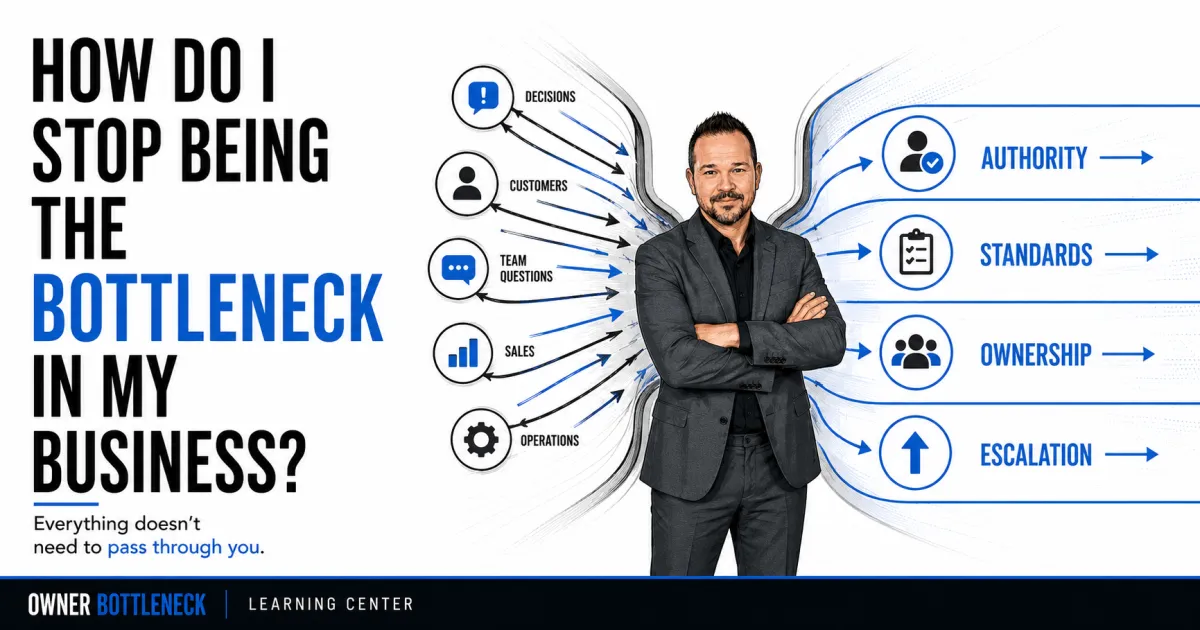
How Do I Stop Being the Bottleneck in My Business?
The message arrived at 7:42 on Monday morning.
“Can you approve this?”
Another came in at 7:49.
“What should we tell the customer?”
At 8:03, a manager stopped by the office.
“Do you have a minute?”
By 9:00, the owner had answered a pricing question, settled a scheduling issue, reviewed a proposal, approved a purchase, and corrected a customer response.
None of the problems seemed especially large.
That was the problem.
The business didn’t need the owner for one major crisis.
It needed the owner for dozens of small decisions that kept normal work moving.
If you want to stop being the bottleneck in your business, you can’t simply work faster, hire more people, or delegate more tasks. You have to identify what repeatedly returns to you, understand why it returns, and transfer the authority, judgment, standards, information, and ownership required for someone else to carry it.
The goal isn’t to make yourself unnecessary.
The goal is to stop making your constant availability necessary.
Key Takeaways
You’re the bottleneck when too much work must pass through your decisions, approval, judgment, knowledge, relationships, or presence.
Working harder may clear today’s queue while strengthening the pattern that created it.
Delegating tasks won’t solve the problem when you retain the authority, outcome, standards, and unusual decisions.
The first step is finding what repeatedly waits for you, not trying to improve the entire company at once.
Responsibility must be supported by clear outcomes, authority, boundaries, information, and accountability.
Your team needs access to how you think, not only instructions about what you do.
Short tests of owner unavailability reveal whether dependence is truly declining.
The goal is intentional owner involvement, not zero owner involvement.
What Does It Mean to Be the Bottleneck in Your Business?
You’re the bottleneck when the business can’t move any faster than you can review, decide, approve, explain, sell, fix, or remember.
The company may have employees.
It may have managers.
You may have documented processes.
You may have delegated a large amount of work.
But when uncertainty appears, the issue still returns to you.
That might include:
A customer asking for an exception
A salesperson needing pricing approval
A manager avoiding an employee conversation
A project falling outside the normal process
A quality question requiring your judgment
A purchase waiting for approval
A customer relationship depending on your involvement
A decision no one feels safe making
Information that exists only in your memory
That’s an Owner Bottleneck.
An Owner Bottleneck exists when too much of the company depends on the owner’s decisions, judgment, knowledge, standards, relationships, approval, or presence.
The issue isn’t that you’re involved.
Owners should be involved in important areas of their businesses.
The issue is that routine progress still requires access to you.
Why Does Everything Keep Coming Back to You?
Most Owner Bottlenecks weren’t created because the owner wanted control for its own sake.
They were built through reasonable decisions.
You answered because it was faster.
You stepped in because the customer mattered.
You corrected the work because the standard wasn’t being met.
You approved the purchase because cash was tight.
You joined the sales call because the deal was important.
You settled the employee issue because the manager wasn’t ready.
You remembered something no one else knew.
Each decision may have protected the company in the moment.
But over time, the business learned where the safest answer lived.
With you.
When uncertainty appeared, people came back to the person most likely to solve it quickly.
That pattern can become so normal that neither you nor the team notices it anymore.
You call it staying involved.
The team calls it checking with you.
The customer calls it speaking with the owner.
The company experiences it as dependence.
Why Working Harder Won’t Solve the Bottleneck
When work begins piling up, the natural response is to move faster.
You answer messages earlier.
You stay later.
You shorten meetings.
You approve things from your phone.
You clear questions between appointments.
You work through lunch.
You tell yourself you’ll build the systems once things calm down.
Then you clear the queue.
For a moment, everything moves again.
But what did the company learn?
It learned that sending the issue to you works.
Working harder can reduce the visible delay while making the underlying dependence stronger.
You become highly efficient at carrying a role the company eventually needs to transfer.
The problem isn’t your speed.
The problem is how much traffic has been designed to pass through you.
Why Hiring More People May Make the Problem Worse
Hiring adds capacity.
It doesn’t automatically reduce dependence.
A new employee may create:
More questions
More training
More approvals
More communication
More handoffs
More quality reviews
More management decisions
More situations the owner must explain
If every new person still depends on you, the company grows around the bottleneck instead of removing it.
The organization gets larger.
Your queue gets longer.
This is one reason a business can become harder to run as it grows.
Growth adds customers, employees, transactions, exceptions, decisions, and complexity.
If decision authority, management capacity, operating systems, and shared standards don’t grow too, the added weight lands on the owner.
Hiring isn’t the wrong move.
Hiring without transferring ownership is.
Why Delegation Hasn’t Fixed It
You may already delegate constantly.
You assign projects.
You hand off recurring tasks.
You give employees responsibilities.
You promote managers.
You remove work from your calendar.
But the work keeps returning.
That’s because delegation often transfers the activity without transferring everything required to complete it independently.
The employee owns the task.
You may still own:
The final outcome
The approval
The unusual decisions
The customer risk
The standard
The financial judgment
The consequences
The authority to change course
That’s why delegation doesn’t always solve the Owner Bottleneck.
Delegation answers:
Who will do this?
Ownership answers:
Who is responsible for making sure this gets the right result?
Those aren’t the same question.
A person can complete nearly every step while still depending on you to finish the responsibility.
Step 1: Find the Queue
Don’t begin by asking:
“How do I fix my entire business?”
That question is too broad.
Start by finding the queue.
Look for work that repeatedly:
Waits for you
Slows down when you’re unavailable
Reaches you for approval
Returns after being delegated
Breaks when something unusual happens
Requires information only you have
Needs your relationship to move forward
Gets corrected by you before completion
Becomes an emergency because no one else decides
Track these issues for at least one full week.
Every time something reaches you, record:
Who brought it to you?
What were they trying to accomplish?
What decision or information did they need?
Why did they believe you were required?
Had the same type of issue happened before?
What would have happened if you hadn’t responded?
What did you know that they didn’t?
What authority did they lack?
You can also use the process in How to Measure Owner Dependence in Your Business to establish a clearer starting point.
You’re looking for patterns, not individual interruptions.
Twenty messages may come from only three dependence points.
For example:
Pricing exceptions
Customer recovery
Schedule changes
That’s useful.
You don’t have twenty unrelated problems.
You have three recurring bottlenecks.
Step 2: Separate Task Dependence From Judgment Dependence
Some responsibilities return because the person doesn’t know how to perform the task.
Others return because the person doesn’t know how to judge the situation.
Those require different solutions.
Task Dependence
The employee may need:
Training
Practice
A checklist
Clearer instructions
Better tools
Access to information
Defined handoffs
Judgment Dependence
The employee may need:
Decision principles
Context
Examples
Authority
Risk boundaries
Standards
Coaching
Permission to act
This distinction matters.
A checklist may solve a missing step.
It won’t teach someone how to balance margin, customer trust, urgency, precedent, and risk.
Many owners document the task and remain frustrated when unusual situations still return.
The issue isn’t always missing documentation.
Sometimes it’s missing judgment transfer.
Step 3: Decide What Should Actually Remain With You
The goal isn’t to transfer every decision.
Some responsibilities belong with the owner.
Those may include:
Major strategic direction
Ownership decisions
Significant financial commitments
Serious legal exposure
Major safety concerns
Critical culture decisions
High-impact leadership appointments
Potential loss of a major account
Decisions that could materially change the company
But routine decisions shouldn’t remain with you simply because you’ve always made them.
For each recurring issue, ask:
Does this truly require ownership-level judgment?
How often does it happen?
Is it reversible?
What’s the real risk if someone else decides?
Can that risk be limited?
Who is closest to the information?
Who should own the outcome?
Could I review the decision afterward instead of approving it beforehand?
Your goal is to reserve owner involvement for owner-level work.
Everything else should have a path that doesn’t depend on immediate access to you.
Step 4: Name One Owner for the Outcome
A responsibility can’t be shared vaguely.
When everyone is involved but no one clearly owns the result, problems rise to the owner.
Replace:
“The team handles customer issues.”
With:
“The service manager owns customer recovery from the first complaint through documented resolution.”
Replace:
“Sales and operations work out scheduling.”
With:
“The operations manager owns the final delivery schedule after confirming scope and capacity.”
Replace:
“Someone needs to follow up.”
With:
“The account manager owns the next customer update and confirms completion by Thursday.”
Ownership should be clear enough that people know:
Who decides
Who acts
Who follows through
Who communicates
Who measures the result
Who is accountable when it doesn’t happen
When ownership is vague, you become the backup owner.
Step 5: Transfer Authority With the Responsibility
Responsibility without authority is disguised dependence.
A manager may be responsible for labor performance but unable to approve overtime.
A salesperson may be responsible for closing but unable to adjust normal terms.
A service manager may be responsible for customer satisfaction but unable to offer a reasonable remedy.
An operations leader may be responsible for delivery but unable to change priorities.
They carry the outcome.
You control the decisions required to produce it.
That isn’t full ownership.
For each responsibility, define:
What the person can decide
The financial limit
The operating limit
The customer limit
What requires documentation
What they should report afterward
What requires approval beforehand
What is completely outside their authority
For example:
“You may approve customer credits up to $750 when we clearly missed a documented commitment. Explain the remedy to the customer, record the reason, and identify whether the underlying process needs to change. Escalate legal threats, safety concerns, critical-account risk, or anything above $750.”
That transfers usable authority.
“Take care of the customer” doesn’t.
Step 6: Define Decision Boundaries
Your team shouldn’t have to choose between asking you about everything and making decisions with no limits.
Give them boundaries.
A useful structure includes three levels.
Decide Independently
The person decides and continues without contacting you.
This covers normal, recurring, reversible decisions inside the role.
Decide and Inform
The person acts, then communicates the decision through the agreed reporting rhythm.
The work doesn’t stop.
Leadership remains informed.
Escalate Before Deciding
The situation crosses an agreed legal, financial, safety, ethical, customer, or authority boundary.
The person pauses and brings it to the correct leader.
This structure reduces unnecessary escalation without creating reckless independence.
A Decision Bottleneck forms when routine decisions keep moving upward because people lack authority, information, boundaries, or confidence.
Clear decision levels help work keep moving.
Step 7: Make Your Standards Visible
Owners often stay involved because they don’t trust the result.
Sometimes that concern is justified.
You may have spent years building a reputation.
You know what customers expect.
You notice details others miss.
You recognize risk before it becomes obvious.
You know what “good” looks like.
But when the standard exists only in your head, the team has two options:
Guess.
Ask you.
Neither creates independence.
Make the standard visible.
Define:
What a successful outcome looks like
What must always be checked
What can’t be compromised
What can be corrected later
What the customer was promised
Which risks matter most
When speed matters more
When precision matters more
What requires a second review
What would make the result unacceptable
Don’t only document the steps.
Explain why the standard exists.
Someone may know that proposals require a second review.
They may not understand which risks that review is meant to catch.
When people understand the reason behind the standard, they’re more capable of protecting it when the exact situation changes.
Step 8: Transfer Context, Not Only Instructions
Your decisions are based on information the team may not have.
You know:
The history of the customer relationship
Why a previous exception was made
Which promise matters most
Which supplier has created problems
Why one margin can’t be reduced
Which employee is ready for more
Which risk is acceptable
Which issue could become much larger
What happened the last time the company tried something similar
That context affects your judgment.
When the team asks what to do, they may not lack intelligence.
They may lack the information you’re using.
Instead of only giving the answer, explain your reasoning:
“I’m not approving the discount because the price isn’t the main issue. The customer is concerned about implementation risk. Lowering the price won’t solve that. We need to clarify the rollout and assign one person to own it.”
Or:
“I’m approving the schedule change because the delay affects three downstream commitments. Normally we’d hold the date, but the total operational risk is greater if we do.”
This helps someone understand how you evaluate tradeoffs.
Answers solve today’s issue.
Reasoning builds tomorrow’s decision-maker.
Step 9: Stop Being the Fastest Answer
This part is uncomfortable.
You may know the answer immediately.
Explaining your reasoning takes longer.
Coaching the person takes longer.
Letting them recommend a solution takes longer.
Reviewing the result afterward takes longer.
It may genuinely be faster to handle it yourself.
But faster for the current issue can be slower for the company.
Before answering, ask:
“What do you recommend?”
“What options have you considered?”
“Which decision would you make if I were unavailable?”
“What standard are you using?”
“What risk concerns you?”
“Is this inside your authority?”
“What would make you escalate it?”
This is especially important when your team keeps coming to you for every decision.
Your team can’t develop judgment if you supply the answer before they think.
The goal isn’t to play games or refuse help.
It’s to stop making the owner’s answer the first step in everyone else’s process.
Step 10: Let Reasonable Decisions Stand
You transfer authority.
A manager makes a decision.
It isn’t the decision you would have made.
You reverse it.
What did the manager learn?
Not that they have authority.
They learned that their authority lasts only when their judgment matches yours.
Next time, they’ll ask.
Separate four types of decisions.
Dangerous
The decision creates serious legal, safety, ethical, financial, or customer risk.
Intervene.
Outside Authority
The person crossed a clearly defined boundary.
Correct the boundary and review why it happened.
Careless
The person ignored available information, standards, or reasonable thought.
Coach the behavior and enforce accountability.
Reasonable but Different
The person used sound judgment and reached a different acceptable decision.
Let it stand.
You can discuss how you would have approached it without taking ownership back.
A company can’t develop additional judgment if every difference is treated as failure.
Step 11: Build Management Capacity
Sometimes the issue isn’t individual employees.
It’s a missing layer of management.
The owner may still be:
Setting priorities
Following up on commitments
Settling disagreements
Coaching performance
Correcting missed deadlines
Coordinating departments
Reviewing quality
Handling customer escalation
Making sure someone finishes
The team performs the work.
The owner manages the system around the work.
That’s a Team Bottleneck.
Promoting someone to manager won’t automatically solve it.
Managers need responsibility for:
Outcomes
Team performance
Priorities
Decision-making
Communication
Follow-through
Coaching
Accountability
Escalation
Continuous improvement
They also need the authority to carry those responsibilities.
A manager who can assign tasks but can’t address performance, resolve conflict, change priorities, or make routine decisions is still a coordinator.
The owner remains the manager behind the manager.
Step 12: Fix Processes That Depend on Owner Rescue
A process may look complete on paper and still depend on you.
Normal work moves.
Then something changes.
A customer requests an exception.
A supplier is late.
A deadline moves.
Two departments disagree.
The work falls outside the checklist.
The issue lands on you.
That’s an Operations Bottleneck.
When a process fails, don’t only fix the immediate problem.
Ask:
Where did the workflow stop?
Which handoff failed?
What decision had no owner?
Which information was missing?
What exception wasn’t planned for?
Why did the issue require me?
What should happen next time?
Does the process need a rule, boundary, owner, or feedback loop?
The goal isn’t a procedure for every possible situation.
It’s an operating system that helps people recognize, decide, communicate, and adapt when the exact script no longer fits.
Step 13: Transfer Sales Trust Beyond the Owner
Some owners reduce dependence everywhere except sales.
The team performs operations.
Managers lead employees.
But revenue still depends on the owner’s reputation, relationships, expertise, diagnosis, or closing ability.
Prospects want to speak with you.
Salespeople bring you into difficult opportunities.
Major customers call you when something matters.
That’s a Sales Bottleneck.
To reduce it:
Clarify how the company explains the problem it solves.
Document how good opportunities are qualified.
Teach the reasoning behind recommendations.
Define pricing and discount authority.
Bring other leaders into customer relationships.
Let salespeople lead meetings while you support.
Transfer account history and context.
Build proof tied to the company, not only the founder.
Measure which deals still require owner involvement.
Review losses without automatically rescuing the next sale.
The goal isn’t to disappear from every important sales conversation.
It’s to make your involvement intentional instead of required for normal revenue.
Step 14: Test Whether the Business Still Needs Immediate Access to You
You won’t know whether owner dependence has declined until you stop answering.
Start small.
One Meeting
Don’t attend a meeting you normally lead.
Give someone else responsibility for the outcome.
Two Hours
Turn off notifications and allow normal decisions to continue.
Half a Day
Become unavailable during a regular work period.
One Full Day
Don’t answer routine calls, messages, or approvals.
Three Consecutive Days
This reveals dependence that may not appear during a single day.
After each test, review:
What stopped?
What waited?
What continued?
What was escalated?
What was handled well?
Which decisions lacked authority?
Which standards were unclear?
What information couldn’t be found?
What reached you that shouldn’t have?
What should have reached you but didn’t?
This isn’t a test of whether the team can avoid bothering you.
It’s a test of whether the company can continue producing normal results.
The guide on how to get your business to run without you gives you a broader staged plan for expanding these tests.
You can also use Can Your Business Run Without You for 30 Days? as the larger stress test once the business has built enough capability.
Step 15: Measure What Returns to You
You don’t need a complicated dashboard.
Track a few useful numbers:
Questions reaching the owner
Approvals waiting for the owner
Decisions made without the owner
Issues returned after delegation
Customer requests for the owner
Sales opportunities requiring the owner
Operating exceptions escalated
Time spent on work that should belong elsewhere
Problems solved permanently
Problems repeated
The goal isn’t to reduce every number to zero.
Some owner involvement is appropriate.
You’re looking for a trend.
Are fewer routine issues returning?
Are managers making more decisions?
Is work waiting less?
Are customers trusting more than one person?
Are recurring problems being fixed at the source?
Can you spend longer periods unavailable without the company slowing?
That’s evidence the bottleneck is widening.
What Should the Owner Do Instead?
Owners sometimes hear “stop being the bottleneck” as:
“Step away from the business.”
That’s incomplete advice.
Removing yourself without building capability leaves a gap.
Your role should shift.
Spend less time:
Answering recurring questions
Approving routine work
Resolving the same problems
Correcting every detail
Joining every customer issue
Chasing people for follow-through
Making decisions others should own
Spend more time:
Clarifying direction
Developing leaders
Defining standards
Allocating resources
Improving systems
Reviewing performance
Building management capacity
Transferring relationships
Removing recurring constraints
Preparing the company for its next stage
You’re not becoming less important.
You’re changing where your importance creates the most value.
A Realistic Example: The Owner Who Approved Everything
Consider the owner of a $4 million specialty contracting company with 24 employees.
The business has:
An operations manager
A sales manager
Four project leads
An office manager
Experienced field employees
The owner no longer performs most of the technical work.
But during an average week, the owner still:
Approves every discount
Reviews every major proposal
Settles schedule conflicts
Handles unhappy customers
Approves overtime
Reviews purchases
Makes final hiring decisions
Corrects quality issues
Joins important sales calls
The owner believes the team needs to take more ownership.
The team believes the owner wants final control.
Both are partly right.
What the Owner Discovers
For two weeks, the owner tracks everything that reaches them.
Most interruptions fall into five groups:
Pricing
Customer recovery
Scheduling
Purchases
Quality
Instead of telling everyone to stop asking questions, the owner addresses one category at a time.
Pricing
The sales manager receives a pricing range based on gross margin, project risk, payment terms, and capacity.
Deals inside the range no longer require approval.
Customer Recovery
The operations manager can approve remedies inside a defined dollar limit when the company clearly missed a commitment.
Scheduling
Project leads receive authority to adjust normal schedules inside capacity and overtime boundaries.
Purchases
The office manager receives approval limits tied to existing budget categories.
Quality
The company defines five nonnegotiable quality checks and identifies which issues require additional review.
What Changes
At first, the team still asks.
The owner stops answering immediately and asks for a recommendation.
Managers begin deciding.
Some decisions differ from what the owner would have chosen.
Reasonable decisions are allowed to stand.
The owner reviews patterns during the weekly leadership meeting instead of approving each issue beforehand.
After three months:
Routine approvals decline.
Fewer customer issues reach the owner.
Projects wait less.
Managers make more documented decisions.
The owner spends more time reviewing performance and less time moving individual jobs forward.
The owner didn’t escape the bottleneck by demanding more independence.
The company became less dependent because authority, standards, context, and accountability were finally transferred.
What Stopping the Bottleneck Does Not Mean
It doesn’t mean:
You stop caring.
You abandon the team.
You never make decisions.
You accept poor work.
You tolerate avoidable mistakes.
Everyone receives unlimited authority.
You eliminate accountability.
You disappear before the company is ready.
You never speak with important customers.
The company no longer needs leadership.
It means the business doesn’t need immediate access to you for normal progress.
Your involvement becomes deliberate.
Why This Affects the Value of the Business
Owner dependence isn’t only an operating problem.
It’s a business-value problem.
A buyer or investor wants to understand what happens when the current owner leaves.
They may ask:
Will customers stay?
Will revenue continue?
Can managers lead?
Are decisions distributed?
Is important information documented?
Does the company have repeatable systems?
Can someone else protect the standards?
Does the team know how to handle exceptions?
Are relationships tied to the company or the owner?
When too much still depends on you, the company may have a Value Bottleneck.
The business may produce strong income while you own it.
That doesn’t prove someone else can operate it successfully.
Reducing owner dependence can improve your freedom today and the transferability of the company later.
How Long Does It Take to Stop Being the Bottleneck?
There isn’t one universal timeline.
It depends on:
The size of the company
The strength of the management team
The amount of knowledge concentrated in the owner
The maturity of the systems
The quality of existing employees
The number of customer relationships tied to the owner
The owner’s willingness to let others decide
The seriousness of the current dependence
You probably won’t solve the entire Owner Bottleneck in 30 days.
But you should be able to reduce one meaningful dependence point.
Choose one recurring issue.
Transfer the outcome.
Define authority.
Explain the standard.
Share the context.
Set escalation boundaries.
Let the person decide.
Review what happens.
Then repeat.
That’s how the business becomes less dependent.
Not through one giant reorganization.
Through repeated ownership transfer.
For a broader company-wide plan, read How Do I Make My Business Less Dependent on Me?. It explains how to identify and reduce dependence across decisions, standards, relationships, operations, and management.
Frequently Asked Questions
How do I know whether I’m the bottleneck?
Look for work that repeatedly waits for your answer, approval, judgment, relationship, or involvement.
You’re likely the bottleneck when normal decisions accumulate while you’re unavailable, employees regularly ask what you would do, managers can’t move without approval, or customer and sales issues consistently return to you.
Is being the bottleneck the same as micromanaging?
Not always.
Micromanagement can create owner dependence, but an Owner Bottleneck can exist even when the owner isn’t intentionally controlling.
The team may lack training, authority, information, management support, decision boundaries, or visible standards.
The question isn’t only whether you’re controlling the work.
It’s whether the company can move without your direct involvement.
Should I stop answering employee questions?
No.
Suddenly refusing to help won’t create capability.
Instead, require employees to bring context, options, and a recommendation. Use the question to teach judgment, clarify authority, and improve the system.
The goal is fewer repeated questions over time.
What should I delegate first?
Start with a recurring responsibility that consumes owner attention but carries manageable risk.
Choose something that happens often enough to practice, has a clear outcome, and can be supported with authority, boundaries, information, and accountability.
Don’t begin with the largest or most dangerous decision in the company.
What if my employees keep making mistakes?
Determine what kind of mistake occurred.
Was the outcome unclear?
Was authority missing?
Was the standard invisible?
Did the person lack information?
Was the decision reasonable but different from yours?
Was it careless?
The right response depends on the cause.
Training, clearer boundaries, better information, coaching, and accountability solve different problems.
Do I need a general manager?
Not always.
You need clear operating ownership.
That may come from one general manager, several department leaders, or a combination of managers with defined outcomes and authority.
Hiring a general manager won’t help when the owner continues making every meaningful decision behind them.
Can I stop being the bottleneck without losing control?
Yes.
Control doesn’t have to mean approving everything beforehand.
Stronger control can come from:
Clear outcomes
Defined authority
Visible standards
Decision boundaries
Reporting rhythms
Measurable performance
Review after action
Accountability
The owner can maintain visibility without remaining inside every workflow.
What Should You Do First?
Don’t begin with your entire company.
Find the most common issue that returned to you this week.
Then answer:
Who should own the outcome?
Why did they need me?
What authority was missing?
What information did I have?
What standard did I use?
What boundary would make the decision safe?
When should they escalate?
How will we review the result?
What will I do the next time they ask?
How will we know the dependence is declining?
Fix that one dependence point.
Then move to the next.
That’s how you stop being the bottleneck.
Not by disappearing.
Not by caring less.
Not by telling everyone to take ownership.
You stop being the bottleneck by building a company that can carry more ownership without requiring you to carry every answer.
Find Where Your Business Still Depends on You
The hardest part isn’t always fixing the bottleneck.
It’s seeing where owner dependence has become normal.
The Owner Bottleneck Scorecard helps you evaluate dependence across decisions, sales, operations, team, and business value.
Take the Owner Bottleneck Scorecard and identify where your business is still waiting on you.