
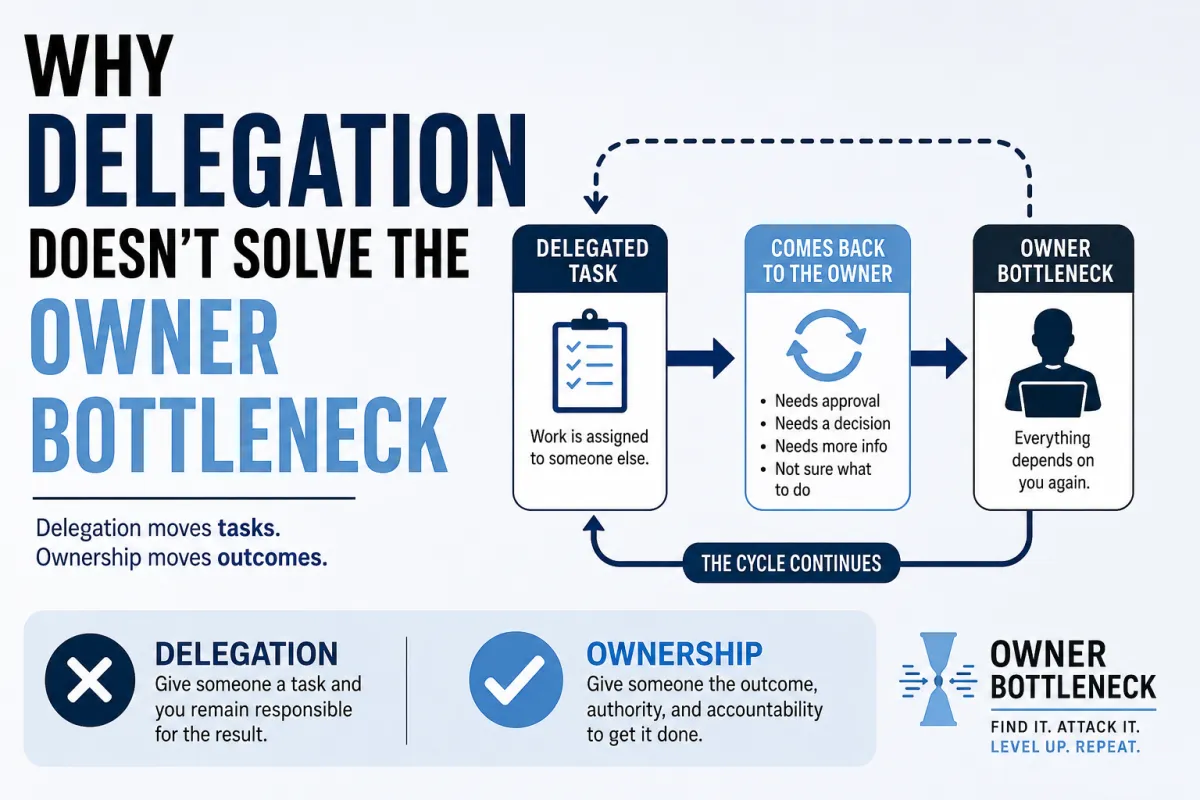
Why Delegation Doesn’t Solve the Owner Bottleneck
You delegated the responsibility.
They brought it back.
You explained it again.
They asked for approval.
You told them to take ownership.
Then you stepped in and fixed it yourself.
A lot of owners reach the same conclusion:
Delegation doesn’t work.
But delegation usually isn’t the real problem.
The problem is that the work moved while the decisions, judgment, authority, and responsibility stayed with the owner.
The employee received something to do.
The owner remained responsible for getting it right.
That isn’t ownership.
It’s task distribution with the owner still sitting in the middle.
Key Takeaways
Delegation moves work, but it doesn’t automatically move authority, judgment, or responsibility.
Employees will continue returning to the owner when the desired outcome, decision boundaries, or standards are unclear.
Owners often reinforce dependence by answering too quickly, overriding decisions, or taking responsibilities back.
True ownership requires a clear outcome, defined authority, access to information, standards for judgment, and accountability.
Delegation has worked when the business moves faster and more consistently without everything returning to the owner.
Why delegation feels like the obvious solution
When too much work piles up around the owner, delegation seems like the answer.
You have more work than you can complete.
Someone else has available capacity.
So you hand them part of the workload.
That can help.
But an Owner Bottleneck isn’t created only by the amount of work the owner performs.
It’s created by how much of the business still depends on the owner’s decisions, judgment, relationships, knowledge, approval, or presence.
You can delegate dozens of tasks and still remain the bottleneck.
Someone else may prepare the proposal.
You still approve the price.
Someone else may speak with the customer.
You still decide what solution to offer.
Someone else may manage the project.
You still handle every exception.
Someone else may supervise the employee.
You still make the difficult personnel decisions.
The activity moved away from you.
The dependence didn’t.
That’s why many owners feel as though they’ve delegated but somehow become busier.
They aren’t doing every task anymore.
Now they’re answering questions, reviewing work, approving decisions, correcting mistakes, and rescuing delegated responsibilities.
They’ve traded execution for supervision without reducing owner dependence.
Delegation moves a task. Ownership moves the outcome.
This is the distinction most businesses miss.
Delegation sounds like:
Please complete this report by Friday.
Ownership sounds like:
You own the accuracy and delivery of our weekly financial reporting. The report must be completed by Friday, explain any meaningful variances, and identify anything leadership needs to act on.
The first statement assigns an activity.
The second defines an outcome.
With delegation, the employee asks:
What do you want me to do?
With ownership, the employee asks:
What result am I responsible for producing?
Those aren’t the same question.
A task tells someone what action to complete.
An outcome tells them what success looks like.
Without a clear outcome, employees may complete exactly what the owner asked and still miss what the owner actually wanted.
The owner then concludes that delegation failed.
In reality, the task was transferred without enough context to own the result.
Why delegated responsibilities keep coming back to the owner
There are several common reasons delegated work returns.
The outcome was never clearly defined
Owners often carry a complete picture of the desired result in their heads.
The employee receives only a piece of that picture.
The owner says:
Take care of this customer.
But what does “take care of” mean?
Does it mean answering the customer’s question?
Solving the underlying problem?
Offering a refund?
Protecting the relationship?
Preventing the issue from happening again?
The employee may complete the immediate task while the owner evaluates the work against an outcome that was never clearly communicated.
The owner sees poor judgment.
The employee sees shifting expectations.
Both become frustrated.
Clear ownership begins with a clear result.
The decision stayed with the owner
An employee may own the work but still lack the authority to make the decisions required to complete it.
They can prepare the quote, but they can’t adjust pricing.
They can speak with the customer, but they can’t approve a credit.
They can manage the project, but they can’t change the schedule.
They can lead the team, but they can’t address poor performance without the owner.
Every meaningful decision still requires escalation.
The responsibility may have someone else’s name on it.
The owner remains the decision-maker.
That creates a Decision Bottleneck, even when the work appears to be delegated.
The owner’s judgment was never transferred
An owner may have spent years learning how to make a certain decision.
They notice patterns other people don’t notice.
They understand the customer’s history.
They know which risks matter and which ones don’t.
They can see when a small problem is about to become a larger one.
Then they delegate the responsibility and expect someone else to make the same judgment after one conversation.
When the employee struggles, the owner says:
They just don’t think like an owner.
Of course they don’t.
They don’t have the same experience, context, information, or pattern recognition.
Good judgment isn’t transferred by telling someone to “use good judgment.”
It has to be taught.
The owner needs to explain:
What factors matter
What risks to consider
What a good decision protects
What tradeoffs are acceptable
What warning signs require escalation
What past experience has taught the company
The goal isn’t to make the employee think exactly like the owner.
It’s to help them understand the principles behind the owner’s decisions.
Authority disappears when something goes wrong
Some owners give authority until the employee makes a decision they wouldn’t have made.
Then the owner steps back in.
The decision gets reversed.
The employee gets corrected in front of others.
The customer is told that the owner will handle it.
The responsibility quietly returns to the owner.
The employee learns an important lesson:
You can make decisions when everything goes well.
When the decision carries risk, wait for the owner.
That creates dependence very quickly.
Authority isn’t real if it disappears the moment someone uses it differently than the owner would have.
That doesn’t mean owners must accept reckless decisions.
It means they need to distinguish between:
A decision that violated a clear boundary
A reasonable decision that produced an imperfect result
A decision that was different from the owner’s personal preference
Those are three different situations.
Treating all three as failure teaches people not to decide.
The owner answers too quickly
Many owners are excellent problem-solvers.
That strength can become part of the bottleneck.
An employee brings a question.
The owner sees the answer immediately.
Giving the answer takes 30 seconds.
Coaching the employee to think through it may take 10 minutes.
So the owner answers.
Today’s problem gets solved quickly.
Tomorrow’s ability doesn’t improve.
The next time something similar happens, the employee comes back again.
The owner becomes frustrated that people keep asking questions.
But every quick answer trained the team to bring questions to the person who can solve them fastest.
You may be training people to wait for you.
Instead of immediately giving the answer, ask:
What do you think we should do?
What information are you using?
What options have you considered?
What risk are you most concerned about?
What would you decide if I weren’t available?
The goal isn’t to turn every question into an interrogation.
It’s to stop making the owner the automatic answer machine.
The owner takes the responsibility back
Delegation becomes uncomfortable when someone struggles.
The customer is unhappy.
The deadline is getting close.
The work isn’t being completed the way the owner would do it.
The owner steps in because stepping in feels faster and safer.
Sometimes that’s necessary.
But when it becomes the normal response, the team learns that responsibility is temporary.
They own it until it gets difficult.
Then the owner takes it back.
The owner may describe this as protecting the business.
The employee experiences it as a lack of trust.
The next time a difficult situation appears, the employee escalates sooner.
The owner becomes even more involved.
The cycle strengthens itself.
There’s no real accountability
Delegation without accountability often becomes hope.
The owner assigns a responsibility.
The employee agrees.
Then no one clearly defines:
What success will be measured
When progress will be reviewed
What decisions the employee owns
What support is available
What happens if the result isn’t produced
The owner checks in inconsistently.
Problems remain hidden until they become urgent.
Then the owner jumps back in.
Accountability doesn’t mean hovering over someone.
It means the outcome, expectations, measurements, and review rhythm are clear before the work begins.
Why documentation alone doesn’t solve it
A lot of owners believe the answer is documenting every process.
Documentation can help.
A checklist can reduce missed steps.
A standard operating procedure can create consistency.
A decision tree can clarify what happens in common situations.
But documentation has limits.
A process can explain what to do when the situation is predictable.
It may not explain how to think when the situation changes.
Customers don’t always follow the script.
Employees don’t always behave predictably.
Projects don’t always go according to plan.
The real test of owner dependence is often what happens when the process stops being obvious.
Does the team understand the outcome well enough to adapt?
Do they have enough authority to decide?
Do they know which principles matter?
Do they know what requires escalation?
If every exception returns to the owner, the business may have documented its processes without transferring ownership.
What true ownership requires
True ownership doesn’t mean giving someone unlimited freedom and hoping for the best.
It requires structure.
A clear outcome
The person needs to understand the result they own.
Not merely the task they perform.
Instead of:
Follow up with these leads.
Try:
You own moving every qualified lead to a clear next step within one business day.
Instead of:
Handle customer complaints.
Try:
You own resolving customer concerns quickly, protecting the relationship, and identifying recurring problems we need to fix.
The clearer the outcome, the easier it becomes to make decisions around it.
Defined authority
People need to know what they can decide without permission.
That might include:
How much money they can approve
What pricing adjustments they can make
Which customer remedies they can offer
What schedule changes they can authorize
What personnel issues they can address
What situations must be escalated
Authority shouldn’t be vague.
“Use your judgment” sounds empowering until the employee discovers that the owner’s definition of good judgment was different.
Clear boundaries
Ownership needs limits.
The employee should know:
What they own completely
What they can decide within certain limits
What requires consultation
What must remain with the owner
Boundaries reduce unnecessary escalation without creating uncontrolled risk.
Access to information
People can’t make strong decisions without the information the owner uses.
That may include:
Financial information
Customer history
Pricing guidelines
Capacity constraints
Previous decisions
Company priorities
Risk thresholds
Performance data
Owners sometimes ask employees to think strategically while withholding the information needed to make strategic decisions.
That isn’t empowerment.
It’s guessing.
Standards for good judgment
A standard isn’t only a step-by-step procedure.
It can also be a principle.
For example:
Protect the long-term customer relationship without rewarding unreasonable behavior.
Never promise a deadline before confirming capacity.
Solve the customer’s immediate problem, then identify why it happened.
Don’t discount simply because the prospect asks.
Escalate issues involving safety, legal exposure, or material financial risk.
These principles help people decide when the exact situation has never happened before.
Accountability for the result
The person must know that ownership includes responsibility for what happens next.
That doesn’t mean punishing every imperfect decision.
It means reviewing results honestly.
What happened?
What decision was made?
What information was available?
What worked?
What should change next time?
Ownership grows when people experience the connection between their decisions and the results those decisions produce.
Room to make reasonable mistakes
You can’t transfer ownership while requiring perfection.
If every mistake causes the owner to take the responsibility back, people will learn to avoid decisions.
The goal isn’t to tolerate carelessness.
The goal is to distinguish between poor judgment and developing judgment.
A person can make a reasonable decision, based on the available information, and still get an imperfect result.
That experience can build capability, provided the business learns from it.
What delegation without ownership looks like
Imagine an owner tells a service manager:
You’re responsible for customer complaints now.
A customer complains about a delayed project.
The service manager calls the customer but doesn’t know:
Whether they can offer a refund
Whether they can provide free additional work
How much authority they have
Whether the relationship is considered strategically important
Whether the owner wants to be involved
So the manager gathers the information and brings it to the owner.
The owner decides what to offer.
The manager communicates the decision.
Technically, the complaint was delegated.
Practically, the owner still handled it.
Now imagine the responsibility is transferred with actual ownership.
The manager knows:
The desired outcome is to resolve valid concerns quickly while protecting trust and controlling unnecessary concessions.
They can approve credits up to a defined amount.
They can authorize certain remedies without permission.
They should escalate legal threats, safety issues, or situations above their financial authority.
They’re expected to identify the operational cause and report recurring patterns monthly.
Now the manager can act.
The owner is no longer required for every complaint.
That’s what reducing owner dependence looks like.
How to transfer ownership without creating chaos
You don’t need to overhaul the entire company.
Start with one responsibility that repeatedly returns to you.
Find the queue
Look for work that waits for your answer, approval, or intervention.
Ask:
What do people bring me repeatedly?
What responsibility have I delegated more than once?
What stops moving when I’m unavailable?
What problem do I keep solving for the same person or department?
Start there.
Define the outcome
Write down the result the person owns.
Make it specific enough that both of you would recognize success.
Avoid vague statements like:
Take care of it
Own the department
Be more proactive
Handle the customer
Keep me out of it
Those phrases describe your frustration.
They don’t define the outcome.
Identify the decisions inside the responsibility
List the decisions the person must make to produce the result.
Which decisions can they make independently?
Which require consultation?
Which must remain with you?
If you don’t transfer the necessary decisions, the responsibility will keep returning.
Set clear boundaries
Create simple limits.
For example:
Financial authority up to a specific amount
Pricing flexibility within a defined range
Escalation required for legal or safety concerns
Hiring authority for certain roles
Customer concessions within an approved framework
Boundaries create speed without removing control.
Teach the judgment behind the work
Don’t only explain what you would decide.
Explain why.
Share:
What you noticed
What mattered most
What risk you were protecting against
What tradeoff you accepted
What would have changed your decision
That’s how experience begins moving out of the owner’s head.
Coach before rescuing
When someone brings you a question, resist answering immediately.
Ask them to recommend a decision first.
You may still need to help.
But make them participate in the thinking.
Over time, your role should move from:
Here’s the answer.
To:
Walk me through your decision.
Eventually, they shouldn’t need the conversation at all.
Review the outcome
Schedule a clear review rhythm.
Discuss:
Results
Decisions made
Issues escalated
Mistakes
Lessons
Changes needed
This gives you visibility without pulling every decision back to you.
Measure whether the dependence is actually shrinking
Don’t measure delegation by how many tasks moved off your list.
Measure it by whether the business needs you less often.
Look for:
Fewer questions returning to you
Faster decisions
Fewer stalled projects
Consistent quality without your review
Problems being resolved at the correct level
Managers explaining their reasoning clearly
Less owner involvement in recurring work
The goal isn’t delegation.
The goal is reduced dependence.
What shouldn’t be delegated?
Not everything should leave the owner.
The owner may need to retain responsibility for:
Major strategic decisions
Material financial commitments
Ownership or equity decisions
High-risk legal matters
Critical leadership hires
Decisions that could threaten the future of the business
But those decisions should remain with the owner because they belong there.
Not because the company has never built anyone else’s capability.
The question isn’t:
How do I delegate everything?
The better question is:
What truly requires me, and what still comes to me only because we haven’t transferred the capability, authority, or trust?
That distinction matters.
How do you know ownership has actually transferred?
Ownership has moved when:
The person can explain the outcome they own.
They understand what they can decide.
They know when escalation is appropriate.
They can explain the reasoning behind their decisions.
Work continues while the owner is unavailable.
The owner doesn’t need to review every detail.
Results remain consistent without constant intervention.
Mistakes create learning instead of immediate rescue.
The responsibility stops returning to the owner.
The owner may still be informed.
They may still coach.
They may still review meaningful results.
But they’re no longer required for the responsibility to move forward.
Transferring ownership requires more than assigning the work.
The person also needs the authority and structure to decide what happens next.
This practical guide explains how to delegate decisions, not just tasks without giving up visibility, standards, or control.
Frequently asked questions about delegation and owner dependence
Should owners stop checking delegated work?
No.
Review is often necessary while someone is developing capability.
The goal is to change what the owner reviews and how often.
Early on, the owner may review individual decisions.
Later, they should review patterns, outcomes, and performance.
If the owner must inspect every task forever, ownership hasn’t transferred.
What if the employee makes the wrong decision?
First, determine whether the decision violated a clear boundary or whether it was a reasonable decision that produced an imperfect result.
Those aren’t the same thing.
If the boundary was unclear, improve the boundary.
If the person lacked information, improve access to information.
If the judgment was weak, coach the reasoning.
If the person repeatedly ignores expectations, then you may have an accountability or capability problem.
Don’t treat every imperfect outcome as proof that only the owner can decide.
Can an SOP solve an Owner Bottleneck?
An SOP can reduce dependence for repeatable work.
It can’t replace judgment in every situation.
Strong ownership usually combines processes, authority, principles, information, coaching, and accountability.
Documentation is part of the solution.
It isn’t the entire solution.
What if the team isn’t capable of taking ownership?
That may be true.
But test the system before making that conclusion.
Have people received:
A clear outcome?
Real authority?
The information they need?
Defined boundaries?
Coaching on judgment?
Enough time to develop?
Consistent accountability?
Some people won’t grow into the responsibility.
Others have never been given the conditions required to succeed.
How long does transferring ownership take?
It depends on the complexity of the responsibility and the experience of the person.
Simple recurring decisions may transfer quickly.
Responsibilities involving customer trust, financial judgment, leadership, or complex operations may take longer.
The goal isn’t to rush the transfer.
It’s to reduce dependence without creating unnecessary risk.
Delegation isn’t the finish line
Delegation can be useful.
But it isn’t proof that the business is becoming less dependent on you.
You can delegate tasks while remaining the approver.
You can delegate work while keeping the judgment.
You can delegate responsibility while taking it back whenever something gets uncomfortable.
The business changes only when the outcome, authority, information, judgment, and accountability begin moving too.
Fixing that requires a broader transfer than delegation alone. Here’s how to make the business less dependent on you by moving authority, judgment, standards, context, and accountability into the company.
That’s when delegation becomes ownership.
And ownership is what allows the company to move without waiting for the owner.
Find the responsibility that keeps returning.
Understand why it returns.
Transfer what’s missing.
Then measure whether the business truly needs you less.
Find it.
Attack it.
Level up.
Repeat.
Find where your business still depends on you
Delegation may not be the only place owner dependence is showing up.
The free Owner Bottleneck Scorecard evaluates your Decision, Sales, Operations, Team, and Value Bottlenecks so you can see where the business may still depend too heavily on you.