At first, being involved in everything helped the business survive.
You knew the customers.
You made the decisions.
You solved the problems.
You protected the quality.
You pushed things forward when nobody else would.
That’s how a lot of owner led businesses get off the ground.
But eventually, the thing that made the business work becomes the thing holding it back.
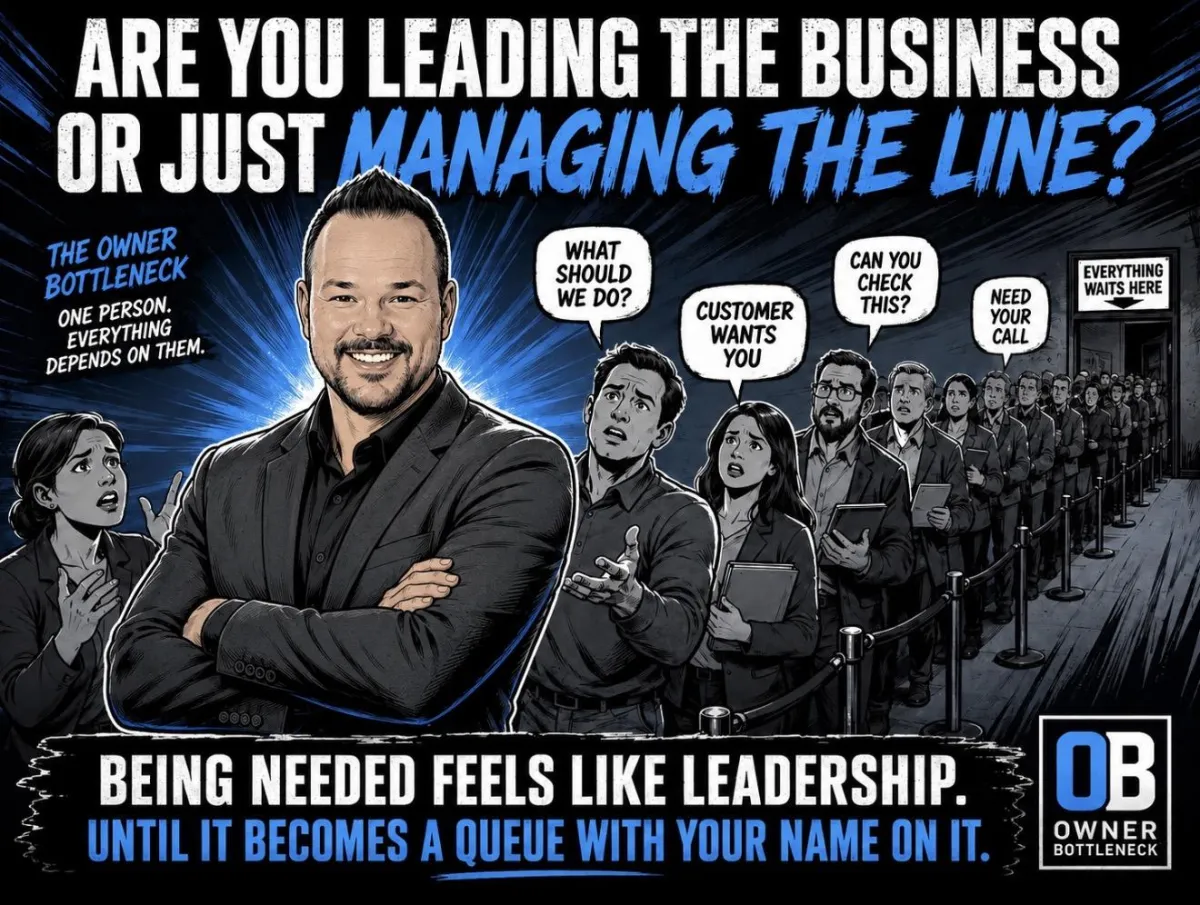
The team waits on you.
Customers still ask for you.
Sales depend on you.
Processes live in your head.
Decisions keep landing on your desk.
And even when the business is busy, it still feels stuck.
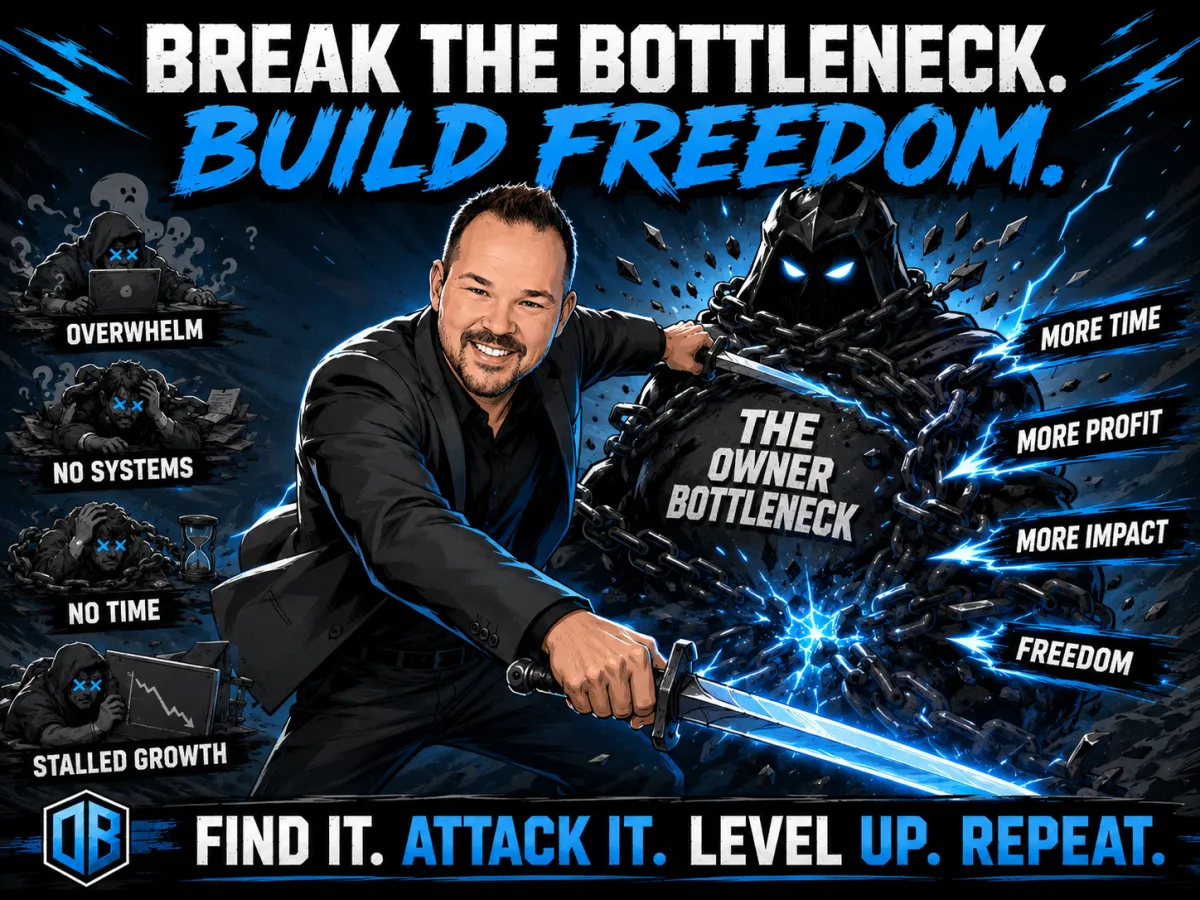
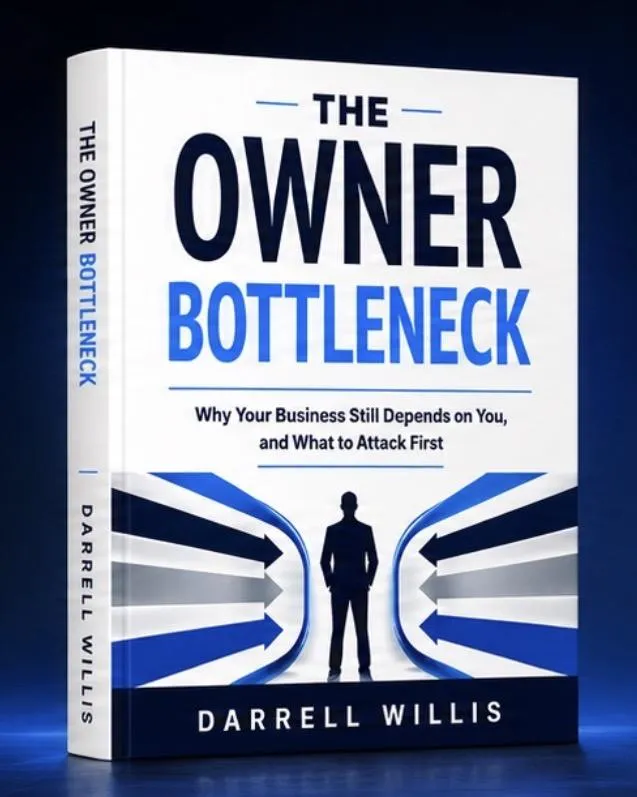
That’s the Owner Bottleneck.
It’s what happens when the business can only grow as far as the owner’s personal capacity allows.
And the longer it goes unaddressed, the more normal it starts to feel.
The Owner Bottleneck doesn’t just make you busy.
It makes the business fragile.
When too much still depends on you, every part of the business slows down.
Growth slows because the team can’t move without your input.
Sales slow because too much revenue still depends on your relationships, follow up, or closing ability.
Operations slow because the process lives in your head instead of inside the business.
People slow down because they’re trained to ask instead of own.
And freedom disappears because even when you step away, the business still follows you.
The cost isn’t just time.
It’s missed growth.
It’s weaker accountability.
It’s constant mental load.
It’s a team that never fully steps up.
It’s a business that looks successful from the outside, but still depends too much on the owner to work.
And eventually, that dependence becomes a value problem.
Because a business that can’t run without the owner is harder to grow, harder to transfer, harder to finance, and harder to sell.
You don’t fix the Owner Bottleneck by working harder.
You fix it by finding the right constraint and attacking it first.
The Owner Bottleneck doesn’t always show up in one obvious place.
Sometimes it’s in sales.
Sometimes it’s in operations.
Sometimes it’s in the team.
Sometimes it’s in the numbers.
Sometimes it’s in the owner’s need to stay involved because letting go feels risky.
But most owner bottlenecks fall into five areas:
Decision Bottleneck
Every important decision still comes back to you.
The team may be capable, but they don’t have enough clarity, authority, or confidence to move without your approval.
Sales Bottleneck
Revenue still depends too much on your relationships, credibility, follow up, pricing, or ability to close.
If you’re the reason deals get done, the business has a sales ceiling.
Operations Bottleneck
The business runs on habits, memory, and constant correction instead of documented systems.
People know what to do because you’re nearby, not because the business has a repeatable process.
People Bottleneck
Your team has tasks, but not true ownership.
They stay busy, but accountability, problem solving, and final responsibility still roll back to you.
Value Bottleneck
The business may be profitable, but too much of that value is tied to you personally.
That makes the business harder to grow, harder to transfer, and harder to eventually sell.
The goal is not to remove you from the business overnight.
The goal is to find the bottleneck creating the most drag right now and attack it first.
Most owners don’t need more ideas.
They need clarity.
Because when everything feels important, it’s easy to keep attacking the wrong problems.
You fix a staffing issue, but the real problem is decision making.
You chase more leads, but the real problem is that sales still depend on you.
You document a process, but the real problem is nobody owns the outcome.
You hire more people, but the real problem is that accountability still rolls back to your desk.
That’s why the first step is not doing more.
The first step is finding the bottleneck that’s creating the most drag right now.
The Owner Bottleneck Scorecard helps you see where the business still depends too much on you, and which area needs to be attacked first.
The Scorecard looks at:
Decision Making
How many meaningful decisions still need your approval before the business can move forward?
If your team waits on you to price, approve, solve, answer, or decide, the business is still depending on your judgment instead of clear standards.
Sales Dependence
How much of your revenue still depends on your personal relationships, credibility, follow up, pricing conversations, or ability to close?
If deals move forward because you are involved, the business may have a sales bottleneck.
Customer Relationships
Do customers trust the business, or do they mainly trust you?
If key customers still expect you to answer questions, solve issues, or stay involved, the relationship may not be fully transferable to the team.
Operations
Can the business run consistently without you stepping in to correct, remind, explain, or rescue the process?
If the business relies on your memory, habits, or constant intervention, operations are still too owner dependent.
Team Ownership
Does your team truly own outcomes, or do they mostly complete tasks?
A team can be busy and still not be accountable. The scorecard looks at whether responsibility actually lives with the team, or keeps rolling back to you.
Financial Visibility
Can you clearly see what is working, what is profitable, and where the business is leaking money?
If the numbers are unclear, delayed, messy, or only understood by you, it becomes much harder to make strong decisions.
Systems
Are the important parts of the business documented, repeatable, and easy for someone else to follow?
If the process lives in your head, it doesn’t really belong to the business yet.
Leadership Depth
Who can lead, decide, solve, and carry responsibility when you are not available?
If everything still depends on your presence, the business does not have enough leadership depth.
Revenue Predictability
Does revenue come from a repeatable process, or does it depend on effort, hustle, referrals, and owner involvement?
Predictable revenue makes a business easier to run, grow, and eventually value.
Owner Freedom
Can you step away without the business slowing down, breaking down, or pulling you back in?
Owner freedom is not about doing nothing. It’s about knowing the business can keep moving without you being the answer to everything.
The scorecard does not just show where the business is weak.
It shows where the business is still depending too much on you.
Finding the bottleneck is the first step.
Attacking it is where the business starts to change.
The Owner Bottleneck Audit is a focused review of where your business still depends too much on you, what that dependence is costing you, and what needs to change first.
This is not generic business coaching.
It is not a long list of ideas.
It is not another strategy session that leaves you overwhelmed.
The goal is simple.
Find the biggest owner bottleneck in the business.
Understand why it is creating drag.
Build a practical 30 day plan to attack it.
What We Look At
We review where the business depends on you most:
Decision making
Sales
Customer relationships
Operations
Team ownership
Financial visibility
Systems
Leadership depth
Revenue predictability
Owner freedom
Then we identify the bottleneck creating the most immediate drag on growth, freedom, team performance, and future business value.
What You Walk Away With
A clear diagnosis of your biggest owner bottleneck.
A practical explanation of what it is costing the business.
A risk map showing where the business is most dependent on you.
A focused 30 day attack plan.
A better understanding of what needs to be fixed first, and what can wait.
The Point
Most owners try to fix too many things at once.
That is how they stay stuck.
The audit helps you find the constraint that matters most right now, so you can stop guessing and start attacking the right problem.

I’ve spent years inside leading and owning small and midsized businesses, not just advising from the outside.
I’ve seen what happens when the business has customers, employees, revenue, and real momentum, but still depends too much on the owner to keep everything moving.
I’ve also seen business through a rare combination of lenses:
Finance.
Sales.
Operations.
Private Equity.
C-Suite.
Ownership.
Why That Matters
The Owner Bottleneck is never just about working too much.
It shows up in how decisions get made, how sales happen, how people take ownership, how numbers are understood, and how the business runs when the owner is not in the room.
My work helps owners find the real constraint, name it clearly, and attack it with a practical plan.
Not theory.
Not vague coaching.
A focused process to help make the business less dependent on the owner.
Bottom Line
The goal isn’t to build a business that keeps needing more from you.
The goal is to build a business that can keep getting stronger without everything running through you.
Owner bottlenecks don’t just create stress today.
They create risk later.
When too much of the business depends on the owner, it becomes harder to grow, harder to lead, harder to transfer, and harder to eventually sell.
That doesn’t mean every owner is trying to sell right now.
Most aren’t.
But every owner should be building a business that is less dependent on them and more valuable without them.
That’s what Sell-Ready really means.
It’s not about rushing toward an exit.
It’s about building a business with stronger systems, clearer numbers, better leadership, repeatable sales, and less owner dependence.
What This Really Means
A business that depends less on the owner becomes easier to run now.
Easier to grow next.
And more valuable when the owner finally wants options.
Whether that means selling, stepping back, passing it on, or simply taking a real vacation without the business falling apart.
I speak to chambers, business groups, owner communities, and local organizations about one core problem:
Why Most Small Businesses Can’t Grow Without Everything Running Through the Owner
This talk helps owners see where they may be limiting growth, freedom, team accountability, and future business value without realizing it.
It is built for real owner led businesses where the owner is still too involved in decisions, sales, customers, operations, and daily problem solving.
No theory.
No motivational fluff.
No generic “work on the business” advice.
Just a practical conversation about why businesses get stuck, where owner dependence shows up, and what needs to be attacked first.
What Owners Walk Away With
A clearer understanding of where the business depends too much on them.
A simple framework for identifying the biggest bottleneck.
Practical examples of how owner dependence limits growth.
A better way to think about delegation, accountability, and team ownership.
A first step toward building a business that can grow without everything running through the owner.
Most owners already know something is slowing the business down.
The harder part is knowing which problem matters most.
Start with the Owner Bottleneck Scorecard.
It will help you see where the business still depends too much on you, where the biggest constraint may be hiding, and what area needs attention first.
You don’t need to fix everything at once.
You need to find the bottleneck creating the most drag and start there.
Build a business that can grow stronger without everything running through you.
An Owner Bottleneck happens when too much of the business still depends on the owner’s decisions, relationships, approvals, knowledge, sales ability, or daily involvement.
The business may be successful, but if everything still runs through the owner, growth gets harder, the team stays dependent, and the business becomes more fragile than it should be.
Start with this question:
Could the business keep running well if you stepped away for 30 days?
If the honest answer is no, there’s probably an owner bottleneck somewhere.
It may be in decision making, sales, customer relationships, operations, team ownership, systems, revenue predictability, or financial visibility.
That’s exactly what the Owner Bottleneck Scorecard is designed to show you.
No.
This is for owners who want a business that’s easier to run, easier to grow, and less dependent on them.
Selling may be an option someday, but this work matters long before an exit.
A business that depends less on the owner usually becomes stronger, more scalable, more valuable, and more enjoyable to own.
The Owner Bottleneck Scorecard is a quick 10 question assessment that gives you your Owner Independence Score.
It helps you see where the business still depends too much on you, and which areas may be creating the most drag.
It’s not a perfect diagnosis, but it is a strong starting point.
A Bottleneck Clarity Call is a focused conversation where we look at your score, talk through where the business is most dependent on you, and identify which bottleneck likely needs attention first.
It is not a generic sales call.
The goal is to give you clarity on what’s actually holding the business back and whether an Owner Bottleneck Audit makes sense as the next step.
The Owner Bottleneck Audit is a deeper diagnostic review of where your business depends too much on you, what that dependence is costing you, and what needs to change first.
You’ll walk away with a clearer diagnosis, a practical explanation of the bottleneck, and a focused plan for attacking it.
Not in the generic sense.
This is not vague motivation, endless brainstorming, or random advice.
The work is focused on identifying where the business is too dependent on the owner and helping you attack the constraint that is creating the most drag.
This is for owners of established businesses who have customers, revenue, employees, and momentum, but still feel like too much depends on them.
You may be the decision maker, lead salesperson, customer fixer, team manager, problem solver, and final approval point.
If the business works, but it still needs too much of you to work well, this is for you.
Small is not the problem.
Owner dependence is the problem.
If your business is still early, this work can help you avoid building a company that traps you later.
If your business is already established, this work can help you find the areas where owner dependence is slowing growth, weakening accountability, or limiting value.
Maybe.
But most owners don’t stay stuck because they’re not smart enough.
They stay stuck because they’re too close to the business to see the real constraint clearly.
The danger is attacking the wrong problem, hiring the wrong person, documenting the wrong process, or trying to fix everything at once.
The goal is to find the bottleneck that matters most and attack that first.
Start with the Owner Bottleneck Scorecard.
It takes a few minutes and gives you a clear snapshot of where the business may still depend too much on you.
From there, you can book a Bottleneck Clarity Call if you want help interpreting your score and deciding what to attack first.
Take the Owner Bottleneck Scorecard
Darrell Willis helps owner led businesses that have customers, revenue, employees, and momentum, but still depend too much on the owner to function well.
These are businesses where the owner is still pulled into too many decisions, sales conversations, customer issues, team questions, approvals, and daily fires.
The business may be successful, but it has become too owner dependent.
Darrell helps owners identify where the business depends on them most, understand what that dependence is costing them, and build a practical plan to attack the bottleneck first.
This work is for owners who want a business that is easier to run, easier to grow, less dependent on them, and more valuable over time.