
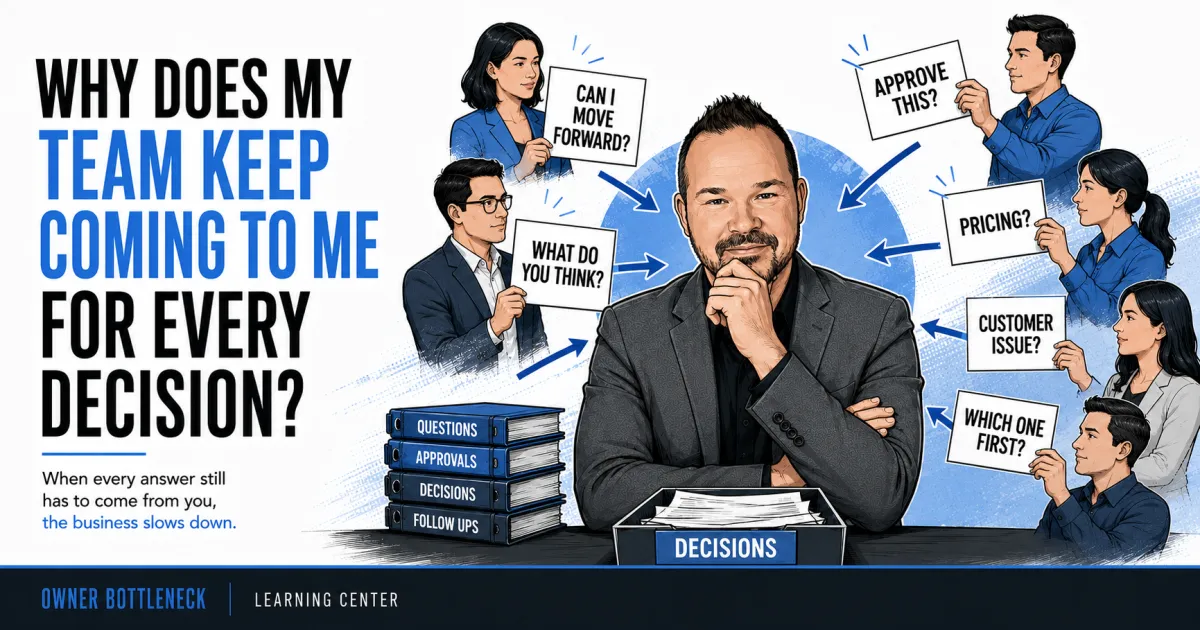
Why Does My Team Keep Coming to Me for Every Decision?
It starts with one question.
“Can you take a quick look at this?”
Then another.
“What would you do here?”
Then a customer asks for something unusual.
A manager needs approval.
An employee wants to know which project comes first.
Someone needs an exception.
Someone else needs a final answer.
By noon, the owner has made twelve decisions they never expected to make that day.
None of them seemed especially large.
Together, they swallowed the morning.
The owner looks around and thinks:
“Why does everyone keep coming to me?”
That’s a fair question.
But it may be the wrong one.
The better question is:
“What has the business taught people to do when they’re uncertain?”
Because when every decision keeps returning to the owner, the team may not simply be indecisive.
They may be doing exactly what the business has trained them to do.
Sometimes the team isn’t only waiting for authority. They’re trying to predict the owner’s personal answer. This guide explains why employees keep asking, “What would you do?” and how to replace owner preference with shared standards, visible priorities, and real decision authority.
Key Takeaways
Employees often return decisions to the owner because asking feels safer than deciding.
Telling people to “take ownership” won’t work when authority, standards, information, and boundaries are unclear.
Owners frequently create decision dependence by answering too quickly, correcting decisions after the fact, or taking work back.
Assigning a task isn’t the same as transferring responsibility for the outcome.
The goal isn’t to stop employees from asking questions. It’s to stop routine judgment from requiring owner approval.
Decision-making improves when the team knows what they own, what good looks like, where the boundaries are, and what truly needs to escalate.
Why Does My Team Keep Coming to Me for Every Decision?
When employees continually return to the owner for answers, the business may have a Decision Bottleneck.
A Decision Bottleneck is a version of the Owner Bottleneck where choices can’t move forward without the owner’s judgment, approval, context, or confidence.
The decision might involve:
Pricing
Scheduling
Customer problems
Project priorities
Hiring
Purchasing
Quality
Deadlines
Refunds
Exceptions
The specific decision changes.
The pattern doesn’t.
The team encounters uncertainty.
The decision returns to the owner.
The owner answers.
The business moves.
That may feel efficient.
It may even feel like leadership.
But every time the owner becomes the fastest path to certainty, the business learns to route uncertainty back through them.
Your Team May Be Doing Exactly What You Trained Them to Do
Most owners don’t intentionally create dependence.
They’re trying to help.
A manager walks in with a question.
The owner knows the answer.
It takes thirty seconds to respond.
So they respond.
Problem solved.
Except the problem wasn’t solved.
The decision was made.
The capability wasn’t built.
The next time something similar happens, the manager comes back again.
Why wouldn’t they?
Asking the owner is:
Faster
Safer
Less risky
More likely to be correct
Less likely to be criticized later
From the employee’s perspective, escalating may be the most rational choice available.
That’s the uncomfortable part.
The owner may be frustrated that the team keeps asking.
The team may have learned that asking is exactly what the owner rewards.
Employees Don’t Avoid Decisions for Just One Reason
It’s easy to assume the team lacks confidence.
Sometimes that’s true.
But there are several reasons a decision may keep returning to the owner.
Authority Is Unclear
The employee may know what work they’re responsible for.
They may not know what they’re allowed to decide.
An owner says:
“You’re in charge of this.”
But what does “in charge” actually include?
Can the employee:
Change the schedule?
Move the deadline?
Speak directly with the customer?
Offer a refund?
Spend money?
Reassign work?
Say no?
Make an exception?
Accept a lower margin?
Correct another employee?
When authority is vague, employees protect themselves by checking.
The owner thinks responsibility transferred.
The employee thinks only the task transferred.
That gap creates the Decision Bottleneck.
The Standards Live Inside the Owner’s Head
Employees can’t consistently make decisions against standards they’ve never been given.
The owner may know instinctively:
Which customers deserve flexibility
Which problems require immediate attention
Which quality issues are acceptable
Which costs are worth paying
Which deadlines can move
Which risks are too dangerous
Which details matter most
The team sees the situation.
The owner sees the history, context, tradeoffs, and consequences.
So the team asks:
“What do you think?”
That isn’t always a motivation problem.
It may be an information problem.
The owner has years of judgment stored in their head.
The team has the situation sitting in front of them.
The Owner Corrects Decisions After the Fact
An employee makes a call.
The owner later changes it.
The employee makes another decision.
The owner explains why they would’ve handled it differently.
Eventually, the employee learns something.
Not how to decide.
They learn that the safest decision is to ask first.
This happens even when the owner is polite.
Even when the owner is right.
Even when the owner is only trying to protect the customer or the company.
The lesson still lands:
“Before I make the call, I should find out what the owner wants.”
Mistakes Feel More Dangerous Than Waiting
Owners often say they want people to make decisions.
Then someone makes the wrong one.
The owner reacts.
The mistake gets replayed.
The cost gets emphasized.
The employee’s judgment gets questioned.
The owner may be completely justified in addressing the mistake.
But if the business punishes a wrong decision more heavily than it punishes delay, employees will choose delay.
They’ll wait.
They’ll check.
They’ll escalate.
They’ll protect themselves.
The owner may say:
“I need people to take more ownership.”
The team hears:
“Take ownership, but don’t get it wrong.”
That isn’t authority.
That’s a guessing game.
The Owner Answers Too Quickly
Some owners create dependence because they’re too available.
A question appears.
They answer immediately.
An employee asks what to do.
The owner solves it.
A manager brings a problem.
The owner jumps straight to the recommendation.
The owner believes they’re keeping things moving.
They are.
They’re also becoming the business’s preferred search engine.
The team never has to sit with the problem long enough to think.
The owner’s speed removes the need for everyone else to develop judgment.
The Owner Takes the Work Back
An employee struggles.
The owner steps in.
A manager misses a detail.
The owner takes over.
A customer becomes upset.
The owner handles it personally.
It works.
The issue gets resolved.
But the work has now returned to the owner.
This is one reason delegation alone doesn’t solve the Owner Bottleneck.
The task moved.
Then difficulty appeared.
Then ownership moved back.
Over time, the team learns that responsibility lasts only until the work gets uncomfortable.
The Team Doesn’t Have the Necessary Information
Sometimes employees ask because the information needed to decide isn’t available.
They may not know:
The budget
The margin
The project priority
The customer history
The staffing capacity
The contractual commitment
The strategic goal
The owner’s risk tolerance
The employee may have authority in theory.
They don’t have enough visibility to use it.
Giving someone permission without information is not decision transfer.
It’s exposure.
The Team Has Been Trained to Execute, Not Think
Some employees have spent years being told exactly what to do.
Then one day, the owner asks:
“Why can’t you just figure it out?”
Because the job may never have required that before.
The employee was hired to follow instructions.
Their performance was measured by compliance.
Questions were answered for them.
Exceptions went to the owner.
Now the owner wants independent judgment.
That transition requires more than encouragement.
It requires training.
The Wrong Person May Be in the Role
This needs to be said clearly.
Not every case of decision dependence is caused by the owner.
Some employees avoid responsibility.
Some don’t want authority.
Some repeatedly bring problems without thinking.
Some won’t use information even when it’s available.
Some lack the judgment the role requires.
Some people are simply in the wrong seat.
But don’t jump to that conclusion too quickly.
Before blaming the person, inspect the environment.
Ask:
Is authority clear?
Are standards clear?
Is the necessary information available?
Are mistakes handled constructively?
Does the owner regularly override decisions?
Has the person been trained to think through problems?
Does the role actually require decision ownership?
You can’t fairly judge someone’s ability to decide inside a system that continually trains them not to.
Assigning Work Isn’t the Same as Transferring Ownership
An owner says:
“I delegated that.”
Maybe.
But what was actually transferred?
The task?
Or the outcome?
There’s a major difference.
Assigning a task means:
“Complete this work.”
Transferring ownership means:
“You’re responsible for producing this result, making the decisions within these boundaries, and escalating only when a defined exception occurs.”
The first transfers activity.
The second transfers judgment.
Many Team Bottlenecks exist because the work moved but the thinking didn’t.
The employee performs the steps.
The owner still owns:
Priorities
Exceptions
Tradeoffs
Customer judgment
Quality calls
Final approval
Consequences
The owner delegated motion.
They kept ownership.
The practical fix is to transfer more than the task.
Employees need a clear outcome, real decision authority, visible standards, defined limits, and rules for when something should escalate.
Here’s how to delegate decisions, not just tasks.
Telling People to “Take Ownership” Usually Doesn’t Work
“Take ownership” sounds clear to the owner.
It often means very little to the employee.
Ownership of what?
Within what limits?
Measured by what result?
Using which standards?
With what authority?
What can they change?
What can they spend?
What should they escalate?
What happens if the decision is wrong?
Employees don’t become more decisive because they receive a motivational phrase.
They become more decisive when the decision environment becomes clear.
The Five Things People Need Before They Can Own Decisions
Decision ownership requires more than permission.
It requires five things.
1. A Clear Outcome
The employee needs to know what result they’re responsible for producing.
Not simply the task.
The outcome.
For example:
Weak assignment:
“Handle the customer complaint.”
Clear outcome:
“Resolve the complaint in a way that protects the customer relationship without giving away more than $500 in value.”
The second version tells the employee what success looks like.
2. Clear Authority
The employee needs to know what they can decide without asking.
Examples:
You may approve refunds up to $500.
You may reschedule work within the same week.
You may move team members between projects.
You may purchase materials within the approved budget.
You may replace a customer order when the error is ours.
You may reject work that doesn’t meet the documented standard.
Authority should be specific enough to use.
3. Clear Boundaries
Authority without boundaries creates risk.
Boundaries may involve:
Dollar limits
Time limits
Margin limits
Legal exposure
Safety
Customer commitments
Brand risk
Staffing changes
Contract terms
Boundaries tell the employee where their authority stops.
4. Access to the Right Information
A person can’t make a strong decision using incomplete information.
They may need access to:
Financial data
Project status
Customer history
Capacity
Inventory
Deadlines
Contracts
Quality standards
Previous decisions
Strategic priorities
Information turns authority into usable judgment.
5. Accountability After the Decision
Transferring decisions doesn’t mean eliminating accountability.
It means moving accountability after the decision instead of requiring approval before it.
The employee makes the call.
The result gets reviewed.
The team learns.
Judgment improves.
That’s how capability develops.
If every decision requires approval in advance, the owner remains the decision-maker.
If decisions are reviewed after the fact, the team can learn to carry them.
How to Stop Routine Decisions From Returning to You
Don’t try to solve every decision category at once.
Choose one recurring type of decision.
Start where the business creates the most interruption, delay, or dependence.
Step 1: Track the Questions Coming Back to You
For two weeks, record every decision someone brings you.
Don’t rely on memory.
Write down:
Who asked
What they asked
What area of the business it involved
Why they believed they needed you
What information was missing
Whether the decision truly required owner involvement
Patterns will appear.
You may discover that most interruptions come from only two or three decision categories.
That’s where to begin.
Step 2: Choose One Decision Category
Don’t announce:
“From now on, make more decisions.”
Choose something specific.
Examples:
Customer refunds
Schedule changes
Rush orders
Pricing adjustments
Overtime approval
Purchasing
Quality corrections
Project prioritization
A narrow category is easier to transfer, teach, and measure.
Step 3: Define the Outcome
Clarify what the decision should accomplish.
For example:
“Customer complaints should be resolved within one business day while protecting the relationship and keeping the total recovery cost below $500.”
Now the employee has a target.
Step 4: Name the Decision Owner
One person should know they own the decision.
Not:
“The team can decide.”
Instead:
“The customer service manager owns customer recovery decisions.”
Shared responsibility often becomes no responsibility.
Step 5: Set the Guardrails
Define what the person may decide without approval.
For example:
Refunds up to $250
Credits up to $500
Replacement work up to four labor hours
Rescheduling within five business days
No changes to signed contract terms
Any legal threat escalates immediately
Guardrails reduce fear because the employee knows where the safe operating area ends.
Step 6: Define the True Exceptions
Not every unusual situation requires the owner.
Define what actually needs to escalate.
Examples:
Safety risk
Legal threat
Contract change
Loss above an agreed amount
Major reputation exposure
A decision that creates a new company-wide precedent
Everything else stays with the decision owner.
Step 7: Require a Recommendation Before Escalation
When someone brings a problem, don’t immediately answer.
Ask:
“What do you recommend?”
Then ask:
“Why?”
And:
“What information did you use?”
And:
“What risks did you consider?”
This doesn’t mean turning every question into an interrogation.
It means making thinking part of the escalation process.
A problem may still require your involvement.
But it shouldn’t arrive without the employee’s judgment attached.
Step 8: Review Decisions Without Retaking Them
Schedule a regular review.
Discuss:
What happened
What the employee decided
Why they decided it
What worked
What didn’t
What should become a standard
What information would improve the next decision
The goal isn’t to prove what the owner would’ve done.
The goal is to improve the employee’s judgment.
Those aren’t the same thing.
Step 9: Resist the Urge to Rescue
This is often the hardest part.
The employee may take longer.
Their decision may not be exactly what you would’ve chosen.
The wording may be different.
The path may feel less elegant.
That doesn’t automatically make it wrong.
Ask:
Did it stay within the guardrails?
Did it protect the desired outcome?
Was the reasoning sound?
Can the decision be corrected without significant damage?
Did the person learn?
If the answer is yes, let the decision stand.
The team can’t develop judgment if the owner requires every decision to look like their own.
Example: Transferring Customer Refund Decisions
Imagine every refund request currently goes to the owner.
The customer service manager gathers information.
They explain the situation.
They wait for the owner.
The customer waits.
The owner makes the final call.
Here’s what decision transfer could look like.
Outcome
Resolve legitimate customer problems quickly while protecting the relationship and avoiding unnecessary giveaways.
Decision owner
Customer service manager.
Authority
The manager may approve refunds up to $250 or account credits up to $500.
Boundaries
The manager may not change signed contract terms or issue cash refunds above $250.
Required information
Order history, customer value, documented issue, cost to correct, and previous recovery offers.
Escalation conditions
Legal threats, social media threats from a high-profile customer, repeated claims from the same customer, or total exposure above $500.
Accountability
Refund decisions are reviewed weekly for consistency, cost, and customer outcome.
The owner no longer approves every refund.
The owner still has visibility.
That’s the difference between losing control and changing how control works.
The Goal Isn’t to Eliminate Questions
Questions are healthy.
Silence can be dangerous.
Employees should ask when:
Safety is involved
Legal exposure exists
The decision changes strategy
The situation falls outside agreed boundaries
Critical information is missing
A new precedent may affect the entire company
The goal isn’t to create a team that never asks.
The goal is to create a team that knows the difference between:
“I need information.”
and:
“I need the owner to think for me.”
What the Owner Must Change
Decision dependence won’t disappear only because the team changes.
The owner must change too.
That may mean:
Waiting before answering
Asking for recommendations
Allowing reasonable mistakes
Clarifying standards
Sharing information
Defining authority
Reviewing without taking over
Accepting decisions that are different but still sound
Resisting the urge to become the shortcut
This is difficult because being the answer feels useful.
It feels responsible.
It feels fast.
But every answer carries a hidden cost when it prevents someone else from learning how to decide.
How to Know Decision Dependence Is Improving
Don’t measure progress by whether people stop talking to you.
Measure whether decision ownership is moving.
Track:
How many routine decisions reach the owner
How many decisions arrive with a recommendation
How long decisions wait for approval
How often the owner reverses a team decision
How many decision categories have a named owner
How often the same question gets asked repeatedly
Whether the business continues moving when the owner is unavailable
The goal is fewer unnecessary return trips to the owner.
For a broader way to measure dependence across the business, read How to Measure Owner Dependence in Your Business.
Frequently Asked Questions
What If My Team Keeps Making the Wrong Decisions?
First determine why the decisions are wrong.
Is the person missing authority, information, standards, training, or judgment?
Correct the cause.
Don’t automatically take the decision back.
If the employee repeatedly makes poor decisions after expectations, information, coaching, and boundaries are clear, the issue may be role fit or capability.
Should Employees Be Allowed to Make Costly Mistakes?
No one should have unlimited authority.
Decision rights should match the person’s experience, judgment, and the level of risk involved.
Start with smaller decisions.
Set clear limits.
Expand authority as capability grows.
What If It’s Faster for Me to Answer?
It probably is.
That’s why the pattern is so difficult to break.
Answering may save five minutes today.
It may also guarantee the same question returns next week.
Sometimes leadership means choosing the slower conversation that builds future capability.
How Do I Stop People From Interrupting Me With Questions?
Don’t solve this only by restricting access.
First clarify which decisions people own, what information they should use, and what truly requires escalation.
Then establish a consistent time or channel for nonurgent questions.
Without decision clarity, an “open door” becomes an approval queue.
What If My Managers Don’t Want More Authority?
Find out why.
They may fear being blamed.
They may lack information.
They may not understand the boundaries.
They may have learned that the owner will override them.
Or they may genuinely not want the responsibility the role requires.
Those are very different problems.
Does Every Decision Need a Written Process?
No.
Not every decision can be reduced to a checklist.
But recurring decisions should have a clear outcome, owner, guardrails, information source, escalation point, and review rhythm.
The goal isn’t to document every possible answer.
It’s to create a structure for sound judgment.
Your Team May Not Need More Motivation
They may need more clarity.
Clear outcomes.
Clear authority.
Clear boundaries.
Clear information.
Clear accountability.
The team may not keep coming to you because they’re lazy.
They may keep coming because the business has made you the safest place for every uncertain decision to land.
That’s a version of the Owner Bottleneck.
And it won’t be fixed by telling people to take ownership.
It gets fixed when ownership becomes real.
Find Where Decisions Still Depend on You
The free Owner Bottleneck Scorecard evaluates owner dependence across Decisions, Sales, Operations, Team, and Value.
It’ll help you identify where the business still depends too heavily on your judgment, approvals, presence, or problem-solving, and where to attack first.