
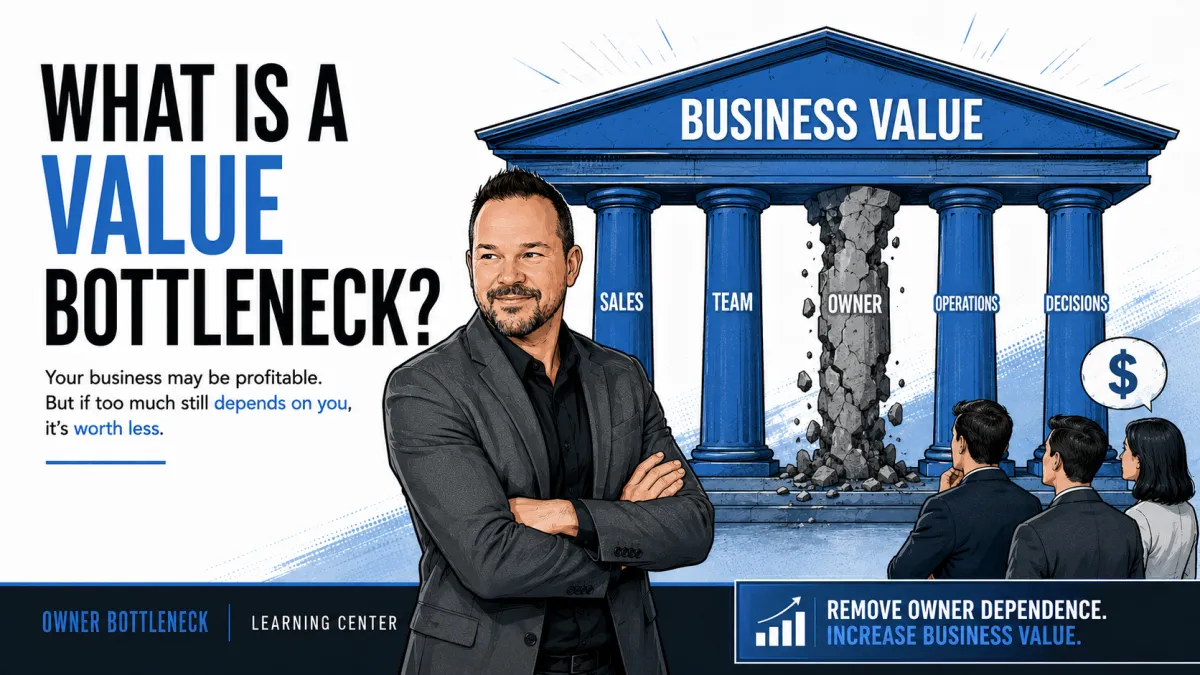
What Is a Value Bottleneck?
The business was profitable.
Revenue had grown every year.
Customers were loyal.
The team was experienced.
The owner had built a great reputation.
Then a buyer asked one question.
“What happens if you leave?”
The room became quiet.
The owner answered honestly.
“I don’t.”
The buyer smiled politely.
The offer got smaller.
Nothing had changed about the business.
The owner simply realized they weren’t selling a business.
They were selling a job that still depended on them.
That’s a Value Bottleneck.
Key Takeaways
A Value Bottleneck exists when a business is worth less because it depends too heavily on the owner.
Buyers don’t purchase historical success. They purchase future cash flow they believe will continue after the owner leaves.
Every Decision, Sales, Team, and Operations Bottleneck eventually becomes a Value Bottleneck.
Owner dependence increases risk, and risk lowers business value.
Removing owner dependence doesn’t just create more freedom. It creates a more valuable company.
The goal isn’t simply to prepare for selling. It’s to build a business that’s stronger because it doesn’t require one person to hold everything together.
What Is a Value Bottleneck?
A Value Bottleneck is a version of the Owner Bottleneck where the company’s value is reduced because too much of its future depends on the owner.
The company may be profitable.
It may be growing.
Customers may be happy.
The team may be talented.
The financial statements may look excellent.
Yet the business is still worth less than it could be.
Why?
Because buyers, investors, lenders, and even future leaders don’t only evaluate what the business earned yesterday.
They evaluate whether those results will continue tomorrow.
If tomorrow still depends on one person, the business becomes riskier.
Risk lowers value.
That’s the Value Bottleneck.
A Business Isn’t Worth What It Earned
Many owners believe business value comes from revenue.
Or profit.
Or growth.
Those matter.
But value comes from confidence.
Confidence that future profits will continue.
Imagine two companies.
Both generate $2 million in annual revenue.
Both earn the same profit.
Both have similar customers.
The difference?
Company A runs smoothly without the owner for months at a time.
Company B still needs the owner for:
Major sales
Customer issues
Pricing
Hiring
Daily decisions
Operations
Team accountability
On paper, the businesses appear similar.
To a buyer, they aren’t.
With Company A, the buyer is purchasing a business.
With Company B, the buyer is purchasing a dependency.
Every Owner Bottleneck Eventually Becomes a Value Bottleneck
The other bottlenecks aren’t isolated problems.
They’re symptoms of one larger issue.
A Decision Bottleneck tells buyers the company can’t make important decisions without the owner.
A Sales Bottleneck tells buyers revenue depends on the owner’s relationships and credibility.
A Team Bottleneck tells buyers leadership hasn’t developed beyond the owner.
An Operations Bottleneck tells buyers daily execution still requires owner involvement.
Each one increases risk.
Together, they reduce value.
What a Value Bottleneck Looks Like
Value Bottlenecks usually don’t announce themselves.
They hide inside successful businesses.
Buyers Ask About the Owner More Than the Business
Questions sound like:
How involved are you today?
What happens when you’re unavailable?
Who owns the customer relationships?
Who approves pricing?
Who makes major decisions?
Who manages the managers?
How long will it take before the business no longer depends on you?
Notice something.
Those aren’t financial questions.
They’re dependency questions.
The Owner Can’t Take an Extended Absence
The owner may take vacations.
But they still answer emails.
Return phone calls.
Approve decisions.
Solve customer problems.
Check dashboards.
Review proposals.
Monitor everything.
The business appears independent.
The owner is still quietly holding it together.
Customers Are Loyal to the Owner
Customers don’t simply trust the company.
They trust the owner.
When something important happens, they ask:
“Can I speak with the owner?”
That relationship creates value while the owner is present.
It creates uncertainty when the owner isn’t.
Key Employees Depend on the Owner
Managers lead departments.
Employees complete work.
Projects move.
Yet everyone still feels safer checking with the owner.
Leadership exists.
Authority hasn’t fully transferred.
Financial Performance Depends on Owner Effort
The owner works sixty hours.
Profit grows.
The owner works forty hours.
Growth slows.
The owner’s effort becomes part of the company’s financial model.
That isn’t leverage.
It’s dependence.
Growth Creates More Owner Involvement
Revenue increases.
The owner’s workload increases.
Larger business.
Larger bottleneck.
The owner becomes more valuable to the business.
The business becomes less valuable to everyone else.
Why Value Bottlenecks Form
Owners rarely create them intentionally.
They grow naturally.
The Owner Built the Company Personally
Every important relationship started with them.
Every customer trusted them.
Every major decision came through them.
That was necessary.
The business survived because the owner carried everything.
The company grew.
The owner never stopped carrying everything.
Success Hides the Problem
The business keeps growing.
Customers stay happy.
Cash flow improves.
The owner assumes the system is working.
The owner’s effort is quietly compensating for structural dependence.
Success delays the diagnosis.
The Owner Became the Company’s Insurance Policy
Employees know:
“If something goes wrong, the owner will fix it.”
Customers know:
“The owner will make it right.”
Managers know:
“The owner will decide.”
Suppliers know:
“The owner will approve.”
The owner becomes the safety net underneath the entire organization.
The Business Never Developed Transferable Systems
Not just documented processes.
Transferable capability.
Transferable leadership.
Transferable relationships.
Transferable judgment.
Transferable trust.
The owner remained the operating system.
What a Value Bottleneck Costs
Most owners think about selling only once.
The Value Bottleneck affects them every day.
Less Freedom
The owner can’t disappear.
They can’t unplug.
Everything eventually comes back.
Slower Growth
The owner becomes the limiting factor.
More business creates more owner dependence.
More Stress
The owner carries every important consequence.
Even when others perform the work.
Lower Business Value
The market discounts risk.
Owner dependence is risk.
The larger the dependence, the larger the discount.
Fewer Buyers
Some buyers walk away completely.
Others lower their offer.
Others require long earn-outs.
Others require the owner to stay for years.
The business becomes harder to transfer.
The Business May Be Profitable and Still Be Worth Less
This surprises many owners.
Profit and value aren’t identical.
A profitable business can still have:
Customer concentration
Owner dependence
Weak leadership
Poor systems
No succession
Fragile operations
Those reduce confidence.
Reduced confidence lowers value.
How to Measure a Value Bottleneck
Don’t begin with valuation multiples.
Begin with dependence.
Ask One Question
If you disappeared for ninety days, would the business continue producing similar results?
If the honest answer is no, find out why.
Measure Owner Involvement
Track every time the business needs you for thirty days.
Record:
Decisions
Sales
Customer issues
Hiring
Pricing
Operations
Financial approvals
Team accountability
Patterns appear quickly.
Ask Your Leadership Team
Ask:
“What decisions would stop if I weren’t here?”
Their answers are usually revealing.
Ask Your Customers
Who do they believe they’re doing business with?
The company?
Or you?
Ask a Buyer’s Question
Ask:
“If I bought this company tomorrow, what would I still need you for?”
Every answer identifies value still trapped inside the owner.
For a broader diagnosis, read How to Measure Owner Dependence in Your Business.
How to Remove a Value Bottleneck
You don’t fix value directly.
You reduce dependence.
Build Leadership
Develop people capable of carrying outcomes.
They shouldn’t only manage tasks.
They should be able to make decisions, solve problems, protect standards, and carry responsibility without everything returning to the owner.
Transfer Relationships
Introduce customers to the team.
Not only when problems happen.
Long before.
Customers need repeated positive experiences with people beyond the owner before trust can truly transfer.
Build a Repeatable Sales System
Sales shouldn’t rely on the owner’s personality, reputation, or relationships.
It should rely on a consistent process the company can execute without requiring the owner to rescue important opportunities.
Strengthen Operations
Work should move because the system works.
Not because the owner notices everything.
Handoffs, exceptions, priorities, standards, and accountability must be clear enough for the operation to keep moving without the owner serving as the hidden process.
Clarify Decisions
Every decision that doesn’t require ownership-level judgment should stop returning to the owner.
That requires clear authority, boundaries, information, standards, and accountability.
Build Visibility Instead of Control
Replace constant involvement with:
Dashboards
Scorecards
Review meetings
Leading indicators
Exception reports
Accountability rhythms
Visibility lets the owner monitor the business without becoming part of every workflow.
Think Like a Buyer
Regularly ask:
“If I were buying this company, what would worry me?”
Then remove that risk.
Example: Two Identical Companies
Company A earns $750,000 each year.
Company B earns $750,000 each year.
Company A:
Customers know multiple leaders.
Sales are repeatable.
Managers run departments.
Processes survive exceptions.
The owner takes month-long vacations.
Company B:
Customers call the owner.
Sales require the owner.
Managers wait for approval.
Operations stop without owner decisions.
Vacations become working remotely.
Both businesses produce identical profit.
One is worth significantly more.
Not because of today’s earnings.
Because of tomorrow’s confidence.
Selling Isn’t the Only Reason This Matters
Some owners say:
“I’m never selling.”
Maybe.
But value still matters.
A stronger business creates:
More freedom
Better leadership
Lower stress
Easier growth
Better financing
Stronger recruiting
Greater resilience
More choices
Building value isn’t only about preparing to exit.
It’s about building a healthier business.
What Should Stay With the Owner?
Some responsibilities always belong with ownership.
Examples include:
Long-term vision
Capital allocation
Ownership decisions
Major acquisitions
Strategic partnerships
Significant legal issues
Those don’t create a Value Bottleneck.
The bottleneck appears when ordinary business can’t function without extraordinary owner involvement.
Ask:
“Does this require the owner because it’s truly strategic, or because we’ve never built the capability anywhere else?”
Frequently Asked Questions About Value Bottlenecks
Does Every Owner-Led Business Have a Value Bottleneck?
Almost every owner-led business has some level of owner dependence.
The question isn’t whether it exists.
The question is how much value it’s reducing.
Can a Business Still Sell With a Value Bottleneck?
Yes.
The sale may simply involve:
Lower valuation
Longer transition
Earn-out requirements
Increased buyer concern
A smaller buyer pool
Is Business Value Only Important If I Want to Sell?
No.
Higher-value businesses usually create more freedom, better leadership, stronger systems, and healthier operations today.
How Can Reducing Owner Dependence Increase Business Value?
Reducing owner dependence can lower transition risk, make future earnings more transferable, and increase buyer confidence.
It isn’t the only driver of value, but it’s one of the most important in an owner-led business.
Does the Owner Need to Become Completely Unnecessary?
No.
The goal isn’t to make the owner irrelevant.
The goal is to make the owner’s involvement intentional.
The owner can remain the visionary, strategist, relationship builder, or capital allocator without being required inside ordinary daily operations.
Can Systems Alone Fix a Value Bottleneck?
No.
Systems help create consistency, but business value also depends on leadership, authority, customer trust, sales capability, judgment, accountability, and the team’s ability to carry outcomes.
The Goal Isn’t to Remove the Owner
The owner may always be the company’s biggest competitive advantage.
They may remain:
The visionary
The strategist
The rainmaker
The culture builder
That’s healthy.
The business simply shouldn’t collapse without them.
That’s the difference.
The owner remains valuable.
The owner stops being required everywhere.
That’s how businesses become stronger.
That’s how they become easier to grow.
That’s how they become easier to sell.
And ultimately, that’s how they become more valuable.
Find Where Your Business Is Losing Value
The free Owner Bottleneck Scorecard evaluates owner dependence across Decisions, Sales, Operations, Team, and Value.
It’ll help you identify where your business still depends too heavily on you, what that’s costing, and where to attack first.