
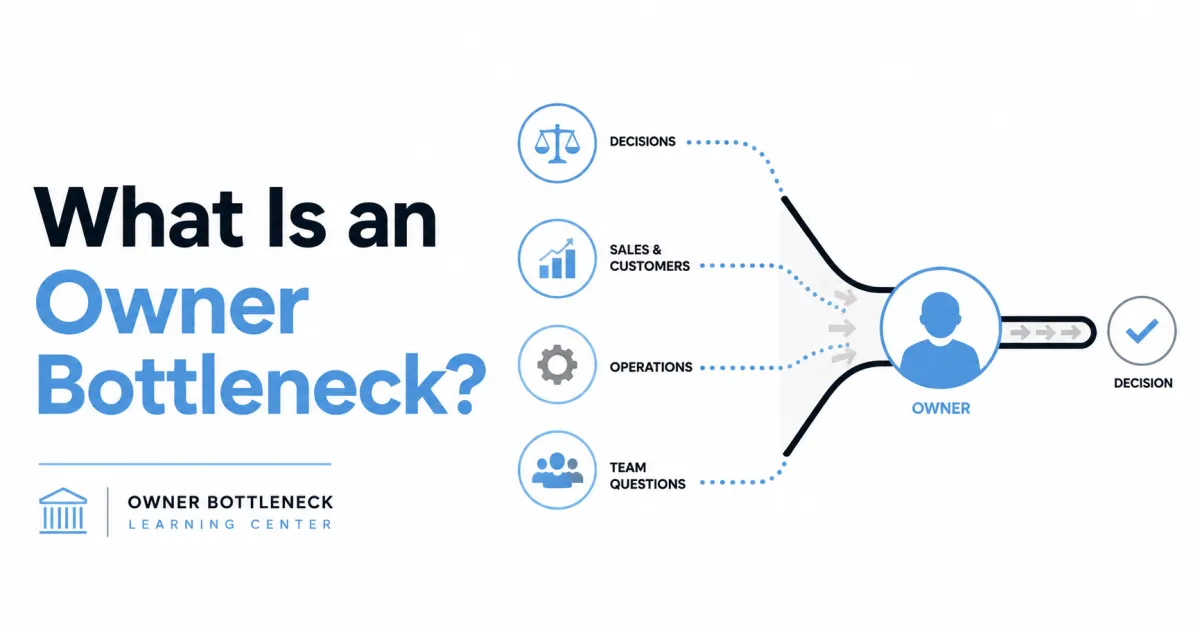
What Is an Owner Bottleneck?
Your business can be profitable, growing, and still be dangerously dependent on you.
Customers ask for you.
Employees wait for you.
Important decisions pile up in your inbox.
Sales slow down when you step away.
Problems sit unresolved until you get involved.
From the outside, the business may look successful.
From the inside, everything still runs through one person.
You.
An Owner Bottleneck exists when too much of a business depends on the owner’s decisions, judgment, knowledge, relationships, approval, or presence.
The business may have employees, managers, customers, and processes.
But it still can’t move any faster than the owner can think, decide, review, approve, sell, or fix.
Key Takeaways
An Owner Bottleneck exists when too much of the business depends on the owner’s decisions, judgment, knowledge, relationships, approval, or presence.
Owner dependence can slow growth, weaken the team, reduce freedom, increase risk, and limit business value.
The five common bottlenecks are Decision, Team, Operations, Sales, and Value.
Delegating tasks doesn’t solve the problem unless authority, judgment, and responsibility move too.
The first step is identifying where the business repeatedly waits for the owner.
What is an Owner Bottleneck?
An Owner Bottleneck exists when the owner becomes the point that too much of the business must pass through before progress can happen.
That dependence might include:
Decisions
Approvals
Customer relationships
Sales conversations
Quality control
Problem-solving
Operational knowledge
Financial judgment
Hiring decisions
Strategic direction
At first, this dependence can look like a strength.
You know the business better than anyone.
You care about the outcome more than anyone.
You know the customers.
You understand the history behind important decisions.
You can often solve the problem faster than the person bringing it to you.
So people keep bringing things to you.
And you keep solving them.
The business moves forward, but it moves forward by relying on you.
Eventually, your experience stops being only an advantage.
It also becomes the narrowest point in the business.
Everything important keeps flowing toward you, and the company can’t move faster than you can handle what reaches you.
That’s the Owner Bottleneck.
How does an owner become the bottleneck?
Most owners don’t intentionally build businesses that depend on them.
It happens gradually.
When the company is small, the owner does nearly everything.
You sell.
You serve customers.
You solve problems.
You manage cash.
You hire people.
You make decisions.
You protect quality.
That’s normal in the beginning.
The problem starts when the business grows, but the way responsibility and decision-making flow through the company doesn’t grow with it.
You hire employees, but you remain the final answer.
You add managers, but important decisions still come back to you.
You create processes, but every exception still requires your judgment.
You delegate tasks, but you continue owning the decisions, the outcome, and the risk.
The team gets bigger.
The number of questions gets bigger.
The number of decisions gets bigger.
But everything still flows through the same person.
Every time you jump in and provide the answer, you create a shortcut.
That shortcut may solve today’s problem.
It may also teach the team what to do the next time something feels important, unfamiliar, or uncomfortable:
Take it to the owner.
Over time, owner dependence becomes part of the company’s operating system.
What are the signs of an Owner Bottleneck?
An Owner Bottleneck doesn’t always look like chaos.
Sometimes the business appears successful.
Revenue may be growing.
The team may be busy.
Customers may be happy.
The owner may even be making good money.
The dependence hides beneath that success.
Here are some of the clearest signs.
Decisions keep coming back to you
Your team handles routine matters, but anything unusual, expensive, sensitive, or important gets pushed to you.
You become the final approver, even when someone else supposedly owns the responsibility.
Projects pause while people wait for your response.
Meetings end with a list of things only you can decide.
Your inbox becomes the waiting room for the company.
Employees wait instead of acting
People ask questions they may already know how to answer.
They hesitate whenever a situation falls outside the normal process.
They avoid making judgment calls because getting your approval feels safer than risking a mistake.
The team may look indecisive.
But they may simply be responding to what the business has taught them.
Customers ask for you
Customers may like your employees, but they still want the owner when something important happens.
They ask for you during major sales conversations.
They want you involved when there’s a problem.
They trust the company, but much of that trust is still attached personally to you.
Your reputation becomes the insurance policy behind the entire business.
Sales depend on your involvement
You may generate the strongest opportunities, close the largest accounts, or rescue deals when the sales process stalls.
Prospects trust your experience.
The sales team may be able to explain what you sell, but you’re still the person who creates the confidence required to buy.
When you step away, the pipeline weakens or important deals slow down.
Problems follow you everywhere
The business follows you home.
It follows you on vacation.
It follows you into evenings, weekends, and family time.
You keep checking messages because you’re not confident that important situations will be handled properly without you.
Even when you aren’t physically working, part of your attention remains trapped inside the business.
Important knowledge lives in your head
Your team may know the standard process.
They may not understand the judgment behind it.
They know what to do when everything goes normally.
They need you when it doesn’t.
The real operating system isn’t fully documented or shared across the company.
It lives inside your experience.
Stepping away creates anxiety
A day away creates a backlog.
A week away creates problems.
A month away feels impossible.
The business may employ several people, but it still operates around your availability.
Is being needed always a problem?
No.
Being involved in your business isn’t automatically bad.
Owners should provide direction.
They should protect important standards.
They should make certain high-level decisions.
They should maintain critical relationships.
They should bring experience, judgment, and leadership to the company.
The goal isn’t to remove the owner from the business.
The goal is to stop the business from depending on the owner for work, answers, and decisions that other people should be able to handle.
There’s a major difference between being valuable and being required.
A valuable owner helps the business make better decisions.
A required owner must be involved before decisions can happen.
A valuable owner contributes strategically.
A required owner gets pulled into daily execution.
A valuable owner strengthens the people and systems around them.
A required owner becomes the system.
The problem isn’t that the business benefits from your involvement.
The problem is that the business can’t function properly without it.
What does owner dependence cost?
Owner dependence creates more than stress.
It affects the speed, strength, stability, freedom, and value of the company.
It slows growth
When decisions, approvals, sales, and problem-solving all run through one person, the business can only grow as fast as that person can keep up.
Hiring more people doesn’t automatically solve the problem.
Sometimes it creates more questions, meetings, approvals, and decisions for the owner.
The company adds capacity around the bottleneck without widening the bottleneck itself.
It weakens the team
Employees don’t develop judgment when the owner always supplies the answer.
Managers don’t become leaders when the owner continues making their decisions.
People may become highly capable at completing assigned work while remaining weak at taking ownership.
They learn how to execute.
They don’t learn how to think, decide, and carry responsibility without the owner.
It creates inconsistency
When the owner is involved, the work gets done one way.
When the owner isn’t involved, quality, speed, or communication may change.
That inconsistency makes it difficult to grow without adding even more oversight from the owner.
It limits the owner’s freedom
The owner may technically control their schedule.
In reality, the business controls their attention.
Time away doesn’t feel like time away.
Growth creates more responsibility instead of more freedom.
The business becomes something the owner has built, but can never fully leave.
It increases risk
When too much depends on one person, that person becomes a single point of failure.
If the owner gets sick, burns out, takes an extended absence, or simply becomes unavailable, the business may struggle immediately.
The stronger the dependence, the more fragile the company becomes.
It weakens business value
A buyer isn’t only buying revenue and profit.
They’re buying the reasonable expectation that the business can continue producing results after the current owner leaves.
If customers, employees, sales, operations, and decisions all depend on the owner, the company becomes harder to transfer.
A business can create excellent income for its owner while still being difficult to sell.
Income and transferable business value aren’t the same thing.
What are the five types of Owner Bottlenecks?
Owner dependence usually appears in five major areas.
A business may show signs of all five, but one is often creating the biggest constraint right now.
1. Decision Bottleneck
A Decision Bottleneck exists when too many decisions require the owner’s approval or judgment.
The team may know how to perform the work, but they don’t feel authorized, prepared, or trusted to make important decisions without the owner.
Common symptoms include:
Projects waiting for approval
Employees constantly asking questions
Managers escalating routine issues
Decisions being delayed while the owner is unavailable
The owner being copied on nearly everything
People avoiding decisions that carry risk
The issue isn’t always a lack of delegation.
It may be a lack of clear authority, decision rules, shared standards, or confidence.
2. Team Bottleneck
A Team Bottleneck exists when people can’t consistently take ownership without the owner stepping in.
The owner may believe the team needs more accountability.
The team may believe the owner won’t truly let go.
Both can be true.
Common symptoms include:
Employees waiting to be told what to do
Managers avoiding difficult conversations
Problems being escalated too quickly
The owner correcting work instead of coaching people
Delegated responsibilities returning to the owner
People focusing on completing tasks instead of owning outcomes
The team may not simply need more motivation.
They may need clearer outcomes, authority, expectations, support, and consequences.
3. Operations Bottleneck
An Operations Bottleneck exists when daily execution depends too heavily on the owner’s knowledge, intervention, or problem-solving.
The work may get done, but only because the owner keeps filling the gaps.
Common symptoms include:
Workflows breaking when something unusual happens
Handoffs failing between departments
Processes existing but not being followed
The owner constantly handling exceptions
Quality dropping when the owner isn’t involved
Recurring problems that never seem permanently solved
The company may have procedures.
It may still lack an operating system that helps people think and act without the owner.
4. Sales Bottleneck
A Sales Bottleneck exists when revenue depends too heavily on the owner’s relationships, reputation, expertise, or closing ability.
The sales team may generate activity, but the owner still creates the trust required to win the most important business.
Common symptoms include:
Prospects asking to speak with the owner
The owner joining late-stage sales conversations
Sales slowing when the owner is unavailable
Major accounts being tied personally to the owner
Salespeople struggling to explain the company’s value
The owner rescuing deals that should have been handled by the team
The problem isn’t that the owner is good at sales.
The problem is that the business hasn’t transferred enough of the owner’s trust, knowledge, and process to other people.
5. Value Bottleneck
A Value Bottleneck exists when owner dependence limits the company’s long-term value and transferability.
This is often the accumulated result of the other four bottlenecks.
Common symptoms include:
Revenue tied to the owner’s relationships
Important decisions controlled by the owner
Critical knowledge living in the owner’s head
Weak leadership depth below the owner
Inconsistent results when the owner steps away
Uncertainty about what happens when the owner leaves
The business may support the owner’s lifestyle today.
That doesn’t automatically mean someone else would be willing to buy it tomorrow.
Is the owner always the problem?
No.
The owner isn’t always the problem.
But the owner is often part of the pattern.
That’s an important distinction.
Your employees may need more training.
Your managers may need to step up.
Your roles may be unclear.
Your processes may be weak.
Your sales approach may be inconsistent.
You may have hired the wrong people.
Those can all be real problems.
But owners sometimes unintentionally reinforce the same dependence they say they want to eliminate.
They answer questions too quickly.
They step in before the team has time to think.
They correct work instead of teaching the standard behind it.
They take responsibilities back when someone struggles.
They tell people to take ownership, then override their decisions.
They say they want independence, but reward escalation.
The team eventually learns that waiting is safer than deciding.
You may be training people to wait for you.
That doesn’t mean you’re a bad leader.
It means the current system has taught everyone that the owner is the safest answer.
Until that pattern changes, adding more employees may only create more traffic around the same bottleneck.
Why doesn’t delegation always solve the Owner Bottleneck?
Delegation often moves the work without moving the dependence.
The owner assigns a task.
The employee completes the task.
But the owner still defines the answer, checks the work, approves the result, and handles anything unusual.
The task moved.
The responsibility didn’t.
Delegation moves a task. Ownership moves the outcome, the authority, and the responsibility for getting it right.
True ownership requires more than handing someone something to do.
The person also needs:
A clear outcome
Defined authority
Decision boundaries
Access to the right information
Standards for good judgment
Support while developing capability
Accountability for the result
Without those things, delegation becomes another form of task management.
The owner remains in the middle, reviewing and approving everything that matters.
How do you identify your biggest Owner Bottleneck?
Don’t begin by trying to fix the entire company.
That usually creates more projects, more meetings, and more work for the owner.
Start by looking for the queue.
Ask yourself:
What repeatedly waits for me?
What slows down when I’m unavailable?
What important problems always return to me?
Where does the team lack confidence or authority?
Which customers or sales opportunities depend on me personally?
What do I keep taking back after trying to delegate it?
What part of the business would struggle most if I disappeared for 30 days?
You’re not looking for everything that could be improved.
You’re looking for the point where owner dependence is creating the greatest constraint.
That’s the bottleneck to attack first.
What should an owner do first?
Once you identify a likely bottleneck, resist the temptation to solve it by working harder.
Instead, slow down and understand why the dependence exists.
Is the responsibility unclear?
Does the person lack authority?
Does important information live only in your head?
Are the standards undefined?
Has the team been punished for mistakes but never taught how to make better decisions?
Are you delegating tasks while keeping every meaningful decision?
Do you keep stepping in before someone else has a real chance to succeed?
The answer determines what should change.
The solution may involve:
Clarifying who owns the outcome
Defining decision authority
Creating a simple process or checklist
Teaching the judgment behind the work
Transferring a customer relationship
Coaching a manager through a difficult responsibility
Allowing someone to make a decision without rescuing them
Measuring whether fewer issues return to the owner
Not every process needs to be documented.
Not every decision should be delegated.
Not every responsibility should leave the owner’s hands.
The goal is to stop depending on the owner for things that can be transferred safely and responsibly.
The real goal isn’t to become unnecessary
Some owners hear this and assume the goal is to build a business that no longer needs them.
That’s not quite right.
The goal is to build a business that no longer needs you in the same way.
Instead of being the answer machine, you develop stronger decision-makers.
Instead of solving every problem, you improve the system that keeps producing the problem.
Instead of being the only person who can create trust, you build a company that customers can trust beyond you.
Instead of protecting quality through constant involvement, you create standards other people can understand and uphold.
Your role becomes more valuable and less required.
You stop being the person everything must pass through.
You become the person building a company capable of moving without waiting for you.
That isn’t losing control.
It’s building a stronger business.
Frequently asked questions about Owner Bottlenecks
Can a profitable business still have an Owner Bottleneck?
Yes.
Profitability doesn’t prove that a business can operate independently of its owner.
A company can generate strong revenue and profit while still relying heavily on the owner’s relationships, decisions, knowledge, and daily involvement.
In some cases, the owner’s effort is one of the main reasons the business remains profitable.
Is an Owner Bottleneck the same as micromanagement?
Not necessarily.
Micromanagement can create owner dependence, but an Owner Bottleneck can exist even when the owner doesn’t consider themselves controlling.
Customers may insist on dealing with the owner.
The team may lack training.
Processes may be unclear.
Important knowledge may never have been transferred.
The question isn’t simply whether the owner micromanages.
The question is whether the business can consistently move forward without the owner’s direct involvement.
Will hiring more people fix an Owner Bottleneck?
Not by itself.
Hiring can add capacity, but it can also add more questions, communication, decisions, and management demands.
If every new person still depends on the owner, the company may grow larger without becoming less owner-dependent.
How do I know which Owner Bottleneck to address first?
Start with the area where dependence is creating the greatest current constraint.
Look for work that repeatedly waits, decisions that keep returning, revenue that depends on you, and problems that become worse when you step away.
You don’t need to solve every form of owner dependence at once.
You need to attack the bottleneck that’s limiting the business most right now.
Are you the Owner Bottleneck?
You probably won’t eliminate owner dependence overnight.
And you shouldn’t try.
The first step is understanding where the company still depends on you most.
Once you can see that dependence clearly, you can decide:
What should remain with you
What can be transferred
What capability the team needs
What system needs to be built
What bottleneck should be attacked first
Find it.
Attack it.
Level up.
Repeat.
Take the Owner Bottleneck Scorecard
Not sure where owner dependence is showing up in your business?
The free Owner Bottleneck Scorecard evaluates your Decision, Sales, Operations, Team, and Value Bottlenecks so you can see where the business may still depend too heavily on you.