
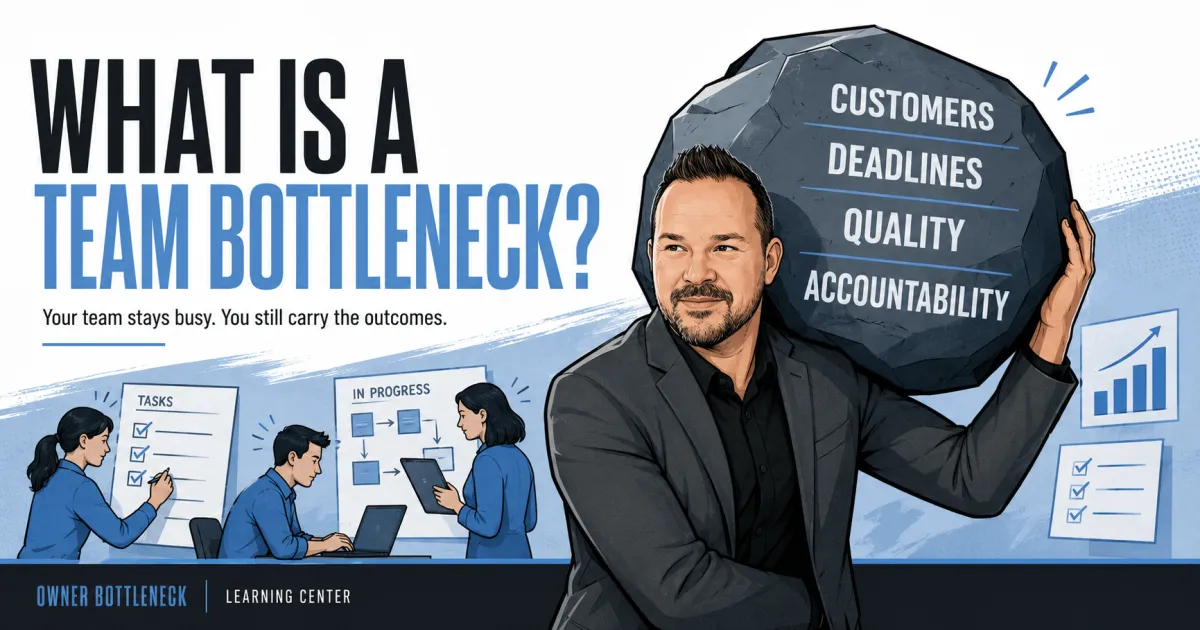
What Is a Team Bottleneck?
The owner walked into the Monday meeting expecting updates.
Instead, they got a list of problems.
One employee was waiting for direction.
A manager needed help with a difficult conversation.
A customer issue had been sitting since Friday.
A project was behind, but no one had changed the plan.
Everyone had been busy.
Everyone had completed work.
But no one had carried the outcome.
By the end of the meeting, the owner had six new responsibilities.
The team left with six new assignments.
That may look like delegation.
It isn’t ownership.
It’s a Team Bottleneck.
Key Takeaways
A Team Bottleneck exists when employees perform work, but the owner still carries the outcome, judgment, accountability, and difficult decisions.
A busy team isn’t automatically an independent team.
Managers can have titles and responsibilities without truly owning results.
Owners often strengthen the bottleneck by answering too quickly, rescuing struggling employees, or taking responsibilities back.
True ownership requires clear outcomes, authority, standards, information, accountability, and room to develop judgment.
The goal isn’t to remove the owner from leadership. It’s to build a team that can carry meaningful responsibility without everything returning to the owner.
What is a Team Bottleneck?
A Team Bottleneck is a version of the Owner Bottleneck where the business has employees, but too much responsibility still flows back to the owner.
The team may complete tasks.
They may serve customers.
They may manage schedules.
They may prepare proposals.
They may supervise employees.
They may run meetings.
But when the outcome becomes uncertain, uncomfortable, risky, or difficult, the owner steps back into the middle.
The owner becomes responsible for:
Making the final call
Resolving the conflict
Protecting the customer relationship
Correcting the missed standard
Following up on the overdue work
Holding the employee accountable
Rebuilding the plan
Making sure the result actually happens
The team performs activity.
The owner carries the weight.
That’s the difference between having employees and having ownership inside the team.
A busy team can still be owner-dependent
Owners often judge team strength by activity.
Everyone is working.
Calendars are full.
Emails are moving.
Customers are being served.
Projects are active.
Meetings are happening.
That can create the appearance of a functioning organization.
But activity doesn’t tell you who carries the outcome.
Ask:
Who notices when the result is slipping?
Who changes the plan?
Who follows up when something is late?
Who addresses weak performance?
Who handles the uncomfortable customer conversation?
Who protects the standard when pressure rises?
Who makes sure the issue doesn’t happen again?
Who feels responsible when the outcome isn’t produced?
If the answer keeps returning to the owner, the business has people doing work without enough people owning results.
Task completion isn’t ownership
A task is something someone does.
An outcome is something someone is responsible for producing.
Those are different.
A team member may complete every assigned task and still fail to own the outcome.
For example:
Call the customer.
That’s a task.
Resolve the customer’s concern, protect the relationship, and identify what caused the problem.
That’s an outcome.
Another example:
Update the project schedule.
That’s a task.
Keep the project on time, communicate risks early, and adjust resources when the plan begins slipping.
That’s an outcome.
When people receive tasks without ownership, they can complete exactly what they were asked to do while the owner remains responsible for whether it worked.
That’s why delegating work doesn’t automatically solve owner dependence.
The activity moved.
The responsibility didn’t.
What a Team Bottleneck looks like
Team Bottlenecks often hide behind normal management activity.
Managers report problems without owning the next move
A manager tells the owner:
We’re behind on the project.
The owner asks:
What are you changing?
The manager responds:
I wanted to see what you thought.
The manager identified the issue.
The owner still owns the response.
Strong managers don’t merely deliver information upward.
They bring judgment, recommendations, and ownership of what happens next.
The owner handles every difficult conversation
The manager oversees the employee.
The owner addresses the performance problem.
The manager manages the account.
The owner handles the upset customer.
The manager runs the department.
The owner resolves the conflict.
The manager may control the normal work.
The owner still carries every uncomfortable moment.
That creates a leadership structure where managers manage only while things are going well.
Work returns when it becomes messy
A responsibility is assigned.
The employee handles it until something unusual happens.
Then the responsibility comes back.
The customer pushes back.
The process doesn’t fit.
The employee makes a mistake.
Two priorities conflict.
Someone becomes upset.
The deadline slips.
The owner steps in because stepping in feels faster, safer, and easier.
Over time, the team learns:
I own this until it becomes difficult.
The owner becomes the company’s permanent rescue plan.
Employees wait for the owner to notice
The team may see that a result is slipping.
But they wait.
They assume the owner will catch it.
They expect the owner to ask.
They know the owner monitors everything closely.
The business begins depending on the owner’s attention.
Nothing has officially been assigned to the owner.
Practically, the owner remains the person making sure nothing gets dropped.
Accountability flows upward
When something goes wrong, the owner asks:
Why didn’t anyone tell me?
The team asks:
Why didn’t the owner step in sooner?
Both sides believe the other should have prevented the problem.
That means accountability was never clear.
When no one below the owner truly owns the outcome, responsibility naturally flows upward.
Managers need the owner to enforce their authority
A manager gives direction.
An employee resists.
The manager goes to the owner.
The owner reinforces the instruction.
The employee learns that the manager’s authority becomes real only when the owner supports it.
The manager’s title may say leader.
The organization still treats the owner as the real authority.
The owner’s absence changes behavior
When the owner is present, people move faster.
Standards are clearer.
Problems get surfaced.
Decisions get made.
When the owner leaves, people become more cautious.
Issues wait.
Standards soften.
Projects lose urgency.
A healthy team shouldn’t need the owner’s presence to create momentum.
The owner knows more about every responsibility than the person assigned to it
The owner remembers the deadlines.
The owner follows the customer history.
The owner knows which employee is struggling.
The owner notices the quality issue.
The owner understands what has to happen next.
The person assigned to the responsibility may be completing the work.
The owner still holds the complete picture.
That makes the owner the invisible manager behind every role.
The team usually isn’t the entire problem
Owners often say:
My team needs to step up.
Sometimes they do.
Some employees avoid responsibility.
Some managers aren’t capable of leading at the level the business requires.
Some people want the title without the accountability.
That happens.
But before blaming the team, examine the system around them.
Ask:
Is the outcome clear?
Is authority real?
Are decision boundaries defined?
Does the person have the information required?
Are standards explained?
Is accountability consistent?
Does the owner reverse reasonable decisions?
Does the owner take responsibilities back when results become uncomfortable?
Has the person been coached on judgment?
Does the organization reward initiative or punish imperfect decisions?
People adapt to the environment.
If waiting is safer than acting, people wait.
If the owner always rescues, people escalate.
If authority disappears when the owner disagrees, people seek approval.
The team’s behavior may be part of the problem.
The owner’s behavior may also be training it.
How a Team Bottleneck differs from a Decision Bottleneck
The two often appear together, but they aren’t identical.
A Decision Bottleneck exists when too many decisions and approvals must reach the owner.
A Team Bottleneck is broader.
It may include:
Weak ownership
Unclear roles
Avoided accountability
Missing leadership depth
Poor follow-through
Responsibilities returning to the owner
Managers who coordinate work but don’t own results
Employees who wait for the owner to create urgency
The owner remaining the safety net behind every role
A Decision Bottleneck asks:
Who can make the call?
A Team Bottleneck asks:
Who carries the result?
You can transfer decision authority and still have a Team Bottleneck if no one feels accountable for the outcome.
You can also have committed employees who care deeply but can’t move because decisions still require the owner.
The problems overlap.
They still need to be diagnosed separately.
Why Team Bottlenecks form
Team Bottlenecks are rarely created by one bad hire or one weak manager.
They usually develop over time.
The owner built the business by carrying everything
Early in the company, the owner had to notice everything.
They sold.
They served customers.
They handled problems.
They protected cash.
They corrected mistakes.
They followed up.
They made sure the result happened.
That behavior helped the company survive.
But as the business grows, the owner’s habit of carrying everything can remain.
The company adds people.
The owner keeps the weight.
Responsibilities were added without redesigning ownership
An employee is hired to help with operations.
A salesperson is hired to help with revenue.
A manager is promoted to oversee the team.
But no one clearly defines:
What outcome they own
What authority they have
How success will be measured
What decisions belong to them
What the owner will stop doing
What happens when the result falls short
The new role absorbs tasks.
It doesn’t absorb enough responsibility.
The owner confuses control with accountability
The owner wants people to be accountable.
But the owner continues reviewing every detail, making every correction, and deciding every exception.
That isn’t accountability.
It’s control.
Accountability means the person owns the outcome and must explain the result.
Control means the owner remains responsible for preventing every mistake.
You can’t fully transfer ownership while continuing to control every step.
Expectations exist only in the owner’s head
The owner knows what good looks like.
They notice when the tone is wrong.
They see when a customer response is incomplete.
They recognize when a project plan is unrealistic.
They understand what details matter.
But the standard hasn’t been made clear to the team.
The employee receives feedback after missing an expectation they didn’t fully understand.
The owner sees poor performance.
The employee sees moving targets.
A Team Bottleneck grows when the owner remains the only person who can recognize the standard.
The owner rescues too quickly
Someone struggles.
The owner steps in.
The customer gets an answer.
The deadline gets saved.
The project gets corrected.
The immediate problem disappears.
So does the opportunity for the person to develop.
The employee learns that the owner will intervene when the stakes rise.
The owner learns that stepping in gets results faster.
Both become more dependent on the pattern.
Mistakes are treated as proof that ownership can’t transfer
A manager makes a poor decision.
The owner takes the responsibility back.
An employee mishandles a customer issue.
The owner decides only they can protect the relationship.
A project runs behind.
The owner resumes controlling the schedule.
One mistake becomes evidence that the owner must remain involved forever.
Some mistakes reveal a capability problem.
Others reveal unclear boundaries, missing information, weak coaching, or normal development.
Treating every mistake as proof that ownership failed guarantees that ownership never grows.
Managers were promoted for technical skill
The best technician becomes the operations manager.
The strongest salesperson becomes the sales leader.
The most reliable employee becomes the team supervisor.
They may be excellent at the work.
Leadership requires different skills.
Managers must learn to:
Set expectations
Make decisions
Address performance
Coach employees
Resolve conflict
Prioritize
Communicate clearly
Hold people accountable
Carry outcomes through uncertainty
A promotion changes the title.
It doesn’t automatically build those capabilities.
Accountability is inconsistent
The owner follows up aggressively on some issues and ignores others.
Deadlines matter when the owner asks about them.
Standards tighten when a customer complains.
Poor performance gets tolerated until the owner becomes frustrated.
The team doesn’t know what will truly be enforced.
Consistent ownership requires consistent accountability.
What a Team Bottleneck costs
The cost isn’t limited to the owner’s workload.
It keeps the owner trapped in management
The owner may want to focus on strategy, growth, capital, partnerships, or long-term value.
Instead, they spend their time:
Following up
Correcting
Reminding
Checking
Resolving conflict
Rebuilding plans
Managing managers
Handling issues other people were assigned to own
The owner becomes the manager behind every manager.
It weakens leadership depth
Leaders develop by carrying real outcomes.
They make decisions.
They handle resistance.
They experience consequences.
They review what happened.
They improve their judgment.
When the owner keeps the hard parts, managers can’t develop the experience required to replace the owner’s involvement.
The owner then concludes that no one is ready.
The system may be preventing anyone from becoming ready.
It makes growth more expensive
More revenue creates more work.
More work creates more employees.
More employees create more coordination.
More coordination creates more management.
If responsibility continues flowing to the owner, every new layer makes the business heavier.
The company grows.
The owner’s burden grows with it.
That isn’t leverage.
It’s swelling.
It creates learned helplessness
People stop trying to solve the complete problem.
They learn to bring the issue to the owner.
The owner becomes faster at solving.
The team becomes faster at escalating.
No one intends to create dependence.
The pattern still becomes stronger.
It frustrates strong employees
Capable people usually want room to contribute.
They want authority that matches responsibility.
They want to know what they own.
They want their judgment to matter.
If every meaningful decision gets reversed, every difficult issue goes to the owner, and every result depends on approval, strong employees may stop trying.
Some leave.
Others stay and become less engaged.
It hides weak performance
The owner’s involvement can cover performance gaps.
Customers remain happy because the owner steps in.
Projects get completed because the owner rescues them.
Problems disappear because the owner works late.
The business appears stronger than the team actually is.
The owner’s effort becomes a subsidy for weak accountability.
It increases risk
If one person is the final safety net behind every role, the company becomes vulnerable when that person is unavailable.
The team may know the tasks.
They may not know how to carry the outcome when conditions change.
It weakens business value
A buyer will want to know:
Who runs the team?
Who handles customer problems?
Who holds employees accountable?
Who keeps projects moving?
Who protects standards?
Who carries the company when the owner leaves?
If the answer keeps returning to the owner, the business may have a Value Bottleneck.
A buyer isn’t only purchasing revenue.
They’re purchasing the organization’s ability to keep producing it.
How to measure a Team Bottleneck
Don’t measure team strength by headcount.
Measure what the team can carry without the owner.
Track what returns to you
For 30 days, record responsibilities that come back after they were assigned elsewhere.
Include:
What returned
Who owned it
Why it returned
What made the person believe you were needed
Whether the issue had happened before
Whether you coached or took over
What would need to change before the responsibility could stay with them
Patterns will appear.
Track owner rescues
Write down every time you step in to save an outcome.
Ask:
Was the intervention necessary?
Was there a safety, legal, financial, or customer risk?
Could the person have solved it with coaching?
Did I make the situation faster today but strengthen dependence tomorrow?
What capability or boundary was missing?
Rescues feel productive.
Repeated rescues are evidence.
Measure how managers use meetings
Look at your management meetings.
Do managers bring:
Updates
Problems
Questions
Requests for approval
Or do they bring:
Results
Recommendations
Decisions
Risks
Corrective actions
Lessons
Managers who only report what happened may not truly own what happens next.
Use the owner absence test
Imagine you were unavailable for 30 days.
Ask:
Who would carry each department?
Who would handle conflict?
Who would protect quality?
Who would manage an upset customer?
Who would address weak performance?
Who would change a plan that stopped working?
Who would know whether the result was acceptable?
What would wait for your return?
For a broader diagnosis, read How to Measure Owner Dependence in Your Business.
Measure outcomes, not completed tasks
Instead of asking:
Did they complete the assignment?
Ask:
Did they produce the result?
A manager can complete every meeting, report, and checklist while the department continues missing its targets.
Task completion can hide weak ownership.
How to remove a Team Bottleneck
You don’t fix a Team Bottleneck by giving a motivational speech about accountability.
You build a system where ownership is clear and real.
Define the outcome
Start by naming the result the person owns.
Not the activities.
Not the job title.
The result.
For example:
You own keeping customer projects on schedule, communicating risks early, and correcting delays before they threaten the customer commitment.
That’s stronger than:
You manage the project schedule.
Another example:
You own resolving valid customer concerns quickly, protecting trust, and identifying recurring causes we need to fix.
That’s stronger than:
You handle complaints.
A clear outcome gives the person something to carry.
Assign one clear owner
Multiple people may contribute.
One person should know they’re accountable for the result.
Shared responsibility often becomes unowned responsibility.
When everyone owns it, no one feels the complete weight.
Define authority
Responsibility without authority creates frustration.
The person needs to know:
What they can decide
What money they can approve
What changes they can make
What conversations they’re expected to handle
What tradeoffs they can accept
What requires escalation
Real ownership requires enough authority to produce the outcome.
Define boundaries
Authority doesn’t mean unlimited freedom.
Set limits.
Examples:
Financial approval limits
Customer remedy limits
Hiring or disciplinary authority
Pricing ranges
Risk thresholds
Situations requiring consultation
Legal, safety, or financial issues requiring escalation
Clear boundaries create speed without removing control.
Transfer the standard
Explain what good looks like.
Don’t assume it’s obvious.
Show:
Examples of strong work
Examples of unacceptable work
The principles behind the standard
What details matter
What tradeoffs are acceptable
What the business is protecting
What warning signs require attention
The goal isn’t to make the person copy the owner’s style.
It’s to help them protect the same important outcomes.
Transfer the information
People can’t own outcomes without access to the information required to manage them.
They may need:
Financial data
Customer history
Capacity information
Performance metrics
Pricing guidelines
Prior decisions
Company priorities
Project risks
Quality expectations
Withholding information while demanding ownership forces people to guess.
Require recommendations
When someone brings a problem, ask:
What do you recommend?
What options did you consider?
What information are you using?
What risk concerns you most?
What would you do if I weren’t available?
What happens next after this decision?
The owner may still coach.
But the employee must participate in the thinking.
Coach the judgment
Don’t only correct the decision.
Explain the reasoning.
Discuss:
What mattered
What was missed
What risk should have been considered
What principle applies
What information would have changed the decision
What should happen next time
That’s how judgment moves out of the owner’s head.
Review results on a predictable rhythm
Accountability shouldn’t appear only after something goes wrong.
Create a regular review rhythm.
Discuss:
Outcomes
Measurements
Decisions made
Problems encountered
Corrective actions
Lessons
Support needed
Commitments before the next review
Predictable accountability reduces the need for constant checking.
Let the owner see without controlling
The owner may need visibility during the transfer.
That doesn’t mean every decision requires approval.
Use:
Scorecards
Dashboards
Weekly reviews
Exception reports
Defined escalation triggers
Post-decision reviews
Visibility can remain while operational control moves.
Allow reasonable mistakes
People need room to develop.
A reasonable mistake made inside a clear boundary should lead to coaching and learning.
Carelessness, dishonesty, repeated avoidance, or ignored expectations require stronger accountability.
Don’t confuse development with lack of standards.
Don’t confuse an imperfect result with proof that only the owner can carry responsibility.
Stop rescuing by default
Before stepping in, ask:
Is there an immediate risk that requires me?
Can I coach without taking over?
Who owns the outcome?
What will they learn if I solve this for them?
What pattern will I reinforce?
Sometimes the owner must intervene.
The intervention should be intentional, not automatic.
Build leadership depth before you need it
Don’t wait until the owner is exhausted or planning to leave.
Develop managers while the business is stable enough to absorb learning.
Give them gradually larger outcomes.
Expand authority as judgment improves.
Let them lead meetings.
Let them handle difficult conversations.
Let them explain results.
Let them experience the consequences of their decisions.
Leadership depth is built before the emergency.
Example: the manager who owns the schedule
Imagine an operations manager is responsible for project scheduling.
Every Friday, the owner asks:
Are we on track next week?
The manager provides the schedule.
The owner notices conflicts, questions unrealistic commitments, moves resources, and calls customers.
The manager built the schedule.
The owner carried the outcome.
To transfer ownership, clarify:
Outcome
Maintain a realistic schedule that protects customer commitments, capacity, quality, and employee workload.
Authority
The manager can adjust assignments, move internal deadlines, coordinate resources, and communicate schedule changes within defined boundaries.
Information
The manager has access to capacity, project status, customer commitments, staffing, and known risks.
Standards
Don’t promise work without confirmed capacity. Surface conflicts early. Protect quality rather than hiding delay.
Accountability
The manager reports schedule health, risks, changes, and corrective actions each week.
Now the owner reviews the system.
The manager owns the schedule.
Example: the manager who owns employee performance
Suppose a supervisor is responsible for a team but avoids difficult conversations.
Performance problems reach the owner.
The owner addresses the employee.
The supervisor returns to managing daily work.
The supervisor has responsibility without full leadership ownership.
To transfer it:
Outcome
Maintain a team that consistently meets performance, quality, conduct, and attendance expectations.
Authority
The supervisor can coach, document, correct, and escalate performance issues according to clear policies.
Standards
Problems are addressed early, expectations are specific, and commitments are documented.
Support
The owner or senior leader coaches the supervisor before difficult conversations rather than automatically taking them over.
Accountability
The supervisor reports performance patterns, actions taken, and unresolved risks.
The owner remains available.
The owner isn’t the automatic disciplinarian behind every manager.
What should stay with the owner?
Some responsibilities may properly remain with the owner.
Examples include:
Strategic direction
Ownership and equity
Material financial commitments
Senior leadership decisions
Major legal risks
Decisions that could threaten the future of the business
Relationships the owner intentionally chooses to retain
The goal isn’t to eliminate the owner.
The goal is to make the owner’s involvement intentional.
Ask:
Does this truly require ownership-level judgment, or does it still come to me because we haven’t built ownership anywhere else?
That’s the test.
Frequently asked questions about Team Bottlenecks
Does a Team Bottleneck mean I have the wrong employees?
Not automatically.
You may have a hiring problem.
You may also have unclear outcomes, weak authority, inconsistent standards, poor coaching, or an owner who repeatedly takes responsibilities back.
Diagnose the system and the person.
What if my team doesn’t want accountability?
Some people won’t.
But make sure accountability is clear before concluding they’re unwilling.
People may resist responsibility when authority, expectations, information, or support are missing.
Should managers bring problems to the owner?
Yes, when the problem exceeds their authority, creates serious risk, or genuinely requires ownership-level judgment.
They should also bring a recommendation and explain their reasoning whenever possible.
How do I stop employees from asking so many questions?
Don’t tell them to stop asking.
Identify why the questions keep returning.
The outcome, authority, information, boundary, standard, or capability may be unclear.
Repeated questions are usually symptoms.
What if the manager keeps making mistakes?
Look at the pattern.
Are the mistakes improving?
Is the manager learning?
Were the expectations clear?
Did they stay within the boundaries?
Are they applying feedback?
Repeated carelessness is different from developing judgment.
Can accountability exist without micromanagement?
Yes.
Accountability focuses on outcomes, measurements, commitments, and review.
Micromanagement focuses on controlling every step.
A strong accountability system can reduce the owner’s need to constantly check.
How long does it take to build team ownership?
Simple responsibilities may transfer quickly.
Leadership, customer judgment, personnel management, and complex operational outcomes take longer.
The goal isn’t instant independence.
It’s measurable reduction in owner dependence over time.
The team shouldn’t just help the owner carry the business
A weak team does work for the owner.
A strong team carries outcomes for the business.
That doesn’t mean the owner becomes uninvolved.
It means the owner isn’t required to:
Create urgency
Catch every problem
Finish every difficult conversation
Rescue every slipping result
Hold every standard
Remember every commitment
Carry every consequence
The team doesn’t become stronger because the owner tells them to take ownership.
The team becomes stronger when the business clearly transfers outcomes, authority, information, standards, judgment, and accountability.
Then the owner has to let them carry it.
That’s often the hardest part.
The owner may still be the most experienced person.
The owner may still see the answer first.
The owner may still be able to solve the problem faster.
But the business can’t build leadership depth if the owner keeps winning every race for the team.
The question isn’t:
Are my employees busy?
The question is:
What outcomes can they carry without everything returning to me?
That answer reveals the strength of the team.
Find where your team still depends on you
The free Owner Bottleneck Scorecard evaluates owner dependence across Decisions, Sales, Operations, Team, and Value.
It’ll help you identify where the business still relies too heavily on your judgment, authority, standards, relationships, or presence.