
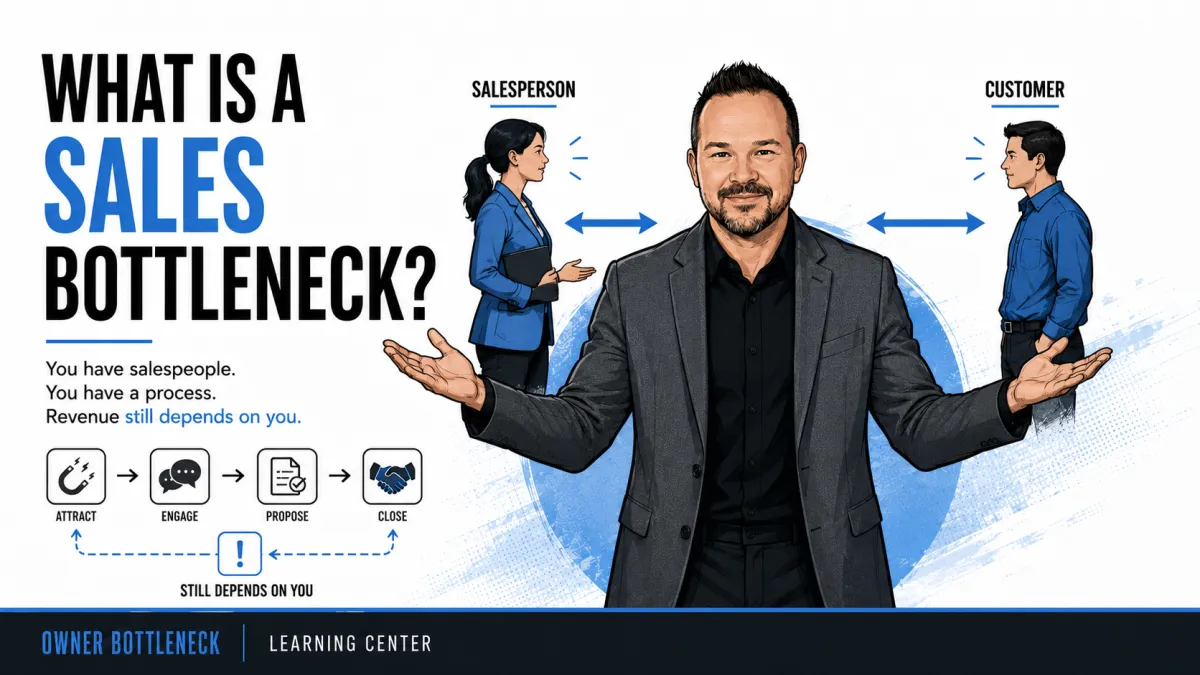
What Is a Sales Bottleneck?
The salesperson ran the meeting.
They asked the questions.
They explained the offer.
They prepared the proposal.
The customer seemed interested.
Then the customer asked:
Will the owner be involved?
The salesperson said the owner would oversee the relationship.
The customer relaxed.
Later that afternoon, the owner joined a second call.
They clarified the recommendation, answered two difficult questions, adjusted the offer, and asked for the business.
The customer signed.
The salesperson handled most of the sale.
The owner was still the reason it closed.
That’s a Sales Bottleneck.
Key Takeaways
A Sales Bottleneck exists when revenue depends too heavily on the owner’s reputation, relationships, knowledge, judgment, credibility, pricing authority, or direct involvement.
Hiring salespeople doesn’t automatically create an independent sales system.
The owner may remain the real salesperson even when employees handle prospecting, meetings, proposals, and follow-up.
Sales dependence can hide behind referrals, strong customer relationships, founder credibility, and the owner’s ability to rescue difficult deals.
A transferable sales process requires clear positioning, qualification, discovery, recommendations, pricing authority, follow-up, measurement, and trust that exists beyond the owner.
The goal isn’t to remove the owner from every important relationship. It’s to make owner involvement intentional rather than necessary for normal revenue production.
What is a Sales Bottleneck?
A Sales Bottleneck is a version of the Owner Bottleneck where too much of the company’s ability to attract, convert, retain, or grow customers depends on the owner.
The owner may be involved in:
Generating referrals
Building trust
Explaining the problem
Diagnosing customer needs
Recommending the solution
Setting the price
Approving discounts
Handling objections
Closing important deals
Repairing weak proposals
Following up on stalled opportunities
Protecting strategic relationships
Reassuring customers after the sale
The business may have salespeople.
It may have a CRM.
It may have proposals, scripts, pipelines, marketing campaigns, and sales meetings.
But when the opportunity becomes valuable, complex, uncertain, or difficult, the owner enters the conversation.
The salesperson may run the process.
The owner still carries the sale.
A Sales Bottleneck isn’t simply a sales problem
A company can have weak sales without having a Sales Bottleneck.
The offer may be poorly positioned.
Lead generation may be inconsistent.
The sales team may lack skill.
Pricing may be wrong.
The market may have changed.
The company may be targeting the wrong customers.
Those are sales problems.
A Sales Bottleneck is more specific.
It exists when the company’s ability to produce revenue depends disproportionately on one person, usually the owner.
The warning sign isn’t simply:
Sales are below target.
The warning sign is:
Sales work differently when the owner isn’t involved.
The company may close fewer deals.
Sales cycles may become longer.
Customers may ask for more reassurance.
Pricing may become less consistent.
Follow-up may weaken.
Larger opportunities may stall.
Existing customers may stop referring.
Important relationships may wait for the owner.
The sales system performs at one level with the owner and another level without them.
That gap is the bottleneck.
Hiring a salesperson doesn’t mean sales transferred
Owners often believe they solved owner dependence when they hired someone to sell.
The new salesperson begins:
Making calls
Responding to leads
Running meetings
Creating proposals
Following up
Updating the CRM
The owner’s calendar may improve.
But activity isn’t the same as transferred sales capability.
Ask:
Can the salesperson create trust without using the owner’s name?
Can they diagnose the customer’s real problem?
Can they explain why the company’s approach is different?
Can they recommend the right solution?
Can they discuss price with confidence?
Can they handle uncertainty without immediately involving the owner?
Can they ask for the business?
Can they recover a stalled opportunity?
Can they protect the relationship after a difficult conversation?
Can they produce consistent results without the owner joining the final call?
If the answer keeps returning to the owner, sales tasks may have transferred while sales ownership has not.
That’s the same distinction explored in Why Delegation Doesn’t Solve the Owner Bottleneck.
The activity moved.
The capability, authority, credibility, or accountability remained with the owner.
What a Sales Bottleneck looks like
Sales Bottlenecks don’t always look like the owner personally making every sales call.
They can hide in several parts of the customer journey.
Most leads come through the owner’s relationships
The company may say it grows through referrals.
Look closer.
Customers aren’t always referring the company.
They may be referring the owner.
The introduction sounds like:
You need to talk to Darrell.
Not:
You need to talk to his company.
The relationship enters through one person.
The prospect expects access to that person.
The referral source may trust the owner’s judgment, history, and reputation more than the broader organization.
Referrals are valuable.
But referrals that can’t transfer beyond the owner are also evidence of dependence.
Prospects ask for the owner
A salesperson responds to the inquiry.
The prospect asks:
Will the owner be on the call?
Or:
Can I speak directly with the owner?
The prospect may not distrust the salesperson personally.
They may believe the owner is where the real knowledge, authority, and accountability live.
The organization has a salesperson.
The market still sees the owner as the company.
The owner joins important sales calls
Small opportunities remain with the salesperson.
Large opportunities involve the owner.
Complex opportunities involve the owner.
Strategic customers involve the owner.
Unusual pricing involves the owner.
The salesperson may believe this is teamwork.
It may be.
But if the owner’s participation is required before a meaningful opportunity can close, the business still depends on the owner for its best revenue.
The owner is the only person who can explain the value clearly
The salesperson explains features.
The owner explains why the customer should care.
The salesperson describes the service.
The owner connects it to the customer’s real business problem.
The salesperson provides information.
The owner creates clarity.
Prospects don’t buy because they received the most information.
They buy because they understand the problem, trust the recommendation, believe the solution fits, and feel confident moving forward.
If only the owner can create that understanding, the sales process hasn’t fully transferred.
Pricing always returns to the owner
The salesperson presents the price.
The prospect asks for flexibility.
The salesperson says:
Let me check with the owner.
Discounts, payment terms, scope adjustments, guarantees, custom requests, and exceptions all return to one person.
That’s partly a Decision Bottleneck.
It’s also a Sales Bottleneck when the salesperson can’t confidently guide the commercial conversation without owner approval.
Proposals need the owner’s review
The salesperson conducts discovery.
They draft the proposal.
The owner rewrites it.
The owner adjusts the scope.
The owner improves the message.
The owner catches the missing issue.
The owner notices the recommendation doesn’t match the customer’s real problem.
The salesperson may be preparing the document.
The owner is still constructing the sale.
The owner rescues stalled deals
An opportunity stops responding.
The salesperson follows up.
Nothing happens.
The owner sends a personal message.
The prospect replies.
A customer becomes uncertain.
The salesperson tries to reassure them.
The owner joins.
The concern disappears.
The owner becomes the company’s closing mechanism and recovery mechanism.
Customers buy because of the owner’s reputation
The owner has experience, credibility, relationships, or a strong personal brand.
That’s an advantage.
It becomes a bottleneck when customers believe the value depends on receiving the owner personally.
They may think:
The owner understands my business.
The owner will protect the outcome.
The owner will make sure the team performs.
The owner will be there if something goes wrong.
The owner is the real expert.
The owner is who I trust.
The company may deliver the work.
The owner remains the reputation insurance behind the sale.
Salespeople sound different from the owner
The owner speaks with conviction.
The salesperson sounds like they’re presenting memorized information.
The owner understands the customer’s industry.
The salesperson understands the service list.
The owner can challenge the prospect’s assumptions.
The salesperson answers the questions they’re asked.
The owner leads the conversation.
The salesperson follows it.
This gap isn’t always solved by another script.
It may require deeper understanding of:
The customer
The problem
The business impact
The company’s point of view
The reason the offer works
Who the offer isn’t right for
How to make a recommendation
How to communicate with confidence
Sales performance drops when the owner becomes unavailable
The owner goes on vacation.
Important calls get delayed.
Large proposals wait.
Pricing exceptions accumulate.
Prospects become harder to move.
The pipeline remains active.
Fewer opportunities reach a decision.
The company may continue generating sales activity.
Its ability to create revenue slows down.
The owner may be the product without realizing it
In many owner-led businesses, customers aren’t only buying the service.
They’re buying access to the owner’s:
Experience
Judgment
Relationships
Reputation
Confidence
Responsiveness
Standards
Problem-solving ability
Personal commitment
That may have been necessary when the company was small.
The owner’s credibility helped the business survive.
The owner made promises personally.
The owner protected customers.
The owner knew every detail.
The owner could honestly say:
I’ll make sure this gets handled.
That promise created trust.
As the company grows, the same promise can become a trap.
Customers continue buying the owner’s personal involvement, even when employees will perform most of the work.
The sales process creates an expectation the operating model can’t scale.
The owner becomes part of every customer promise.
Why Sales Bottlenecks form
Sales Bottlenecks are usually created for understandable reasons.
The owner was the first salesperson
The owner learned sales through direct experience.
They heard every objection.
They saw why customers bought.
They learned which problems mattered.
They discovered how to position the offer.
They understood which customers were profitable.
They developed language that worked.
Much of that knowledge was never documented or taught.
The owner became good at selling.
The business never built a sales system.
The owner knows the customer better
The owner understands the customer’s history, industry, fears, expectations, and decision-making process.
They can recognize what a prospect means before the prospect says it clearly.
They know which questions reveal the real issue.
That experience is difficult to replace quickly.
But if the thinking behind the owner’s sales approach stays only in the owner’s head, the team can’t develop the same depth.
The company’s positioning is unclear
Ask three people inside the business:
Why should a customer choose us?
You may hear three different answers.
One talks about service.
One talks about quality.
One talks about experience.
The owner may communicate something far more specific and compelling.
When positioning isn’t clear, salespeople rely on generic claims.
The owner remains the only person who can explain the company in a way that creates urgency and trust.
The offer changes with every customer
The company may customize constantly.
Every customer receives different pricing, scope, terms, or delivery.
Customization isn’t automatically bad.
But when no one understands the boundaries, every sale becomes a new design problem for the owner.
The salesperson can’t sell a defined solution.
They must ask the owner to construct one.
Pricing authority is unclear
Salespeople may not know:
The minimum acceptable margin
What can be discounted
Which terms can change
What can be added
What can be removed
Which concessions are valuable
Which concessions are dangerous
When an exception is appropriate
So they return to the owner.
The owner may believe the salesperson lacks confidence.
The salesperson may believe they lack real authority.
The owner doesn’t trust the salesperson’s judgment
The owner has seen weak discovery, poor proposals, unnecessary discounts, and promises operations couldn’t fulfill.
So the owner increases control.
The owner reviews more.
Approves more.
Joins more calls.
Corrects more proposals.
That may protect revenue today.
It can also prevent the salesperson from developing judgment for tomorrow.
The owner steps in too early
A salesperson encounters resistance.
The owner joins.
The prospect becomes more engaged.
The deal closes.
Everyone feels relieved.
The owner’s involvement appears justified.
But the salesperson didn’t get the opportunity to work through the difficult part.
The team learns:
When the deal matters, bring in the owner.
The owner learns:
Important deals need me.
The pattern strengthens.
The company hired for personality instead of process
A salesperson may be outgoing, confident, likable, and experienced.
That doesn’t mean they understand how this company sells.
They still need clarity on:
Ideal customers
Customer problems
Qualification
Discovery
Positioning
Recommendations
Pricing
Handoffs
Follow-up
Measurements
Decision authority
A strong personality can’t compensate forever for a weak sales system.
Customer trust never moved into the company
The owner built deep relationships.
Customers know the owner will respond.
They believe the owner will make things right.
They may not have the same confidence in anyone else.
Trust wasn’t transferred through:
Consistent communication
Clear ownership
Team introductions
Visible expertise
Strong account management
Reliable delivery
Documented commitments
The owner remains the trust layer behind the company.
How a Sales Bottleneck differs from a Decision Bottleneck
The two often overlap.
A Decision Bottleneck exists when too many decisions and approvals reach the owner.
A Sales Bottleneck exists when revenue production depends too heavily on the owner.
Pricing approval may be a Decision Bottleneck.
Needing the owner to create trust, diagnose the problem, explain the value, or close the opportunity is a Sales Bottleneck.
A Decision Bottleneck asks:
Who can make the call?
A Sales Bottleneck asks:
Can the company create revenue without the owner making the sale possible?
How a Sales Bottleneck differs from a Team Bottleneck
A Team Bottleneck centers on whether employees can carry outcomes, accountability, leadership, and difficult responsibility.
A salesperson who refuses to follow up, avoids asking for the business, or doesn’t own their pipeline may be creating a Team Bottleneck.
A salesperson who owns their work but lacks the positioning, authority, process, information, or trust required to close without the owner may be operating inside a Sales Bottleneck.
A Team Bottleneck asks:
Who carries the result?
A Sales Bottleneck asks:
Can the organization consistently produce the result without depending on the owner’s personal involvement?
How a Sales Bottleneck differs from an Operations Bottleneck
An Operations Bottleneck centers on how work moves from beginning to end.
A broken sales-to-operations handoff is usually an operational issue.
A salesperson making promises that only the owner understands may involve both.
The sales process creates the expectation.
Operations must deliver it.
When the owner is required to translate between the two, the business may have both bottlenecks.
What a Sales Bottleneck costs
The cost extends beyond the owner’s calendar.
It limits revenue capacity
The owner has a finite number of hours.
If larger deals, important relationships, difficult proposals, and final closes require the owner, revenue capacity becomes tied to the owner’s availability.
The company may generate more leads than the owner can support.
The pipeline grows.
The closing capacity doesn’t.
It makes growth heavier
More leads create more owner involvement.
More salespeople create more proposals to review.
More customers create more relationships to protect.
More opportunities create more pricing decisions.
Revenue increases.
The owner’s sales burden increases with it.
That isn’t leverage.
It’s a bigger sales job for the owner.
It weakens salesperson confidence
A salesperson who repeatedly needs the owner may begin doubting their own authority.
The prospect senses it.
The salesperson may hesitate when discussing:
Price
Recommendations
Scope
Risk
Objections
Next steps
The owner’s involvement can unintentionally signal that the salesperson isn’t the real expert.
It confuses the customer
The salesperson says one thing.
The owner adjusts it.
The proposal changes.
Operations interprets it differently.
The customer may not know who truly owns the relationship.
That weakens confidence and creates more requests for the owner.
It creates inconsistent pricing
When every exception goes to the owner, pricing may depend on:
The relationship
The owner’s mood
The urgency of the month
The size of the opportunity
The salesperson’s negotiating ability
How strongly the prospect pushes
Inconsistent pricing can weaken margins and create confusion inside the team.
It makes salespeople harder to evaluate
A salesperson’s numbers may look strong because the owner helps close their best opportunities.
Another salesperson’s numbers may look weak because they don’t ask for the same help.
The company can’t clearly see which parts of the result belong to the salesperson and which belong to the owner.
It hides weaknesses in the sales process
The owner’s skill can cover:
Weak qualification
Poor discovery
Generic positioning
Bad proposals
Inconsistent follow-up
Missing urgency
Unclear next steps
Weak closing behavior
The company believes the process works.
The owner may be compensating for a process that doesn’t.
It can weaken customer retention
If customers believe the owner is the relationship, they may feel abandoned when the owner becomes less available.
They may bypass account managers.
They may escalate normal concerns.
They may lose confidence when the owner isn’t present.
The sale created dependence that delivery must continue supporting.
It increases business risk
If the owner becomes unavailable, the company may lose:
Referral flow
Key relationships
Closing capacity
Pricing judgment
Strategic accounts
Market credibility
Revenue dependence on one person is operational and financial risk.
It weakens business value
A buyer will want to know:
Where leads come from
Why customers buy
Who owns the relationships
How salespeople are trained
How pricing works
Whether sales performance is repeatable
What happens when the owner leaves
Whether customers are loyal to the company or the owner
If revenue depends on the owner’s relationships, reputation, or personal selling ability, the business may have a Value Bottleneck.
A buyer may see strong historical revenue.
They may also see uncertainty about whether that revenue will continue.
How to measure a Sales Bottleneck
Don’t measure owner dependence only by counting the owner’s sales calls.
Measure where the owner changes the outcome.
Track owner involvement in opportunities
For 30 days, record every opportunity where the owner becomes involved.
Include:
Why the owner entered
When they entered
What they contributed
Whether the deal would likely have moved without them
What skill, information, authority, or credibility was missing
Whether the situation has happened before
What would need to transfer before the owner was no longer required
You may discover the owner is repeatedly needed for:
Discovery
Technical explanations
Pricing
Proposals
Closing
Negotiation
Customer reassurance
Follow-up
Strategic relationships
Measure owner-assisted revenue
Separate revenue into categories:
Closed without owner involvement
Closed with minor owner support
Closed with significant owner involvement
Personally sold by the owner
Look at both revenue and gross margin.
The company may have many salesperson-led deals while most profitable revenue still depends on the owner.
Track lead sources
Ask where opportunities originate.
Are they coming from:
The owner’s personal relationships
Referrals specifically asking for the owner
The company’s marketing
Salesperson prospecting
Partnerships
Existing customer expansion
Repeatable outbound or inbound channels
A referral system isn’t fully transferable if the referrals stop when the owner steps away.
Compare closing rates
Compare:
Owner-led calls
Salesperson-led calls
Calls where the owner joins late
Calls where the owner is absent
A large performance gap reveals where capability or trust hasn’t transferred.
Track proposal revisions
Record:
How often the owner reviews proposals
How much the owner changes
What types of errors repeat
Whether the recommendation fits the customer’s problem
Whether pricing follows defined rules
Whether operations can deliver what was promised
Frequent owner rewrites reveal that proposal creation may still depend on the owner’s judgment.
Track pricing exceptions
Measure:
How many deals require owner approval
What percentage receive discounts
Why discounts are given
Whether margins remain healthy
Which exceptions repeat
Whether the salesperson could handle them inside defined boundaries
Track pipeline ownership
Ask:
Who notices when an opportunity stalls?
Who determines the next step?
Who follows up?
Who challenges weak pipeline activity?
Who forecasts the result?
Who feels responsible when the target is missed?
The CRM may list a salesperson as the opportunity owner.
The real owner may still be the business owner.
Use the owner absence test
Imagine the owner is unavailable for 30 days.
Ask:
Would new leads continue entering?
Would prospects trust the sales team?
Could salespeople diagnose customer problems?
Could they recommend the right solution?
Could they discuss price?
Could they handle common objections?
Could they close larger opportunities?
Would referral partners keep sending business?
Would strategic customers remain confident?
What opportunities would wait for the owner’s return?
For a broader diagnosis, read How to Measure Owner Dependence in Your Business.
How to remove a Sales Bottleneck
You don’t remove a Sales Bottleneck by telling the salesperson to be more confident.
Confidence usually follows clarity, capability, authority, experience, and results.
Start by identifying where the owner is still necessary.
Choose one point of sales dependence
Don’t try to rebuild the entire sales organization at once.
Choose one recurring point where opportunities return to the owner.
Examples:
Discovery
Technical recommendations
Proposal creation
Pricing
Negotiation
Closing
Follow-up
Referral relationships
Strategic accounts
Start with the point creating the greatest constraint.
Define the ideal customer
Salespeople need clarity on:
Who the company helps best
Which problems it solves
Which customers are most profitable
Which customers are difficult to serve
What conditions create a strong fit
What warning signs suggest poor fit
Which opportunities should be declined
The owner may qualify instinctively.
The team needs the thinking made visible.
Clarify the customer’s real problem
Don’t build the sales process around explaining the company.
Build it around understanding the customer.
Define:
What problems usually cause customers to seek help
How those problems show up
What they cost
What customers have already tried
Why previous attempts may have failed
What happens if the problem continues
What outcome the customer actually wants
The salesperson should be able to diagnose before recommending.
Clarify the company’s position
Salespeople need a clear answer to:
Why should the customer choose this company instead of another option?
Avoid generic claims such as:
Better service
Higher quality
More experience
We care more
We’re a trusted partner
Those may be true.
They’re rarely specific enough to create meaningful separation.
Clarify:
What the company believes
What it does differently
Why the difference matters
Which common approach fails
What the customer should understand before buying
Who the solution isn’t right for
The salesperson should be able to communicate a point of view, not only recite features.
Map the sales process
Define the stages from first contact to signed agreement.
For each stage, clarify:
The purpose
The required information
The questions to answer
The decision that should occur
The exit criteria
The next step
The owner
The measurement
A CRM stage shouldn’t simply describe activity.
It should describe meaningful progress toward a customer decision.
Build a discovery process
The owner often sells well because they understand how to uncover the real issue.
Transfer that thinking.
Help salespeople learn to understand:
The customer’s current situation
The problem
The context
The impact
The cost
The desired outcome
The decision process
The risks
The urgency
The fit
The goal isn’t to memorize a long list of questions.
The goal is to understand what must be learned before making a recommendation.
Teach the recommendation
A salesperson shouldn’t only describe available options.
They should be able to say:
Based on what you told me, here’s what I recommend and why.
Define:
Which solution fits which problem
What tradeoffs exist
What results are realistic
What the customer must contribute
What could prevent success
What should happen first
When the company should say no
A strong recommendation transfers expert judgment.
Create pricing boundaries
Clarify:
Standard pricing
Minimum margin
Discount authority
Payment terms
Scope flexibility
Nonprice concessions
Approval thresholds
Situations requiring escalation
“Check with the owner” shouldn’t be the normal pricing strategy.
Transfer proof
The owner may carry years of stories, examples, and customer outcomes.
Build a usable proof library.
Include:
Case studies
Customer examples
Common before-and-after situations
Relevant results
Mistakes the company has helped prevent
Examples by industry or problem
Customer language
Testimonials
References when appropriate
The goal isn’t to overwhelm the prospect.
It’s to help the salesperson choose the right proof for the problem being discussed.
Review calls instead of rescuing them
When possible, let the salesperson complete the call.
Review afterward.
Discuss:
What the customer said
What was missed
What question should have been asked
Whether the recommendation fit
Where certainty weakened
What the next step should be
What principle applies next time
Coaching after the call develops capability.
Rescuing during every call reinforces dependence.
Use joint calls as a transfer tool
The owner may still join important calls during development.
But the role should be intentional.
Before the call, define:
Who leads
What the salesperson owns
Why the owner is attending
When the owner will speak
What the salesperson should learn
What must transfer before future calls happen without the owner
After the call, review what happened.
The goal is to make joint selling temporary where appropriate, not permanent by default.
Transfer relationships deliberately
For important referral partners and customers:
Introduce the salesperson or account leader early
Explain their role clearly
Let them lead parts of the relationship
Include them in important conversations
Route normal communication through them
Support their authority publicly
Avoid taking the relationship back unnecessarily
Trust moves through repeated positive experiences.
It won’t transfer through one introduction email.
Create follow-up standards
Define:
Who follows up
How quickly
What each follow-up should accomplish
Which channels are appropriate
When an opportunity becomes inactive
How stalled opportunities are reviewed
What information must remain in the CRM
Follow-up shouldn’t depend on the owner remembering which deal matters.
Build sales accountability
Review:
Pipeline quality
Conversion rates
Deal movement
Follow-up
Win reasons
Loss reasons
Pricing
Margins
Forecast accuracy
Owner involvement
Development needs
Don’t make the meeting a place where the salesperson reports activity and the owner decides what happens next.
Require the salesperson to bring:
Their assessment
Their recommendation
Their commitments
Their corrective action
Measure whether owner dependence is falling
Look for:
More opportunities closed without the owner
Fewer owner-reviewed proposals
Fewer pricing approvals
More salesperson-generated opportunities
Stronger closing rates
Better qualification
More accurate forecasts
Fewer stalled opportunities requiring rescue
Referral relationships expanding beyond the owner
Customers trusting other leaders
Revenue continuing during owner absence
Don’t measure progress by whether the owner attended fewer meetings.
Measure whether the sales system produced results without needing the owner to change the outcome.
Example: transferring the final sales call
Suppose a salesperson conducts the first meeting.
They understand the customer’s needs.
They prepare the recommendation.
The owner joins the final call to present pricing and close.
To transfer the call, define:
Outcome
Help a qualified customer make a clear, confident decision about the right solution.
Discovery requirements
The salesperson must understand the problem, impact, desired outcome, decision process, fit, urgency, and risks before presenting.
Recommendation
The salesperson must explain what they recommend, why it fits, what the customer should expect, and what could prevent success.
Authority
The salesperson can present standard pricing and terms without owner approval.
Boundaries
Custom scope, material margin exceptions, legal risk, or commitments outside the normal offer must escalate.
Accountability
Calls are reviewed regularly, and conversion, margin, and customer fit are measured.
The owner may coach.
The owner no longer needs to appear simply because the conversation reached the decision stage.
Example: transferring referral relationships
Suppose most new business comes from five referral partners who know the owner personally.
Every introduction goes directly to the owner.
The owner qualifies the lead and then hands it to a salesperson.
The referral partner still believes the owner owns the relationship.
To reduce dependence:
Outcome
Maintain strong referral relationships that consistently generate qualified opportunities for the company, not only for the owner.
Transfer
The owner introduces a sales leader as the person responsible for helping referred customers.
Visibility
The owner remains present during the transition but doesn’t lead every conversation.
Communication
The sales leader follows up with referral partners, reports outcomes, and protects the trust behind each introduction.
Standards
Referred customers receive fast response, clear communication, strong qualification, and an appropriate recommendation.
Accountability
Referral volume, quality, conversion, and relationship activity are reviewed.
The owner’s reputation may open the door.
The company must learn to carry the relationship after it opens.
Don’t remove the owner from sales too quickly
Some owners hear “Sales Bottleneck” and assume the answer is to stop selling.
That can be a mistake.
The owner may still be:
The company’s strongest source of market insight
The most credible voice with strategic customers
The best person to open new markets
Essential to major partnerships
Valuable in complex or high-risk opportunities
Important to the company’s public positioning
The goal isn’t to make the owner irrelevant.
The goal is to stop using the owner where a capable sales system should work.
The owner may remain involved in:
Strategic relationships
Major accounts
New offers
New markets
High-risk commitments
Partnerships
Ownership-level negotiations
That involvement should be chosen.
It shouldn’t be required because the rest of the sales process can’t function without it.
What should stay with the owner?
Some sales responsibilities may properly remain with the owner, including:
Ownership or equity discussions
Material financial commitments
Strategic partnerships
Major legal or reputation risks
Offers that haven’t been standardized
Relationships the owner intentionally chooses to retain
Deals that could significantly change the company
Ask:
Does this opportunity genuinely require ownership-level involvement, or does it reach me because the sales system still depends on me?
That question separates intentional involvement from dependence.
Frequently asked questions about Sales Bottlenecks
Does a Sales Bottleneck mean the owner should stop selling?
No.
The owner can remain an important salesperson.
The problem is when normal revenue production can’t continue without the owner.
Does hiring a salesperson solve a Sales Bottleneck?
Not by itself.
The salesperson needs positioning, process, skill, authority, information, coaching, proof, accountability, and time to develop judgment.
What if customers only want to work with the owner?
Determine why.
They may trust the owner’s expertise, responsiveness, authority, or reputation.
Identify what that trust represents, then build those qualities into the broader company experience.
What if the salesperson can’t close without me?
Diagnose where the sale breaks.
Is discovery weak?
Is the recommendation unclear?
Does the salesperson lack authority?
Is the company’s positioning generic?
Is pricing inconsistent?
Does the customer believe the owner is the real expert?
“Can’t close” is a symptom.
Find the missing transfer.
Should the owner join large sales calls?
Sometimes.
The question is whether the owner is strategically valuable or operationally required.
A major opportunity may justify owner involvement.
Every meaningful opportunity shouldn’t automatically require it.
Can scripts solve a Sales Bottleneck?
Scripts can create consistency.
They can’t replace understanding, judgment, authority, credibility, listening, or experience.
Use scripts as support, not as a substitute for sales capability.
How long does it take to transfer sales?
Simple parts of the process may transfer quickly.
Founder relationships, complex recommendations, market credibility, and high-value closing judgment may take longer.
The goal is steady reduction in unnecessary owner involvement.
What if referrals slow down when the owner steps back?
That reveals the referrals may belong more to the owner than the company.
Transfer referral relationships gradually, maintain service quality, and create a consistent experience beyond the owner.
Is a personal brand always a Sales Bottleneck?
No.
A personal brand can generate attention, credibility, and opportunity.
It becomes a bottleneck when customers believe value exists only through direct access to the owner.
Revenue shouldn’t depend on one person’s presence
The owner may always be the company’s strongest salesperson.
They may have the most experience.
The deepest relationships.
The greatest conviction.
The clearest understanding of the customer.
But the company can’t build durable sales capacity if every meaningful opportunity eventually returns to them.
A strong sales system can:
Attract the right customers
Build trust
Diagnose real problems
Make clear recommendations
Communicate value
Discuss price
Handle normal resistance
Follow up consistently
Close appropriate opportunities
Transfer accurate expectations into operations
Maintain customer confidence
The owner can still add value.
The owner stops being the invisible requirement behind revenue.
That’s the shift.
Don’t ask only:
Do we have salespeople?
Ask:
Can this company consistently earn trust and create revenue without the customer needing me?
The answer reveals whether sales belongs to the company or still belongs to the owner.
Find where sales still depends on you
The free Owner Bottleneck Scorecard evaluates owner dependence across Decisions, Sales, Operations, Team, and Value.
It’ll help you identify where the business still relies too heavily on your judgment, authority, relationships, standards, or presence.