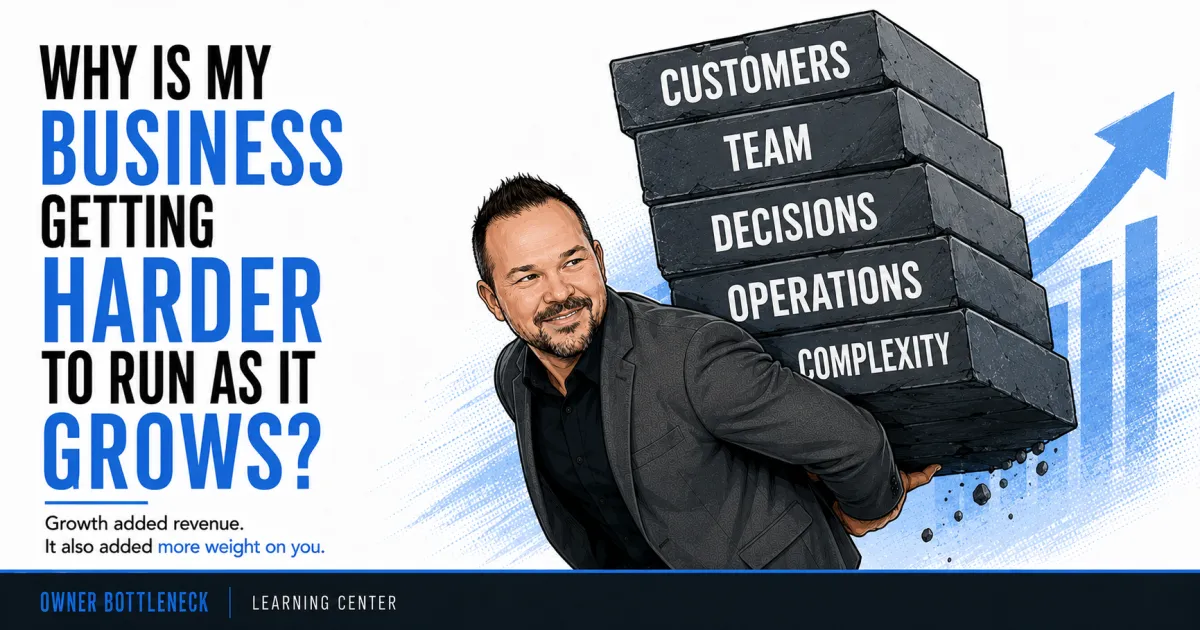
Illustration of a business owner struggling to carry a growing company as more customers, employees, decisions, and responsibilities are added.

Why Is My Business Getting Harder to Run as It Grows?

July 16, 202621 min read

The business was smaller then.

Fewer employees.

Fewer customers.

Less revenue.

The owner worked hard, but the company still felt manageable.

They knew every customer.

They understood every job.

They could see what needed attention.

Then the business grew.

Revenue increased.

More people were hired.

More customers came in.

More services were added.

The company moved into a larger space.

From the outside, everything looked better.

Inside, the owner’s day became heavier.

There were more meetings.

More questions.

More approvals.

More customer problems.

More departments that needed coordination.

More people waiting for answers.

The owner had built the larger business they wanted.

They just hadn’t built a business that was easier to lead.

That’s when the question appears:

Why is my business getting harder to run as it grows?

Because growth doesn’t automatically create scale.

Sometimes it only creates a larger version of the same owner-dependent business.

Key Takeaways

  • Growth adds customers, employees, revenue, decisions, handoffs, and exceptions. It doesn’t automatically add capacity.

  • A business is growing when activity and revenue increase. It’s scaling when the business can handle that growth without requiring a matching increase in owner involvement.

  • Hiring more people can make the business harder to lead when authority, standards, information, and accountability still return to the owner.

  • Growth doesn’t always create the Owner Bottleneck. It often exposes and multiplies one that was already there.

  • A business can look successful while becoming more fragile, more complicated, and more dependent on the owner.

  • Healthy growth requires the owner’s role to change as the company changes.

  • The goal isn’t simply to make the business bigger. It’s to build a company that can carry more without placing all the added weight back on the owner.

Why Does a Business Get Harder to Run as It Grows?

A business gets harder to run when growth adds more complexity than the company has the ability to absorb.

More customers create more requests.

More employees create more communication.

More services create more exceptions.

More departments create more handoffs.

More revenue creates more financial decisions.

More activity creates more places where something can go wrong.

If the systems, leadership, authority, information, and decision-making capacity don’t grow with the company, the extra weight returns to the owner.

The business gets larger.

The owner becomes busier.

That’s often a sign of the Owner Bottleneck.

The Owner Bottleneck exists when too much of the company still depends on the owner’s judgment, memory, approvals, relationships, standards, or presence.

When the company is small, that dependence may feel manageable.

The owner can answer the question.

Fix the problem.

Call the customer.

Review the proposal.

Check the work.

Make the decision.

Growth changes the volume.

The owner is no longer handling ten dependencies.

They’re handling fifty.

The business grew.

The owner’s role didn’t.

Growth and Scale Aren’t the Same Thing

These words are often treated like they mean the same thing.

They don’t.

Growth means the business is producing more.

That might include:

  • More revenue

  • More customers

  • More employees

  • More locations

  • More projects

  • More services

  • More transactions

Scale means the business can handle more without requiring a matching increase in effort, cost, complexity, or owner involvement.

A business can grow without scaling.

Revenue can double while the owner’s workload doubles.

The team can grow while the number of questions reaching the owner triples.

The customer base can expand while every important relationship still depends on the owner.

That isn’t scale.

It’s a larger company that still runs through one person.

Some Businesses Scale

The company adds volume.

Its leaders gain authority.

Its systems absorb more work.

Its information becomes more visible.

Its team develops stronger judgment.

The owner’s daily involvement becomes more selective.

The business grows stronger as it grows larger.

Other Businesses Swell

The company adds people.

It adds meetings.

It adds software.

It adds customers.

It adds departments.

But the owner remains the central decision-maker, problem-solver, relationship holder, and quality filter.

The company gets bigger.

It doesn’t become more capable.

It swells around the owner.

That’s why some businesses look impressive from the outside while feeling exhausting from the inside.

Growth Multiplies Whatever Already Exists

Growth rarely fixes a weak structure.

It multiplies it.

If one customer issue out of every ten requires the owner, doubling the customer base may double the owner’s interruptions.

If every salesperson needs help closing important deals, hiring three more salespeople may create three more people who need the owner.

If managers can complete tasks but can’t make decisions, adding departments creates more decision queues.

If operational exceptions always return to the owner, more work creates more exceptions.

Growth doesn’t remove dependence.

It gives dependence more opportunities to appear.

The Business May Have Outgrown the Way It Was Built

Many owner-led businesses were built around speed.

The owner made quick decisions.

Everyone communicated directly.

Problems were solved informally.

Knowledge lived in people’s heads.

Customers knew who to call.

The owner could see almost everything.

That worked when the company was smaller.

Then the business changed.

The old way of operating remained.

A five-person company can rely heavily on conversations, memory, and direct owner involvement.

A fifty-person company can’t operate the same way without creating confusion, delay, and dependence.

What worked at one stage can become the bottleneck at the next.

The owner often feels this before they can explain it.

They say:

“Things didn’t used to be this complicated.”

They’re right.

The business changed.

The operating model didn’t.

More Customers Create More Exceptions

Growth brings volume.

Volume brings variation.

When the business had twenty customers, the owner could remember:

  • Who expected special treatment

  • Which customer had a unique agreement

  • Who paid slowly

  • Who needed extra communication

  • Which promises had been made

  • Which problems had happened before

At two hundred customers, memory stops being a reliable system.

Yet many businesses continue depending on it.

The team sees a customer request.

They don’t know the history.

They don’t know the exception.

They don’t know whether the customer should receive special treatment.

So they ask the owner.

More customers didn’t just create more revenue.

They created more situations where the owner’s context was required.

More Employees Create More Coordination

Hiring should create capacity.

Sometimes it creates more management work for the owner.

Each person brings:

  • Questions

  • Training needs

  • Priorities

  • Performance issues

  • Communication needs

  • Decisions

  • Conflicts

  • Handoffs

  • Expectations

If those employees report directly or indirectly to the owner, the owner may become responsible for coordinating the growing organization.

This creates a frustrating pattern.

The owner hires to reduce the workload.

The new hire needs support.

The owner provides it.

The team grows.

The owner spends more time answering, reviewing, correcting, clarifying, and following up.

The owner hired more hands.

They didn’t build more leadership.

More Managers Don’t Automatically Create More Leadership

A title doesn’t transfer authority.

A manager may supervise people while still returning every meaningful decision to the owner.

They may schedule work.

Run meetings.

Assign tasks.

Track performance.

But when something becomes uncomfortable, unusual, expensive, or consequential, it comes back.

That creates a Decision Bottleneck.

The manager coordinates activity.

The owner still carries judgment.

That’s why an owner can build a management team and still feel surrounded by decisions.

The organizational chart changed.

The decision flow didn’t.

More Departments Create More Handoffs

A small company may have one group of people doing most of the work.

As the business grows, responsibilities separate.

Sales sells.

Operations delivers.

Customer service responds.

Finance bills.

Leadership sets priorities.

Specialization can create efficiency.

It also creates handoffs.

A customer moves from sales to operations.

A project moves from planning to production.

A problem moves from customer service to a manager.

Each handoff creates a chance for:

  • Information to disappear

  • Expectations to change

  • Responsibility to become unclear

  • Deadlines to move

  • Standards to be interpreted differently

  • Problems to fall between departments

When the handoff fails, the owner often becomes the person who reconnects everything.

The owner explains what sales promised.

Clarifies what the customer expected.

Decides which department owns the problem.

Resets the priority.

Follows up until the issue is resolved.

The company has departments.

The owner remains the bridge between them.

More Revenue Creates More Consequential Decisions

A larger business usually creates larger consequences.

A pricing decision affects more revenue.

A hiring mistake costs more.

A bad customer experience reaches more people.

A delayed project affects a larger account.

A purchasing decision involves more money.

A quality issue creates more exposure.

As the stakes increase, owners often pull decisions closer.

They tell themselves:

“This is too important to get wrong.”

That instinct is understandable.

It can also make the business more dependent.

The larger the company becomes, the more decisions the owner feels they must protect.

Growth increases the stakes.

The owner increases control.

The business becomes slower.

More Systems Can Still Create More Work

Owners often respond to complexity by adding tools.

A new CRM.

A project management platform.

A dashboard.

An approval workflow.

A communication channel.

A reporting system.

Those tools can help.

They can also create more places where information lives, more notifications to monitor, and more systems that require someone to maintain them.

Software doesn’t automatically create clarity.

A dashboard doesn’t create accountability.

A workflow doesn’t create decision rights.

A CRM doesn’t transfer customer trust.

A checklist doesn’t teach judgment.

A larger technology stack can make the business look more sophisticated while the owner remains the person making everything work together.

Systems matter.

But systems alone won’t solve an Owner Bottleneck when the owner still carries the context, authority, standards, and consequences behind the work.

Why Hiring More People Can Make the Owner Busier

Hiring is one of the most common responses to an overloaded owner.

Sometimes it’s the right answer.

Sometimes the business doesn’t have a people shortage.

It has an ownership shortage.

The current team may have enough people to complete the work.

What’s missing is clarity about who owns:

  • The outcome

  • The decision

  • The customer relationship

  • The handoff

  • The standard

  • The follow-up

  • The exception

  • The consequence

Without that clarity, additional employees create additional activity.

The owner remains responsible for making the activity produce an outcome.

That’s why delegation doesn’t solve the Owner Bottleneck when tasks move but ownership doesn’t.

More people don’t create leverage when every person creates more questions for the owner.

The Five Bottlenecks That Make Growth Feel Heavy

The growing business usually doesn’t have one isolated issue.

Several bottlenecks begin reinforcing one another.

1. Decision Bottleneck

The team can perform the work.

Important decisions still require the owner.

As the company grows, the number of decisions grows with it.

The owner becomes the queue.

Common signs include:

  • Managers wait for approval

  • Pricing keeps returning to the owner

  • Customer exceptions stall

  • Spending decisions move slowly

  • Priorities aren’t changed without the owner

  • Employees bring questions instead of recommendations

The owner may blame the team for being indecisive.

But the business may have trained people to wait.

That pattern is explored further in Why Does My Team Keep Coming to Me for Every Decision?.

2. Sales Bottleneck

Revenue grows, but important sales still depend on the owner.

The owner remains:

  • The strongest closer

  • The primary source of referrals

  • The person customers trust

  • The only one who can explain the value clearly

  • The final pricing authority

  • The person called when a deal stalls

Adding salespeople may increase activity.

It won’t necessarily reduce dependence.

A Sales Bottleneck means the business has sales resources, but revenue still runs through the owner.

3. Operations Bottleneck

The regular process works until something unusual happens.

Growth creates more work.

More work creates more exceptions.

The owner becomes the place where those exceptions go.

Common signs include:

  • Projects stall at handoffs

  • Departments blame each other

  • Quality changes depending on who performs the work

  • Priorities are unclear

  • Customer promises aren’t visible

  • The owner resolves recurring operational conflicts

An Operations Bottleneck becomes more painful as volume increases because every weak handoff and missing standard is repeated more often.

4. Team Bottleneck

The team stays busy.

The owner still carries the outcomes.

Employees complete tasks.

The owner tracks whether the customer was satisfied, the deadline was protected, the standard was met, and the problem was truly resolved.

That’s a Team Bottleneck.

As headcount grows, the owner may become responsible for coordinating more people without gaining more true ownership.

The team got larger.

The owner’s mental load did too.

5. Value Bottleneck

The business may be more profitable than ever.

It may also be more dependent on the owner than ever.

That creates a Value Bottleneck.

A buyer may see:

  • More revenue

  • More customers

  • More employees

  • More locations

Then ask:

“What happens when the owner leaves?”

If the larger business still depends on the owner for sales, decisions, customer trust, operations, and leadership, growth may have increased the size of the company without increasing its transferability.

The company became bigger.

The risk remained concentrated.

Signs Your Business Is Swelling Instead of Scaling

A business may be swelling if:

  • Revenue increases while the owner’s hours increase

  • Every new employee creates more owner questions

  • Managers coordinate work but don’t own decisions

  • More customers create more direct owner involvement

  • The owner joins more sales calls as the sales team grows

  • More software creates more information for the owner to monitor

  • Departments grow but the owner still manages the handoffs

  • The owner remains the final quality check

  • Vacations become working remotely

  • The company slows when the owner becomes unavailable

  • Profit grows, but so does the owner’s stress

  • The owner can’t explain what role they’re supposed to play anymore

The clearest sign may be this:

The business can handle more work only when the owner handles more work too.

That’s growth.

It isn’t scale.

Why the Owner Keeps Becoming the Shortcut

The owner usually knows the answer.

They know the customer.

They know the history.

They know what matters.

They can resolve the problem faster than anyone else.

That makes going to the owner efficient.

At least in the moment.

A manager could spend thirty minutes gathering information and making a judgment.

Or they could ask the owner and get an answer in thirty seconds.

The shortcut wins.

Then it wins again.

Eventually, the business stops building its own ability to decide because the owner remains the fastest path.

The owner’s competence becomes the company’s dependence.

The Owner’s Role Must Change as the Business Changes

The role that built the company may not be the role that scales it.

Early in the business, the owner may need to be:

  • The salesperson

  • The manager

  • The problem-solver

  • The customer contact

  • The quality inspector

  • The scheduler

  • The strategist

  • The final decision-maker

That may be necessary.

But the owner can’t remain all of those things as the company grows without becoming the bottleneck.

The question shifts from:

“How do I personally make this happen?”

to:

“What capability must the business have so this no longer requires me?”

That’s a different kind of leadership.

The Owner Must Move From Answering to Building

Answering solves today’s problem.

Building creates the company’s future ability.

The owner may need to spend less time:

  • Giving the answer

  • Fixing the work

  • Joining the call

  • Correcting the customer issue

  • Making the exception

  • Chasing the deadline

And more time:

  • Clarifying outcomes

  • Defining authority

  • Making information visible

  • Transferring relationships

  • Developing leaders

  • Setting standards

  • Reviewing patterns

  • Removing recurring dependence

That work can feel slower.

It’s also the work that creates scale.

How to Make Growth Feel Lighter

You don’t make a growing business easier by attacking everything at once.

You find the recurring dependence creating the most weight.

Then you remove it.

Step 1: Track Where Growth Creates Owner Involvement

For two weeks, record every time growth pulls you into the business.

Examples:

  • A new employee asks for a decision

  • A customer exception reaches you

  • A proposal needs review

  • A department conflict needs mediation

  • A manager needs you to reset priorities

  • A quality issue requires your judgment

  • A project stalls at a handoff

  • A larger purchase needs approval

Don’t write down only the major interruptions.

Record the small ones too.

Small dependencies become heavy through repetition.

Step 2: Group the Dependence Points

Sort each request into a category:

  • Decisions

  • Sales

  • Operations

  • Team

  • Value

Then look for concentration.

You may discover that most owner involvement comes from:

  • Customer recovery decisions

  • Proposal review

  • Scheduling conflicts

  • Department handoffs

  • Pricing exceptions

The business may feel complicated.

The dependence may be concentrated in only a few places.

Step 3: Choose One Recurring Pattern

Don’t launch a company-wide transformation.

Choose one pattern.

For example:

“Every customer credit above $100 comes to me.”

Or:

“Every proposal needs my review before it’s sent.”

Or:

“Every conflict between sales and operations ends up with me.”

A specific pattern is easier to diagnose and transfer.

Step 4: Identify What’s Actually Missing

Ask why the request reaches you.

Is the team missing:

  • Authority?

  • Information?

  • A standard?

  • Confidence?

  • Training?

  • A clear outcome?

  • A decision owner?

  • An escalation rule?

  • Accountability?

Don’t assume the solution is another procedure.

The real problem may be unclear judgment or ownership.

Step 5: Build the Missing Structure

For that one dependence point, define:

Outcome

What result must be protected?

Owner

Who is responsible for producing it?

Authority

What can they decide without asking?

Boundaries

Where does their authority stop?

Information

What do they need to see?

Escalation

What truly needs to return to the owner?

Accountability

How will decisions and outcomes be reviewed?

This turns vague delegation into real ownership.

Step 6: Review Without Taking It Back

The team may make a different decision than you would.

That doesn’t make it wrong.

Ask:

  • Did it protect the outcome?

  • Did it stay within the boundaries?

  • Was the reasoning sound?

  • Can the mistake be corrected?

  • Did the person learn?

If the owner requires every decision to match their personal approach, authority never truly transfers.

Step 7: Measure Whether Owner Involvement Decreased

After thirty days, ask:

  • How many times did this return to me?

  • How many decisions were made without me?

  • Did speed improve?

  • Did quality remain acceptable?

  • Did the owner reverse decisions?

  • Did the same questions repeat?

  • Did customers continue receiving a strong experience?

The goal isn’t simply to document a new process.

The goal is to reduce dependence.

Example: Growth Creates a Customer Recovery Bottleneck

Imagine a company grows from 100 customers to 500.

At 100 customers, the owner personally handles unusual complaints.

There may be two each month.

It feels manageable.

At 500 customers, there are ten.

The customer service manager gathers the information.

The owner decides what to offer.

The manager returns to the customer.

The owner becomes frustrated.

They say:

“Why do I still have to handle every customer problem?”

Because customer volume grew.

Decision ownership didn’t.

Here’s how the company could transfer it.

Outcome

Resolve legitimate customer problems quickly while protecting trust and financial discipline.

Decision owner

Customer service manager.

Authority

Refunds up to $250 and credits up to $500.

Boundaries

No changes to contract terms. No commitments exceeding the approved limits.

Information

Customer history, issue details, cost to correct, account value, and previous recovery attempts.

Escalation

Legal threats, serious reputation risk, repeated claims, or financial exposure above $500.

Accountability

Weekly review of decisions, cost, consistency, and customer outcome.

The owner doesn’t lose visibility.

The owner stops becoming the required approval step.

That’s how growth becomes lighter.

Example: Growth Creates a Sales Review Bottleneck

Imagine a company hires three salespeople.

The owner expects to spend less time selling.

Instead, every proposal comes back for review.

The owner checks:

  • Scope

  • Pricing

  • Wording

  • Margin

  • Customer fit

  • Promises

  • Delivery risk

The sales team creates the proposal.

The owner remains the judgment behind it.

Sales activity increased.

Owner dependence increased with it.

The solution may include:

Outcome

Send accurate, profitable proposals that clearly communicate value and don’t create delivery promises the company can’t keep.

Authority

Salespeople may send proposals within approved offers, pricing, margins, and terms.

Boundaries

Discounts beyond a defined percentage, custom scope, unusual terms, or margin below a set level require review.

Information

Current capacity, pricing structure, margin targets, scope options, contract terms, and delivery limitations.

Accountability

Review a sample of completed proposals weekly instead of approving every proposal before it goes out.

The owner moves from gatekeeper to coach.

Sales can move without waiting.

What Healthy Growth Looks Like

Healthy growth doesn’t mean the business becomes simple.

Larger companies are naturally more complex.

The difference is where the complexity lives.

In an unhealthy business, complexity lives in the owner’s head.

In a healthier business, complexity is distributed through:

  • Clear leadership

  • Visible information

  • Defined authority

  • Strong systems

  • Shared standards

  • Reliable review rhythms

  • Team accountability

  • Transferable customer relationships

Healthy growth may look like:

  • Revenue increasing while owner hours stay stable or decrease

  • Managers making more decisions within clear boundaries

  • Customer trust expanding beyond the owner

  • Sales continuing without owner rescue

  • Operational exceptions being handled by the team

  • Fewer routine questions reaching the owner

  • Stronger visibility without constant involvement

  • The business continuing to move when the owner is away

The company becomes larger.

The owner’s role becomes narrower and more strategic.

Test the Business With Absence

One of the clearest tests is whether the company can continue moving when the owner is unavailable.

Start with two hours.

Then one day.

Then several days.

Eventually, test whether the business can operate without routine owner involvement for a longer period.

The article Can Your Business Run Without You for 30 Days? explains how to build toward that test.

The goal isn’t to prove that the owner doesn’t matter.

It’s to reveal where the company still can’t function without them.

Measure Dependence, Not Just Growth

Owners track revenue.

Profit.

Headcount.

Customers.

Locations.

Sales activity.

Those numbers matter.

But they don’t tell you whether the business is becoming less dependent.

Also track:

  • Routine decisions reaching the owner

  • Owner-assisted revenue

  • Customer issues escalated

  • Proposal reviews required

  • Projects stalled at handoffs

  • Manager decisions reversed

  • Questions asked repeatedly

  • Owner hours spent in daily operations

  • Days the business can operate without owner access

Growth tells you whether the company is getting bigger.

Dependence tells you whether it’s getting stronger.

For a deeper measurement process, read How to Measure Owner Dependence in Your Business.

Frequently Asked Questions

Is It Normal for a Growing Business to Become More Complicated?

Yes.

Growth naturally adds customers, people, information, decisions, and coordination.

The problem isn’t that complexity exists.

The problem is when the owner remains the person personally absorbing all of it.

Does Being Busier Mean the Business Is Growing Successfully?

Not necessarily.

The owner can become busier because the business is producing more.

They can also become busier because authority, systems, leadership, and ownership haven’t kept pace.

Busyness isn’t proof of healthy growth.

Should I Stop Growing Until the Business Is Less Dependent on Me?

Not always.

But aggressive growth can magnify weak structures.

You may need to slow certain areas, strengthen the foundation, or focus on one major dependence point before adding more volume.

Will Hiring an Operations Manager Fix This?

It may help.

But a new manager won’t fix the problem if the owner continues making every decision, holding all the context, overriding judgment, and remaining the final approval step.

A manager needs real outcomes, authority, information, boundaries, and accountability.

How Do I Know Whether I Need More People or Better Ownership?

Ask whether the current team lacks capacity or whether work keeps returning because ownership is unclear.

If people genuinely don’t have enough time to complete necessary work, you may need capacity.

If work is completed but decisions, follow-up, judgment, and outcomes keep returning to the owner, you may need stronger ownership.

Can a Business Be Profitable but Still Fail to Scale?

Yes.

A profitable company can still depend heavily on the owner.

Profit shows what the company earns today.

Scale reflects how effectively the business can handle more without requiring the owner to carry more.

Does Scaling Mean the Owner Should Stop Working in the Business?

No.

The goal isn’t complete removal.

The owner may remain involved in strategy, leadership, key relationships, capital allocation, innovation, and major opportunities.

The difference is that their involvement becomes intentional instead of required everywhere.

What Should I Fix First?

Start with the recurring dependence point creating the most risk, delay, interruption, or owner involvement.

Don’t begin with the most ambitious transformation.

Begin with the pattern that keeps coming back.

The Business Isn’t Supposed to Get Easier by Accident

Growth won’t automatically free the owner.

More revenue won’t automatically create leadership.

More employees won’t automatically create ownership.

More systems won’t automatically create judgment.

More managers won’t automatically create authority.

Those things must be built intentionally.

The owner who keeps solving every problem may be the reason the company continues growing.

They may also be the reason growth continues getting heavier.

That isn’t an accusation.

It’s a diagnosis.

The business grew because the owner carried it.

The next stage requires the business to learn how to carry more of itself.

Bigger Isn’t the Same as Stronger

A bigger business has more.

More revenue.

More people.

More customers.

More complexity.

A stronger business can carry more without everything depending on one person.

That’s the real goal.

Not growth at any cost.

Not a larger company that consumes more of the owner’s life.

A business that grows in revenue, capability, leadership, independence, and value.

The company should get bigger.

The Owner Bottleneck should get smaller.

Find Out Where Growth Still Depends on You

The free Owner Bottleneck Scorecard evaluates owner dependence across Decisions, Sales, Operations, Team, and Value.

It’ll help you identify where growth is creating more dependence on your judgment, approvals, relationships, presence, or problem-solving, and where to attack first.

Take the Owner Bottleneck Scorecard

Darrell Willis
Darrell Willis is an Owner Bottleneck advisor and author of The Owner Bottleneck. He helps owner-led businesses find where too much still depends on the owner, understand what that dependence is costing, and attack the right bottleneck first. Darrell brings together experience in finance, sales, business ownership, operations, and private equity to help owners build businesses that are easier to run, easier to grow, and less dependent on them.
Back to Blog

Build a Business That Depends on You Less

Darrell Willis helps owner-led businesses find and attack the Owner Bottleneck so the business can grow, run, and create value without everything depending on the owner.

© 2026 Darrell Willis. All rights reserved