
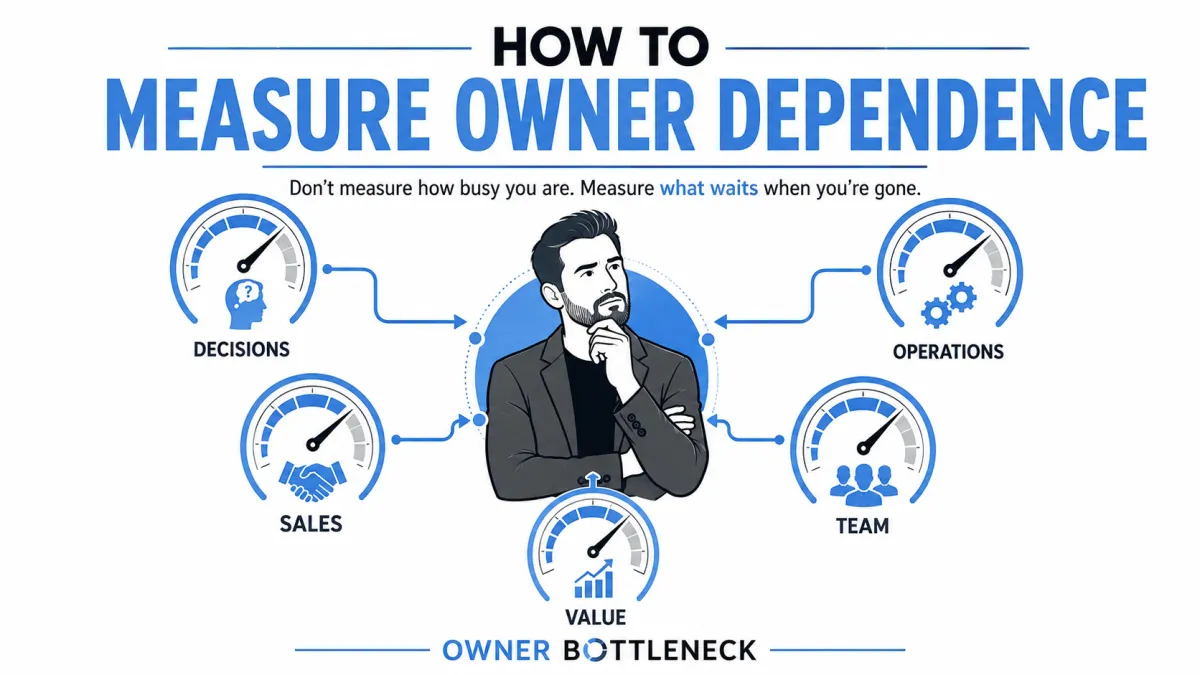
Illustration showing five gauges measuring owner dependence across decisions, sales, operations, team, and business value

How to Measure Owner Dependence in Your Business

July 14, 202617 min read

You can’t measure owner dependence by asking how busy the owner feels.

Some owners work 60 hours a week because they enjoy being involved.

Others work 30 hours and still control every decision that matters.

One owner may be buried in tasks.

Another may appear removed from daily work while remaining the final answer behind the scenes.

Hours worked can tell you something about workload.

They don’t tell you whether the business can operate without the owner.

Owner dependence is measured by what waits, slows down, weakens, changes, or stops when the owner isn’t involved.

That’s the real test.

Key Takeaways

  • Owner dependence isn’t measured only by how many hours the owner works.

  • The strongest evidence is what waits, slows down, changes, or stops when the owner becomes unavailable.

  • Dependence should be measured across five areas: Decision, Sales, Operations, Team, and Value.

  • Look for repeated patterns rather than isolated questions, emergencies, or unusual situations.

  • The goal isn’t to remove the owner from everything. It’s to identify where the business relies on the owner more than it should.

What is owner dependence?

Owner dependence exists when the business relies too heavily on the owner’s decisions, judgment, knowledge, relationships, approval, standards, or presence.

It’s the condition underneath an Owner Bottleneck.

The business may have employees.

It may have managers.

It may have documented processes.

It may even produce strong revenue and profit.

But when something important, unusual, expensive, sensitive, or uncertain happens, the business still turns toward the owner.

That dependence may be obvious.

The owner might approve every purchase, answer every customer complaint, or close every major sale.

It may also be subtle.

The team may technically make decisions, but only after predicting what the owner would want.

Managers may appear to lead while checking important choices privately with the owner.

Customers may work with employees while continuing to believe the owner is the person who will ultimately protect the relationship.

The business looks independent.

The confidence behind it still comes from one person.

Why hours worked are a poor measurement

Owners often use hours worked as the primary measure of dependence.

They assume:

If I’m working fewer hours, the business must depend on me less.

That isn’t always true.

An owner may reduce their workload while remaining the final approver.

They aren’t completing the work.

They’re still required before the work can move forward.

Another owner may work long hours on strategy, product development, acquisitions, or other high-value responsibilities.

That doesn’t automatically make them the bottleneck.

The better question isn’t:

How many hours does the owner work?

It’s:

What happens to the business when the owner stops working?

Does the team keep deciding?

Do customers continue trusting the company?

Does the sales process continue producing revenue?

Do projects continue moving?

Are standards maintained?

Are problems resolved at the right level?

Can the company function without creating a backlog for the owner?

Those questions reveal dependence.

The 30-day absence test

One of the clearest ways to think about owner dependence is to imagine the owner disappearing from the business for 30 days.

Not checking email.

Not answering the phone.

Not joining meetings.

Not stepping in when something goes wrong.

What would happen?

Some businesses would continue operating normally.

The owner might return to updates, decisions that appropriately waited, and a few issues requiring strategic attention.

Other businesses would start backing up within hours.

Quotes would wait.

Customers would become frustrated.

Employees would delay decisions.

Projects would stall.

Managers would avoid taking risks.

Payments might not be approved.

Sales opportunities would sit untouched.

The owner would return to a month’s worth of unresolved work.

The difference between those two businesses is owner dependence.

You don’t need to disappear for 30 days to learn from this question.

But you do need to answer it honestly.

Measure what waits for the owner

Every bottleneck creates a queue.

For an owner-dependent business, that queue often forms around the owner.

Look at what repeatedly waits for:

  • Approval

  • Direction

  • Judgment

  • A final review

  • A customer response

  • A pricing decision

  • A hiring decision

  • A financial decision

  • A difficult conversation

  • Permission to move forward

One item waiting on the owner doesn’t prove there’s a serious problem.

Some decisions should remain with the owner.

The warning sign is repetition.

The same type of decision keeps returning.

The same department keeps waiting.

The same manager keeps escalating.

The same customer issue requires owner involvement.

The same project stalls at the same point.

Repeated waiting is evidence that dependence has become part of the operating system.

Ask:

  • What waited for me last week?

  • How long did it wait?

  • Who was waiting?

  • Why couldn’t they move forward?

  • Was my involvement truly necessary?

  • Has this happened before?

You’re not looking for random interruptions.

You’re looking for patterns.

Measure what slows down when you’re unavailable

Some work doesn’t completely stop without the owner.

It just becomes slower.

That can be harder to notice.

The team eventually gets the job done.

The sale eventually closes.

The customer eventually receives an answer.

The project eventually moves forward.

But everything takes longer because people are working around the missing owner.

They delay action.

They schedule another meeting.

They send a follow-up message.

They wait for the owner to return.

They make a temporary decision but avoid committing fully.

The business continues operating, but at reduced speed.

That matters because bottlenecks don’t always shut down the entire system.

Sometimes they quietly reduce throughput.

Ask:

  • Which decisions take longer when I’m away?

  • Which projects lose momentum?

  • Which customers receive slower responses?

  • Which employees postpone action?

  • Which opportunities become less likely to close?

  • Which meetings get rescheduled because I’m not available?

A business that continues moving at half speed is still dependent.

Measure what changes when you aren’t involved

Owner dependence can also appear as inconsistency.

The work continues.

The quality changes.

When the owner is involved:

  • Communication is sharper.

  • Customers feel reassured.

  • Problems are resolved more completely.

  • Standards are clearer.

  • Sales conversations are stronger.

  • Details are caught earlier.

When the owner isn’t involved:

  • The work becomes less consistent.

  • Customers sense uncertainty.

  • Employees interpret standards differently.

  • Decisions become overly cautious.

  • Problems get technically resolved without addressing the real issue.

This doesn’t automatically mean the team is incapable.

It may mean the owner’s standards, judgment, or context haven’t been transferred.

The business knows what good looks like when the owner is present.

It hasn’t yet made that standard repeatable without them.

Ask:

  • Where does quality change when I’m not involved?

  • Where does customer confidence change?

  • Where do employees interpret standards differently?

  • Where do problems get solved differently than I would solve them?

  • Where does the team know the steps but not the judgment behind them?

The owner may not be doing the work.

Their involvement may still be the quality-control system.

Measure how often decisions escalate

Not every question is evidence of owner dependence.

Employees should ask questions.

Managers should escalate meaningful risks.

Leaders should involve the owner in decisions that belong at the ownership level.

The issue is unnecessary escalation.

Track how often decisions rise to the owner that could reasonably be handled elsewhere.

That might include:

  • Routine customer concessions

  • Scheduling changes

  • Small purchases

  • Pricing within an approved range

  • Employee coaching

  • Vendor problems

  • Project adjustments

  • Operational exceptions

  • Standard hiring decisions

Then ask why each decision escalated.

Was authority unclear?

Was the outcome unclear?

Was the person afraid of being wrong?

Did the owner previously reverse similar decisions?

Was important information unavailable?

Did the person lack the necessary skill?

Was the decision genuinely outside their role?

The number of escalations matters.

The reason behind them matters more.

A high number of unnecessary escalations usually points to a Decision Bottleneck.

Measure the percentage of revenue tied to the owner

Revenue dependence is one of the most important areas to measure.

Ask how much revenue would be at risk if the owner stopped participating in sales and customer relationships.

Look at:

  • Sales personally closed by the owner

  • Opportunities requiring owner involvement

  • Accounts tied to the owner’s relationship

  • Referrals generated by the owner’s network

  • Customers who ask specifically for the owner

  • Renewals influenced by the owner

  • Major accounts the team isn’t confident managing alone

An owner may have a sales team and still remain central to revenue.

Salespeople may find the opportunities.

The owner creates trust.

Salespeople may run the process.

The owner joins when the conversation becomes important.

Account managers may serve customers.

The owner protects the relationship when something goes wrong.

That’s a Sales Bottleneck.

Ask:

  • What percentage of new revenue requires my involvement?

  • What percentage of total revenue depends on relationships I personally hold?

  • Which customers would feel less confident if I left?

  • Which deals become harder to close without me?

  • Can the team explain our value with the same clarity and conviction?

  • Can someone else carry the relationship when the stakes are high?

Strong revenue doesn’t always mean the sales function is transferable.

Measure how many exceptions return to the owner

Most businesses can handle normal work.

Owner dependence becomes visible when something unusual happens.

A customer asks for something outside the standard offer.

A project falls behind.

An employee makes a mistake.

A supplier fails.

A scheduling conflict appears.

The process doesn’t clearly cover the situation.

Who handles the exception?

In many owner-led businesses, the answer is always the owner.

The company may have procedures for predictable work.

The owner remains the procedure for everything unpredictable.

That creates an Operations Bottleneck.

Track exceptions for 30 days.

For each one, record:

  • What happened

  • Who first received the problem

  • Why they couldn’t resolve it

  • What decision the owner made

  • Whether a similar exception has happened before

  • What would need to change for the issue to be resolved without the owner next time

Repeated exceptions are especially valuable.

They’re evidence that the business keeps treating a recurring problem as though it were unusual.

Measure whether managers truly own outcomes

A company can have managers without having management depth.

A title doesn’t prove ownership has transferred.

Measure whether managers can:

  • Make decisions within their responsibilities

  • Address poor performance

  • Resolve conflict

  • Prioritize work

  • Hold people accountable

  • Communicate standards

  • Manage customer issues

  • Explain their reasoning

  • Produce results without constant owner intervention

Then look at what happens when the manager struggles.

Does the owner coach them?

Or does the owner take over?

Does the manager remain responsible for the outcome?

Or does the responsibility move back upstairs?

That’s where many Team Bottlenecks become visible.

The owner may say:

My managers need to step up.

The managers may believe:

The owner will step back in anyway.

Both sides may be responding to years of learned behavior.

Ask:

  • Which outcomes do my managers truly own?

  • What decisions can they make without me?

  • What difficult conversations do they avoid?

  • What responsibilities keep returning to me?

  • Am I coaching their judgment or replacing it?

  • Do they know what success looks like?

  • Are they accountable for the result, or only the activity?

True management depth is measured by what the organization can handle below the owner.

Measure how much knowledge lives only in the owner’s head

Some owner dependence is based on information.

The owner remembers:

  • Why a customer received special terms

  • Which vendor can be trusted

  • How a complicated service is priced

  • What happened during a previous employee issue

  • Why the company stopped offering something

  • Which warning signs matter

  • What a strong customer fit looks like

  • How cash decisions are made

  • Why certain standards exist

The team may have access to data.

The owner holds the meaning behind the data.

This is why documenting steps doesn’t always solve owner dependence.

A checklist can tell someone what to do.

It may not teach them what to notice, why it matters, or how to decide when the situation changes.

Ask:

  • What important information exists only in my memory?

  • What context would disappear if I left?

  • What decisions depend on history only I understand?

  • What customer or vendor relationships rely on undocumented knowledge?

  • What standards are obvious to me but difficult for others to explain?

  • Where have we documented the process but not the reasoning?

Knowledge becomes transferable when people can use it without constantly returning to the person who originally gained it.

Measure how much trust belongs to the company versus the owner

Customers may say they trust the business.

Listen closely to what they mean.

Do they trust the company?

Or do they trust the owner to protect them if something goes wrong?

Those are different kinds of trust.

The owner may be the company’s reputation insurance.

The customer works with the team because they believe the owner is still standing behind the work.

That can be powerful.

It can also create dependence.

Ask:

  • Who do customers call when the situation becomes serious?

  • Who do they ask for during a major purchase?

  • Who reassures them after a mistake?

  • Would they accept the same answer from a manager?

  • Are customer relationships attached to the company or to me personally?

  • Can the team preserve trust without using my name as the final guarantee?

The goal isn’t to weaken the owner’s reputation.

It’s to transfer more of that trust into the company.

Measure the owner’s approval footprint

Your approval footprint is the number of places where work can’t be considered complete until you approve it.

That may include:

  • Marketing

  • Pricing

  • Proposals

  • Hiring

  • Purchases

  • Scheduling

  • Customer remedies

  • Design

  • Quality control

  • Contracts

  • Content

  • Payments

Approval feels different from doing the work.

But approval still creates dependence.

The team completes 95 percent.

The final 5 percent waits on the owner.

That final step may control the speed of the entire process.

Ask:

  • What requires my signature?

  • What requires my review?

  • What requires my opinion?

  • What requires my verbal approval even when it isn’t formally documented?

  • How many items are waiting for approval right now?

  • Which approvals exist because of real risk?

  • Which approvals exist because we’ve always done it this way?

You may discover that the owner’s calendar isn’t full of work.

It’s full of other people’s finished work waiting to become official.

Measure what happens to business value without the owner

Owner dependence isn’t only an operational problem.

It affects business value.

Imagine a buyer evaluating the company.

They’ll want to know:

  • Who owns customer relationships?

  • Who drives sales?

  • Who makes important decisions?

  • Who understands the financial model?

  • Who manages employees?

  • Who protects quality?

  • Who handles major problems?

  • What happens when the owner leaves?

The more often the answer is the current owner, the harder the business becomes to transfer.

That creates a Value Bottleneck.

Ask:

  • Would revenue remain stable after my departure?

  • Would major customers stay?

  • Could managers operate the business?

  • Is critical knowledge documented and understood?

  • Could someone else produce the same decisions?

  • Would the company maintain its standards?

  • Would a buyer be purchasing a business, or purchasing a job that only I know how to perform?

A business can be profitable and still be heavily dependent on the owner.

Profit measures what the company produces today.

Transferability measures whether it can continue producing after the owner leaves.

Use a 30-day Owner Dependence Log

One of the simplest ways to measure owner dependence is to track it for 30 days.

Every time something reaches you, record:

  • What came to you

  • Who brought it

  • Why they needed you

  • How long the issue had been waiting

  • Whether your involvement was truly necessary

  • Whether the same type of issue has happened before

  • What would have allowed the issue to stay with the team

Don’t attempt to fix every issue while tracking it.

First, observe the pattern.

At the end of 30 days, group the entries into:

  • Decisions

  • Sales

  • Operations

  • Team

  • Value

You may find that one area generates far more dependence than the others.

That’s useful.

You don’t need to attack every bottleneck at once.

You need to find the one creating the largest current constraint.

Look for frequency, impact, and transferability

Not every owner-dependent activity deserves the same level of attention.

Evaluate each one using three questions.

How frequently does it happen?

A minor issue that reaches the owner every day may create more damage than a major issue that occurs once a year.

Frequency creates queues.

Queues create delays.

What is the impact?

Some dependencies affect convenience.

Others affect revenue, customers, employees, risk, or cash.

The more meaningful the consequence, the more seriously the dependence should be evaluated.

Can it be transferred safely?

Some responsibilities belong with the owner.

Others remain with the owner because the business hasn’t yet transferred the necessary authority, information, process, judgment, or capability.

The goal isn’t to transfer everything.

It’s to separate true ownership-level work from dependence that exists only because no better system has been built.

Common measurement mistakes

Measuring activity instead of dependence

Counting the owner’s tasks doesn’t reveal whether the business needs the owner.

Focus on what requires their involvement.

Treating every question as a problem

Healthy teams ask questions.

The issue is repeated escalation that prevents people from developing judgment.

Measuring only during a crisis

Crises naturally pull the owner in.

Measure normal operating conditions too.

Assuming fewer hours means less dependence

The owner may work fewer hours while remaining the final decision-maker behind everything important.

Blaming the team too quickly

A team may appear dependent because authority, standards, information, and outcomes were never made clear.

Trying to fix everything immediately

If you change every process while measuring, you may never see the pattern clearly.

Observe first.

Prioritize second.

Attack third.

What healthy owner involvement looks like

A healthy business can still benefit from the owner.

The owner may:

  • Set direction

  • Make major strategic decisions

  • Maintain certain critical relationships

  • Protect the company’s mission

  • Approve material investments

  • Develop leaders

  • Evaluate risk

  • Allocate capital

  • Identify the next constraint

The difference is that the company doesn’t need the owner to keep ordinary work moving.

The owner is valuable.

They aren’t the point every task, question, decision, customer, and exception must pass through.

What should you do after measuring owner dependence?

Don’t build a giant improvement plan.

Choose the strongest pattern.

Maybe decisions keep waiting for approval.

Maybe customer issues always come back to you.

Maybe sales still depend on your presence.

Maybe managers aren’t carrying outcomes.

Maybe every operational exception lands in your lap.

Start with the area creating the greatest constraint.

Then ask:

  • Why does this keep coming back?

  • What outcome is unclear?

  • What authority is missing?

  • What information is unavailable?

  • What judgment needs to be taught?

  • What standard exists only in my head?

  • What capability needs to be developed?

  • What boundary needs to be defined?

  • What accountability is missing?

The solution depends on the cause.

That’s why measuring comes before fixing.

Frequently asked questions about measuring owner dependence

Is owner dependence always bad?

No.

Some level of owner involvement is normal and healthy.

The concern is excessive dependence, especially when work that should be handled elsewhere repeatedly waits for the owner.

How long should I track owner dependence?

Thirty days is usually long enough to reveal recurring patterns.

A shorter period may overemphasize an unusual week.

A longer period may be useful for seasonal businesses or infrequent responsibilities.

Should I count every question employees ask me?

No.

Track questions that require your judgment, approval, knowledge, or intervention before progress can continue.

Routine communication isn’t automatically evidence of a bottleneck.

What if I’m still the best person to handle the responsibility?

You may be.

The question is whether you must remain the only person capable of handling it.

Being the best person today doesn’t mean the company should depend on you forever.

Does having SOPs mean my business isn’t owner-dependent?

No.

SOPs can reduce dependence for predictable work.

The business may still rely on the owner for exceptions, judgment, standards, relationships, and decisions.

Can a business be valuable if it still depends on the owner?

Yes, but the dependence can weaken transferability and increase risk.

The more results depend on the current owner, the more uncertainty a buyer may see.

Measure the business by what happens without you

The strongest business isn’t the one where the owner does nothing.

It’s the one where the owner’s involvement is intentional.

Important work doesn’t wait simply because the owner is unavailable.

People know what they own.

They understand what they can decide.

Customers trust the company beyond one person.

Processes handle predictable work.

Principles and judgment guide the exceptions.

Managers carry real responsibility.

The owner remains valuable without being required everywhere.

That’s the standard.

Don’t measure owner dependence by how tired you feel.

Measure it by what the business can do without waiting for you.

See where your business depends on you most

The free Owner Bottleneck Scorecard evaluates owner dependence across Decisions, Sales, Operations, Team, and Value.

It’ll help you see which bottleneck may be creating the greatest constraint in your business right now.

Take the Owner Bottleneck Scorecard

Darrell Willis
Darrell Willis is an Owner Bottleneck advisor and author of The Owner Bottleneck. He helps owner-led businesses find where too much still depends on the owner, understand what that dependence is costing, and attack the right bottleneck first. Darrell brings together experience in finance, sales, business ownership, operations, and private equity to help owners build businesses that are easier to run, easier to grow, and less dependent on them.
Back to Blog

Build a Business That Depends on You Less

Darrell Willis helps owner-led businesses find and attack the Owner Bottleneck so the business can grow, run, and create value without everything depending on the owner.

© 2026 Darrell Willis. All rights reserved