
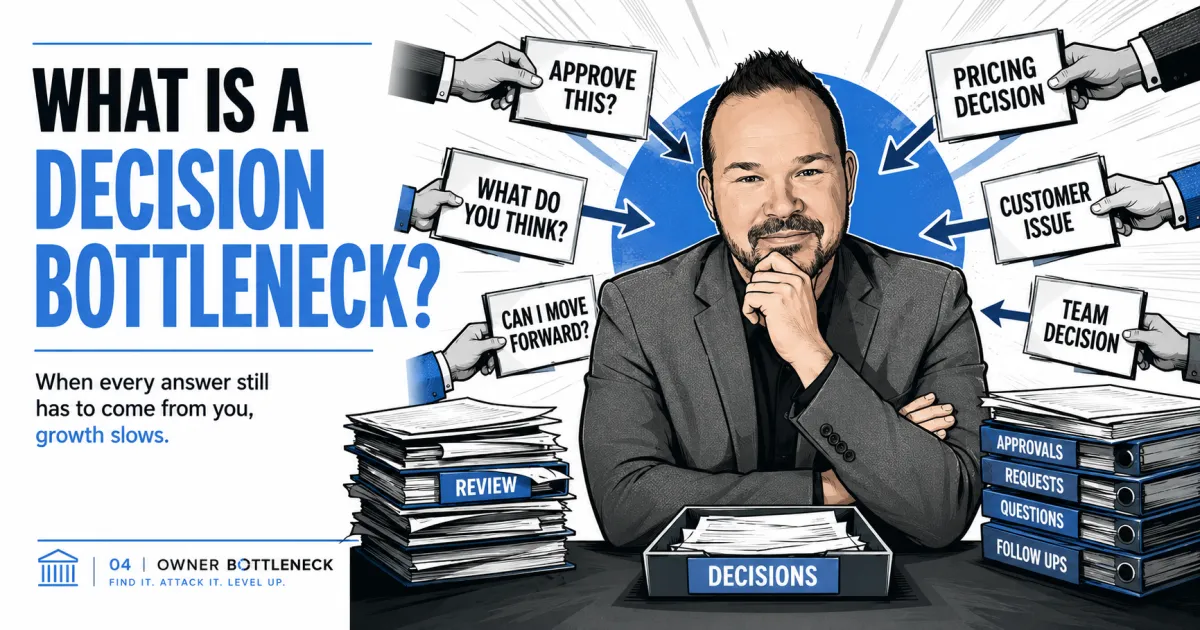
What Is a Decision Bottleneck?
At 8:17 a.m., someone asks whether they can adjust a customer’s delivery date.
At 8:46, a manager needs approval to replace a piece of equipment.
At 9:12, sales wants to know how much flexibility they have on pricing.
At 9:38, an employee issue gets forwarded to the owner.
At 10:04, marketing needs the final word on a campaign.
None of these decisions takes very long.
That’s what makes the problem easy to miss.
The owner answers one question, approves one request, settles one disagreement, and moves on to the next thing.
But while each decision may take the owner only a few minutes, the business may have spent hours waiting for the answer.
The owner isn’t completing all the work.
The owner is still controlling whether the work can move.
That’s a Decision Bottleneck.
Key Takeaways
A Decision Bottleneck exists when too many decisions must reach the owner before the business can move forward.
The problem isn’t simply that the owner makes important decisions. It’s that routine, recurring, or reversible decisions keep returning to the owner unnecessarily.
Decision Bottlenecks slow execution, weaken managers, create approval queues, and make the owner’s availability part of the operating system.
Employees need clear outcomes, authority, boundaries, information, and decision principles before responsibility can truly move.
The goal isn’t to remove the owner from every decision. It’s to make the owner’s involvement intentional.
What is a Decision Bottleneck?
A Decision Bottleneck is a version of the Owner Bottleneck where too many decisions depend on the owner’s judgment, approval, preference, knowledge, or authority.
The company may have employees.
It may have managers.
Responsibilities may appear to be delegated.
But when someone reaches a point of uncertainty, risk, disagreement, or exception, the decision moves back to the owner.
The team can perform the work.
They can’t always decide what happens next.
That difference matters.
The business may not stop completely when the owner is unavailable.
Instead, decisions begin accumulating.
Quotes wait.
Purchases wait.
Customer remedies wait.
Schedules wait.
Hiring decisions wait.
Projects wait.
Employees work around what they can’t decide, then return to the unfinished issue later.
The owner eventually comes back to a queue filled with decisions that no one else believed they could make.
Important decisions aren’t the problem
Owners should make certain decisions.
Major investments, strategic direction, ownership changes, material financial commitments, senior leadership hires, and significant legal risks may belong with the owner.
The existence of owner decisions doesn’t automatically mean there’s a bottleneck.
A Decision Bottleneck forms when decisions reach the owner because of habit, fear, missing authority, unclear standards, or incomplete transfer, not because the decision genuinely belongs at the ownership level.
The warning sign isn’t:
The owner makes decisions.
The warning sign is:
The business keeps sending decisions to the owner that should be made somewhere else.
A healthy organization routes a decision to the level closest to the information and responsibility required to make it.
An owner-dependent organization routes uncertainty upward.
The phrase that reveals a Decision Bottleneck
Listen for this sentence:
Let me check with the owner.
Sometimes that’s appropriate.
But when customers, employees, vendors, managers, and salespeople hear it repeatedly, it reveals how authority actually works inside the company.
A salesperson can explain the offer.
They need the owner to approve the terms.
A manager can investigate the employee issue.
They need the owner to decide what happens.
A customer service employee can understand the complaint.
They need the owner to approve the remedy.
An operations leader can identify the scheduling problem.
They need the owner to choose between the options.
The work happens throughout the organization.
The authority remains concentrated in one person.
What a Decision Bottleneck looks like
Decision Bottlenecks don’t always look dramatic.
They often show up as normal parts of the owner’s day.
Work is almost finished
The team completes most of the work.
The proposal is prepared.
The customer response is drafted.
The schedule is rebuilt.
The candidate has been interviewed.
The purchase has been researched.
Everything is ready.
But it isn’t considered complete until the owner looks at it.
The final 5 percent controls whether the previous 95 percent can produce a result.
Managers bring problems instead of decisions
A manager enters the owner’s office and explains what happened.
The owner asks:
What do you think we should do?
The manager responds:
I wanted to see what you thought.
The manager may have a title.
The owner still carries the decision.
Over time, managers can become highly skilled at gathering information for the owner without becoming skilled at deciding.
Meetings end with the owner settling everything
The team discusses options.
People share perspectives.
Risks are identified.
Then everyone looks toward the owner.
The meeting wasn’t designed to produce a team decision.
It was designed to help the owner make a better one.
That may be appropriate for major strategic issues.
It becomes a bottleneck when routine operating meetings function the same way.
The owner’s inbox becomes a waiting room
Emails contain phrases like:
Can you approve this?
What would you like us to do?
Are you okay with this?
Can I move forward?
Which option do you prefer?
Can you take a quick look?
The customer wants to know what you think.
Each message appears small.
Together, they reveal that the owner is part of dozens of workflows.
Vacations create a decision backlog
The owner leaves for several days.
Employees continue performing what they already understand.
Anything uncertain waits.
When the owner returns, the inbox is full of issues that were technically active but practically stalled.
The company didn’t stop working.
It stopped deciding.
Employees predict the owner instead of serving the outcome
People stop asking:
What’s the best decision for the business?
They start asking:
What would the owner want?
Those questions may sometimes lead to the same answer.
But they create very different organizations.
One develops judgment.
The other develops dependence.
The owner is interrupted all day
Decision Bottlenecks rarely arrive as one giant strategic decision.
They arrive as 20 small questions.
The owner tries to complete focused work, but every few minutes someone needs a response.
By the end of the day, the owner has been busy without moving their most important priorities forward.
The day didn’t get consumed by one major problem.
It got drained by small decisions the business couldn’t make without them.
Why Decision Bottlenecks form
Decision Bottlenecks usually develop for understandable reasons.
The owner built the company by making decisions quickly, protecting customers, controlling risk, and noticing things other people missed.
That ability helped the business survive.
The problem appears when the company grows but the decision structure doesn’t.
The owner has more context
The owner remembers why a policy exists.
They understand the customer’s history.
They know how one decision affects another part of the company.
They recognize risks that aren’t obvious to someone with less experience.
Giving the owner the decision may seem efficient because the owner can see the entire picture.
But when the context remains only in the owner’s head, the business can’t develop decision-making depth elsewhere.
The owner keeps making the decision because the owner has the context.
The team never gains the context because the owner keeps making the decision.
Authority was never clearly defined
Employees may be told to take ownership without being told what they can decide.
They don’t know:
How much money they can authorize
Which customer remedies they can offer
How far they can adjust a schedule
What pricing flexibility they have
Which employee issues they can handle
What risks require escalation
What consequences they’re allowed to accept
When authority is vague, escalation feels safer.
The owner has reversed decisions before
An employee makes a choice.
The owner disagrees.
The owner changes the decision, communicates something different to the customer, or takes the responsibility back.
The employee learns that authority is temporary.
They can decide until the owner decides differently.
The next time, they wait.
This can happen even when the owner believes they’re merely correcting a mistake.
The team may experience it as proof that the safest decision is no decision without approval.
The owner’s preferences are mistaken for standards
The owner may have a specific way they would handle a situation.
That doesn’t automatically make every other reasonable approach wrong.
If employees are corrected whenever their choice differs from the owner’s preference, they stop using judgment.
They begin trying to reproduce the owner.
A standard protects an important outcome.
A preference reflects how one person likes to reach it.
Confusing the two creates unnecessary approval.
The cost of a wrong decision feels too high
Some employees escalate because they’re afraid of the consequences.
They may have seen mistakes criticized more heavily than delayed decisions.
They may believe the owner values avoiding error more than moving quickly.
So they wait.
From the employee’s perspective, waiting is rational.
A delayed decision may create frustration.
A wrong decision may create blame.
The owner answers faster than they coach
The employee brings a question.
The owner knows the answer immediately.
Explaining the reasoning would take several minutes.
Giving the answer takes 20 seconds.
So the owner answers.
The immediate issue gets resolved.
The employee’s decision-making ability stays the same.
The next similar decision returns.
Speed today creates dependence tomorrow.
Accountability is unclear
Sometimes the person making the decision won’t be accountable for the outcome.
They may believe the owner will ultimately carry the consequence.
That makes ownership feel optional.
Real decision authority must be connected to real responsibility for the result.
What a Decision Bottleneck costs
The cost is larger than the time the owner spends answering questions.
It slows the entire business
A two-minute decision can create a two-day delay.
The owner sees the time required to answer.
The business experiences the time spent waiting.
That difference hides the true cost.
It weakens managers
Managers develop by making decisions, seeing results, reviewing mistakes, and improving their judgment.
If the owner continues making the difficult decisions, managers gain information without gaining experience.
The owner may later conclude that the managers aren’t ready.
But the system never allowed them to become ready.
It makes growth heavier
More customers create more exceptions.
More employees create more questions.
More projects create more tradeoffs.
More departments create more decisions.
If the percentage of decisions reaching the owner stays the same, growth doesn’t create leverage.
It creates a larger queue.
Revenue may increase while the owner’s freedom decreases.
It increases hidden risk
Concentrating decisions in one person can feel like control.
It also creates a single point of failure.
If the owner becomes unavailable, the company may lose the ability to respond quickly.
The business may know how to perform normal work but struggle whenever judgment is required.
It trains the team to avoid responsibility
People adapt to the system around them.
When waiting is safer than deciding, people wait.
When approval protects them from consequences, they seek approval.
When the owner eventually steps in, they escalate sooner.
The owner may believe the team lacks initiative.
The team may believe the owner doesn’t truly want them to decide.
Both behaviors reinforce each other.
It consumes the owner’s attention
Decision fatigue isn’t only created by major strategic choices.
It’s created by switching constantly between unrelated issues.
Pricing.
Scheduling.
Hiring.
Customer complaints.
Purchases.
Marketing.
Employee conflicts.
Project priorities.
The owner spends the day changing mental context, often without enough uninterrupted time to think deeply about the decisions that genuinely require them.
It can weaken business value
A buyer isn’t only evaluating what the business earns.
They’re evaluating how those earnings are produced.
If the owner remains the final decision-maker behind customers, employees, operations, and sales, the buyer may see greater transition risk.
The company may be profitable while still carrying a Value Bottleneck.
How to measure a Decision Bottleneck
Don’t estimate it based only on how interrupted you feel.
Track the decisions.
For 30 days, record every decision that reaches the owner.
Include:
What decision was needed
Who brought it
How long it had been waiting
Why the person believed the owner was required
Whether the decision had happened before
What information the owner used
Whether the decision could safely be made elsewhere
What would need to change before it could transfer
Then group the decisions.
You’ll usually find patterns.
Pricing exceptions.
Customer remedies.
Scheduling conflicts.
Purchases.
Hiring.
Quality approval.
Employee issues.
Marketing review.
Operational exceptions.
The goal isn’t to count every conversation.
It’s to identify recurring decisions that keep returning to the same person.
For a broader diagnosis across Decisions, Sales, Operations, Team, and Value, read How to Measure Owner Dependence in Your Business.
Which decisions should stay with the owner?
Keep decisions with the owner when they involve:
Major strategic direction
Ownership or equity
Material financial commitments
Significant legal exposure
Senior leadership selection
Irreversible changes
Risks that could threaten the company
Responsibilities that properly belong at the ownership level
But challenge decisions that return to the owner because:
The team has always asked
The owner has always answered
Authority was never documented
The standard exists only in the owner’s head
The employee is afraid of being wrong
The owner wants the result handled exactly as they would handle it
No one has been developed to carry the responsibility
The test isn’t whether the owner can make the decision better.
The owner may be the best decision-maker in the company.
The test is whether the business must continue depending on that forever.
Reversible versus irreversible decisions
One useful distinction is whether a decision can be reversed.
Some decisions are difficult or expensive to undo.
Others can be changed quickly after new information appears.
A major acquisition may be difficult to reverse.
Testing a different meeting rhythm is not.
Signing a long-term facility lease may be difficult to reverse.
Allowing a manager to approve a modest customer credit is not.
Owners often apply the same approval standard to both kinds of decisions.
That slows the company unnecessarily.
Reversible decisions should usually be made faster, closer to the work, and with enough room for adjustment.
Irreversible or high-risk decisions deserve more scrutiny.
The goal isn’t careless decision-making.
It’s matching the level of control to the actual level of risk.
How to remove a Decision Bottleneck
You don’t solve this by telling everyone to stop asking questions.
You solve it by building a better decision system.
Find the recurring decision queue
Start with decisions that repeatedly reach you.
Don’t begin with the most complicated strategic issue in the business.
Choose a common decision that creates frequent interruption or delay.
Examples might include:
Customer credits
Pricing within a certain range
Schedule changes
Routine purchases
Employee coaching
Vendor substitutions
Project adjustments
Quality approval
Frequency matters.
Removing one recurring decision can eliminate dozens of future interruptions.
Define the outcome
What result is the decision supposed to protect?
For a customer complaint, the outcome might be:
Resolve legitimate concerns quickly, preserve trust, and avoid unnecessary concessions.
For pricing, it might be:
Protect margin while giving qualified prospects enough flexibility to move forward.
For scheduling, it might be:
Meet customer commitments without creating unsafe or unrealistic workloads.
The clearer the outcome, the easier it becomes to make decisions without reproducing the owner’s exact preference.
Set decision boundaries
Define what the person can decide without approval.
That could include:
Financial limits
Discount ranges
Customer remedy limits
Hiring authority
Schedule flexibility
Risk thresholds
Situations requiring escalation
Boundaries should be specific enough to create confidence.
“Use your best judgment” isn’t a boundary.
It’s a request to guess what the owner would approve.
Transfer the information behind the decision
People need access to the information the owner uses.
For example:
Customer profitability
Capacity
Cash position
Pricing guidelines
Project history
Customer history
Previous decisions
Current priorities
Risk levels
You can’t ask someone to make an informed decision while keeping the relevant information concentrated with the owner.
Teach decision principles
Processes handle predictable situations.
Principles help with situations that don’t fit perfectly.
Examples might include:
Protect the long-term relationship without rewarding unreasonable behavior.
Never promise a deadline before confirming capacity.
Don’t discount simply because someone asks.
Fix the immediate problem, then identify why it happened.
Escalate safety, legal, or material financial risks.
Choose the option that protects the company’s ability to deliver what it promised.
Principles carry judgment farther than rules alone.
Require a recommendation
When someone brings a decision to the owner, don’t accept only the problem.
Ask for:
Their recommended decision
The alternatives they considered
The information they used
The risk they’re most concerned about
What they would do if the owner were unavailable
This doesn’t mean refusing to help.
It means the person must participate in the thinking.
Over time, the conversation should move from:
What should I do?
To:
Here’s what I recommend and why.
Eventually, many of those conversations should disappear.
Review decisions instead of approving all of them
Early in the transfer, the owner may need visibility.
But visibility doesn’t require preapproval.
Let the person decide within defined boundaries.
Then review the decisions afterward.
Discuss:
What happened
What reasoning was used
What worked
What didn’t
What principle should guide the next decision
Whether the boundary needs adjustment
This develops judgment without placing the owner back in the middle of every workflow.
Allow reasonable mistakes
Transferring authority means accepting that someone may make a decision differently than the owner.
Some decisions will produce imperfect results.
That isn’t automatically failure.
Ask whether the person:
Had the right information
Stayed within the boundary
Applied the agreed principles
Made a reasonable judgment
Learned from the outcome
Carelessness needs accountability.
Developing judgment needs coaching.
Treating both the same will send every future decision back to the owner.
Stop taking decisions back
The owner must change too.
When a situation becomes uncomfortable, the instinct may be to step in.
Sometimes that’s necessary.
But if the owner repeatedly takes control whenever risk appears, the team learns that ownership exists only during easy situations.
The most important decisions for development are often the ones that contain uncertainty.
Measure whether the queue is shrinking
Look for:
Fewer approvals reaching the owner
Shorter decision times
Fewer stalled projects
Managers bringing recommendations
More issues resolved at the correct level
Better explanations of decision reasoning
Fewer decisions waiting during the owner’s absence
Consistent outcomes without owner review
Don’t measure success by how many times you told someone to take ownership.
Measure whether the business actually waits for you less.
Example: transferring customer credits
Suppose every customer credit requires owner approval.
The employee investigates the problem.
A manager confirms what happened.
The customer waits.
The owner reviews the details and decides whether to issue the credit.
The owner may spend only three minutes deciding.
But the customer may have waited a full day.
To transfer the decision, define:
Outcome
Resolve valid customer concerns quickly while protecting trust and avoiding unnecessary concessions.
Authority
The service manager can approve credits up to a defined amount.
Boundaries
Safety issues, legal threats, repeated large concessions, or credits above the limit must be escalated.
Information
The manager can access the customer’s history, project value, previous credits, and profitability.
Principles
Own legitimate mistakes. Don’t reward abusive behavior. Resolve the immediate concern, then identify the operational cause.
Accountability
Credits and recurring complaint patterns are reviewed monthly.
The owner still has visibility.
The customer no longer waits for every decision.
Example: transferring pricing decisions
A salesperson may be authorized to sell but unable to adjust anything without the owner.
Every negotiation reaches the owner.
That creates delay and teaches the prospect that the salesperson isn’t the real authority.
Instead, define:
Standard pricing
Acceptable discount range
Minimum margin
Conditions required for flexibility
Nonprice concessions the salesperson can offer
Situations requiring escalation
How exceptions will be reviewed
Now the salesperson can decide within the structure.
The owner remains involved only when the decision falls outside it.
That’s what delegation with actual ownership looks like.
Frequently asked questions about Decision Bottlenecks
Should the owner stop making decisions?
No.
The goal isn’t to remove the owner from the business.
The goal is to keep the owner focused on decisions that genuinely require ownership-level judgment.
What if the team makes poor decisions?
Determine why.
Did they lack information?
Was the outcome unclear?
Were the boundaries vague?
Did they misunderstand the principle?
Did they act carelessly?
Do they lack the necessary capability?
The solution depends on the cause.
Don’t use one poor decision as proof that no decisions can transfer.
How quickly can a decision transfer?
Simple, recurring decisions may transfer quickly once the boundaries are clear.
Decisions involving significant judgment, customer trust, leadership, or financial risk may require coaching and gradual expansion of authority.
Can an SOP solve a Decision Bottleneck?
An SOP can help with repeatable decisions.
It won’t cover every exception.
Strong decision-making also requires outcomes, principles, information, authority, judgment, and accountability.
What’s the difference between a Decision Bottleneck and a Team Bottleneck?
A Decision Bottleneck centers on where decisions and approvals live.
A Team Bottleneck is broader. It may involve weak ownership, accountability, leadership depth, role clarity, or capability.
The two often reinforce each other.
What if employees don’t want more authority?
Some may not.
Others may have learned that authority carries risk without real support.
Start by creating clear boundaries, coaching decisions, and reviewing outcomes fairly.
Then evaluate whether the person is willing and capable of carrying the responsibility.
The owner shouldn’t be the automatic answer
The owner may always be capable of making the decision.
That doesn’t mean the decision should always reach them.
Every repeated approval teaches the business where authority lives.
Every quick answer teaches the team where answers come from.
Every reversed decision teaches employees whether their authority is real.
The business becomes less dependent when decisions can move without waiting for one person.
The owner still sets direction.
The owner still protects the company.
The owner still makes the decisions that belong at the ownership level.
But the owner is no longer the automatic answer behind every moment of uncertainty.
That’s the shift.
Don’t begin by asking how to make fewer decisions.
Begin by asking:
Which decisions keep reaching me that shouldn’t require me anymore?
Find the queue.
Understand why it exists.
Transfer what’s missing.
Then measure whether the business moves faster without waiting for you.
Find where decisions still depend on you
The free Owner Bottleneck Scorecard evaluates owner dependence across Decisions, Sales, Operations, Team, and Value.
It’ll help you identify which bottleneck may be creating the greatest current constraint in your business.