
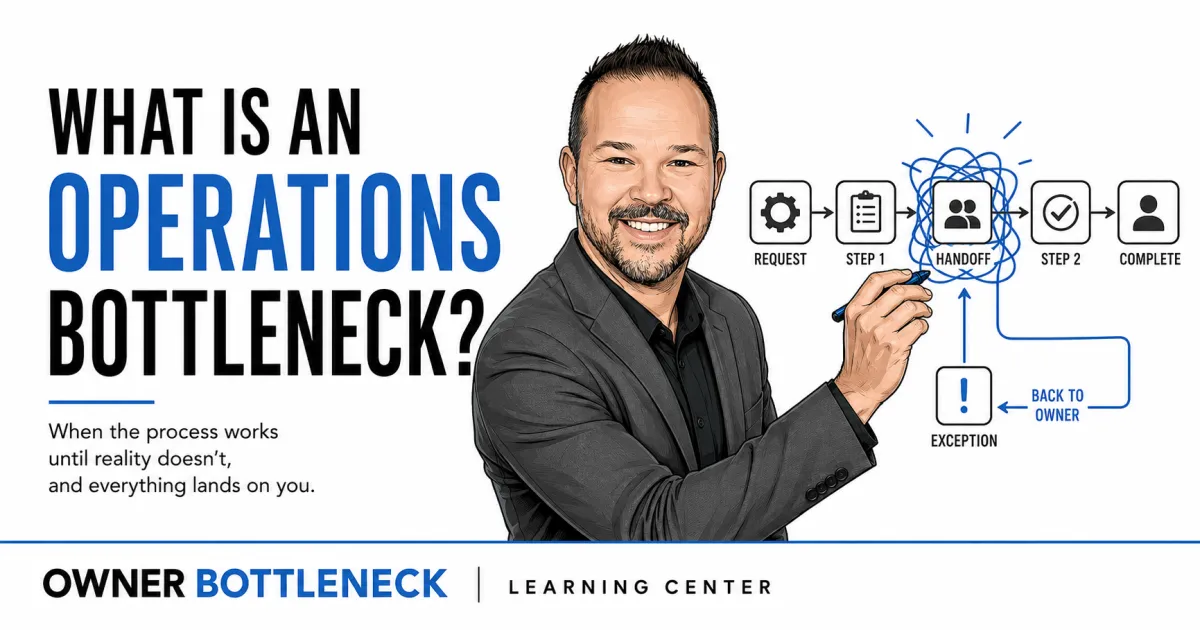
What Is an Operations Bottleneck?
The project was moving.
Sales had sold it.
The customer had approved it.
The team had started the work.
Then someone noticed a problem.
The schedule didn’t match what sales had promised.
Operations wasn’t sure which deadline mattered most.
The customer expected something that wasn’t included.
No one knew who had the authority to change the plan.
So the project stopped moving.
A message went to the owner.
The owner called the customer, corrected the schedule, explained the priority, approved the exception, and told the team what to do next.
The problem was solved.
The process wasn’t.
That’s an Operations Bottleneck.
Key Takeaways
An Operations Bottleneck exists when workflows, handoffs, standards, exceptions, or daily execution depend too heavily on the owner.
A business can have processes and employees while still relying on the owner to connect the pieces.
Most Operations Bottlenecks become visible when normal work changes, a handoff fails, or an exception appears.
Documentation helps, but procedures alone won’t replace judgment, authority, accountability, or clear ownership.
The goal isn’t to remove the owner from operations completely. It’s to stop making the owner the operating system behind the operations.
What is an Operations Bottleneck?
An Operations Bottleneck is a version of the Owner Bottleneck where the business depends too heavily on the owner to keep work moving.
The owner may not perform every task.
Employees may complete most of the work.
The company may use software, checklists, meetings, and documented processes.
But when work crosses departments, priorities compete, a customer asks for something unusual, or the process stops fitting the situation, the owner becomes necessary again.
The owner may be required to:
Clarify what was promised
Set the priority
Resolve a handoff
Approve an exception
Correct a misunderstanding
Interpret the standard
Reassign resources
Communicate with the customer
Decide what happens next
Make sure the issue doesn’t get dropped
The workflow appears to belong to the business.
The owner is still holding it together.
The process works until reality doesn’t
Most businesses can handle normal work.
The quote follows the usual format.
The customer selects the standard option.
The project starts on time.
The materials arrive.
The employee shows up.
The customer pays according to the normal terms.
The process works.
Then reality changes.
The customer wants something different.
The deadline moves.
A supplier is late.
An employee calls off.
A mistake is discovered.
Two departments interpret the agreement differently.
The process doesn’t explain what happens next.
That’s when the business turns toward the owner.
The company may have procedures for predictable work.
The owner remains the procedure for everything unpredictable.
That’s one of the clearest signs of an Operations Bottleneck.
Having processes doesn’t mean the business is operationally independent
Owners often believe process documentation should solve operational dependence.
Sometimes it does.
A checklist can reduce missed steps.
A standard operating procedure can create consistency.
A template can make work faster.
A project management system can improve visibility.
But documentation isn’t the same as an operating system.
A documented process may explain what to do when everything happens normally.
It may not explain:
Who owns the final outcome
Who can change the plan
What happens when priorities conflict
Which customer commitments matter most
What level of risk is acceptable
When an exception requires escalation
Who communicates across departments
What standard should guide an unusual situation
Who is accountable when the handoff fails
The steps may be documented.
The judgment behind the steps may still live with the owner.
What an Operations Bottleneck looks like
Operations Bottlenecks usually don’t appear as one giant failure.
They appear as recurring friction.
Work stalls between departments
Sales believes the job is ready.
Operations says information is missing.
The team waits.
The customer assumes the project has started.
The owner becomes the person who translates what sales promised into what operations can actually deliver.
The problem isn’t always inside either department.
It’s in the handoff between them.
The owner becomes the human routing system
People don’t always know where an issue belongs.
So they send it to the owner.
The owner decides:
Who should handle it
What information they need
What priority it has
Who needs to be informed
When it should be completed
Whether it requires follow-up
The owner may not complete the work.
They route the work.
That still makes the owner part of every workflow.
Exceptions always return to the owner
The standard customer request can be handled.
The unusual one can’t.
The normal purchase can be approved.
The unexpected one waits.
The routine project moves.
The complicated one returns to the owner.
A business that can handle only predictable work isn’t fully independent.
The strength of the operation is revealed by what happens when the situation changes.
The owner is the only person who sees the whole picture
Each employee understands their part.
The owner understands how all the parts connect.
Sales knows the customer.
Operations knows the workflow.
Finance knows the payment status.
The team knows the work.
The owner knows which detail affects everything else.
That makes the owner the invisible project manager behind the company.
Handoffs depend on memory
A salesperson remembers to tell operations about a special request.
A manager remembers to tell accounting about a change.
An employee remembers to update the customer.
Someone remembers to follow up.
When the right person remembers, the system works.
When they don’t, the owner catches the problem.
The owner’s attention becomes the backup process.
The same problems keep being treated as surprises
A late vendor delivery happens again.
A customer misunderstands the same part of the offer.
A project repeatedly enters production without complete information.
The company solves each incident individually.
No one changes the system that keeps producing it.
The owner becomes excellent at solving recurring problems.
The operation never becomes excellent at preventing them.
Meetings are used to rebuild the operating picture
People enter the meeting with pieces of information.
The owner connects them.
Sales says what was promised.
Operations explains what is possible.
Finance mentions a payment issue.
The owner identifies the conflict and rebuilds the plan.
The meeting appears collaborative.
The owner is still doing the integration.
Priorities change depending on who speaks to the owner last
One department says its work is urgent.
The owner agrees.
Another department raises a different issue.
The priority changes.
Employees learn that the operating plan is temporary until the owner gives new direction.
Work stays active.
Focus becomes unstable.
The owner has to inspect work before it can move
The estimate is prepared.
The customer response is drafted.
The schedule is created.
The project is completed.
But the next step can’t happen until the owner reviews it.
The owner may believe they’re protecting quality.
The operation experiences another waiting point.
The business runs differently when the owner is gone
When the owner is present:
Questions get answered
Priorities become clear
Customers receive updates
Problems move quickly
Departments coordinate
Standards stay visible
When the owner is unavailable:
Work becomes slower
People become cautious
Decisions wait
Handoffs weaken
Exceptions accumulate
Issues remain unresolved
The company doesn’t necessarily stop.
It operates at reduced speed.
An Operations Bottleneck is bigger than a process problem
A broken process can create an Operations Bottleneck.
But not every Operations Bottleneck can be solved by writing a better process.
The problem may involve:
Unclear ownership
Missing decision authority
Weak handoffs
Incomplete information
Conflicting priorities
Standards that exist only in the owner’s head
No escalation rules
Poor visibility
Repeated rework
Employees who understand their tasks but not the complete outcome
A process tells people what usually happens.
An operation must also explain what happens when the usual process no longer fits.
How an Operations Bottleneck differs from a Team Bottleneck
The two can look similar.
A Team Bottleneck centers on who carries the outcome, accountability, leadership, and difficult responsibility.
An Operations Bottleneck centers on how work moves through the business.
A Team Bottleneck asks:
Who owns the result?
An Operations Bottleneck asks:
Can the work move from beginning to end without the owner connecting, correcting, or rescuing it?
A weak handoff may be an operational problem.
A manager refusing to own the failed handoff may be a team problem.
The two often reinforce each other.
They still need different fixes.
How an Operations Bottleneck differs from a Decision Bottleneck
A Decision Bottleneck exists when too many decisions and approvals must reach the owner.
An Operations Bottleneck may include those decisions, but it’s broader.
The problem may not be one decision.
The workflow itself may be unclear.
Information may not transfer.
The wrong department may receive the work.
The standard may change during execution.
No one may own the handoff.
The owner may be required because the process doesn’t reliably connect one stage to the next.
A Decision Bottleneck asks:
Who can make the call?
An Operations Bottleneck asks:
Can the work keep moving?
Why Operations Bottlenecks form
Most Operations Bottlenecks develop gradually.
The business grew faster than the operating system
Early in the company, everyone talked directly to the owner.
That worked when the team was small.
The owner could remember every customer, project, promise, deadline, and issue.
Then the business grew.
More employees were added.
More customers came in.
More services were offered.
More departments formed.
The work became more complex.
But the original communication pattern remained.
Everyone still returned to the owner when something didn’t fit.
Roles were added without redesigning the workflow
The company hired more people.
Responsibilities were divided.
But no one redesigned how work should move between those people.
Sales owns the sale.
Operations owns delivery.
Finance owns payment.
Customer service owns the relationship.
But who owns the complete customer outcome?
Where does one responsibility end?
Where does the next begin?
What information must move with the work?
Who confirms the handoff is complete?
Adding roles without redesigning the flow can create more gaps, not fewer.
The owner’s workarounds became the process
The owner knows how to get things done.
They call the right person.
They remember the customer’s history.
They bypass the normal system.
They make an exception.
They solve the immediate problem.
Because the workaround succeeds, the business continues using it.
But a workaround that depends on the owner isn’t a scalable process.
It’s a shortcut with one authorized user.
The process documents activity instead of outcomes
A checklist may say:
Send the email
Update the system
Schedule the work
Call the customer
Complete the report
Those are actions.
The process may never define the result those actions are supposed to produce.
Employees complete the steps.
The outcome still fails.
Then the owner steps in.
Handoffs have no clear owner
One department believes the work has been transferred.
The next department believes the work isn’t ready.
Both may be technically correct.
No one owns the space between them.
The owner becomes responsible for closing the gap.
Important information lives in conversation
The owner mentions something in a meeting.
A manager remembers part of it.
An employee hears about it later.
The customer assumes everyone knows.
The information never becomes part of the operating record.
The business depends on people remembering what was said.
Standards aren’t visible
The owner can look at the work and know something is wrong.
The team may not see it.
The owner understands:
What details matter
What level of quality is acceptable
What risks should be caught
What the customer truly expects
What shortcuts are dangerous
What tradeoffs are reasonable
If those standards remain inside the owner’s judgment, quality will continue returning to the owner.
The company adds software without fixing the workflow
A new project management system is introduced.
A CRM is implemented.
A communication tool is added.
A dashboard is created.
But the underlying responsibility, handoff, or decision structure remains unclear.
The company digitizes the confusion.
Technology can make a strong process faster.
It can also make a broken process more visible without actually fixing it.
Metrics arrive too late
The owner learns a project is behind after the customer complains.
The company discovers a margin problem after the work is completed.
A capacity problem becomes visible after deadlines have already been promised.
The business operates reactively because the warning signs aren’t measured early enough.
The owner becomes the early-warning system.
What an Operations Bottleneck costs
The cost is larger than the owner’s time.
It creates delays
A five-minute clarification from the owner can create a full day of waiting.
Employees may continue working on other tasks.
The stalled workflow still loses speed.
It creates rework
Incomplete information moves downstream.
The next person begins the work.
A missing detail appears.
The work gets redone.
The owner steps in to correct it.
Rework consumes labor without creating additional value.
It weakens margins
Operational friction costs money.
Extra meetings.
Repeated communication.
Expedited shipping.
Overtime.
Customer credits.
Remakes.
Missed capacity.
Delayed billing.
The business may remain profitable while quietly losing margin inside broken workflows.
It makes growth heavier
More sales create more handoffs.
More handoffs create more chances for confusion.
More customers create more exceptions.
More employees create more coordination.
If the operating system remains dependent on the owner, growth creates more owner involvement.
Revenue increases.
Freedom decreases.
It damages the customer experience
Customers experience the operation, not the organization chart.
They don’t care which department missed the handoff.
They experience:
Delays
Repeated questions
Conflicting answers
Broken promises
Slow updates
Inconsistent quality
The owner may keep protecting the relationship by stepping in.
That can hide the weakness while strengthening customer dependence on the owner.
It frustrates employees
Employees may want to do strong work.
They become frustrated when:
Information is missing
Priorities keep changing
Other departments don’t complete handoffs
The owner changes the plan
Standards remain unclear
Decisions wait
Completed work gets redone
Operational confusion can look like a motivation problem.
Sometimes people are working inside a system that makes good performance difficult.
It hides the real capacity of the business
The company may believe it needs more employees.
The deeper issue may be rework, waiting, poor handoffs, unclear priorities, or excessive owner approval.
Adding people to a broken workflow can increase complexity without increasing throughput.
It increases risk
If the owner is the person who sees, connects, and corrects everything, their absence creates operational risk.
The process may function while conditions remain normal.
The business may struggle when judgment is required.
It weakens business value
A buyer will want to understand how the company operates.
They’ll ask:
How does work enter the business?
Who owns each stage?
How are promises transferred?
How are projects tracked?
How are exceptions handled?
How is quality protected?
What happens when something falls behind?
How involved is the owner?
If the owner remains the operating system, the company may have a Value Bottleneck.
A buyer may see profitable operations.
They may also see a difficult transition.
How to measure an Operations Bottleneck
Don’t measure it only by whether work gets completed.
Measure how much owner involvement was required to complete it.
Track owner touches
For 30 days, record every time an operational issue reaches the owner.
Include:
What happened
Where the work was in the process
Who brought the issue
Why the owner was needed
How long the work waited
What the owner decided or corrected
Whether the issue has happened before
What would need to change before it could be handled without the owner
This reveals where the operation repeatedly routes back through one person.
Track handoff failures
Identify the major handoffs in the business.
Examples:
Marketing to sales
Sales to operations
Operations to billing
Project manager to production
Production to quality control
Customer service to operations
Hiring to onboarding
For each handoff, ask:
What information must be transferred?
Who confirms it’s complete?
What happens if something is missing?
How often does the next person send it back?
How often does the owner need to intervene?
Track waiting time
Measure how long work waits for:
Approval
Information
Clarification
Scheduling
Customer communication
A priority decision
An exception
The owner’s review
A short decision can create a long queue.
Track rework
Look at work that must be corrected, repeated, rebuilt, or resent.
Ask:
Why wasn’t it right the first time?
Was the standard clear?
Was the information complete?
Did the handoff fail?
Did the process change?
Did the owner catch something no one else knew to check?
Track recurring exceptions
Create an exception log.
Every time the normal process doesn’t fit, record:
What happened
Why the process failed
Who resolved it
What decision was required
Whether it has happened before
What rule, boundary, or process could prevent the issue next time
A recurring exception isn’t an exception anymore.
It’s an undocumented part of the operation.
Use the owner absence test
Imagine the owner is unavailable for 30 days.
Ask:
Which projects would stall?
Which handoffs would weaken?
Which customers would receive slower answers?
Which quality issues would go unnoticed?
Which priorities would become unclear?
Which exceptions would wait?
Which meetings would lose direction?
What backlog would be waiting when the owner returned?
For a broader diagnosis, read How to Measure Owner Dependence in Your Business.
How to remove an Operations Bottleneck
You don’t fix operations by documenting the entire company at once.
Start with one important workflow that repeatedly breaks, waits, or returns to the owner.
Choose one critical workflow
Select a workflow that has meaningful impact.
Examples:
Lead to signed customer
Signed customer to project start
Project start to completion
Customer complaint to resolution
Purchase request to approval
Candidate to productive employee
Completed work to invoice
Order to delivery
Don’t begin with the easiest process.
Begin with the one creating the greatest current constraint.
Map what actually happens
Don’t map the process people claim to follow.
Map the real process.
Ask:
Where does the work begin?
Who touches it?
What information moves?
Where does it wait?
What gets sent back?
Where does the owner enter?
What exceptions appear?
What signals completion?
Where does accountability become unclear?
The goal isn’t to create a beautiful diagram.
It’s to expose the actual flow.
Define the outcome
What result should the workflow produce?
For example:
Move a signed customer into a fully prepared project without missing information, conflicting expectations, or avoidable delays.
That’s stronger than:
Complete the onboarding checklist.
The checklist is part of the process.
The outcome explains why it exists.
Assign one owner for the complete workflow
Multiple people may perform parts of the work.
One person should own whether the workflow produces the result.
That person doesn’t have to complete every task.
They must be accountable for:
Movement
Handoffs
Visibility
Exceptions
Delays
Corrective action
The final outcome
Shared participation is normal.
Shared accountability often becomes no accountability.
Define each handoff
For every handoff, clarify:
What information must be included
What “ready” means
Who sends it
Who receives it
Who confirms acceptance
What happens when information is incomplete
How quickly the next step begins
A handoff isn’t complete because someone sent an email.
It’s complete when the next person has what they need to move.
Define decision authority
A workflow will keep returning to the owner if the people inside it can’t make the necessary decisions.
Clarify:
What they can decide
What changes they can approve
What money they can authorize
What customer commitments they can adjust
What risks they can accept
What requires escalation
This is where operations and delegation with real ownership connect.
Define exception thresholds
Don’t try to document every unusual situation.
Define when an exception can be handled inside the team and when it must escalate.
For example:
Schedule changes within two business days can be handled by the project manager.
Customer remedies below a defined amount can be approved without the owner.
Safety, legal, or material financial risks must escalate.
Capacity conflicts affecting multiple customers require leadership review.
Clear thresholds reduce unnecessary owner involvement without creating uncontrolled risk.
Transfer the judgment behind the process
Explain:
What the process protects
Which risks matter
Which tradeoffs are acceptable
What warning signs require attention
What a strong outcome looks like
Why previous failures happened
What the owner notices that others may miss
A process becomes stronger when people understand the reasoning, not only the steps.
Create visibility without requiring approval
The owner may still need to see what’s happening.
Use:
Workflow dashboards
Status indicators
Weekly scorecards
Exception reports
Aging reports
Capacity views
Quality measurements
Defined escalation alerts
Visibility allows the owner to monitor the system without controlling every action.
Review the workflow regularly
Ask:
Where did work wait?
Which handoffs failed?
What information was missing?
Which exceptions repeated?
Where did the owner become necessary?
What rework occurred?
What should change before the next cycle?
The process shouldn’t become permanent simply because it was documented.
Operations improve through review.
Fix the system, not only the incident
When something goes wrong, solve the immediate customer or operational problem.
Then ask:
What allowed this to happen?
Maybe the standard was unclear.
Maybe the handoff lacked information.
Maybe authority was missing.
Maybe the workflow had no owner.
Maybe a recurring exception was never added to the process.
The incident needs a response.
The system needs a correction.
Example: fixing the sales-to-operations handoff
Imagine sales closes a new customer.
The salesperson sends an email to operations.
The email includes the basic project information.
Operations begins planning.
Then they discover:
The customer expects an accelerated deadline
A custom feature was discussed
Pricing assumed a different scope
The customer has a special communication preference
A key decision-maker wasn’t included
Operations contacts sales.
Sales explains part of it.
The owner joins because the promise, relationship, and margin may be at risk.
The owner calls the customer and rebuilds the plan.
The customer is saved.
The handoff remains broken.
A stronger workflow might define:
Outcome
Transfer every signed customer into operations with complete expectations, scope, schedule, financial terms, and relationship context.
Required information
Scope, exclusions, pricing, payment terms, deadline, customer contacts, decision-makers, risks, special commitments, and success criteria.
Acceptance
Operations must confirm the project is ready before the start date is promised.
Authority
Operations can request missing information, adjust internal scheduling, and flag commitments that fall outside approved capacity.
Escalation
Material scope, margin, legal, safety, or customer relationship risks move to leadership.
Accountability
One person owns the completed transfer.
The owner may still be informed.
The owner is no longer required to reconstruct every agreement.
Example: fixing customer complaints
Imagine every meaningful complaint reaches the owner.
The team can listen.
They can gather information.
They can apologize.
They can’t decide what remedy to offer.
They may not know whether the issue is isolated or recurring.
The owner reviews the situation, decides the response, contacts the customer, and tells operations what to change.
To reduce owner dependence, define:
Outcome
Resolve valid customer concerns quickly, protect trust, and identify operational causes that must be corrected.
Authority
A manager can approve defined remedies within clear limits.
Information
The manager has access to customer history, project value, previous issues, and relevant operational records.
Standards
Own legitimate mistakes. Don’t reward unreasonable behavior. Communicate clearly. Fix the immediate issue, then address the cause.
Escalation
Safety, legal, major financial, or high-risk relationship issues go to the owner.
Accountability
Recurring complaint patterns are reviewed monthly and assigned corrective action.
The owner remains available for serious issues.
The owner isn’t the normal complaint process.
Don’t overengineer the operation
Some owners respond to operational frustration by building enormous manuals.
Every possible step gets documented.
Every action requires a form.
Every decision requires approval.
The business becomes slower in the name of consistency.
The goal isn’t maximum process.
The goal is reliable flow.
A strong operating system should create:
Clarity
Speed
Accountability
Consistency
Visibility
Appropriate control
Room for judgment
Document what needs to be repeatable.
Define principles for what can’t be predicted.
Create boundaries for what can be decided.
Escalate what genuinely requires higher-level involvement.
Keep it usable.
A process no one follows isn’t a process.
It’s a document.
What should stay with the owner?
Some operational involvement may properly remain with the owner.
Examples include:
Major resource allocation
Material financial decisions
Significant legal or safety risks
Strategic customer commitments
Critical capacity tradeoffs
Operational decisions that could threaten the company
Responsibilities the owner intentionally chooses to retain
The goal isn’t to remove the owner from operations entirely.
The goal is to stop using the owner for work that should move without them.
Ask:
Does this require ownership-level judgment, or does it reach me because the operation still doesn’t know how to handle it?
That distinction matters.
Frequently asked questions about Operations Bottlenecks
Does an Operations Bottleneck mean we need more employees?
Not necessarily.
The business may need additional capacity.
It may also be losing capacity through waiting, rework, weak handoffs, unclear priorities, and owner approvals.
Fix the flow before assuming headcount is the answer.
Will better software solve an Operations Bottleneck?
Software can improve visibility, consistency, and communication.
It won’t fix unclear ownership, missing authority, weak standards, or broken handoffs by itself.
Technology supports the operation.
It doesn’t replace operating clarity.
Do we need to document every process?
No.
Start with workflows that are frequent, important, risky, or repeatedly dependent on the owner.
Documenting everything at once can create a large library without solving the greatest constraint.
What if every customer or project is different?
The details may differ.
The operating principles, handoffs, decision boundaries, information requirements, and escalation rules can still be defined.
Customization doesn’t require confusion.
How do I know whether the problem is the process or the employee?
Look for patterns.
If multiple capable people struggle at the same point, the process may be weak.
If one person repeatedly ignores a clear process, standard, or expectation, the issue may be performance.
Diagnose both the system and the person.
Should the owner stop reviewing quality?
Not immediately.
The owner may need to review while standards and capability are being transferred.
Over time, the review should move from inspecting every item to reviewing outcomes, trends, exceptions, and performance.
How long does it take to remove an Operations Bottleneck?
One recurring workflow can often improve quickly.
Reducing deeper owner dependence may take longer because authority, information, judgment, standards, and accountability must move together.
The goal is measurable progress, not instant perfection.
The owner shouldn’t be the operating system
The owner may always understand the business better than anyone else.
They may see the risk first.
They may know the customer best.
They may connect the pieces faster.
That doesn’t mean the company should require them to keep every workflow together.
A strong operation can:
Move information reliably
Complete handoffs clearly
Handle normal work consistently
Manage reasonable exceptions
Protect standards
Surface risks early
Assign accountability
Keep the owner informed without making the owner necessary everywhere
The owner remains valuable.
The owner stops being the hidden process behind the process.
That’s the shift.
Don’t ask only:
Do we have procedures?
Ask:
Can work move from beginning to end without me translating, correcting, approving, or rescuing it?
That answer reveals the strength of the operation.
Find where operations still depend on you
The free Owner Bottleneck Scorecard evaluates owner dependence across Decisions, Sales, Operations, Team, and Value.
It’ll help you identify where the business still relies too heavily on your judgment, authority, standards, relationships, or presence.