
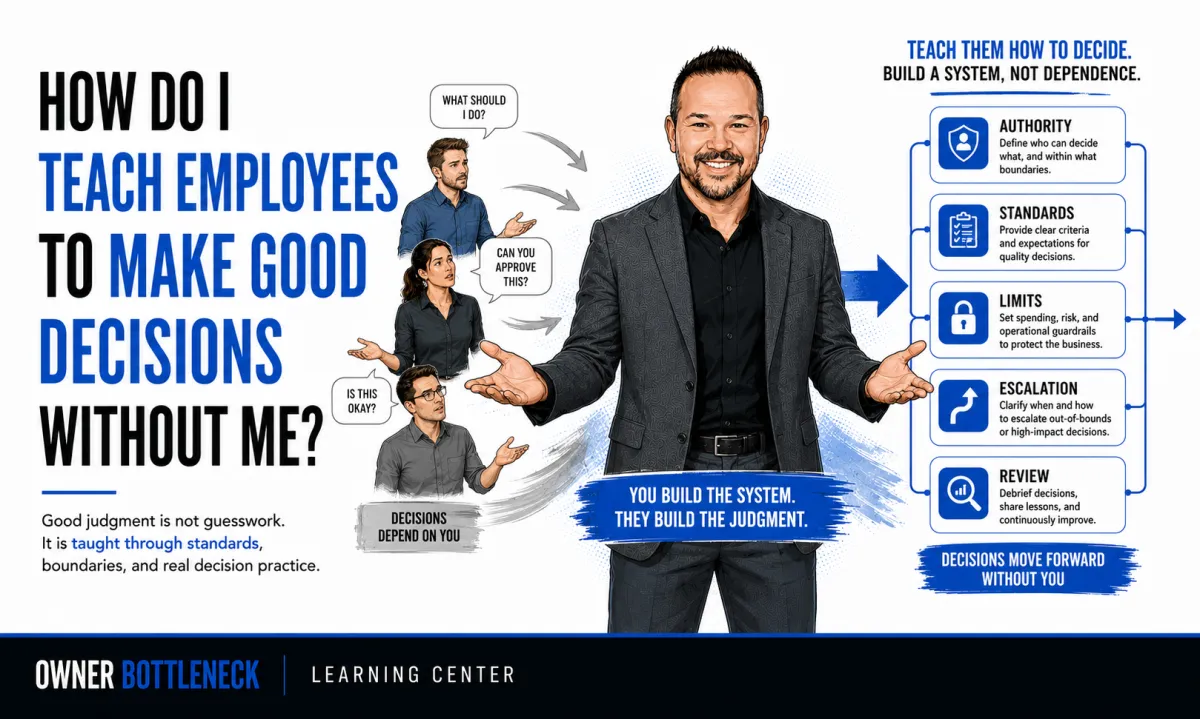
How Do I Teach Employees to Make Good Decisions Without Me?
You teach employees to make good decisions without you by showing them what the business is trying to protect, giving them clear authority and boundaries, letting them make real decisions, and reviewing how they thought without correcting every answer that differs from yours. SOPs can explain the normal path. Judgment Transfer prepares the team for the moment the normal path no longer fits.
The service company had missed a deadline.
The customer was angry.
The company had an SOP for complaints.
Acknowledge the issue within two hours.
Gather the facts.
Document what happened.
Contact the customer.
Record the resolution.
The manager followed every step.
Then the customer asked for a full refund.
The manager walked into the owner’s office.
What do you want me to do?
The owner looked at the account.
The customer had been loyal for five years.
The mistake was clearly the company’s fault.
Redoing the work would take another week.
The owner approved the refund.
The entire decision took four minutes.
The customer was taken care of.
The manager returned to work.
The process had worked.
The problem had been solved.
Then, two weeks later, another customer issue appeared.
The facts were different.
The customer wanted the work redone instead of refunded.
The cost was higher.
The relationship was newer.
The manager returned to the owner.
What do you want me to do?
The owner thought:
We already have a process for this. Why does everything still come back to me?
Because the SOP explained how to handle the complaint.
It didn’t teach the manager how to decide what a fair remedy looked like.
The business had transferred the known steps.
The authority to interpret reality still belonged to the owner.
That’s the hidden Owner Bottleneck inside many well-documented businesses.
The Process Didn’t Fail
Owners often assume an exception proves the process is broken.
Sometimes it does.
The SOP may be outdated.
A handoff may be missing.
The instructions may be unclear.
But sometimes the process has done everything it was designed to do.
It has simply reached the point where someone must think.
A vendor misses a shipment.
Two managers want the same employee.
A valuable customer asks for an exception.
The normal pricing doesn’t fit the opportunity.
An employee makes a mistake nobody has seen before.
A deadline can be protected only by increasing cost or reducing quality.
There may not be one correct step.
Someone has to interpret what’s happening.
They have to weigh competing priorities.
Accept some risk.
Protect something important.
Make a call.
If only the owner can do that, the business still depends on the owner, no matter how many processes have been documented.
That’s an Owner Bottleneck.
The company may know how to perform the work.
It still doesn’t know how to decide what happens when the work stops fitting the plan.
SOPs Transfer the Known
SOPs matter.
A good SOP creates consistency around repeatable work.
It tells people:
What starts the process
What outcome the process should produce
Which normal steps should happen
What information is required
Where the handoffs occur
What quality checks must be completed
Which predictable problems should be prevented
That’s valuable.
You don’t want ten people inventing ten ways to enter an order, onboard a customer, close a facility, inspect a completed job, or prepare a routine proposal.
But an SOP works best when the situation is known and the normal response can be described in advance.
Business doesn’t stay inside those conditions.
The SOP can explain how to record a complaint.
It may not determine whether the correct remedy is a refund, a credit, a redo, an apology, or holding the line.
The SOP can explain how to build a production schedule.
It may not determine which customer should be protected when two urgent projects need the same crew.
The SOP can explain how to prepare a proposal.
It may not determine whether an unusual scope change creates too much delivery risk.
The SOP can explain the normal day.
Business often reveals the bottleneck on an abnormal one.
That doesn’t mean you should stop documenting.
It means you should stop asking documentation to do work it can’t do alone.
The guide on what to turn into an SOP first explains how to choose the repeatable work that deserves documentation.
This article is about what happens after the process runs out.
Judgment Transfer Prepares the Team for the Unknown
An SOP says:
When this happens, do this.
Judgment asks:
What matters most here?
Judgment is the ability to look at a situation that doesn’t perfectly match the instructions and make a sound decision inside the company’s priorities and limits.
It includes knowing:
Which fact matters most
Which standard must be protected
Which tradeoff is acceptable
Which risk can be carried
Which precedent should be avoided
Which decision can be reversed
Which situation must be escalated
Most experienced owners do this quickly.
Not because the answer is obvious.
Because years of decisions have been compressed into instinct.
The owner remembers the customer who abused a generous refund policy.
The employee who left because an exception was handled badly.
The project that lost money after a salesperson made a small promise.
The legal issue that began with what looked like a harmless shortcut.
The client relationship that was saved because the company chose trust over margin.
All of that history is sitting behind the owner’s answer.
The team often hears only the conclusion.
Refund the customer.
Move the job.
Hold the price.
Replace the product.
Don’t make the exception.
The owner made a decision.
The team didn’t learn how the decision was made.
The next unusual situation returns to the same person.
The Owner’s Helpful Answer Can Preserve Dependence
An exception appears.
The employee asks the owner.
The owner answers quickly because it feels responsible.
The problem gets solved.
The employee gets no practice making the call.
The next exception appears.
The employee asks again.
The owner concludes:
They still aren’t ready.
The owner may be right.
The employee may lack experience.
They may need training.
They may not understand the risk.
But constantly answering the question guarantees they won’t become ready.
People don’t build judgment by watching the owner make every important call.
They build it by thinking, recommending, deciding, seeing what happened, and learning from the result.
The owner’s answer may solve today’s problem.
It can quietly preserve tomorrow’s dependence.
When decisions keep returning, the team may not simply be indecisive.
They may be following the safest path the business has trained them to use.
This guide explains why your team keeps coming to you for every decision and how unclear authority, invisible standards, missing information, and owner behavior reinforce that pattern.
That’s why telling employees to “use better judgment” rarely changes anything.
The business needs a way to build it.
The Owner Bottleneck Judgment Transfer System
I call that method the Owner Bottleneck Judgment Transfer System.
It helps owners move from being the final answer for every exception to building a team that can make sound decisions inside clear standards and boundaries.
The goal isn’t for employees to guess what the owner would do.
It’s for them to understand what the business is trying to protect, know what authority they have, and make a decision they can explain.
The system has five parts:
Document the Known
Define What Matters
Set the Boundaries
Transfer the Decision
Review and Reinforce
Each part fixes a different reason decisions keep returning to the owner.
How the Five-Part System Works
1. Document the Known
Start with the normal process.
In the customer complaint example, the known steps might be:
Acknowledge the complaint within two hours.
Gather the customer’s description.
Confirm what was promised.
Verify what happened.
Record the customer impact.
Contact the customer within one business day.
Document the resolution.
Those steps shouldn’t require the owner.
They’re known.
They repeat.
They can be trained and checked.
Then identify the point where the process stops supplying the answer.
Perhaps the employee has to decide:
Whether the company failed
How serious the failure was
What remedy would be fair
Whether the customer’s request is reasonable
Whether the remedy creates an unhealthy precedent
Whether the risk crosses the employee’s authority
That’s the judgment point.
Mark it clearly.
Don’t hide it inside a sentence such as:
Handle the issue appropriately.
“Appropriately” usually means:
Use the judgment currently living inside the owner.
A useful SOP should show where the employee follows and where the employee must choose.
Don’t attempt to write every possible future exception into the document.
The manual will grow.
The judgment will remain with the owner.
Document the repeatable path.
Identify the point where context takes over.
2. Define What Matters
When the normal steps no longer fit, the employee needs to know what the business is trying to protect.
Owners often rely on broad values:
Take care of the customer.
Do the right thing.
Protect quality.
Use common sense.
Those phrases sound good until two good priorities conflict.
Taking care of the customer may hurt margin.
Protecting quality may delay delivery.
Moving quickly may create greater risk.
Supporting an employee may feel unfair to another employee.
Winning the deal may strain operations.
What does “do the right thing” mean then?
The owner may know.
The team may not.
For each decision area, define the decision intent.
The decision intent describes what matters most when the person has to make a call.
A customer-remedy intent might be:
Protect customer trust by delivering a fair remedy when we fail. Stay inside the approved cost limit, don’t promise work the team can’t deliver, and don’t create a reward for abusive behavior.
Now the manager has something usable.
They know what comes first.
They know what must remain protected.
They know what shouldn’t happen.
A simple Decision Intent Statement can follow this structure:
When this type of situation appears, protect [priority] first, stay within [limits], and avoid [unacceptable outcome].
For scheduling:
Protect committed customer dates first, stay inside approved labor capacity, and avoid solving one delay by creating a larger delay somewhere else.
For pricing:
Protect the value and delivery margin of the work, stay within the approved commercial range, and avoid making concessions without understanding what changes in return.
For employee performance:
Protect the required result and fair treatment of the employee, stay inside company policy, and avoid allowing repeated misses to become the team’s new standard.
The owner’s knowledge isn’t only how the process works.
It’s knowing what matters when the process no longer fits.
That’s part of getting the knowledge in your head into the business.
3. Set the Boundaries
Telling someone:
Use your judgment.
isn’t enough.
The employee may wonder:
How much can I spend?
What can I promise?
What if the customer threatens to leave?
What if my decision is different from yours?
What happens if I’m wrong?
The owner may be wondering the same thing.
Authority without boundaries feels reckless.
Responsibility without authority feels fake.
The answer is clear decision boundaries.
Use three levels.
May decide
The person can make the call without asking first.
For example:
The customer service manager may approve a cash credit up to $500 when the company clearly failed to meet the agreed standard.
Decide and inform
The person makes the call, then reports it afterward.
For example:
The operations manager may move a project within the same week when the customer commitment remains protected and no overtime is created. Report the change in the weekly operations review.
Must escalate
The decision crosses the person’s authority.
For example:
Escalate legal threats, safety concerns, commitments beyond available capacity, remedies above the approved amount, or anything likely to create serious reputation risk.
Good boundaries may involve:
Money
Time
Safety
Legal exposure
Customer promises
Quality
Hiring or firing
Reputation
Capacity
Whether the decision can be reversed
The boundary shouldn’t be:
Ask me whenever you’re unsure.
That turns uncertainty into an owner-level decision.
The employee should understand what uncertainty they’re expected to work through and what risk genuinely deserves escalation.
Clear authority needs more than permission.
This guide explains how to set decision boundaries for employees using May Decide, Decide and Inform, and Must Escalate, so people know where they can act and where genuine risk returns to leadership.
This is the same distinction behind delegating decisions instead of only assigning tasks.
4. Transfer the Decision
This is where many systems stop.
The owner writes the process.
Explains the priorities.
Defines the authority.
Then continues making the decision.
The employee can’t build judgment without using it.
Start with decisions that are:
Frequent enough to practice
Meaningful enough to matter
Usually reversible
Close to the employee’s work
Inside a risk level the business can tolerate
Don’t begin with the company’s largest legal exposure.
Don’t begin with a decision that could threaten safety, ownership, or survival.
Start where the business currently sends too many manageable questions to the owner.
The transfer can happen in stages.
Ask
Here’s the problem. What do you want me to do?
Recommend
Here’s the problem. These are the options. I recommend this one because of these facts and risks.
Decide and inform
I made the decision inside the agreed boundary. Here’s what I chose and why.
Decide and review
I’m making these decisions. Here’s the pattern I’m seeing, the results we’re getting, and what the system may need to improve.
Teach
I helped someone else learn how to make this decision.
The first meaningful move is usually from asking to recommending.
When someone brings a problem, the owner’s first response should often be:
What do you think we should do, and why?
Not as a trick.
Not as a way to refuse help.
As a way to see how the person is thinking.
They may already have a sound answer.
They may only be seeking the owner’s emotional permission to use it.
If the owner immediately supplies the solution, the business learns to bring questions.
If the owner asks for a recommendation, the business learns to bring thinking.
5. Review and Reinforce
A review isn’t a delayed approval meeting.
It shouldn’t become:
You made the decision, but now I’m going to explain why I would’ve made a better one.
The purpose is to make the person more prepared to decide next time.
Ask:
What happened?
What did you notice that mattered most?
What were you trying to protect?
What options did you consider?
What risk did you accept?
Did the decision stay inside the boundary?
What happened because of the choice?
What would you repeat or change?
Does the SOP, boundary, principle, or training need to improve?
Those questions help separate the decision from the outcome.
That matters because a sound decision can produce a poor result.
And a weak decision can get lucky.
Imagine the manager chooses to redo a customer’s work instead of issuing a refund.
The reasoning is sound.
The remedy fits inside the approved cost.
The company can deliver it.
The decision protects customer trust.
Then a second delay happens.
The customer becomes even more upset.
The result was poor.
That doesn’t automatically mean the original decision was unreasonable.
Punishing every sound decision that produces an imperfect result teaches the team:
Don’t carry risk. Ask the owner.
Now imagine the manager makes a careless decision outside the approved limit, but the customer happens to accept it.
The result looks good.
The reasoning was still weak.
A lucky result isn’t proof of good judgment.
Review both.
The goal isn’t to create perfect outcomes.
It’s to produce increasingly sound decisions inside increasingly useful boundaries.
The review is where delegated authority becomes real or disappears. This guide explains how to review an employee’s decision without taking back control by separating the quality of the reasoning from the quality of the result.
Different Is Not Always Wrong
This may be the hardest part for the owner.
The manager makes a decision.
It stays inside the agreed authority.
The reasoning is sound.
The important standard is protected.
The owner would have chosen differently.
What happens next?
Many owners reverse it.
They say:
I understand why you did it, but here’s what we’re going to do instead.
The manager learns that authority exists only when their decision matches the owner’s.
The next time, they ask first.
That’s why authority is proven during disagreement.
Not every disagreement.
Not a reckless decision.
Not a boundary violation.
Not a decision that ignores a critical fact.
A different but sound decision.
Perhaps the owner would refund the customer.
The manager decides to redo the work.
Both may be reasonable.
If both protect customer trust, stay inside the cost limit, and avoid a bad precedent, the owner’s preference doesn’t automatically become the company’s only correct answer.
The goal isn’t cloning the owner.
The business doesn’t need twenty smaller versions of one person.
It needs capable people who understand what matters and can use their strengths to produce the required result.
Teach people what matters.
Don’t teach them to imitate you.
A Good Result Can Come From Weak Judgment
Owners often review only whether the outcome worked.
The customer stayed.
The project finished.
The employee didn’t quit.
The deal closed.
Therefore, the decision must have been good.
Not necessarily.
The salesperson may have given away too much margin to close the deal.
The manager may have avoided a necessary performance conversation and gotten lucky when the employee improved temporarily.
The operations leader may have overloaded the team and still hit the deadline through unsustainable effort.
The customer service manager may have approved a remedy outside their authority, and the customer happened to be satisfied.
A good outcome can hide weak thinking.
Coach the reasoning.
Ask:
Did we produce the result in a way we should be willing to repeat?
That question separates a good outcome from a sound operating decision.
A Poor Result Can Come From Sound Judgment
The opposite is also true.
A manager may make a reasonable call based on the available information.
The situation changes.
The vendor fails again.
The customer reacts unpredictably.
A good employee leaves anyway.
The project runs into a problem nobody could reasonably see.
If the owner punishes every decision that fails, employees learn to avoid responsibility.
The standard shouldn’t be:
Did everything work perfectly?
It should be:
Was the decision explainable, inside the authority, based on the important facts, and aligned with what we agreed to protect?
Reasonable risk sometimes produces a loss.
The business can learn from it without teaching the employee that deciding was the mistake.
The Owner Must Transfer More Than Permission
An owner announces:
From now on, you don’t need to ask me. You have the authority.
Nothing changes.
Why?
Because authority is more than an announcement.
The employee may still lack:
The standard
The information
The context
The boundaries
The confidence that the owner will support the decision
A way to learn from what happens
The employee may remember the last time someone made a decision the owner didn’t like.
The owner said:
You were allowed to decide, but I didn’t think you’d decide that.
The authority disappeared the first time it was tested.
Real transfer requires the owner to change how they respond.
They must:
Delay the answer long enough for someone else to think
Ask for a recommendation before giving the solution
Explain tradeoffs instead of announcing conclusions
Separate company standards from personal preferences
Allow reversible decisions to create learning
Let different but sound decisions stand
Review patterns instead of monitoring every move
Every owner behavior becomes an organizational lesson.
When the owner steps in at the first sign of discomfort, the team learns that authority is temporary.
When the owner allows a sound decision to stand, the team learns that the authority is real.
This is also why owners often keep taking back work they delegated.
They aren’t only taking back the task.
They’re taking back the right to decide what success looks like.
Stop Asking Employees to Read Your Mind
Some businesses look like they have a strong culture.
Everyone knows the owner.
They know what the owner likes.
How the owner writes.
What the owner notices.
Which details irritate them.
Which customers receive exceptions.
Which risks make them nervous.
Which answer will get approved.
Employees become skilled at predicting the owner.
That isn’t the same as building a culture that can guide decisions without the owner in the room.
In an owner-centered culture, people ask:
What would the owner do?
In a company-centered culture, people ask:
What are we trying to protect?
In an owner-centered culture, success means matching the owner’s path.
In a company-centered culture, success means reaching the standard inside the agreed boundaries.
When employees keep asking what the owner would do, personal preferences may have quietly become unwritten company rules. This guide explains why your team keeps asking, “What would you do?” and how to replace owner-centered thinking with shared standards, boundaries, and decision intent.
The owner’s influence should remain.
Their standards, hard lessons, values, and judgment helped build the company.
The goal is to turn that invisible influence into something the right people can actually use.
If good people must predict your preferences to succeed, the culture still depends on your personality.
Not Every Decision Should Leave the Owner
Judgment Transfer isn’t unlimited autonomy.
Some decisions should remain with ownership or senior leadership.
Use three broad decision types.
Process Decisions
The correct response is known and repeatable.
Document it.
Train it.
Examples might include routine order entry, standard onboarding, normal payroll processing, or an established quality check.
Bounded Judgment Decisions
Several reasonable answers may exist.
Context matters.
Set the decision intent, define the boundaries, and transfer the call.
Examples might include customer remedies, scheduling conflicts, small commercial exceptions, project recovery, and normal employee coaching.
Owner-Reserved Decisions
The decision involves ownership, major capital, serious legal exposure, existential risk, or a material change to the company’s future.
Keep it with the owner or the proper governing group.
Examples may include selling the business, taking on major debt, entering a new market, a large acquisition, ownership changes, or litigation with significant exposure.
The owner-reserved category should remain narrow and clearly defined. This guide explains which decisions should stay with the owner by separating process decisions, bounded judgment decisions, and decisions carrying ownership, survival, legal, capital, strategic, or difficult-to-reverse risk.
The goal isn’t to push every decision away from the owner.
It’s to stop spending owner-level attention on decisions that no longer require it.
Start With One Decision Area
Don’t launch Judgment Transfer across the entire company next Monday.
You’ll create confusion.
Managers will interpret authority differently.
The owner will see one bad decision and take everything back.
Start with one recurring decision area.
A good starting point:
Happens often enough to practice
Creates real delay or interruption
Is meaningful but usually reversible
Has a capable person close to the work
Falls inside a manageable risk level
Has an owner willing to tolerate a sound answer that may differ from their own
Good starting areas may include customer remedies, scheduling changes, small purchasing decisions, normal discounts, project recovery, and employee coaching.
Choose the recurring question that keeps arriving at the owner’s desk.
Then build the five parts around it.
A 30-Day Judgment Transfer Test
Week 1: Map the Dependence
Record every question in the selected decision area.
What happened?
Who asked?
What did they need from the owner?
How long did the work wait?
Was the decision repeatable, judgment-based, or truly owner-reserved?
Look for the pattern.
Week 2: Build the Decision System
Define:
The normal process
The judgment point
What must be protected
What may be decided
What should be reported afterward
What must be escalated
Three real examples
Ask the person to apply the system to previous situations.
Don’t assume the boundary is clear because it sounds clear to you.
Week 3: Transfer Real Decisions
Move from asking to recommending.
Then move appropriate decisions into decide and inform.
Hold short reviews after real decisions.
Don’t turn the review into a lecture.
Week 4: Lock In the Learning
Look at what happened.
Which questions still returned?
Which boundaries were too narrow?
Which risks weren’t visible?
Which example should be added?
Does the SOP need an update?
Does the person need more training?
Can the authority widen?
The goal isn’t to prove the system is finished in 30 days.
It’s to prove that one recurring decision can begin moving without the owner.
If you’re ready to run that test, this guide explains how to run a 30-day Judgment Transfer pilot, including how to choose the decision, define success, set the boundary, transfer real authority, and review the evidence.
How Do You Know Judgment Is Actually Transferring?
You’ll hear the change before you see it on a dashboard.
At first:
What do you want me to do?
Then:
Here are the options. I think we should do this.
Then:
I made the call inside the boundary. Here’s why.
Later:
Here’s the pattern I’m seeing and what I think we should improve.
Eventually:
I helped someone else learn how to make this call.
That’s maturity.
The team moves from seeking answers to supplying recommendations, then decisions, then improvements, then judgment development for others.
You can also measure:
Exceptions escalated to the owner
Operating decisions made by the owner
Average time required to make the decision
Decisions reversed by the owner
Escalations that arrive with a recommendation
Repeat exceptions that return without the system learning
What stops when the owner is unavailable
These fit inside the broader Owner Dependence KPIs.
The system shouldn’t merely create more documentation.
It should reduce the number of decisions that still require the owner.
Common Ways Judgment Transfer Fails
The Company Writes an SOP for Every Exception
The manual grows.
People still avoid deciding.
Document repeated patterns.
Use intent and boundaries for the rest.
The Values Are Too Vague
“Take care of the customer” offers little help when customer trust, margin, capacity, and fairness conflict.
Define what gets protected first.
Use real cases.
The Authority Is Fake
The owner says:
You decide.
Then reverses every decision that feels unfamiliar.
Transfer a real decision and let sound differences stand.
Preferences Become Standards
The owner treats their style as the company’s required result.
Correct boundary breaches and weak reasoning.
Don’t correct harmless differences.
Reasonable Risk Gets Punished
The team learns that asking is safer than deciding.
Separate sound judgment from an imperfect outcome.
The Owner Answers Too Fast
The person never has to form a recommendation.
Ask:
What do you think we should do, and why?
Only Bad Decisions Get Reviewed
Decision reviews begin to feel like punishment.
Review strong calls too.
Make good thinking visible.
Too Much Authority Moves at Once
The owner panics.
A mistake happens.
Every decision gets reclaimed.
Start with reversible decisions and widen the boundary through evidence.
Escalation Remains Vague
People either ask about everything or hide too much.
State exactly what must be escalated and why.
Judgment Transfer Doesn’t Remove Accountability
An employee makes a decision outside the agreed boundary.
They ignore an important fact.
They repeatedly use weak reasoning after clear coaching.
They avoid communicating a risk they were required to report.
That isn’t a harmless difference.
Address it.
Judgment Transfer doesn’t mean every decision gets praised.
It means the response matches the actual problem.
Was the boundary unclear?
Improve it.
Was information missing?
Provide it.
Was the employee undertrained?
Develop them.
Was the decision reckless?
Correct it.
Did the employee knowingly exceed clear authority?
Hold them accountable.
Did the decision stay inside the boundary but produce a poor result?
Learn from it without pretending deciding was the mistake.
Good accountability protects real authority.
It doesn’t replace it.
The guide on holding employees accountable without micromanaging explains how to keep outcomes visible without dragging the owner back into every step.
The Business Doesn’t Need Everyone to Think Like You
Your judgment matters.
You’ve built it through risk, mistakes, customers, employees, money, and years of decisions.
The goal isn’t to pretend that experience can be copied into a document overnight.
The goal is to stop treating it as something the company can access only by contacting you.
Make the priorities visible.
Explain the tradeoffs.
Define the authority.
Let people make real calls.
Review how they thought.
Capture what the system learns.
Then do it again.
Your team may never make every decision exactly as you would.
They shouldn’t have to.
The business becomes stronger when capable people can make sound decisions without needing to reproduce your exact path.
Frequently Asked Questions
Can Employee Judgment Really Be Taught?
Yes, but not through instructions alone.
People build judgment by understanding priorities, seeing examples, making recommendations, using real authority, observing outcomes, and reviewing their reasoning.
Is Judgment Transfer the Same as Delegation?
No.
Delegation may move a task or responsibility.
Judgment Transfer moves the ability and authority to interpret situations when the normal process no longer fits.
Does This Mean SOPs Aren’t Useful?
No.
SOPs are essential for stable, repeatable work.
Judgment Transfer completes the work SOPs can’t do when context, tradeoffs, or risk require a choice.
What if an Employee Makes the Wrong Decision?
First determine whether the decision crossed a clear boundary, ignored an important fact, used weak reasoning, or simply produced an unexpected result.
The response should match the cause.
How Much Authority Should I Give at First?
Begin with frequent, meaningful, usually reversible decisions.
Use narrow boundaries, review the evidence, and expand authority as judgment improves.
What if My Employee’s Decision Is Different From Mine?
Judge the decision against the outcome, standards, authority, and risk.
Different isn’t automatically wrong.
Allow a different but sound decision to stand.
Which Decisions Should Stay With the Owner?
Keep decisions involving ownership, existential risk, major capital, significant legal exposure, or major strategic direction with the owner or appropriate governing group.
How Do I Stop Employees From Escalating Everything?
Clarify what they may decide, what they should decide and report afterward, and the exact triggers requiring escalation.
Also require recommendations rather than unfinished questions.
How Do I Keep Employees From Hiding Important Problems?
Define mandatory escalation conditions clearly.
Judgment Transfer should reduce unnecessary escalation without hiding safety, legal, financial, customer, or reputation risk.
How Long Does Judgment Transfer Take?
One decision category can begin moving within weeks.
Developing deeper judgment across managers, departments, and complex business situations requires repeated decisions, review, and increasing authority.
How Is This Different From Telling Employees to Use Common Sense?
“Use common sense” gives people no shared standard when priorities conflict.
Judgment Transfer defines what matters, what limits apply, what authority exists, and how decisions will be reviewed.
Stop Being the Only Person Who Knows What to Do Next
Your team may know the process.
They may complete the work.
They may understand their roles.
And the business may still stop the moment the situation becomes unusual.
That’s where the Owner Bottleneck hides.
Not inside the normal step.
Inside the judgment required when the normal step no longer works.
You don’t solve that by answering faster.
You solve it by transferring what the answer depends on.
The priority.
The standard.
The context.
The boundary.
The authority.
The chance to decide.
The chance to learn.
The free Owner Bottleneck Scorecard evaluates dependence across:
Decisions
Sales
Operations
Team
Value
It’ll help you identify where normal work still returns to you when judgment is required.
Take the Owner Bottleneck Scorecard
SOPs transfer the known.
Judgment Transfer prepares the team for the unknown.