
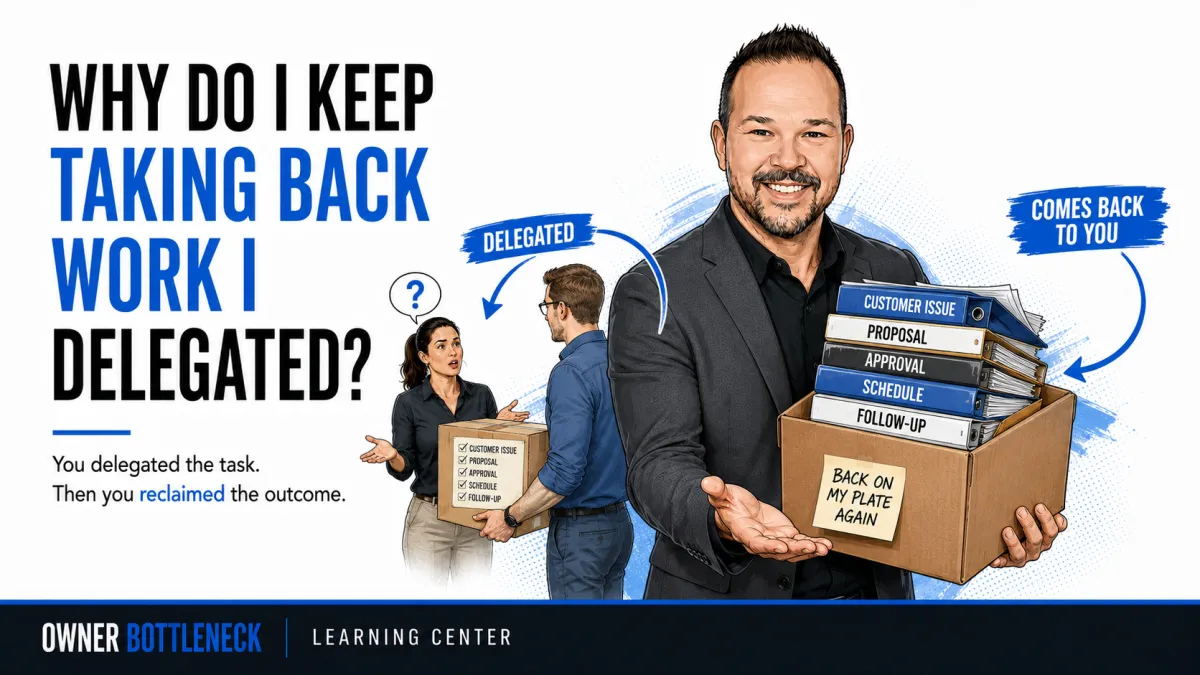
Why Do I Keep Taking Back Work I Delegated?
You keep taking delegated work back because reclaiming it solves the immediate problem faster than developing someone else’s capability. The work improves today, but the business learns that responsibility returns to you whenever the result is late, imperfect, uncomfortable, or different from how you would have done it.
The owner handed the weekly production schedule to his operations manager.
They had discussed it for months.
The owner was tired of rebuilding the schedule every time a customer changed a date, an employee called off, or an urgent job appeared.
So he finally said:
You own the schedule now.
The first week went well.
The second week, two jobs were assigned to the wrong crew.
The operations manager caught the mistake and moved one of them.
The change created overtime.
The owner noticed.
He opened the schedule, moved three jobs, called two customers, and reassigned the technicians.
It took him forty minutes.
When he finished, the schedule looked better.
The overtime disappeared.
The customers were happy.
The owner thought:
This is why I have to stay involved.
The operations manager learned something too.
Not how to build a better schedule.
Not how the owner weighed labor, customer priority, geography, and capacity.
They learned that the schedule belonged to them until the owner became uncomfortable.
The next week, the manager brought every difficult decision back to him.
The owner had taken the work back for forty minutes.
The business gave it back permanently.
Taking Work Back Usually Feels Responsible
Owners rarely reclaim delegated work because they enjoy being overloaded.
They do it because something important is at risk.
A customer may be disappointed.
A deadline may be missed.
The work may not meet the standard.
The employee may be moving too slowly.
The owner may see a mistake developing that the employee doesn’t yet recognize.
Stepping in feels responsible.
Sometimes it is.
If the situation involves serious legal, safety, financial, ethical, or customer risk, the owner may need to intervene.
But many owners use the same response for every level of discomfort.
A dangerous decision.
A coachable mistake.
A slower first attempt.
A different method.
An unfinished thought.
An email they would have worded differently.
All of them trigger the same move:
Give it back. I’ll handle it.
That move solves the visible problem.
It also creates a less visible one.
The employee loses the chance to recover.
The owner loses the chance to coach.
The business loses evidence about what the person can actually handle.
And everyone becomes more certain that the owner is still the safest person to finish important work.
That’s how an Owner Bottleneck rebuilds itself after the owner thought they had delegated it away.
The Rescue Becomes the System
A salesperson writes a proposal.
The owner rewrites it before it goes out.
A manager prepares for a difficult employee conversation.
The owner decides it would be easier to handle it personally.
An employee responds to a customer complaint.
The owner reads the draft and takes over the call.
An operations leader creates a new process.
The owner changes it before the team uses it.
Each rescue may improve the immediate result.
But every rescue teaches the same lesson:
The owner owns the final result.
Employees begin protecting themselves.
They wait longer before deciding.
They ask for approval earlier.
They bring incomplete work because they expect the owner to finish it.
They stop developing confidence because confidence requires making decisions and living with the outcome.
The owner sees this hesitation and concludes:
They still aren’t ready.
That may be true.
It may also be the predictable result of a system where responsibility keeps being revoked.
The employee never gets enough uninterrupted ownership to become ready.
You May Have Delegated the Activity, Not the Outcome
An owner tells an employee:
Send the weekly customer report.
The employee gathers the numbers, fills in the template, and sends the report.
Then the owner notices that one customer’s decline isn’t explained.
The employee completed the activity.
They didn’t understand the outcome.
The owner wanted the report to identify risks early enough for someone to act.
The employee thought the job was sending the spreadsheet on Friday.
The owner thinks:
They don’t think beyond the task.
The employee thinks:
I did what I was told.
Both may be right.
The delegated instruction described the activity.
It didn’t define what the activity was supposed to accomplish.
A stronger transfer would sound like:
You own the weekly customer health report. Its purpose is to show which accounts are growing, weakening, at risk, or waiting on us. Every Friday, identify the changes that require action, name who owns the response, and flag anything that could affect retention or revenue.
Now the employee understands the result.
They’re not merely completing a report.
They’re protecting customer health.
Tasks tell people what to do.
Outcomes tell them what they’re responsible for making true.
That’s why delegating decisions instead of only assigning tasks matters.
The Standard May Still Live Inside Your Head
The owner says:
I need this presentation to look professional.
The employee builds it.
The owner reviews the slides and immediately knows something is wrong.
Too much text.
The numbers don’t tell a clear story.
The opening is weak.
The recommendation arrives too late.
The owner takes over.
Three hours later, the deck is better.
The owner believes the employee lacks judgment.
The employee may never have been shown the judgment being used.
“Professional” isn’t a standard.
“Make it better” isn’t coaching.
“I know it when I see it” can’t be transferred.
Owners often have years of experience compressed into instinct.
They notice problems quickly because they’ve seen hundreds of versions.
They remember customer reactions, previous failures, margin problems, promises, exceptions, and tradeoffs.
Then they compare someone’s first attempt with their own twentieth year.
The gap is real.
But taking the work back doesn’t close it.
The owner must make the invisible standard visible.
Instead of:
This proposal isn’t good enough.
Explain:
The proposal describes what we’ll do, but it doesn’t make the recommendation clear. The customer should understand the problem we heard, what we recommend, why it fits, what’s included, what isn’t included, the investment, and the next decision. Right now, they’ll have to interpret too much themselves.
Now the employee can see what the owner sees.
The goal isn’t to document every preference.
It’s to transfer the standards that repeatedly cause work to return.
That’s part of getting the knowledge in your head into the business.
You May Be Correcting a Different Method, Not a Bad Result
A manager handles a customer issue.
They don’t use the same words the owner would use.
They don’t make the same offer.
They don’t structure the conversation the same way.
But the customer feels heard.
The issue is resolved.
The financial impact stays inside the approved limit.
The relationship remains strong.
The owner still feels the urge to correct it.
Why?
Because the manager’s path looked unfamiliar.
Owners often compare the method instead of the result.
They see a different approach and interpret it as a lower standard.
But there’s a difference between:
A decision that creates unacceptable risk
A result that misses the agreed outcome
A reasonable decision the owner wouldn’t have made
A different style that still works
If every successful result must look like the owner’s version of success, responsibility never truly transfers.
The team is allowed to own the outcome only when they imitate the owner.
That isn’t ownership.
It’s remote-controlled execution.
The hardest test of delegated authority isn’t what happens when someone makes your decision.
It’s what happens when they make a reasonable decision you wouldn’t have made.
If you reverse it simply because it’s different, everyone learns that authority is borrowed.
You May Be Stepping In Before the Person Can Recover
A project begins slipping.
The employee notices.
They start contacting the vendor, adjusting the schedule, and preparing a customer update.
Before they finish, the owner sees the delay and takes over.
The owner may be correct that the project needs attention.
But the employee was never given the chance to complete the recovery.
This matters because ownership isn’t proven when everything goes according to plan.
It’s proven when reality changes.
Can the person recognize the risk?
Can they respond?
Can they communicate?
Can they make a reasonable tradeoff?
Can they recover when the first plan fails?
Owners often want employees who can handle problems.
Then they remove the problem the moment it becomes uncomfortable.
The employee receives responsibility for execution.
The owner keeps responsibility for recovery.
That guarantees the difficult work will keep coming back.
Before stepping in, ask:
Does this person see the problem?
Do they understand the consequence?
Do they have a recovery plan?
Is the risk still inside an acceptable range?
Can I coach without taking control?
Sometimes the right move is:
Walk me through what happened, what you’ve already done, and what you recommend next.
That keeps the problem in the employee’s hands while giving the owner visibility into the thinking.
You May Be Delegating Before the Person Is Ready
Not every case is owner-created.
Sometimes the person genuinely lacks the capability.
They may not understand the work.
They may avoid responsibility.
They may have poor judgment.
They may fail to communicate.
They may repeat the same mistake after clear coaching.
They may want the title without carrying the result.
The answer isn’t pretending everyone can grow into every responsibility.
But “not ready” needs to become more specific.
What’s missing?
Knowledge?
Experience?
Judgment?
Authority?
Confidence?
Attention to detail?
Communication?
Follow-through?
Willingness?
Capacity?
Those aren’t the same problem.
An employee who lacks experience may need examples and supervised repetitions.
An employee who lacks authority needs clearer boundaries.
An employee who lacks judgment needs decision coaching.
An employee who lacks follow-through needs visible commitments and accountability.
An employee who repeatedly avoids ownership may be in the wrong role.
You can’t develop someone accurately when every disappointment gets labeled:
They’re just not ready.
Define the gap.
Then decide whether it can reasonably be closed.
You May Have Given Responsibility Without Authority
The owner assigns a manager responsibility for customer satisfaction.
Then every refund needs owner approval.
The manager is responsible for the result.
They can’t make the normal decision required to produce it.
The owner assigns a salesperson responsibility for revenue.
Then every pricing adjustment, scope change, and payment term needs approval.
The salesperson owns the target.
The owner owns the deal.
The owner assigns an operations leader responsibility for on-time delivery.
Then the leader can’t approve overtime, change a priority, or move people between projects.
The leader owns the deadline.
The owner controls the tradeoffs.
When authority doesn’t move, responsibility becomes a reporting role.
The employee gathers information and brings it to the person who can act.
The owner then complains that everything still comes back.
It comes back because the system requires it to.
A stronger transfer defines:
What the person may decide independently
What they may decide and report afterward
What must be escalated before deciding
Which outcome they must protect
Which limits they can’t cross
What information they need to remain inside those limits
The owner shouldn’t have to choose between approving everything and giving away unlimited control.
Clear authority lives between those extremes.
You May Have No Review Rhythm Except Interruption
An owner delegates a responsibility.
Then they hear nothing for two weeks.
They start wondering.
Is the work moving?
Did the employee forget?
Is a customer waiting?
Is the deadline at risk?
The owner starts checking.
Messages appear.
Meetings get added.
The owner reviews drafts.
The employee feels micromanaged.
The owner feels forced to micromanage because silence is the only alternative.
The problem may not be trust.
It may be visibility.
A healthy transfer includes an agreed review rhythm.
For example:
You own the project. Every Tuesday, update the timeline, current status, risks, decisions made, and anything that crosses the escalation threshold. If the completion date is at risk by more than three days, tell me when you know, not at the next meeting.
Now the owner doesn’t have to interrupt the work to find out whether the work is healthy.
The employee knows what must remain visible.
That’s how you stay informed without being involved in everything.
Without a visibility system, the owner often uses involvement as the substitute.
They take the work back because that’s the only way they know what’s happening.
The Four Questions to Ask Before Taking It Back
The moment you feel yourself thinking:
I’ll just do it.
Stop and ask four questions.
Is the Risk Too High to Let This Continue?
Some situations require immediate intervention.
Step in when the decision creates serious:
Safety risk
Legal exposure
Ethical concerns
Financial loss
Customer harm
Reputation damage
Consequences outside the person’s authority
Protecting the business matters more than preserving a coaching moment.
But after the immediate risk is handled, don’t end the lesson there.
Review why the issue happened.
Was the authority unclear?
Was the person undertrained?
Was information missing?
Did the escalation arrive too late?
Did the role exceed the person’s capability?
A rescue without a transfer guarantees another rescue.
Is the Outcome Actually Wrong?
Separate a disappointing method from a missed outcome.
Did the work fail the agreed standard?
Did it create an unacceptable consequence?
Did the person ignore an important requirement?
Or does it simply look different from what you would have produced?
Owners need to protect standards.
They don’t need to protect every personal preference.
Can I Coach Without Taking Control?
Instead of solving it, ask:
What do you see?
What’s at risk?
What options have you considered?
What do you recommend?
What standard are you using?
What would you do if I weren’t available?
The employee may already have the right answer.
They may only be seeking confidence.
Giving them the answer creates another dependency.
Reviewing their recommendation develops judgment.
Does the Responsibility Belong With This Person?
Sometimes repeated failures reveal a role problem.
The responsibility may require a level of judgment, capacity, communication, or technical ability the person doesn’t have.
Don’t keep handing the same responsibility back, reclaiming it, and repeating the cycle.
Either develop the missing capability, redesign the responsibility, or choose someone else.
Taking work back temporarily may be necessary.
Keeping it forever without making a deliberate role decision isn’t.
Four Better Responses Than “I’ll Do It”
You don’t need one response for every situation.
Use the response that matches the problem.
Correct the Risk, Then Return the Responsibility
When immediate action is required, fix what can’t safely wait.
Then return the responsibility.
Say:
I stepped in because the customer exposure had moved outside your authority. Let’s review how it reached that point, what should have been escalated earlier, and what you’ll own from here.
The owner handles the dangerous part.
The employee keeps the role.
Coach the Recommendation
When the issue is inside an acceptable risk range, don’t decide first.
Ask for the employee’s recommendation.
Say:
I’m not going to take this over. Walk me through what you think should happen and why.
Then test the thinking.
The goal is to improve the decision without replacing the decision-maker.
Let a Reasonable Decision Stand
When the decision fits the outcome, authority, and risk boundaries, allow it to continue even when you would have chosen differently.
You can review it afterward.
You can discuss another option.
But don’t automatically reverse it.
Authority becomes real when someone makes a reasonable decision the owner wouldn’t have made, and the owner allows it to stand.
Make a Real Role Decision
When the pattern shows that the person can’t or won’t carry the responsibility, stop pretending the delegation is working.
Define the gap.
Create a development plan with evidence and a review date.
Redesign the role if necessary.
Replace the person when necessary.
That’s not failure.
Leaving the responsibility in a permanent loop between the employee and owner is failure.
What to Say When Someone Brings the Work Back
Employees often return work through innocent questions.
What do you want me to do?
Can you look at this?
Which option should I choose?
Can you handle this customer?
Would you just rewrite it?
The owner can reclaim the work without realizing it.
Try responses such as:
What do you recommend?
What outcome are you responsible for here?
Which standard applies?
What authority do you already have?
What’s the risk of your recommendation?
What part requires my decision, specifically?
What would you do if I were unavailable?
What support do you need without transferring ownership back to me?
This isn’t a game where the owner refuses to help.
The owner is helping differently.
They’re supporting the person while keeping the responsibility where it belongs.
Don’t Confuse Ownership With Abandonment
Some owners hear “stop taking it back” and swing too far.
They delegate the work and disappear.
The employee struggles.
The owner refuses to answer questions because they’re trying not to micromanage.
The result fails.
Then the owner blames the employee.
That isn’t ownership transfer.
It’s abandonment.
A strong transfer includes:
A clear outcome
Defined authority
Visible standards
Necessary context
Access to information
Training
A review rhythm
Escalation boundaries
Coaching
Accountability
The employee shouldn’t need the owner for every normal step.
They should still have appropriate access to leadership while capability is developing.
You can remain supportive without becoming responsible again.
The First Version Will Probably Be Worse Than Yours
This is the part owners don’t like hearing.
The first delegated version may take longer.
The first employee-led customer recovery may feel clumsy.
The first proposal may need coaching.
The first schedule may include a tradeoff you would have avoided.
The first difficult employee conversation may not be as direct as yours.
That doesn’t automatically mean the transfer failed.
You’ve had years to build your pattern recognition.
The employee may be performing the responsibility for the first time.
The question isn’t whether they’re immediately as good as you.
Ask:
Is the result inside an acceptable range?
Is the person learning?
Are the same mistakes repeating?
Is their judgment improving?
Are they requiring less intervention?
Can they recover when something goes wrong?
Capability is built through repetitions the owner doesn’t take away.
You can’t compare someone’s first month with your tenth year and call the difference proof that nobody else can do it.
A 30-Day Stop-Taking-It-Back Reset
Choose one responsibility you’ve repeatedly delegated and reclaimed.
Don’t choose everything.
Pick the one creating the most frustration, interruption, or dependence.
Days 1 Through 7: Study the Reclaiming Pattern
Record each time you step in.
Write down:
What happened
What made you uncomfortable
Whether the outcome was actually at risk
Whether the person exceeded their authority
What you took over
What the employee learned
Whether you returned the responsibility afterward
Look for the trigger.
Are you stepping in because of risk?
Poor standards?
Silence?
Slow execution?
Different methods?
Lack of trust?
A real capability gap?
Days 8 Through 14: Rebuild the Transfer
Clarify:
The outcome
The outcome owner
The decisions they can make
The limits
The standard
The information they need
The review rhythm
The escalation threshold
What happens when the result misses
Use examples from previous failures.
Ask the employee to explain the responsibility back to you.
Clarity isn’t proven by what you said.
It’s proven by what they understood.
Days 15 Through 21: Coach Without Reclaiming
When the person brings a question, require a recommendation.
When you see a problem, ask what they see before giving your answer.
When the method differs, judge the result against the standard.
When a coachable mistake happens, let the person participate in the recovery.
Track how often you successfully support the work without taking it back.
Days 22 Through 30: Review the Evidence
Ask:
Did the responsibility continue without me?
Which decisions still returned?
Why?
Did the person’s judgment improve?
Were the standards clear enough?
Were the authority limits usable?
Did I reverse reasonable decisions?
Did the same mistake repeat?
Does this responsibility still belong with this person?
Then decide the next move.
Continue the transfer.
Provide targeted development.
Adjust the boundaries.
Redesign the role.
Or choose a different person.
Don’t drift back into the old cycle.
How Do You Know You’ve Actually Stopped Taking It Back?
The evidence isn’t that the owner never helps.
It’s that support no longer turns into permanent ownership.
You’ll see progress when:
Employees bring recommendations instead of unfinished problems
Reasonable decisions remain with the person who made them
Mistakes become coaching instead of automatic reassignment
The owner reviews selected decisions afterward instead of approving everything beforehand
Standards are visible before work begins
The team can recover from normal problems
Commitments remain visible without the owner chasing them
The same responsibility doesn’t repeatedly change hands
Owner involvement decreases while the result remains healthy
Employees gain confidence because their authority survives contact with the owner
You can also track the number of commitments, decisions, projects, and customer issues that require you to step back into ownership.
Those are some of the KPIs that show whether your business is becoming less dependent on you.
Sometimes You Should Take the Work Back
Taking work back isn’t always wrong.
You may need to reclaim it when:
The person can’t safely perform the responsibility
The risk exceeds the authority of the role
Repeated coaching hasn’t changed the result
The responsibility was delegated to the wrong person
The business has changed and the role no longer fits
The outcome genuinely belongs at the owner level
The person refuses accountability
The company needs a temporary emergency response
The mistake isn’t taking it back once.
The mistake is reclaiming it without diagnosing why the transfer failed and what will change next.
Otherwise, the owner becomes the permanent backup plan for every weak role, unclear outcome, missing standard, and uncomfortable decision.
The Goal Isn’t to Prove You Can Do It Better
You probably can.
That’s not the test.
The business already knows you can handle the customer.
Write the proposal.
Fix the schedule.
Make the decision.
Follow up on the commitment.
Protect the standard.
The question is whether the company can build that capability beyond you.
Every time you take the work back, you may improve one result.
Every time you coach, clarify, transfer authority, and let a reasonable decision stand, you improve the system that will produce future results.
That’s slower at first.
It’s also how the business eventually becomes less dependent on you.
The owner’s job isn’t to remain the fastest solution to every problem.
It’s to build a company that no longer needs the fastest solution to be the owner.
Frequently Asked Questions
Why Do Employees Give Delegated Work Back?
They may lack authority, clarity, confidence, information, skill, or accountability.
They may also have learned that the owner will take over when the work becomes difficult.
Identify what they’re returning before assuming it’s laziness.
Should I Let Employees Make Mistakes?
Allow mistakes that remain inside acceptable safety, legal, ethical, financial, and customer-risk boundaries.
Dangerous mistakes should be prevented.
Coachable mistakes should become learning.
What if I Can Complete the Work Much Faster?
You probably can in the beginning.
Completing it yourself may save time today while preserving the same owner dependence tomorrow.
Balance the immediate consequence with the long-term need to build capability.
How Do I Know Whether the Employee Is the Wrong Person?
Look for repeated failures after the outcome, authority, standards, information, training, and accountability have been made clear.
A person who can’t or won’t improve may be mismatched with the responsibility.
What if Their Method Is Different From Mine?
Judge it against the agreed outcome, standards, authority, and risk.
Different isn’t automatically worse.
If the result is sound, allow the person to develop their own effective method.
Does Delegation Mean I Should Stop Reviewing the Work?
No.
Review may be appropriate while capability develops.
The goal is to move from approving every decision beforehand to reviewing selected decisions afterward, then reducing review as evidence builds.
How Do I Help Without Taking Over?
Ask for the person’s recommendation, review their reasoning, clarify the standard, provide missing context, and keep the decision inside their authority whenever possible.
Support the responsibility without reclaiming it.
What if the Result Is Too Important to Risk?
Define what level of risk is acceptable and begin with smaller decisions.
You don’t have to transfer the highest-risk version first.
Build evidence through increasingly meaningful responsibility.
How Does Taking Work Back Create an Owner Bottleneck?
It teaches the company that difficult or important outcomes ultimately belong to the owner.
Employees become less likely to decide, recover, and carry accountability without owner involvement.
Stop Solving the Same Transfer Failure
You delegated the work.
Then it came back.
Before you blame the employee or reclaim it permanently, ask what never transferred.
The outcome?
The standard?
The authority?
The context?
The judgment?
The visibility?
The accountability?
Or the right person?
Taking the work back may rescue today’s result.
It won’t build tomorrow’s capability.
The free Owner Bottleneck Scorecard evaluates dependence across:
Decisions
Sales
Operations
Team
Value
It’ll help you identify where responsibility keeps returning to you and which dependency deserves to be attacked first.
Take the Owner Bottleneck Scorecard
Don’t just take it back.
Find out why it came back.
Then fix the transfer.