
How Do I Review an Employee’s Decision Without Taking Back Control?
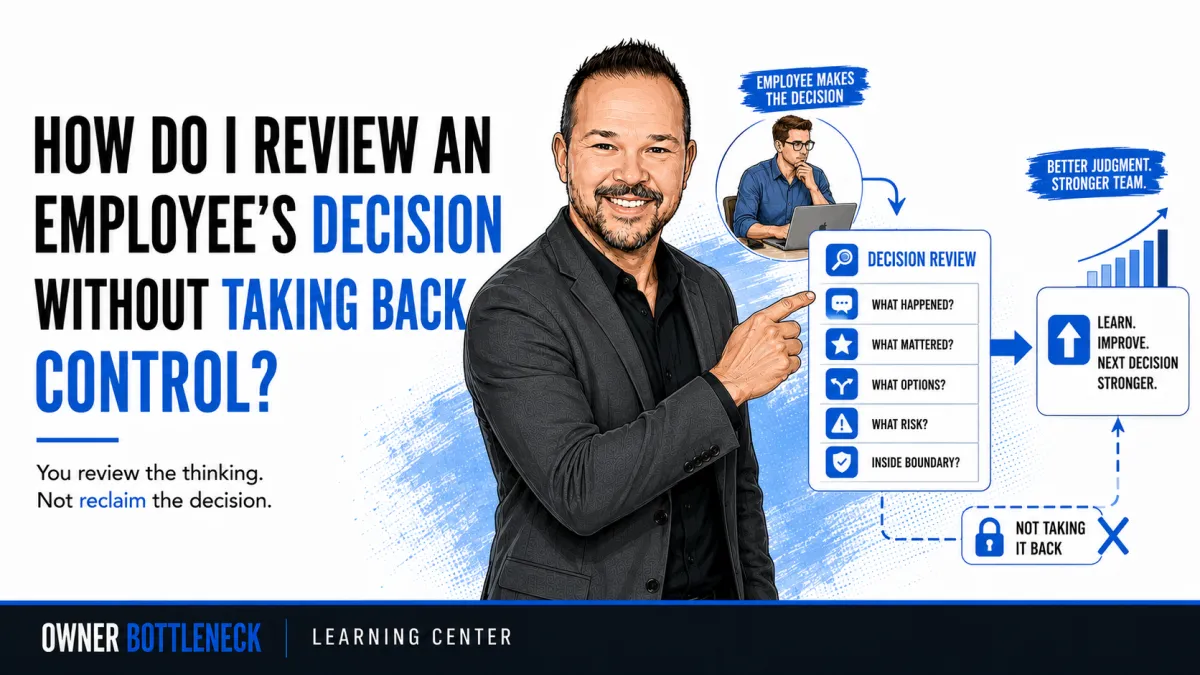
You review an employee’s decision without taking back control by examining what they noticed, what they were trying to protect, which options they considered, what risk they accepted, and whether they stayed inside the agreed boundaries. The review should prepare them to make the next decision more soundly. It shouldn’t prove that the owner still has the final answer.
The operations manager had moved a major job from Thursday to Friday.
One technician had called off.
The remaining crew couldn’t finish both scheduled jobs safely.
The manager looked at the customers, travel time, available skills, promised dates, and possible overtime.
One customer had flexibility.
The other had equipment sitting idle until the work was completed.
The manager moved the flexible customer to Friday, called them, explained the problem, and offered a small service credit.
Both jobs were completed that week.
During the Friday review, the owner saw the schedule change.
Why did you move that customer?
The manager explained.
The owner shook his head.
I wouldn’t have done that. I would’ve split the crews and finished both on Thursday.
For the next ten minutes, the owner explained exactly how he would’ve rearranged the technicians.
The manager listened.
Then asked:
So next time, should I check with you first?
The owner thought they were reviewing a decision.
The manager experienced a delayed approval.
They had been allowed to make the call on Thursday.
On Friday, they learned whether the call was truly theirs.
That’s where most delegated authority becomes real or disappears.
The Review Teaches More Than the Decision
Owners often focus on the original choice.
Move the job.
Issue the credit.
Hold the price.
Approve the overtime.
Redo the work.
Address the employee.
But the review that follows teaches the organization what authority actually means.
If the owner reviews a different decision and says:
Here’s what you should’ve done,
the team learns that the safest decision is the owner’s decision.
If the owner reverses a sound call because it feels unfamiliar, the team learns that authority lasts only until the owner becomes uncomfortable.
If the owner punishes a reasonable decision because the outcome was imperfect, the team learns that carrying risk is dangerous.
If the owner reviews only mistakes, the team learns that decision reviews are where people get corrected.
The next time something unusual happens, asking becomes safer than deciding.
That’s why a good review should answer one final question:
Is this person now more prepared to make the next decision, or more likely to bring it back to me?
Use that as the test of every review. A good review strengthens the person’s thinking. A bad one trains them to ask the owner sooner.
A Decision Review Isn’t a Hidden Approval Meeting
An owner tells a manager:
You can decide and inform me afterward.
The manager acts.
Then the owner reviews every detail.
Changes the decision.
Rewrites the customer message.
Corrects the method.
Explains the better option.
The employee technically decided first.
The owner still approved the decision afterward.
That isn’t transferred authority.
It’s delayed approval.
The timing changed.
The control didn’t.
A real review doesn’t ask:
Did you make the same decision I would’ve made?
It asks:
Was the decision sound, explainable, inside the boundaries, and aligned with what we agreed to protect?
Those are different standards.
The owner may have more experience.
They may see another option.
They may still prefer a different path.
But the purpose of Judgment Transfer isn’t to create people who can accurately predict the owner.
It’s to build people who can make sound decisions without the owner in the room.
That’s why teaching employees to make good decisions without you requires more than giving them permission to act.
Their authority has to survive the review.
Start With the Decision, Not Your Verdict
The owner enters the review already believing:
That was the wrong decision.
The conversation becomes a prosecution.
Every question is designed to prove the conclusion.
Why didn’t you call me?
Didn’t you know that could happen?
Why would you choose that customer?
What were you thinking?
The employee becomes defensive.
They explain less.
Protect themselves more.
And learn almost nothing.
Start with the situation.
Ask:
Walk me through what happened.
Let the person reconstruct the moment as they experienced it.
What did they know?
What didn’t they know?
What changed?
What pressure existed?
What information was available?
What decision had to be made?
You may discover that the employee ignored something important.
You may also discover that the owner knows facts now that nobody knew when the decision was made.
Hindsight changes the picture.
The decision should be reviewed against the information reasonably available at the time, not every fact discovered afterward.
That doesn’t excuse carelessness.
It prevents the review from pretending uncertainty never existed.
Separate the Reasoning From the Result
This is the most important part of the review.
Owners naturally look at what happened.
The customer stayed.
The job finished.
The margin held.
The employee improved.
The problem disappeared.
Good result.
Or:
The customer left.
The schedule broke.
The project lost money.
The employee quit.
The problem got worse.
Bad result.
But the outcome alone doesn’t tell you whether the decision was sound.
There are four possibilities.
Sound Reasoning and a Good Result
The employee noticed the important facts.
Protected the agreed priority.
Considered reasonable options.
Stayed inside the decision boundary.
Accepted an appropriate risk.
The result was good.
Reinforce the thinking.
Say:
You identified the customer impact, protected the committed deadline, stayed inside the labor boundary, and communicated the change early. That’s exactly the kind of thinking we want used here.
Don’t respond only with:
Good job.
Name what was good.
Otherwise, the employee knows the result pleased you but may not understand which thinking should be repeated.
Good reviews make sound judgment visible.
That helps the person use it again.
It also gives you examples to teach other employees.
Sound Reasoning and a Poor Result
The employee made a reasonable decision.
They used the available information.
Stayed inside the authority.
Protected the agreed standard.
Accepted a risk the business had already decided was reasonable.
Then the outcome went badly.
A supplier failed again.
The customer reacted unexpectedly.
The project developed a new problem.
The employee’s recommendation didn’t produce the hoped-for result.
This is where owners often destroy authority.
They say:
See? You should’ve asked me.
But would the owner reasonably have known the outcome beforehand?
Was the employee careless?
Or did an acceptable risk produce a loss?
Business decisions involve uncertainty.
If every reasonable decision that ends badly is treated as proof the employee shouldn’t decide, authority becomes impossible.
The employee learns:
I’m allowed to decide only when the outcome is guaranteed.
No meaningful judgment works that way.
Review the result.
Learn from it.
Ask whether the information, boundary, example, or process can improve.
But don’t punish someone merely because a sound decision encountered a poor outcome.
Say:
Your reasoning stayed inside what we agreed. The result wasn’t what we wanted. Let’s understand what changed and whether there was anything we could reasonably have seen earlier.
The decision can be sound even when the result hurts.
That distinction protects responsible risk-taking.
Weak Reasoning and a Good Result
The employee makes a poor decision.
They ignore an important fact.
Fail to examine another option.
Cross a risk they didn’t recognize.
The result happens to work out.
The customer accepts the answer.
The deadline is met.
The deal closes.
The owner may celebrate and move on.
That’s dangerous.
A lucky result isn’t the same as a sound decision.
Imagine a salesperson discounts the offer more than necessary without understanding the buyer’s real concern.
The customer signs.
Good outcome.
Weak reasoning.
Or a manager avoids addressing repeated underperformance.
The employee improves for two weeks.
Good outcome.
Weak reasoning.
Or operations overloads the strongest employee to protect a deadline.
The employee manages to complete the work.
Good outcome.
Weak reasoning.
Ask:
Did we produce the result in a way we should be willing to repeat?
The answer may be no.
Coach the reasoning even when the result looks good.
Say:
The customer accepted it, but we changed the price before understanding what they were trying to solve. That worked this time. I don’t want that to become our method.
The review shouldn’t punish the person for succeeding.
It should prevent luck from becoming policy.
Weak Reasoning or a Boundary Violation and a Poor Result
The employee ignored a critical fact.
Crossed a clear boundary.
Violated a nonnegotiable standard.
Accepted a risk outside their authority.
The result was poor.
Correct it.
This isn’t a harmless difference.
It isn’t responsible experimentation.
The employee may need:
Clearer boundaries
Better information
Additional training
More examples
Narrower authority
Stronger accountability
A different role
The correct response depends on why the decision failed.
An unclear boundary is a system problem.
A missing fact may be an information problem.
Weak pattern recognition may be a development problem.
Knowingly ignoring clear authority is an accountability problem.
Don’t collapse all four into:
I guess you’re not ready.
Diagnose what’s actually missing.
Then correct the decision, reset the boundary if needed, and decide what support or consequence belongs next.
The Nine Decision Review Questions
You don’t need to turn every review into an hour-long interview.
Use the questions that help the person reconstruct the decision and learn from it.
1. What Happened?
Begin with the facts.
What triggered the decision?
What changed?
Who was affected?
What needed to be decided?
Avoid beginning with blame or interpretation.
2. What Did You Notice That Mattered Most?
This reveals where the person’s attention went.
Did they notice the customer’s actual impact?
The financial risk?
The promised deadline?
The employee’s history?
The available capacity?
The legal concern?
People can look at the same situation and notice different things.
Judgment depends partly on seeing the right facts.
3. What Were You Trying to Protect?
Connect the decision to the agreed intent.
Were they protecting:
Customer trust?
Safety?
Margin?
Quality?
Capacity?
Fairness?
A committed deadline?
Cash?
Team stability?
The person should be able to explain which priority guided the choice.
If they can’t, the decision may have been instinctive rather than grounded in a shared standard.
4. What Options Did You Consider?
A person who saw only one possible answer may not have fully examined the situation.
Ask:
What else could you have done?
Why didn’t you choose it?
The goal isn’t forcing five artificial options into every decision.
It’s seeing whether the employee recognized meaningful alternatives.
5. What Risk Did You Accept?
Every choice carries something.
The customer may leave.
The project may be delayed.
Margin may fall.
The team may work overtime.
The employee may react badly.
Ask what could have gone wrong.
Strong decision-makers don’t pretend risk disappears.
They identify which risk they’re willing and authorized to carry.
6. Did the Decision Stay Inside the Boundary?
Return to what was agreed.
Was the person allowed to make the call?
Did they stay inside the financial, customer, legal, safety, quality, time, or capacity limits?
Did they report what they were required to report?
Did the situation contain an escalation trigger?
This is why setting clear decision boundaries for employees matters.
A boundary gives the review something more objective than the owner’s mood.
7. What Happened Because of the Choice?
Look at the result.
What worked?
What didn’t?
What happened immediately?
What may happen later?
What unintended consequence appeared?
The result matters.
It simply shouldn’t be confused with the entire quality of the decision.
8. What Would You Repeat or Change Next Time?
Let the employee identify the learning first.
They may already see the weakness.
They may also recognize that the reasoning was sound and the result was an acceptable risk.
Ask:
What would you do the same?
This prevents every review from assuming change is required.
Good judgment deserves repetition.
9. Does the System Need to Learn Anything?
The decision may expose more than an employee problem.
Ask whether the business needs:
A clearer SOP
A better decision boundary
A stronger principle
A new example
Better information
Additional training
A changed handoff
A new escalation rule
The exception happened inside the business.
The business should learn from it.
Don’t automatically create another checklist.
Choose the tool that solves the actual weakness.
Don’t Start With “Here’s What I Would’ve Done”
Owners love this sentence.
Here’s what I would’ve done.
Sometimes the experience is valuable.
But when it comes first, it ends the employee’s thinking.
The owner provides the expert answer.
The rest of the conversation becomes a comparison.
The employee may begin editing their explanation to match what they now know the owner wanted.
You lose the chance to see how they genuinely thought.
Ask the questions first.
Understand the decision.
Then share your perspective when it adds useful context.
Even then, separate:
Another reasonable option would’ve been...
from:
The correct answer was...
The first expands judgment.
The second may shrink authority to one owner-approved path.
Don’t begin the review by announcing what you would’ve done. Don’t reverse a sound decision to restore your comfort, punish reasonable judgment because the outcome was imperfect, or turn the review into a lecture.
Different Isn’t the Same as Wrong
The manager refunds the customer.
You would’ve redone the work.
The salesperson holds the price.
You would’ve reduced the scope.
The operations leader delays one job.
You would’ve approved overtime.
The manager handles an employee conversation more gently than you would have.
Were the decisions wrong?
Maybe.
But the fact that they differ from yours isn’t enough.
Judge the choice against:
The intended outcome
The company standard
The decision boundary
The relevant facts
The risk accepted
The result
Whether the decision is defensible
If the decision is sound, let it stand.
You may offer another possibility.
You may discuss tradeoffs.
You may build a better example.
But don’t teach the employee that successful authority requires copying your style.
When every acceptable result must travel the owner’s exact path, the team isn’t using judgment.
They’re trying to imitate the owner.
Know When to Correct the Decision
“Different isn’t always wrong” doesn’t mean nothing is wrong.
Correct the decision when the employee:
Acted recklessly
Ignored an important fact they should reasonably have considered
Crossed a clear authority boundary
Violated a legal, ethical, safety, or other nonnegotiable standard
Hid information they were required to communicate
Repeated a weak pattern after clear coaching
Made a commitment the role wasn’t authorized to make
Be specific.
Don’t say:
I didn’t like how you handled it.
Say:
You had authority to approve up to $500. You committed $900 without escalating. The issue isn’t that I preferred another remedy. The issue is that you accepted financial exposure outside your role.
Now the employee knows what failed.
The standard didn’t move after the decision.
Review Good Decisions Too
If decision reviews happen only when something goes wrong, people will avoid them.
The words:
Let’s review that decision,
will sound like:
You’re in trouble.
Review sound decisions.
Ask what the person noticed.
What they protected.
Which tradeoff they made.
Why the result worked.
This accomplishes several things.
The employee learns which reasoning should be repeated.
The owner sees whether good outcomes are coming from sound judgment or luck.
The company collects examples that can teach others.
And reviews become part of development instead of punishment.
You don’t need to review every normal decision forever.
Select meaningful examples.
Good calls.
Difficult calls.
Unexpected outcomes.
Repeated exceptions.
Situations that may help the system learn.
Review the Pattern, Not Every Move
An owner begins Judgment Transfer and decides to review every decision.
Every customer credit.
Every schedule change.
Every proposal exception.
Every employee conversation.
The review system becomes another Owner Bottleneck.
The owner is no longer approving decisions beforehand.
They’re inspecting all of them afterward.
Use two review rhythms.
Review Significant Decisions Quickly
Review soon when:
The risk was meaningful
The result was poor
The employee crossed or approached a boundary
The decision exposed a serious weakness
The learning is time-sensitive
The employee needs support before the next version occurs
Don’t wait three weeks to discuss something important.
The details and thinking will disappear.
Review Normal Decisions as a Pattern
Use a weekly or biweekly review for ordinary decisions inside the boundary.
Look at:
What decisions were made
Which exceptions repeated
Which outcomes changed
Where the employee felt uncertain
What was escalated
Whether the boundary needs improvement
Whether authority can widen
The purpose isn’t to relitigate every choice.
Look for the system lesson.
That’s how the owner can remain informed without returning to the workflow. The broader reporting rhythm is explained in How Do I Stay Informed Without Being Involved in Everything?.
The Decision May Reveal a Person Problem or a System Problem
A customer complaint is handled poorly.
The owner assumes:
The manager used bad judgment.
Perhaps.
Or perhaps:
The customer history wasn’t visible
The financial limit was unclear
The manager never saw examples
The escalation rule was missing
Sales made a promise operations didn’t know about
The SOP directed the manager toward the wrong information
The owner previously reversed similar decisions
The stated company value conflicted with the real expectation
Don’t use “judgment” as a vague label for every failure.
Ask what the person would’ve needed to make a better decision.
If the answer is clearer information, fix the information.
If it’s a better boundary, fix the boundary.
If it’s experience, build the experience.
If the person repeatedly ignores what they’ve been given, address accountability.
This prevents the owner from turning every mistake into proof that all decisions belong back with them.
When an Exception Repeats, the System Should Change
One customer asks for an unusual remedy.
That may remain a judgment call.
Seven customers ask for the same remedy.
The exception may no longer be unusual.
A repeated exception should create a system decision.
Does it need:
A clearer SOP?
A stronger decision intent?
A better boundary?
A standard offer?
A new template?
A training example?
A process redesign?
A policy change?
The employee’s decision isn’t the end of the learning.
The company should become better prepared for the next version.
Every decision review should end by asking whether the SOP, principle, boundary, example, or training needs to change.
The goal isn’t merely better decision-makers.
It’s a business that keeps turning experience into company capability.
What to Say During the Review
Owners don’t need a memorized script.
These phrases help preserve ownership.
To Begin
Walk me through what happened from your perspective.
What decision did you believe you had to make?
To Understand the Thinking
What did you notice that mattered most?
What were you trying to protect?
What other options did you consider?
To Examine Risk
What did you believe could go wrong?
What made that risk acceptable?
To Check Authority
Which boundary were you working inside?
Was there anything that should’ve triggered escalation?
To Develop Learning
What would you repeat?
What would you change?
What should the business learn from this?
When the Decision Was Different but Sound
I would’ve chosen another path, but your decision stayed inside the boundary and protected the result. Let’s see what we learn from it.
When the Decision Crossed the Boundary
The issue isn’t that your choice differed from mine. The issue is that it crossed the limit we agreed required escalation.
When the Result Was Poor but the Reasoning Was Sound
The outcome hurt, but your reasoning was responsible based on what we knew. Let’s identify what changed and whether the system can prepare us better next time.
These responses make the correction clearer and the authority more believable.
Don’t Make the Employee Defend Every Decision Forever
The employee makes sound calls for six months.
The owner continues asking for a complete explanation of every one.
What did you notice?
What options?
What risk?
Why?
Eventually, the review becomes proof that the owner still doesn’t trust the role.
Review intensity should decrease as evidence grows.
At first, review several decisions closely.
Then review a sample.
Then review patterns and exceptions.
Eventually, the person may be teaching someone else.
The maturity path moves from:
What do you want me to do?
to:
Here’s what I recommend.
Then:
I made the call. Here’s why.
Then:
Here’s the pattern and what we should improve.
Finally:
I helped someone else learn to make this call.
The owner shouldn’t remain the permanent audience for every decision explanation.
The company’s judgment should begin developing beyond them.
A 30-Day Decision Review Reset
Choose one decision category already being transferred.
Customer remedies.
Scheduling changes.
Pricing exceptions.
Project recovery.
Normal employee coaching.
Don’t attempt to review every decision in the company.
Days 1 Through 7: Watch How You Currently Review
Record several decision conversations.
Ask:
Did I begin with my answer?
Did I ask how the person thought?
Did I separate the reasoning from the result?
Did I correct a harmless difference?
Did I make the person more confident or more cautious?
Did I identify a system lesson?
Did I return ownership afterward?
You may discover that the review, not the original delegation, is where authority keeps being taken back.
Days 8 Through 14: Use the Review Questions
For the selected category, consistently ask:
What happened?
What mattered?
What were you protecting?
What options did you consider?
What risk did you accept?
Did you stay inside the boundary?
What was the result?
What would you repeat or change?
What should the system learn?
Keep the conversation short.
The questions are there to expose and strengthen thinking.
Not to create another meeting nobody wants.
Days 15 Through 21: Review Good and Bad Calls
Select:
One sound decision with a good result
One sound decision with a poor result
One weak decision that happened to work
One decision that revealed a boundary or training gap
The business may not produce every category during the week.
Use past examples if needed.
Teach the difference between reasoning and outcome.
Days 22 Through 30: Improve the System
Look across the reviews.
Ask:
Which weakness repeated?
Which priority remained unclear?
Which boundary created confusion?
What information was missing?
Which decisions no longer need review?
Can authority widen?
Does the employee need focused development?
Is there a real accountability issue?
What should become a company example?
The goal isn’t to create better review notes.
It’s to improve future decisions while reducing owner dependence.
How Do You Know the Reviews Are Working?
You’ll see:
Employees bring clearer recommendations
Decisions become easier to explain
The right facts are noticed earlier
Risks are identified instead of hidden
Boundaries are followed
Escalations become more appropriate
The same exceptions repeat less often
Employees recover from imperfect outcomes
Different but sound choices remain in place
The owner reverses fewer decisions
Review conversations become shorter
Managers begin reviewing decisions with their own teams
You can track:
Owner decision reversals
Escalations with recommendations
Repeat exceptions
Decision cycle time
Decisions still requiring owner involvement
Employees progressing from asking to deciding and teaching
Those measurements fit inside the broader Owner Dependence KPIs.
The review is working when decision quality improves while the owner’s involvement falls.
Decision Reviews Aren’t a Replacement for Accountability
An employee knowingly crosses a clear boundary.
Hides an important risk.
Repeatedly ignores required information.
Refuses to document decisions.
Uses the same weak reasoning after clear coaching.
That’s not merely a learning conversation.
The employee may need accountability.
Judgment Transfer doesn’t protect people from consequences.
It protects sound judgment from being punished merely because it differs from the owner or produces an imperfect result.
When expectations, authority, visibility, support, and standards are clear, repeated failure becomes easier to address honestly.
The guide on holding employees accountable without micromanaging explains that distinction.
Frequently Asked Questions
Should I Review Every Employee Decision?
No.
Review meaningful decisions, early examples, unusual outcomes, boundary questions, and repeated patterns.
Reduce review as evidence builds.
How Soon Should I Review a Decision?
Review significant or problematic decisions while the facts remain fresh.
Normal decisions can be reviewed as patterns during a weekly or biweekly rhythm.
What if the Employee Made a Different Decision Than I Would Have?
Judge the decision against the outcome, standards, authority, information, and risk.
Different isn’t automatically wrong.
Allow a different but sound decision to stand.
What if the Result Was Bad?
Determine whether the reasoning was sound.
A poor result may come from weak judgment, missing information, an inadequate boundary, or an acceptable risk that didn’t work out.
What if the Result Was Good?
Examine the reasoning anyway.
A lucky result can hide a poor decision the business shouldn’t repeat.
When Should I Reverse an Employee’s Decision?
Reverse or correct it when it creates continuing serious risk, crosses clear authority, violates a nonnegotiable standard, or must be changed to protect the business or customer.
Don’t reverse it merely to restore your preferred method.
How Do I Keep the Review From Feeling Like Criticism?
Review strong decisions too.
Begin with questions, separate reasoning from results, and make the purpose learning rather than proving the owner’s answer was better.
What if the Employee Can’t Explain Their Reasoning?
They may need clearer intent, better examples, more practice, or additional coaching.
Begin by helping them identify what mattered and which standard should guide the decision.
Should the Review Be Documented?
Document meaningful decisions, patterns, system changes, and lessons that can help others.
Don’t create paperwork for every routine choice.
What if the Employee Repeatedly Crosses the Boundary?
Confirm that the boundary is clear and usable.
If the employee knowingly continues crossing it, address the accountability or role-fit problem.
Can Managers Run These Reviews Without the Owner?
Yes.
That’s an important sign of maturity.
Managers should eventually develop judgment inside their teams rather than forwarding every review to the owner.
The Next Decision Matters More Than Proving You Were Right
You may have made another decision.
A faster one.
A safer one.
A decision built on twenty years of experience.
That doesn’t mean the review should end with the employee borrowing your answer.
The goal is to improve what happens the next time you aren’t there.
Ask what they saw.
What they protected.
What they considered.
What risk they accepted.
Whether they stayed inside the boundary.
What happened.
What the person and the system should learn.
Correct what was reckless.
Clarify what was missing.
Reinforce what was sound.
Let reasonable differences stand.
The free Owner Bottleneck Scorecard evaluates dependence across:
Decisions
Sales
Operations
Team
Value
It’ll help you identify where decisions still return to you and where the team needs clearer authority, judgment, or accountability.
Take the Owner Bottleneck Scorecard
A good review doesn’t prove the owner had the better answer.
It builds someone who can make a better decision next time.