
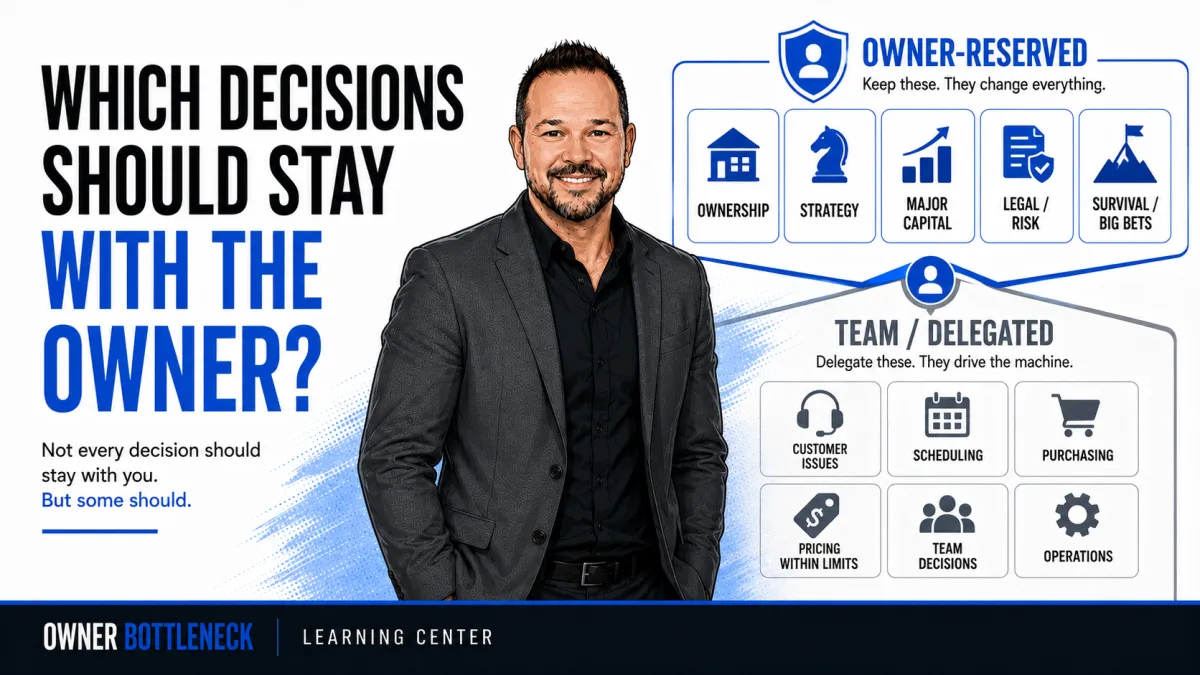
Which Decisions Should Stay With the Owner?
Decisions should stay with the owner when they can materially change the company’s ownership, survival, legal standing, capital structure, long-term direction, or ability to recover from a mistake. Most normal operating decisions shouldn’t remain there. The goal isn’t to remove the owner from every decision. It’s to protect the owner’s attention for the few decisions that truly require ownership.
The owner had spent six months trying to get decisions off his desk.
He was tired of approving customer credits.
Schedule changes.
Small purchases.
Proposal exceptions.
Employee issues.
So when his operations manager walked in and asked whether she could approve a $600 customer remedy, he said:
You’re closer to it. You decide.
She did.
The next week, she entered his office again.
This time, she carried a folder.
The company had an opportunity to open a second location.
The property owner wanted a seven-year lease.
The expansion would require new equipment, additional debt, twelve employees, and nearly all the company’s available cash.
The manager placed the proposal on his desk.
What do you think?
The owner pushed it back.
You run operations. You decide.
The manager didn’t look empowered.
She looked abandoned.
The customer credit and the seven-year expansion were both decisions.
They weren’t the same kind of decision.
One belonged close to the customer.
The other could change the future of the company.
The owner had become so determined not to be the bottleneck that he nearly handed away a decision only ownership could responsibly carry.
That isn’t delegation.
It’s abdication.
Judgment Transfer Doesn’t Mean Transferring Every Decision
Owners are right to worry about giving away too much authority.
Some decisions can hurt a customer.
Some can hurt a month.
Others can threaten the company.
The answer isn’t to choose between:
I approve everything.
And:
My team decides everything.
Both are weak systems.
The first makes the owner the final answer for normal work.
The second gives people responsibility for risks they may not have the authority, information, or ownership position to carry.
A stronger system places each decision at the lowest responsible level.
That means the decision should sit as close to the work as it safely can.
But not lower.
A customer service manager may be able to decide how to resolve an ordinary complaint inside approved limits.
They probably shouldn’t decide whether the company accepts a legal settlement that could expose the business to future claims.
An operations manager may be able to approve overtime inside a budget.
They probably shouldn’t decide whether the company takes on $1 million of debt to build a second facility.
A salesperson may be able to adjust a standard proposal.
They probably shouldn’t decide whether the company enters a market that requires an entirely new delivery model.
The point of teaching employees to make good decisions without you isn’t to make the owner irrelevant.
It’s to stop using ownership-level attention on decisions that no longer require it.
Important Doesn’t Automatically Mean Owner-Reserved
This is where many owners get stuck.
They say:
This decision matters too much to delegate.
Most business decisions matter.
Customer issues matter.
Hiring matters.
Pricing matters.
Scheduling matters.
Quality matters.
Purchasing matters.
If every meaningful decision stays with the owner, nothing meaningful has actually been transferred.
The broader delegation question also includes tasks, relationships, responsibilities, and decisions that can move now or after capability is built. This guide explains what you should delegate and what you should keep without treating every important decision as owner-only.
The question isn’t:
Is this important?
Ask:
What kind of risk does this decision create?
A customer remedy may cost $1,000.
It still may belong with a capable manager who has clear authority, information, and limits.
A public statement responding to a legal allegation may cost nothing to send.
It may still belong with ownership and legal counsel because the downside extends far beyond the immediate action.
The dollar amount alone doesn’t classify the decision.
Neither does discomfort.
A decision can feel uncomfortable and still belong with a manager.
A decision can appear small and carry ownership-level consequences.
You need a better classification.
The Three Types of Business Decisions
Not every decision should be handled the same way.
There are three broad types.
Process Decisions
A process decision has a known and repeatable answer.
The correct response can usually be documented, trained, and followed.
Examples may include:
How to enter an order
How to onboard a standard customer
How to complete a routine quality check
How to issue a standard invoice
How to close the building
How to prepare a normal report
These decisions shouldn’t require the owner.
They may not require much judgment at all.
Document the process.
Train the person.
Keep the outcome visible.
When the same known decision repeatedly returns to the owner, the company may have a process, training, ownership, or accountability problem.
Bounded Judgment Decisions
A bounded judgment decision may have several reasonable answers.
Context matters.
The employee must weigh priorities, risk, and tradeoffs.
But the possible damage remains inside limits the company can define and tolerate.
Examples may include:
Customer remedies
Scheduling conflicts
Standard pricing exceptions
Project recovery
Normal purchasing decisions
Employee coaching
Changes to a routine delivery plan
Selecting between qualified vendors
These decisions can move to the team when the business defines:
What must be protected
What the person may decide
What limits apply
What should be reported afterward
What must be escalated
That’s the role of clear decision boundaries for employees.
Owner-Reserved Decisions
An owner-reserved decision carries a level or type of risk that properly belongs with ownership or the appropriate governing group.
The decision may affect:
Who owns or controls the company
Whether the company can survive
The company’s legal standing
A major financial commitment
The company’s long-term direction
An obligation that is difficult to reverse
The future identity of the business
These decisions shouldn’t be pushed onto a manager merely because the owner wants fewer interruptions.
The manager can gather information, build options, make a recommendation, prepare the decision, and execute it afterward.
But ownership still carries the final call.
Which Decisions Are Usually Owner-Reserved?
There isn’t one universal list for every business.
A decision that could threaten a $2 million company may be routine inside a $200 million company.
But several categories commonly belong with ownership.
Ownership and Control
Decisions that change who owns, controls, or governs the company should usually remain with the owners or the body legally authorized to make them.
Examples include:
Selling the company
Selling part of the company
Issuing equity
Bringing in a new owner
Buying out a partner
Changing voting rights
Merging with another company
Creating a new ownership entity
Changing the company’s governing structure
Signing an agreement that transfers meaningful control
These decisions do more than affect operations.
They change who has the right to decide what the company becomes.
A manager may research the transaction.
A CFO may model it.
An attorney may structure it.
An advisor may challenge it.
The ownership group still owns the choice.
Decisions That Could Threaten the Company’s Survival
Some decisions create a downside the business may not recover from.
That doesn’t mean the worst outcome is guaranteed.
It means the decision carries existential risk.
Examples might include:
Betting most available cash on one expansion
Accepting a project too large for the company to deliver safely
Becoming heavily dependent on one customer
Entering a contract with uncapped liability
Making a guarantee the company couldn’t afford to honor
Taking on debt the company couldn’t service through a downturn
Committing critical capacity without a recovery plan
Entering a legal dispute that could overwhelm the business
These decisions may involve sales, operations, finance, or legal issues.
What makes them owner-reserved is the size of the consequence.
A salesperson shouldn’t decide whether the company risks survival to win a deal.
An operations manager shouldn’t decide whether the company gambles its entire capacity on one customer.
Ownership must decide whether the possible return justifies the threat to the company itself.
Major Capital and Debt Commitments
A manager may have authority to purchase tools, equipment, inventory, or services inside an approved budget.
That doesn’t mean they should decide whether the company:
Buys a building
Signs a long-term property lease
Borrows a material amount
Guarantees another party’s debt
Purchases another company
Builds a major facility
Commits to expensive equipment with limited resale value
Uses most available cash for an expansion
No universal dollar amount separates a normal purchase from an owner-reserved one.
The threshold must reflect the size and health of the business.
A $50,000 commitment may be ordinary for one company and dangerous for another.
Define the threshold relative to:
Available cash
Annual profit
Debt capacity
Existing obligations
Recovery time
Resale value
Length of commitment
The cost of being wrong
The larger the commitment and the harder it is to reverse, the more likely it belongs with ownership.
Fundamental Strategic Direction
Teams need room to make decisions inside the company’s strategy.
Ownership usually decides when the strategy itself changes.
Examples may include:
Entering a new market
Exiting a major market
Creating an entirely new business model
Discontinuing a core offer
Acquiring a competitor
Building a new location
Changing the company’s primary customer
Moving from services to manufacturing
Franchising the business
Making a major shift in how the company creates revenue
A sales manager may decide how to pursue the existing market.
They shouldn’t quietly decide that the company now serves a different market.
An operations leader may improve how the current service is delivered.
They shouldn’t redefine what business the company is in.
Strategy shouldn’t become an excuse for the owner to approve every move.
But decisions that materially redefine where the company is going should remain at the level responsible for its future.
Significant Legal, Safety, or Regulatory Exposure
Employees should have clear instructions for responding to normal compliance and safety situations.
But some issues require ownership, legal counsel, a board, or another properly authorized leader.
Examples may include:
Serious injury
Significant regulatory violations
Litigation
Government investigations
Suspected fraud
Major data or privacy incidents
Criminal allegations
Serious harassment or misconduct claims
Product safety failures
Decisions that could expose the company to broad liability
Agreements containing unusual indemnification or guarantees
These situations shouldn’t be hidden in the name of employee autonomy.
The employee should know what requires immediate escalation.
The owner may not personally know the correct legal answer.
That isn’t the point.
The owner-reserved decision may be:
Which qualified advisors must be involved?
What level of risk will the company accept?
Do we settle, defend, report, pause, disclose, or change direction?
Owner-reserved doesn’t mean owner-expert.
It means the final responsibility belongs at the ownership or governing level.
Senior Leadership Decisions That Change Company Control
Not every hiring decision belongs with the owner.
If every technician, coordinator, salesperson, and supervisor still requires owner approval, the hiring process remains owner-dependent.
But certain leadership decisions may materially change who controls the company’s daily direction.
Examples could include:
Hiring or removing a general manager
Appointing a president or CEO
Hiring a senior financial leader with substantial authority
Creating a new executive role
Giving someone company-wide authority
Changing who leads the leadership team
Restructuring reporting across the entire company
These decisions may appropriately involve other leaders, partners, or a board.
The key distinction is impact.
Hiring an employee to perform work isn’t the same as appointing someone who will direct major parts of the business.
Even here, the owner shouldn’t conduct every interview, reference check, compensation analysis, and onboarding task personally.
Keep the final decision.
Transfer the work around it.
The article on whether you need a general manager explains why adding leadership doesn’t automatically move decision authority.
Long-Term Commitments That Are Hard to Reverse
Some decisions are dangerous because they lock the company into a path.
The immediate cost may not look threatening.
The duration changes the risk.
Examples might include:
A ten-year lease
A long-term exclusivity agreement
A multi-year customer guarantee
A major vendor commitment
A partnership that restricts future choices
A contract with difficult termination terms
A technology decision that becomes expensive to unwind
A long-term compensation commitment
A promise that changes what every future customer can expect
Reversibility matters.
A small decision that can be corrected tomorrow may belong close to the work.
A decision that can’t be changed for seven years deserves a higher level of review.
Ask:
If we’re wrong, how quickly and affordably can we recover?
The harder the recovery, the more likely ownership should remain involved.
Owner-Reserved Doesn’t Mean Owner-Alone
A decision can belong with the owner without being made in isolation.
The owner shouldn’t sit alone with a blank sheet of paper trying to understand an expansion, lawsuit, acquisition, or senior hire.
They may need input from:
The leadership team
Finance
Legal counsel
Operations
Sales
Customers
A partner
A board
An outside advisor
A technical specialist
The person who will execute the decision
The owner owns the final call.
The company should still contribute the thinking.
Imagine the second-location decision.
Operations builds the capacity plan.
Finance models the cash requirement and debt.
Sales estimates demand.
Human resources examines the hiring requirement.
Legal counsel reviews the lease.
The manager closest to the work recommends whether the location can succeed.
Then the owner decides whether the company should accept the strategic and financial risk.
That isn’t an Owner Bottleneck.
That’s ownership doing ownership-level work.
It becomes a bottleneck when the owner:
Hoards the information
Refuses to define what they need
Avoids the decision
Changes the criteria repeatedly
Ignores the recommendation
Lets the deadline pass
Keeps everyone waiting without visibility
An owner-reserved decision still needs a decision system.
Keep the Decision, Not Every Piece of Work Around It
Owners often believe:
If the decision belongs to me, I have to handle the entire thing.
They research every option.
Build the spreadsheet.
Schedule every meeting.
Call every advisor.
Draft every message.
Negotiate every detail.
Explain the final decision.
Manage the execution.
Then they point to the workload as proof that ownership is exhausting.
The decision may belong to you.
The surrounding work may not.
For an acquisition, the owner may decide whether to buy.
Someone else can gather financial documents, coordinate diligence, schedule advisors, maintain the issue list, and build the implementation plan.
For a senior hire, the owner may make the final selection.
A manager or recruiter can source candidates, arrange interviews, check references, gather scorecards, and prepare the recommendation.
For a major facility decision, the owner may approve the commitment.
Operations, finance, and legal can prepare the options.
Keep:
The ownership-level judgment
The final acceptance of risk
The decision only the owner is authorized to make
Transfer:
Research
Data collection
Option development
Scheduling
Documentation
Recommendation preparation
Communication
Implementation
Progress reporting
The owner should receive a decision that is ready to make.
Not a pile of unfinished work disguised as an important choice.
Require Recommendations for Owner-Reserved Decisions
A decision can remain owner-reserved without every problem arriving unfinished.
The manager shouldn’t simply say:
Should we open a second location?
They should bring:
Here are the three options.
Here’s what each requires.
Here’s the projected return.
Here are the largest risks.
Here’s how reversible each option is.
Here’s what operations recommends.
Here’s the decision we need from ownership by Friday.
Ownership keeps the decision.
The team still develops judgment.
That matters because some decisions may eventually move.
It also prevents senior leaders from becoming couriers who bring raw uncertainty to the owner.
A strong recommendation should include:
The decision to be made
Why it must be made now
The meaningful options
The recommended choice
The facts supporting it
The financial impact
The largest risks
The cost of delay
How reversible the decision is
Who will execute it
The deadline for the decision
The owner may reject the recommendation.
But they should reject prepared thinking, not become responsible for creating all the thinking themselves.
Build an Owner-Reserved Decision List
Employees shouldn’t learn that a decision was owner-reserved only after making it.
Create a short list of the decision categories that must remain with ownership or another governing group.
The list might include:
Ownership changes
Sale or acquisition of a business
Debt above an established threshold
Capital commitments above an established threshold
Significant litigation or legal exposure
Major market entry or exit
Long-term contracts above a defined duration or risk
Appointment or removal of the company’s top leader
Commitments that could threaten company survival
Material changes to the business model
Keep it short.
If the list contains eighty categories, the owner has probably renamed normal management work as ownership.
For each category, define:
Who makes the final decision
Who must be consulted
What information is required
What recommendation should be provided
What triggers the decision
How quickly it should be made
Who owns execution afterward
An owner-reserved list should create clarity.
Not another waiting room.
Use Relative Thresholds, Not Random Dollar Amounts
The owner says:
Anything over $10,000 comes to me.
Where did $10,000 come from?
Perhaps it’s sensible.
Perhaps it was chosen years ago when the company was half its current size.
Perhaps it applies equally to an easily resold vehicle and a nonrefundable three-year software contract.
Those aren’t the same risk.
Use thresholds based on the actual exposure.
Questions might include:
What percentage of available cash does this require?
How many months of profit does it represent?
How long are we committed?
Can the asset be sold?
Can the agreement be canceled?
What happens if revenue falls?
Does the decision create personal guarantees?
Does it concentrate risk in one customer, vendor, or market?
Could the decision prevent us from pursuing a better option later?
The threshold should evolve as the company changes.
A growing business shouldn’t continue sending routine purchases to the owner because an old dollar limit was never updated.
Don’t Keep a Decision Because You’re Better at It
The owner may be the best negotiator.
The best judge of talent.
The strongest customer relationship builder.
The person with the most financial experience.
That doesn’t automatically make every related decision owner-reserved.
Skill and ownership are different.
You may be better at negotiating a standard deal.
A sales manager can still develop authority inside defined pricing and terms.
You may be better at resolving customer complaints.
A service manager can still decide normal remedies.
You may be better at reading employees.
A manager can still own coaching and performance inside company policy.
The question isn’t:
Could I make a better decision?
You probably could in many situations.
Ask:
Does this decision carry a type or scale of risk that only ownership should accept?
If not, your superior skill may be a reason to coach.
Not a reason to keep the decision forever.
The commercial example is explored in How Do I Stop Approving Every Discount and Proposal?.
Don’t Transfer a Decision Merely Because You Hate Making It
The opposite mistake also happens.
The owner dislikes conflict.
They ask a manager to decide whether to remove a senior leader.
The owner fears debt.
They tell finance to choose whether the company should borrow.
The owner doesn’t understand a legal issue.
They tell the operations manager to handle it.
The owner feels tired of carrying the company’s future.
They call the avoidance delegation.
A decision doesn’t become transferable because the owner finds it uncomfortable.
Sometimes discomfort is part of ownership.
The owner may need counsel.
Better information.
A recommendation.
More time.
A governing process.
But they still have to carry the final risk.
Judgment Transfer isn’t a system for removing every hard choice from the owner.
It’s a system for removing the wrong choices so the owner has the capacity to make the right ones.
“I’m Ultimately Responsible” Doesn’t Mean You Decide Everything
Owners often say:
I’m ultimately responsible, so I need the final say.
The first part is true.
Owners remain responsible for the company.
The conclusion doesn’t follow.
You’re responsible for whether the company has safe equipment.
That doesn’t mean you personally inspect every tool.
You’re responsible for customer outcomes.
That doesn’t mean you approve every remedy.
You’re responsible for financial health.
That doesn’t mean you approve every expense.
You’re responsible for leadership.
That doesn’t mean every employee reports to you.
Ownership responsibility includes designing the system that allows other people to carry real authority.
You’re responsible for deciding:
Which decisions belong where
Which standards apply
Which limits protect the company
Which people are capable
What remains visible
When authority should widen
Which decisions must remain reserved
Ultimate responsibility should create a stronger decision structure.
It shouldn’t become the reason every decision returns to the owner.
A Decision Can Graduate Out of Ownership
A decision may begin as owner-reserved and later become bounded judgment.
The company sells a new service for the first time.
The owner approves every proposal because the cost, scope, and delivery risks are still unknown.
After twenty successful projects, the offer becomes more predictable.
The team builds:
A standard scope
Pricing boundaries
Margin requirements
Delivery rules
Escalation triggers
Examples
Normal proposals can now move without the owner.
Or the company opens its first additional location.
Ownership decides whether the expansion should happen.
Later, managers may have authority to replace equipment, hire staff, adjust the schedule, and manage the operating budget inside the approved plan.
The strategic decision remained owner-reserved.
The operating decisions created by it did not.
Ask periodically:
Does this still carry ownership-level risk?
Or has experience made the decision predictable enough to transfer?
Owner-reserved decisions should remain few, and every one should carry real ownership-level risk.
A Decision Can Move Back Toward the Owner
Authority doesn’t move in only one direction.
Risk can change.
A routine customer decision may involve a new legal threat.
A normal proposal may become a strategic partnership.
A standard hire may involve a senior leader.
A common purchase may create a long-term exclusive commitment.
A routine product issue may become a safety concern.
The decision may cross from bounded judgment into owner-reserved territory.
That isn’t failure.
That’s the escalation system working.
The important thing is that the trigger is visible.
Employees should know why the decision moved upward.
Not simply hear:
This one feels important.
How the Owner Can Bottleneck the Decisions That Properly Belong to Them
A decision can rightfully belong to the owner and still be handled badly.
The team prepares a recommendation.
The owner delays.
Requests more information.
Then different information.
Changes the decision criteria.
Avoids committing.
Keeps the issue open for weeks.
The team can’t move.
The owner says:
This is an ownership decision.
That explains who should decide it.
It doesn’t excuse indecision.
Owner-reserved decisions need:
A clear decision owner
Required inputs
A decision deadline
Defined advisors
Visible criteria
A documented answer
An execution owner
Ownership-level authority should bring clarity.
Not indefinite waiting.
Track how long these decisions take.
An owner who successfully transfers normal decisions but delays every strategic decision can still become the company’s largest constraint.
A Simple Classification Test
When a decision appears, ask these questions in order.
Is the Correct Response Known and Repeatable?
If yes, it’s probably a process decision.
Document it and train it.
Could Two Capable People Choose Differently and Both Be Reasonable?
If yes, it’s probably a bounded judgment decision.
Define the intent and boundaries, then transfer it to the appropriate person.
Could the Decision Change Ownership or Control?
If yes, it likely belongs with ownership or the governing group.
Could It Threaten the Company’s Survival, Legal Standing, or Safety?
If yes, it may be owner-reserved or require immediate specialist involvement.
Does It Commit Major Capital or Create a Long-Term Obligation?
If yes, compare the commitment with the company’s cash, profit, debt capacity, and ability to reverse the decision.
Does It Materially Change the Company’s Direction?
If it changes the market, business model, leadership control, or future identity of the company, it likely requires ownership.
Can the Risk Be Safely Contained With a Clear Boundary?
If yes, the decision may not need to remain with the owner.
Move it to the capable person closest to the work.
The classification is more important than the title of the person asking.
A general manager shouldn’t make ownership decisions merely because they’re senior.
An employee shouldn’t be blocked from a normal decision merely because they’re not.
A 30-Day Decision Classification Reset
Days 1 Through 7: Record the Owner’s Decisions
Track every decision the owner makes.
Include:
What was decided
Who brought it
Why it reached the owner
The possible downside
Whether the decision was reversible
How long it waited
Whether the team brought a recommendation
What happened afterward
Don’t assume every current owner decision belongs there.
Collect the evidence.
Days 8 Through 14: Classify the Decisions
Sort each one into:
Process decision
Bounded judgment decision
Owner-reserved decision
Challenge the owner-reserved category.
Ask:
Could a capable leader safely make this with better information or boundaries?
Also challenge the transfer category.
Ask:
Does this decision carry a risk only ownership is authorized to accept?
Days 15 Through 21: Move the Wrong Decisions
For process decisions, document and train the response.
For bounded judgment decisions, define:
What must be protected
What the person may decide
What limits apply
What must be reported
What must be escalated
For owner-reserved decisions, define the decision process:
Required recommendation
Inputs
Advisors
Decision deadline
Final decision-maker
Execution owner
Days 22 Through 30: Test the Structure
Ask:
Which routine decisions stopped reaching the owner?
Which owner decisions arrived better prepared?
Did strategic decisions move faster?
Were any meaningful risks pushed too low?
Did the owner keep work that could have been transferred?
Were escalation triggers clear?
Does the owner-reserved list need to shrink?
Does any authority need to move back temporarily?
The goal isn’t fewer owner decisions at any cost.
It’s the right owner decisions, prepared well and made on time.
How Do You Know the Decision Structure Is Working?
You’ll see:
Routine work moves without the owner
Managers make decisions inside clear boundaries
True owner-level risks are escalated early
Owner-reserved decisions arrive with recommendations
The owner spends less time gathering basic information
Major decisions have deadlines
Fewer decisions are delayed by unclear authority
The owner reverses fewer team decisions
Strategic decisions receive more owner attention
Execution begins quickly after the owner decides
You can also track:
Owner operating decisions per week
Decisions waiting for the owner
Average decision time
Owner reversals
Escalations arriving with recommendations
Projects delayed by owner input
Owner-independent operating days
Those are part of the KPIs showing whether your business is becoming less dependent on you.
The owner should be making fewer operating decisions.
That creates room to make better ownership decisions.
Frequently Asked Questions
Should the Owner Approve Every Large Expense?
No universal dollar amount works for every business.
Define a threshold based on available cash, profitability, debt capacity, reversibility, length of commitment, and the consequence of being wrong.
Should the Owner Make Every Strategic Decision?
Ownership should retain decisions that materially change the company’s direction, capital structure, control, or future risk.
The leadership team should still contribute analysis and recommendations.
Can a General Manager Make Owner-Reserved Decisions?
A general manager may prepare and recommend the decision.
The final authority depends on the company’s legal structure, governance, ownership agreements, and the authority formally granted to that role.
Should the Owner Handle Every Legal Issue?
No.
Routine compliance may belong with trained leaders and specialists.
Serious legal exposure, litigation, government action, or decisions that could materially affect the company should involve ownership and qualified counsel.
What’s the Difference Between an Important Decision and an Owner-Reserved Decision?
Important decisions affect meaningful results.
Owner-reserved decisions create ownership, existential, major capital, legal, strategic, or difficult-to-reverse risk that only ownership or the governing group should accept.
Can Owner-Reserved Decisions Be Delegated Later?
Some can.
As the business gains information, experience, standards, and boundaries, a decision may become predictable enough to move into bounded judgment.
Does the Owner Need to Make the Decision Alone?
No.
The owner should use the leadership team, finance, legal counsel, advisors, partners, and specialists to prepare and stress test major decisions.
What if the Owner Doesn’t Understand the Decision?
Ownership may need expert advice.
Not understanding a legal, technical, or financial issue doesn’t mean the final risk should be handed to someone who lacks the authority to accept it.
What if a Manager Keeps Escalating Decisions That Aren’t Owner-Reserved?
Clarify the decision type, authority, priorities, limits, and reporting expectations.
Then require the manager to bring a recommendation rather than an unfinished question.
How Many Decisions Should Stay With the Owner?
As few as the company can responsibly reserve.
The list should contain true ownership-level decisions, not every decision the owner considers important.
Keep the Decisions Only Ownership Can Carry
The goal isn’t to build a company where the owner makes no decisions.
That would make ownership meaningless.
The goal is to stop spending ownership on questions the company should already be able to answer.
The owner shouldn’t decide every customer remedy.
Every schedule change.
Every proposal.
Every purchase.
Every employee issue.
Every normal exception.
But the owner may still need to decide:
Who owns the company.
How much risk the company will carry.
Where the company is going.
Which commitments could change its future.
Which threats could endanger it.
And which opportunities justify a bet only ownership can make.
Keep those decisions.
Transfer the preparation.
Transfer the operating work.
Transfer the execution.
And stop calling every meaningful decision an ownership decision simply because you’re the owner.
The free Owner Bottleneck Scorecard evaluates dependence across:
Decisions
Sales
Operations
Team
Value
It’ll help you identify where normal operating decisions still depend on you and where your involvement genuinely belongs.
Take the Owner Bottleneck Scorecard
The goal isn’t zero owner decisions.
It’s zero unnecessary ones.