
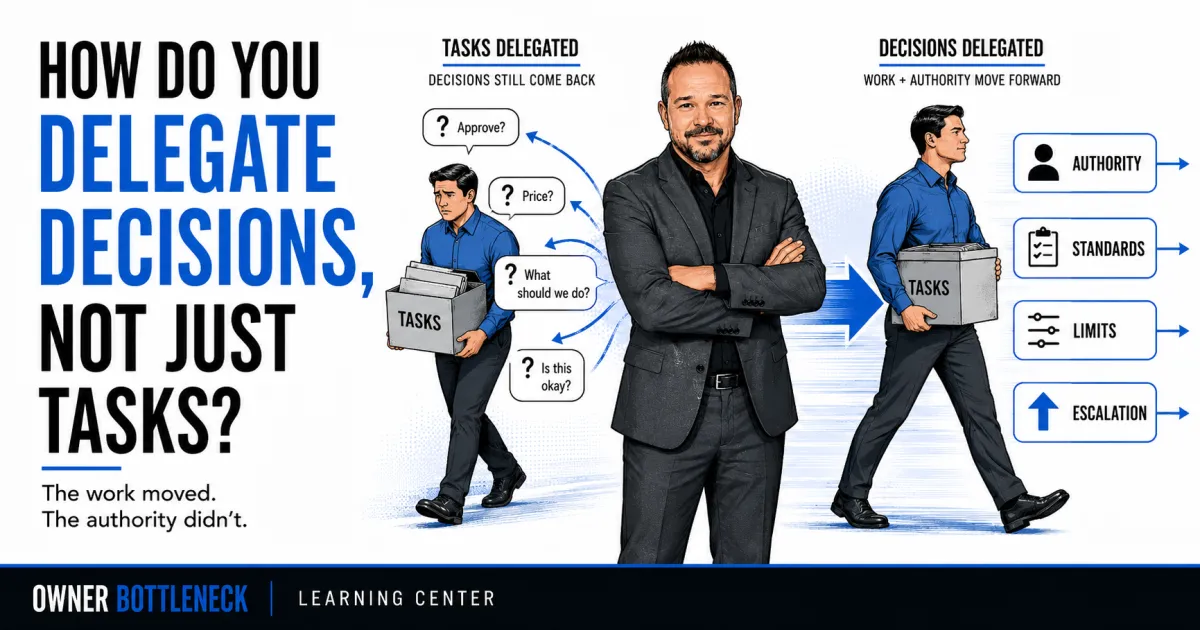
How Do You Delegate Decisions, Not Just Tasks?
The project manager had the schedule.
The team had the materials.
The customer had approved the scope.
The job was ready to move.
There was only one problem.
The project manager still needed the owner to approve overtime.
Then the owner had to approve the equipment change.
Then the owner had to decide whether the customer should receive a credit.
The project manager owned the work.
The owner still owned every decision that made the work move.
That’s the difference between delegating tasks and delegating decisions.
Task delegation transfers activity.
Decision delegation transfers the right and responsibility to choose what happens next.
If you want your team to take real ownership, you can’t only tell them what to do. You have to give them a clear outcome, usable authority, visible standards, decision boundaries, the right information, and accountability for the result.
Otherwise, the task moves.
The authority doesn’t.
Key Takeaways
Task delegation transfers work. Decision delegation transfers the right and responsibility to choose what happens next.
Employees can own a task and still depend on the owner for approval, judgment, exceptions, and risk.
Telling someone to “use your judgment” isn’t enough when the standards and boundaries remain unclear.
Good decision delegation includes a defined outcome, authority, limits, information, standards, escalation rules, and accountability.
The owner should review many decisions after they happen instead of approving every decision beforehand.
Managers need room to make reasonable decisions differently without having their authority taken back.
Decision delegation should begin with recurring, lower-risk decisions before moving into larger ones.
The goal isn’t less control. It’s control through clarity, boundaries, visibility, and accountability.
What Does It Mean to Delegate Decisions?
Delegating a decision means transferring more than the work.
It means another person has the authority and responsibility to choose what happens within clear limits.
They understand:
The outcome they own
The decisions they can make
The financial limits
The operating limits
The standard they’re protecting
The information they should use
The risks that matter
When they should act
When they should inform you
When they should escalate
Without those pieces, employees may be responsible for the activity while still waiting for you to determine the result.
That creates a Decision Bottleneck.
A Decision Bottleneck forms when too many normal decisions depend on the owner’s approval, judgment, knowledge, or presence.
The company may have plenty of people.
The people may be busy.
The work may be assigned.
But progress can’t move any faster than the owner can decide.
Task Delegation and Decision Delegation Are Not the Same
Consider a salesperson.
Task Delegation
“Build the proposal and send it to me for review.”
The salesperson gathers the information.
They create the proposal.
They may even present part of the recommendation.
But the owner still decides:
The final price
The discount
The terms
The scope
The risk
Whether the proposal is ready
Whether the opportunity should move forward
The salesperson owns the activity.
The owner owns the decision.
Decision Delegation
“You own the proposal, including the recommendation, pricing within the approved margin range, and final follow-up. You can adjust payment terms inside the approved options. Escalate anything below 35 percent margin, anything involving unusual legal terms, or any promise outside our normal delivery capacity.”
Now the salesperson has:
A clear outcome
Authority
Limits
Standards
Escalation rules
Accountability
The owner isn’t absent.
The owner has simply stopped standing inside every normal deal.
Why Owners Delegate Tasks but Keep the Decisions
Most owners don’t hold decisions because they enjoy being interrupted.
They keep the decisions because the consequences feel real.
They worry about:
Losing margin
Upsetting an important customer
Setting a bad precedent
Creating a quality problem
Making the wrong hire
Spending too much
Damaging the reputation
Losing control
Allowing small mistakes to become expensive
Discovering the team wasn’t ready
Those concerns aren’t irrational.
The owner has usually spent years learning which decisions matter.
They’ve made mistakes.
They’ve carried the financial risk.
They know how quickly a small issue can become a large one.
So they delegate the task and keep the decision.
That feels safer.
But it also teaches the company that responsibility stops where uncertainty begins.
The team handles the normal part.
The owner handles the judgment.
Over time, the owner becomes the answer to every exception.
That’s one reason delegation alone doesn’t solve the Owner Bottleneck.
The task may have moved.
The outcome, judgment, and authority may still belong to you.
Why “Use Your Judgment” Isn’t Enough
Owners often become frustrated and say:
“I need you to use your judgment.”
The employee may want to.
But what judgment are they supposed to use?
The owner may be weighing:
Customer value
Margin
Long-term relationship
Operational capacity
Past promises
Precedent
Risk
Timing
Reputation
Cash flow
The employee may only see the immediate issue.
Without the context, standard, and authority, “use your judgment” can feel like:
“Make the right decision, but I won’t tell you what right means until after you decide.”
That doesn’t create confidence.
It creates caution.
Employees begin asking because asking is safer than guessing.
That pattern is explored in Why Does My Team Keep Coming to Me for Every Decision?.
If you want people to use judgment, you have to transfer the thinking that supports it.
Step 1: Define the Outcome
Don’t start by asking:
“What task should I delegate?”
Start with:
“What outcome should this person own?”
Tasks describe activity.
Outcomes describe responsibility.
Weak
“Follow up with the customer.”
Stronger
“Own the customer issue until the customer has a clear answer, the agreed remedy is completed, and the cause is documented.”
Weak
“Manage the schedule.”
Stronger
“Own the weekly schedule so customer commitments, labor capacity, and priority work stay aligned.”
Weak
“Handle the proposal.”
Stronger
“Own the proposal from recommendation through customer decision, while protecting margin and delivery capacity.”
A clear outcome helps the person decide what matters when the exact steps change.
Without an outcome, employees can complete the task while missing the result.
Step 2: Name One Decision Owner
Decision-making becomes weak when ownership is shared vaguely.
You hear phrases like:
“Sales and operations will figure it out.”
“The team can decide.”
“Someone should handle that.”
“We’ll talk about it.”
“Run it by everyone.”
Shared input can be useful.
Shared ownership usually isn’t.
One person should know:
“I own the decision.”
That doesn’t mean they decide without information.
It means they’re responsible for gathering input, weighing the facts, making the choice, communicating it, and owning the result.
For each recurring decision, name one decision owner.
Examples:
The sales manager owns pricing inside the approved range.
The operations manager owns weekly scheduling.
The service manager owns customer recovery.
The office manager owns routine purchasing.
The project manager owns normal scope decisions.
The department manager owns employee coaching.
When nobody owns the decision, it usually rises to the owner.
Step 3: Define the Authority
A responsibility without authority is incomplete.
The person may own the outcome in theory but still need your approval to produce it.
Clarify exactly what they can decide.
Ask:
What choices can they make independently?
What can they approve?
What can they change?
What can they spend?
What can they promise?
What can they communicate?
What can they correct?
What can they decline?
What can they prioritize?
What can they stop?
The authority should be usable.
Weak
“You’re empowered to take care of the customer.”
Stronger
“You can approve a refund or credit up to $500 when we clearly failed to meet the agreed standard. You can offer a redo at no charge when the issue is within our responsibility. Escalate legal threats, safety concerns, or anything involving a top-ten account.”
The second version tells the manager what empowerment means.
Step 4: Set Financial and Operating Limits
Authority without limits can create unnecessary risk.
Limits make delegation safer.
You can define boundaries around:
Dollar amount
Margin
Labor hours
Overtime
Customer value
Contract terms
Delivery dates
Scope
Safety
Legal exposure
Reputation risk
Employee impact
For example:
Pricing
“You can approve discounts up to 5 percent when gross margin remains above 38 percent.”
Purchasing
“You can approve routine purchases up to $2,000 inside the existing department budget.”
Customer Recovery
“You can offer credits up to $750 when we missed a documented commitment.”
Scheduling
“You can approve up to ten hours of overtime when it protects a contractual deadline and stays inside the monthly labor target.”
The limit shouldn’t be random.
It should reflect the real risk the company is willing to carry.
Step 5: Make the Standard Visible
A person can have authority and still struggle if the standard lives only in your head.
The owner may know:
What a good proposal looks like
What a fair customer remedy feels like
Which jobs deserve priority
What quality can’t be compromised
Which risks matter most
When speed is more important
When margin is more important
When an exception is justified
The team needs access to that standard.
Define:
What success looks like
What must be protected
What must never happen
What can vary
What can be corrected later
What requires a second review
Which tradeoffs are acceptable
Which tradeoffs are not acceptable
Example: Customer Recovery Standard
A good customer recovery decision should:
Acknowledge the company’s responsibility
Protect the relationship when reasonable
Avoid promising more than the company can deliver
Stay inside the approved financial limit
Correct the immediate issue
Identify whether a process needs to change
Avoid creating a harmful precedent
Now the manager has more than a dollar limit.
They understand what the decision is supposed to accomplish.
Step 6: Create Three Decision Levels
A simple decision framework can reduce unnecessary owner involvement.
Use three levels.
Decide Independently
The person makes the decision and continues.
This should include normal, recurring, reversible decisions inside their role.
Examples:
Routine schedule changes
Customer credits inside limits
Purchases inside budget
Normal employee coaching
Pricing inside the approved range
Minor project adjustments
Decide and Inform
The person decides, acts, and reports what happened afterward.
This keeps work moving while preserving visibility.
Examples:
A customer remedy near the top of the approved limit
A schedule change affecting another department
Overtime approved inside the monthly target
A small exception that may become a pattern
A decision the owner should know about but doesn’t need to approve
Escalate Before Deciding
The person pauses and gets the right leader involved.
Examples:
Serious legal risk
Safety concerns
Significant financial exposure
Major employee misconduct
Potential loss of a critical account
Decisions outside agreed authority
Unusual contractual commitments
Decisions that could damage the company’s reputation
This framework gives employees a path.
They don’t have to choose between asking about everything and acting with no boundaries.
Step 7: Transfer the Information Needed to Decide
Employees may lack authority.
They may also lack information.
You may be making decisions based on facts they can’t see.
That might include:
Customer profitability
Account history
Margin
Capacity
Vendor performance
Cash position
Employee performance history
Past exceptions
Contract obligations
Strategic priorities
Someone can’t make a sound decision without the information that makes the decision sound.
Ask:
What information do I use?
Where does that information live?
Does the decision owner have access?
Is it current?
Is it understandable?
Is it available when the decision must be made?
If the answer depends on your memory, the decision still depends on you.
Step 8: Transfer the Reasoning Behind the Decision
Information tells someone what’s happening.
Reasoning teaches them how to think about it.
When you make a decision, explain:
What mattered most
Which risk concerned you
What tradeoff you accepted
Which outcome you prioritized
What precedent you considered
What would have changed your decision
Which detail looked small but mattered
For example:
“I’m approving the credit because we missed the agreed date and the delay created a measurable cost for the customer. I’m not approving a full refund because the customer received and used the service. The goal is to make the failure right without giving away work they received.”
That teaches more than:
“Give them a $500 credit.”
The answer solves one issue.
The reasoning helps someone solve the next one.
Step 9: Require Recommendations, Not Open-Ended Questions
When someone brings you a decision, don’t always answer immediately.
Ask for their recommendation.
Instead of:
“What should we do?”
Expect:
“Here’s what happened. Here are the options. Here’s what I recommend. Here’s why. Here’s the risk. Here’s whether it falls inside my authority.”
This changes your role.
You’re no longer the first thinker.
You’re reviewing and coaching another person’s thinking.
Useful questions include:
What do you recommend?
Why?
What standard are you using?
What options did you consider?
What risk matters most?
Is this inside your authority?
What would make you escalate it?
What outcome are you trying to protect?
That may feel slower.
It is slower at first.
But it builds the ability the company needs to stop returning every decision to you.
Step 10: Review Decisions Afterward
Owners often try to maintain control by approving everything before it happens.
That keeps the owner inside the flow of work.
A better long-term model is often review after action.
The process looks like this:
Define the outcome.
Set the authority.
Set the boundaries.
Let the person decide.
Review selected decisions afterward.
Coach the reasoning.
Adjust the standard or boundary when needed.
This keeps leadership informed without making leadership the gate.
A weekly decision review can include:
What decisions were made?
What information was used?
What happened?
What worked?
What would change next time?
Did the person stay inside authority?
Does the boundary need adjustment?
Did the decision expose a missing standard?
Review builds judgment without stopping work.
Step 11: Let Reasonable Decisions Stand
This is one of the hardest parts of decision delegation.
A manager makes a decision you wouldn’t have made.
The decision stays inside the boundary.
The reasoning is sound.
The outcome is acceptable.
Do you let it stand?
Many owners don’t.
They reverse it because it feels different.
The manager learns that the authority wasn’t real.
Next time, they ask.
Separate four kinds of decisions.
Dangerous Decision
The decision creates serious safety, legal, ethical, financial, or customer risk.
Intervene immediately.
Decision Outside Authority
The person crossed a clearly defined boundary.
Correct it and review why it happened.
Careless Decision
The person ignored available information, standards, or basic responsibility.
Coach it and enforce accountability.
Reasonable but Different
The person used sound judgment and reached a different acceptable conclusion.
Let it stand.
You can discuss how you would have handled it.
But don’t take back the decision simply because it wasn’t yours.
Ownership requires room for judgment.
Step 12: Start With Lower-Risk Decisions
Don’t begin by transferring the largest, most dangerous decision in the company.
Start with decisions that are:
Recurring
Reversible
Easy to measure
Inside a clear area of responsibility
Financially limited
Frequent enough to practice
Important enough to matter
Safe enough to coach
Good starting points may include:
Routine discounts
Customer credits
Scheduling changes
Small purchases
Overtime inside limits
Proposal changes
Minor scope decisions
Normal employee coaching
Vendor choices inside an approved list
The person needs repetition.
Judgment improves through practice, review, and feedback.
Step 13: Clarify Accountability
Decision authority without accountability can become careless.
The decision owner should understand what they’re responsible for after choosing.
That may include:
Communicating the decision
Documenting the reason
Following through
Measuring the result
Fixing downstream issues
Updating affected people
Reviewing what happened
Improving the process
Owning mistakes
The goal isn’t to punish someone for every imperfect decision.
It’s to connect authority to responsibility.
When someone owns the decision, they should also own the follow-through.
Step 14: Fix the System When the Same Decision Keeps Returning
A decision may need to reach you once.
It shouldn’t automatically reach you forever.
When the same issue repeats, ask:
Why is this still reaching me?
Is ownership unclear?
Is authority missing?
Is the boundary too narrow?
Is the standard unclear?
Is information unavailable?
Is the person avoiding responsibility?
Have I reversed past decisions?
Is the process creating the question?
Should this become a standing rule?
This is how you move from solving the issue to removing the dependence.
The goal isn’t to answer the same question faster.
The goal is to stop the same category of question from requiring you.
Step 15: Test Whether the Decision Has Truly Been Delegated
A decision isn’t fully delegated because you announced it.
It’s delegated when the work continues while you’re unavailable.
Test it.
Choose one decision category.
Then become unavailable for a normal period.
Afterward, review:
Did the person decide?
Did the work continue?
Did they stay inside the boundary?
Did they use the right information?
Did they protect the standard?
Did they escalate appropriately?
Did they communicate the outcome?
Did they own the result?
You can use the broader process in How to Measure Owner Dependence in Your Business to see whether decisions are actually moving away from the owner.
As the company improves, test longer periods using How Can I Get My Business to Run Without Me?.
Eventually, the larger benchmark is whether your business can run without you for 30 days.
A Realistic Example: The Manager Who Owned the Job but Not the Decisions
Consider a $6 million commercial roofing company with 34 employees.
The business has:
An operations manager
Four project managers
A sales manager
An office manager
Experienced field crews
The project managers are responsible for delivering jobs on time and on budget.
But they still need the owner to approve:
Overtime
Material substitutions
Customer credits
Schedule changes
Small scope adjustments
Vendor changes
Rework
Expedited delivery costs
The owner believes the project managers need to take more ownership.
The project managers believe they aren’t allowed to make the decisions.
Both are right.
What the Owner Changes
The company begins with material substitutions.
The owner and operations manager define:
Approved equivalent materials
Minimum quality requirements
Maximum cost difference
Customer communication requirements
Situations requiring customer approval
Situations requiring owner escalation
The project managers can now approve substitutions when:
The material meets the minimum standard
The cost difference stays under $1,500
The warranty remains protected
The schedule improves or remains unchanged
The customer receives required notice
Anything outside those boundaries is escalated.
The Next Category
The company addresses customer recovery.
Project managers can approve remedies up to $1,000 when the company clearly missed a written commitment.
They must document:
What happened
What the customer experienced
The remedy
The cause
What should change
What Happens
At first, project managers still ask.
The owner responds:
“What do you recommend, and is it inside your authority?”
Some decisions are imperfect.
One project manager approves a $900 credit when the owner might have approved $600.
The decision stays inside the boundary.
The reasoning is reasonable.
The owner lets it stand.
After several months:
Fewer jobs wait for approval.
Customer issues are resolved faster.
Project managers bring recommendations.
The owner sees patterns through weekly review.
Boundaries improve.
The company learns which decisions truly require the owner.
The owner didn’t lose control.
Control moved from constant permission to clear standards, limits, visibility, and accountability.
Signs You’re Still Delegating Tasks Instead of Decisions
Look for these patterns:
Employees complete the work but wait for your approval.
Managers are responsible for results but can’t control the inputs.
Pricing, refunds, purchases, and schedule changes still reach you.
Employees ask what you would do before making normal decisions.
“Use your judgment” is common, but decision boundaries aren’t written.
You reverse decisions that are reasonable but different.
The team lacks access to the information you use.
You review everything before action instead of afterward.
Responsibilities are shared vaguely.
Decisions stop when you’re unavailable.
Managers bring problems without recommendations.
The same questions return repeatedly.
Employees are accountable for results but lack authority.
Customer and operational exceptions automatically rise to you.
You’re still the fastest way to get an answer.
These are signs the task moved but the decision didn’t.
What Decision Delegation Does Not Mean
It doesn’t mean:
Giving unlimited authority
Accepting reckless decisions
Abandoning oversight
Eliminating accountability
Allowing anyone to spend anything
Ignoring legal or safety risks
Never speaking with your team
Transferring every owner-level decision
Removing standards
Losing visibility
It means people can make normal decisions inside clear boundaries without waiting for permission every time.
That’s stronger control than sitting in every workflow.
How Does This Help You Stop Being the Bottleneck?
Owners often become the bottleneck because normal decisions keep returning.
When you delegate decisions properly:
Work waits less.
Managers carry more responsibility.
Customers receive faster answers.
Employees learn judgment.
The owner handles fewer recurring approvals.
Problems are solved closer to where they happen.
Leadership capacity grows.
The company becomes less dependent on immediate owner access.
That’s a key part of stopping yourself from being the bottleneck in your business.
It also supports the broader work of making your business less dependent on you.
Frequently Asked Questions
How do I delegate decisions without losing control?
Replace constant approval with clear outcomes, authority, financial limits, operating boundaries, standards, reporting, and accountability.
You can stay informed without approving every normal decision beforehand.
What decisions should I delegate first?
Start with recurring, reversible, lower-risk decisions that consume owner attention.
Good examples include normal discounts, customer credits, routine purchases, scheduling changes, limited overtime, and minor scope decisions.
What decisions should the owner keep?
Owners should usually retain decisions involving major strategy, ownership, significant financial exposure, legal risk, serious safety issues, critical leadership roles, or material changes to the company.
Routine decisions shouldn’t remain with the owner simply because they always have.
What if my manager makes the wrong decision?
Determine why it was wrong.
Was the boundary unclear?
Was information missing?
Was the standard invisible?
Did the manager ignore the standard?
Was the decision reasonable but different from yours?
The cause determines whether the answer is training, clearer authority, better information, coaching, or accountability.
How much authority should I give an employee?
Give enough authority to produce the outcome they own, while setting limits around real risk.
The right authority depends on the role, experience, financial exposure, customer impact, and maturity of the person.
Should employees have to tell me every decision they make?
No.
Use decision levels.
Some decisions should be made independently. Some should be made and reported afterward. Some should be escalated before action.
The goal is useful visibility, not constant permission.
How do I get employees to bring recommendations?
Set the expectation clearly.
Ask them to bring:
What happened
The options
Their recommendation
Their reasoning
The risk
Whether the decision falls inside their authority
Then stop answering before they’ve done the thinking.
What if I disagree with their decision?
If the decision was dangerous, careless, or outside authority, address it.
If it was reasonable, inside the boundary, and simply different from your preference, let it stand.
Authority can’t develop if every difference is reversed.
What Should You Do This Week?
Choose one decision that reached you more than once.
Then answer:
What outcome should someone else own?
Who should own the decision?
What authority do they need?
What financial or operating limit applies?
What standard are they protecting?
What information do they need?
When should they decide independently?
When should they decide and inform?
When should they escalate?
How will you review the decision afterward?
Write it down.
Explain it.
Let the person make the next decision.
Then review the result without automatically taking the authority back.
That’s how decision-making moves into the company.
Not through a speech about empowerment.
Through clear ownership, usable authority, visible standards, and room to decide.
Find Where Decisions Still Depend on You
You may have delegated more work than you realize.
The question is whether you also delegated the decisions that make the work move.
The Owner Bottleneck Scorecard helps you evaluate dependence across decisions, sales, operations, team, and business value.
Take the Owner Bottleneck Scorecard and identify where your business is still waiting for your approval, judgment, or answer.