
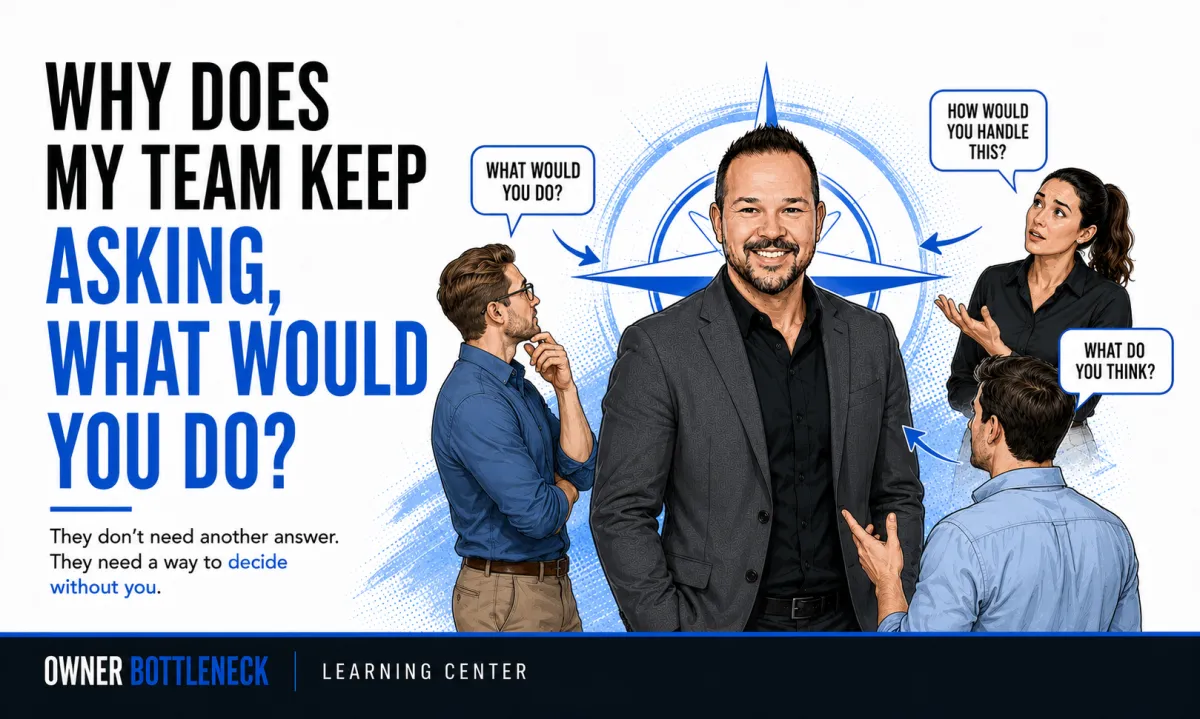
Why Does My Team Keep Asking, “What Would You Do?”
Your team keeps asking, “What would you do?” because they’ve learned that making a good decision may not be enough. The decision also has to match your preferences. To change that, separate company standards from your personal preferences and style, make the priorities and boundaries visible, and let different but sound decisions stand.
The customer wanted the work finished by Friday.
Operations could meet the date, but only by moving another customer into the following week.
The manager studied both projects.
One customer had already experienced a delay.
The other had told the salesperson that Friday would be helpful, but not critical.
The manager believed the answer was clear.
Protect the commitment already at risk.
Keep the first project on schedule.
Move the flexible customer.
Then she walked into the owner’s office.
I think I know what we should do, but what would you do?
The owner smiled.
At least she was thinking.
He asked what she recommended.
She explained the customer histories, current capacity, promised dates, and risk.
Her recommendation was responsible.
The owner would’ve made the other choice.
He believed the newer customer could become a major account. He would’ve protected that relationship and called the delayed customer himself.
So he said:
Your reasoning makes sense, but I’d move the first customer.
The manager changed the schedule.
The following week, another conflict appeared.
This time she didn’t prepare a recommendation.
She brought the problem directly to the owner.
What do you want me to do?
The owner thought her judgment had gone backward.
It hadn’t.
She had learned the real standard.
Success didn’t mean making a responsible decision.
Success meant predicting the owner’s decision.
The Question Is Usually a Culture Signal
“What would you do?” can sound respectful.
Sometimes it is.
The employee may value the owner’s experience.
They may be facing something genuinely new.
They may want to understand how an expert thinks.
But when the question appears constantly, it usually signals something deeper.
The employee doesn’t trust that the company’s stated standards are enough to make the decision.
They believe there’s another standard.
The owner’s personal answer.
They may know:
The outcome they’re supposed to produce
The process they’re supposed to follow
The authority they supposedly have
The financial limit they must stay within
The customer promise they’re trying to protect
And still feel unsafe deciding.
Why?
Because they’ve watched what happens when someone makes a choice the owner wouldn’t have made.
The owner corrects it.
Reverses it.
Rewrites it.
Explains the better method.
Or says:
You were allowed to decide. I just didn’t expect you to decide that.
The team learns that authority has an invisible condition:
Your decision is yours as long as it looks like the owner’s.
That’s not Judgment Transfer.
It’s owner imitation.
A Team Can Know You Too Well
Some owner-led businesses appear to have a strong culture.
Employees know how the owner thinks.
They know which details the owner notices.
Which words the owner uses.
Which customers receive exceptions.
Which mistakes will be forgiven.
Which delays will create anger.
Which proposals will be rewritten.
Which decisions will be praised.
They can often predict the owner’s reaction before the owner enters the room.
That can look like alignment.
It may actually be adaptation.
The team has become skilled at reading one person.
That’s fragile.
New employees struggle because the real standards aren’t written or taught.
Managers hesitate because they know the stated authority may not match the owner’s reaction.
Decisions become slower because people discuss what the owner will think.
Good employees may become frustrated because their judgment is accepted only when it matches the founder’s path.
The company hasn’t built a culture that guides people.
It has built a culture that guides people toward the owner.
An Owner Bottleneck doesn’t exist only when tasks and approvals come back to the owner.
It can also exist when the owner remains the company’s emotional and intellectual reference point for every important choice.
Owner-Centered Culture and Company-Centered Culture
An owner-centered culture asks:
What would Darrell do?
A company-centered culture asks:
What are we trying to protect?
An owner-centered culture defines success as matching the owner’s path.
A company-centered culture defines success as reaching the required result inside shared standards and boundaries.
An owner-centered culture relies on people knowing the owner.
A company-centered culture relies on people understanding the business.
An owner-centered culture treats different as suspicious.
A company-centered culture asks whether different is still sound.
The goal isn’t to remove the founder’s influence.
The founder’s judgment, values, history, and hard lessons helped shape the company.
The goal is to turn that influence into something people can use without needing the founder in the room.
That means transferring:
The outcomes that matter
The standards that must be protected
The tradeoffs the company accepts
The risks different roles may carry
The decisions people can make
The conditions requiring escalation
The lessons learned from past choices
Your experience should remain inside the business.
It just shouldn’t remain accessible only through you.
How Owners Accidentally Build This Pattern
Owners rarely announce:
Every decision should look like mine.
They build the pattern through small reactions.
You Answer Before They Finish Thinking
An employee begins explaining the problem.
The owner recognizes it immediately.
They’ve seen this before.
They interrupt.
Here’s what you need to do.
The problem gets solved faster.
The employee learns that preparing a recommendation isn’t necessary.
The owner will supply the answer.
The next question arrives even earlier.
You Correct the Path When the Result Was Fine
The manager reaches the right outcome.
The owner still corrects the wording, sequence, tone, or method.
Some corrections matter.
A vague proposal creates risk.
A weak employee conversation avoids accountability.
A customer message may create a promise the business can’t keep.
But sometimes the method was simply different.
If every difference receives feedback, employees learn that the owner’s style is part of the required result.
You Reverse Decisions That Feel Unfamiliar
The employee stays inside the authority.
Protects the agreed standard.
Accepts a reasonable risk.
The owner sees another option and reverses the choice.
The owner may call this coaching.
The employee experiences it as evidence that the authority wasn’t real.
You Review Only Failures
Nobody discusses the ten responsible decisions that worked.
The owner reviews the one that didn’t.
Decision reviews begin to feel like punishment.
Employees learn that making decisions creates personal exposure.
Asking the owner transfers the exposure back where it feels safer.
You Reward Escalation
An employee brings a problem.
The owner solves it.
The employee receives relief and sometimes praise for “keeping the owner informed.”
Another employee decides independently.
The result is imperfect.
They receive correction.
The company has rewarded asking and punished deciding.
The next behavior is predictable.
You Say “You Decide” Without Defining What Matters
The employee receives permission.
They don’t receive:
Clear priorities
Visible standards
Usable authority
Risk limits
Examples
Escalation rules
Support after the decision
They’re expected to fill the gap by guessing what the owner would do.
That’s why teaching employees to make good decisions without you requires more than telling people to trust themselves.
The business must give them something trustworthy to decide from.
What the Employee Is Really Asking
When an employee asks:
What would you do?
They may really be asking one of several questions.
What Matters Most Here?
Two priorities conflict.
Customer trust and margin.
Speed and quality.
Fairness and performance.
Capacity and growth.
The employee may know the options but not the company’s priority.
What Risk Am I Allowed to Accept?
The decision might cost money.
Delay a project.
Upset a customer.
Create overtime.
Set a precedent.
The employee may not know which risk belongs to their role.
That uncertainty needs a clear boundary, not another owner answer. Employees need to know what they may decide, what they should decide and report afterward, and which risks must return to leadership. This guide explains how to set decision boundaries for employees using May Decide, Decide and Inform, and Must Escalate.
What Does Good Look Like?
The owner says:
Handle it professionally.
Or:
Make it right.
Or:
Use good judgment.
The employee doesn’t have a usable standard.
They’re asking for the owner’s example because the company’s definition of good remains invisible.
Will You Support Me if My Decision Is Different?
The employee may already have a recommendation.
They’re testing whether the owner actually wants them to decide.
They remember what happened last time someone chose differently.
Will I Be Punished if the Outcome Is Poor?
The employee may understand the decision and the boundary.
They don’t trust how the owner will respond if an acceptable risk doesn’t work out.
The question is less about judgment.
It’s about personal safety.
Before treating “What would you do?” as a confidence problem, determine which answer the employee is missing.
Separate Company Standards From Owner Preferences
Owners frequently confuse three things:
A nonnegotiable company standard
A preferred method
A personal style
Those aren’t the same.
A customer email may need to:
State the issue clearly
Take responsibility where appropriate
Avoid making an unsupported promise
Name the next step
Set a response time
Those are standards.
The owner may prefer short paragraphs, a particular greeting, or a warmer tone.
Those may be preferences.
The owner may personally call the customer instead of emailing.
That may be style.
If the employee’s message protects the relationship, meets the communication standard, and creates a clear next step, it may be sound even when it doesn’t sound exactly like the owner.
Before correcting a decision, ask:
Did this violate a real standard?
Did it cross a boundary?
Did it create unacceptable risk?
Did it miss the required outcome?
Or do I simply prefer another path?
Personal preference isn’t automatically wrong.
Owners are allowed to have preferences.
The problem appears when a preference quietly becomes a company rule nobody was told existed.
The employee discovers it only after choosing differently.
Replace “What Would I Do?” With “What Are We Trying to Protect?”
This is the central shift.
Don’t teach employees to search for your answer.
Teach them to search for the business priority.
When the employee asks:
What would you do?
respond with:
What are we trying to protect here?
That question moves the conversation away from personality and toward decision intent.
For a customer issue, the answer might be:
Protect customer trust by providing a fair remedy when we fail, without making a promise we can’t deliver or rewarding abusive behavior.
For scheduling:
Protect committed deadlines and safe team capacity. Don’t solve one delay by creating a larger one elsewhere.
For pricing:
Protect the value, margin, cash, and delivery requirements of the offer.
For employee performance:
Protect the required result and fair treatment of the employee. Address repeated misses before they become the team’s new standard.
Once the priority is clear, ask:
What options do you see?
Which option best protects that priority?
What risk does it create?
Does it stay inside your boundary?
Now the employee is practicing judgment.
The owner may still provide context.
But the employee isn’t trying to read the owner’s mind.
They’re learning how the company decides.
Teach the Tradeoffs Behind Your Answer
Owners often share the conclusion without sharing the tension.
Hold the price.
Refund the customer.
Move the project.
Don’t fire the employee.
The employee hears an answer.
They don’t hear what competed underneath it.
The owner may have been weighing:
Short-term margin against long-term trust
One customer’s urgency against another customer’s promise
The cost of rework against the cost of losing the account
One employee’s history against the standard applied to everyone else
A valuable opportunity against delivery capacity
Speed against safety
Explain the tradeoff.
Instead of:
Don’t offer the refund.
say:
We clearly failed, so we need to make it right. A full refund would exceed the impact the customer experienced and create a remedy we wouldn’t repeat in similar cases. I’d offer the redo plus a smaller credit because it protects trust without disconnecting the remedy from the actual failure.
Now the employee can use the reasoning again.
The company has gained more than one answer.
It has gained part of the owner’s judgment.
That’s how you get the knowledge in your head into the business.
Use Real Cases, Not Vague Values
Values become useful when they survive a difficult choice.
“Take care of the customer” sounds clear until:
The customer caused part of the problem
The requested remedy is unreasonable
The team can’t deliver what the customer wants
Helping one customer harms another
The customer becomes abusive
Use real situations to test what the value means.
Ask the team:
What happened?
What are we trying to protect?
Which facts matter most?
What options exist?
What would each option cost?
Which risk belongs to us?
Which risk belongs to the customer?
What can this role decide?
What must be escalated?
Past decisions can become training examples.
Not as proof that the owner’s answer was perfect.
As evidence of how the business weighs priorities.
Use examples where:
The owner made a good call
The owner would make a different call today
Two different answers could both be sound
The result was poor even though the reasoning was responsible
The outcome was good even though the reasoning was weak
The team needs more than success stories.
They need to see how judgment works when the answer isn’t obvious.
Let Different but Sound Decisions Stand
This is where owner-centered culture either begins to change or protects itself.
The manager makes a decision you wouldn’t have made.
It stays inside the authority.
The reasoning is responsible.
The standard is protected.
The risk is acceptable.
The result is healthy.
Can you leave it alone?
You may still discuss another option.
You may share a lesson.
You may improve the example.
But if you reverse it simply because it differs from your answer, the team will return to prediction.
Authority is tested during disagreement.
When the employee agrees with you, there’s no real test.
The test arrives when they choose a reasonable path you dislike.
Allowing that decision to stand tells the organization:
The standard matters more than my personal method.
That’s how a company begins developing judgment larger than the owner.
It’s also why reviewing an employee’s decision without taking back control matters.
The review should strengthen the next decision.
It shouldn’t restore the owner’s answer as the only acceptable one.
Change What You Say When the Question Appears
Don’t shame the employee for asking.
You helped build the system they’re responding to.
Use the question as a coaching moment.
Instead of answering immediately, try:
What are we trying to protect?
What do you recommend?
What facts matter most?
Which boundary applies?
What options did you consider?
What risk would your recommendation create?
What part truly requires my authority?
What would you do if I were unavailable?
Is this a standard question, a judgment call, or an owner-reserved decision?
What support do you need without transferring the decision back to me?
The goal isn’t to play a game where the owner refuses to help.
Sometimes the employee needs information only the owner has.
Sometimes the issue genuinely crosses their authority.
Sometimes they’re learning and need coaching.
Help them.
But return the decision whenever it still belongs to them.
Don’t Answer a Recommendation With Your Preference
The employee says:
I recommend moving the project to Friday because the other customer already has a contractual commitment, and we can make the change without overtime.
The owner says:
I’d still move the other job.
The employee has no idea whether their reasoning was weak or the owner simply prefers another answer.
Respond more clearly.
If the recommendation is sound:
Your recommendation protects the committed date, stays inside the labor boundary, and keeps both projects inside the week. I would’ve considered another option, but your decision is reasonable. Go ahead.
If the reasoning missed something:
You’ve considered the deadline and labor impact. You haven’t accounted for the fact that the second customer’s equipment is currently shut down. Add that consequence and reconsider your recommendation.
If the decision crosses authority:
Your reasoning may be sound, but this customer is inside the key-account escalation rule. Bring the recommendation, but the final call still belongs at this level.
The employee should leave knowing what happened.
Not merely that the owner chose something else.
Managers Must Stop Becoming Translators for the Owner
A manager meets with the team.
An employee asks what to do.
The manager says:
Let me see what Darrell thinks.
The manager returns later with the owner’s answer.
They may have a management title.
They’re functioning as a messenger.
Managers should eventually become judgment builders.
They need to know:
What their team may decide
Which standards guide the work
What must remain visible
Which risks require escalation
How to review a decision
How to allow sound differences
How to improve the system after repeated exceptions
If every manager still asks the owner what the owner would do, the company has added layers without moving authority.
The organizational chart grew.
The decision structure didn’t.
That’s one reason teams can keep coming to the owner for every decision, even after managers have been hired.
What if the Owner’s Preference Really Is Better?
Sometimes it is.
You have more experience.
You see a risk the employee missed.
You understand a customer relationship they don’t know yet.
You remember a previous exception.
You recognize a pattern faster.
Don’t pretend every decision is equally strong.
Explain what the person missed.
Say:
Your recommendation stayed inside the financial boundary, but you didn’t account for the precedent. We’ve made this exception twice for this customer, and they now treat it like a normal term. That’s why we’re going to hold the line.
Now the employee has gained context.
The correction was tied to a business standard or fact.
Not merely:
I know better.
The owner’s experience should shape the company.
But it needs to become reasoning others can use, not authority only the owner can exercise.
What if the Employee Genuinely Lacks Judgment?
They may.
Not every hesitation is caused by the owner.
The employee may lack:
Relevant experience
Attention to important details
Commercial understanding
Pattern recognition
Communication skill
Follow-through
Willingness to accept responsibility
Define the gap.
An inexperienced employee may need examples and smaller decisions.
Someone missing information may need better access.
Someone who doesn’t understand the standard may need clearer decision intent.
Someone who fears reversal may need evidence that sound decisions will stand.
Someone who repeatedly ignores boundaries may need accountability.
Someone who can’t develop the required capability may be in the wrong role.
Don’t label every problem:
They lack judgment.
That phrase hides too much.
Name what they don’t yet see, understand, or do.
Then decide whether it can be developed.
Stop Asking People to Become Smaller Versions of You
Owners sometimes say:
I need people who think like an owner.
What they may mean is:
I need people who make my decisions without requiring me to make them.
Those aren’t the same.
Thinking like an owner should mean:
Seeing the broader consequence
Protecting important standards
Understanding tradeoffs
Recognizing risk
Carrying accountability
Thinking beyond the immediate task
It shouldn’t mean:
Sharing the owner’s personality
Using the same words
Choosing the same style
Following the same path
Reacting emotionally in the same way
Reproducing every personal preference
The business needs shared judgment.
It doesn’t need cloned personalities.
Teach people what matters.
Let the right people use their strengths to protect it.
A 30-Day “What Would You Do?” Reset
Choose one team, manager, or recurring decision area.
Don’t attempt to change the entire culture through one speech.
Days 1 Through 7: Track the Question
Record every version of:
What would you do?
What do you want me to do?
Is this okay?
Can you approve this?
For each one, ask:
Did the person have authority?
Was the standard clear?
Did they have the needed information?
Was the boundary usable?
Were they protecting themselves from owner correction?
Did the issue genuinely require escalation?
Did I answer before they formed a recommendation?
Look for the reason behind the question.
Days 8 Through 14: Make What Matters Visible
Choose the largest recurring decision category.
Define:
What the business is trying to protect
Which standards apply
What the person may decide
What they should report afterward
What must be escalated
What personal preferences aren’t required standards
Use three real examples.
Include at least one where two different choices could both be sound.
Days 15 Through 21: Require Thinking Before Answers
When the question arrives, ask:
What do you recommend, and why?
Help the employee examine:
Important facts
Priorities
Options
Risks
Boundaries
Likely consequences
Don’t turn the conversation into an interrogation.
Coach the thinking.
Return the decision when it still belongs to the employee.
Days 22 Through 30: Let Sound Differences Stand
Track what happens when employees make decisions you wouldn’t have made.
Ask:
Did the decision protect the outcome?
Did it stay inside the boundary?
Was the reasoning responsible?
Was the risk acceptable?
Did I reverse it because it was wrong or because it was different?
What did my response teach the team?
Review the pattern with the manager.
Decide what standards, boundaries, examples, or owner behaviors need to change.
How Do You Know the Culture Is Shifting?
You’ll begin hearing different language.
Instead of:
What would you do?
you’ll hear:
Here’s what we’re trying to protect.
Instead of:
Can you approve this?
you’ll hear:
This stays inside my boundary. I’m making the call and will report the result.
Instead of:
I didn’t know what you wanted.
you’ll hear:
I considered these options and chose this one because it best protects the standard.
Instead of:
That’s not how Darrell would do it.
you’ll hear:
Does this meet the outcome and stay inside the boundary?
You may also see:
More recommendations
Faster decisions
Fewer routine escalations
Fewer owner reversals
More visible standards
Better decision reviews
Managers developing judgment in others
Less time spent interpreting the owner’s preferences
Different but sound approaches remaining in place
The goal isn’t to remove the owner’s influence.
It’s to stop making the owner’s presence necessary for that influence to guide the company.
Frequently Asked Questions
Why Do Employees Ask What the Owner Would Do?
They may lack clear standards, authority, information, examples, or confidence that a different but sound decision will be supported.
They may also have learned that matching the owner’s preference is safer than using their own judgment.
Is It Wrong for Employees to Ask for the Owner’s Advice?
No.
Advice can build judgment when the owner explains priorities, tradeoffs, and risks.
The problem appears when advice becomes the required path for routine decisions.
How Should I Answer “What Would You Do?”
Start with:
What are we trying to protect?
Then ask for the employee’s recommendation and reasoning before offering your answer.
Should Employees Try to Think Like the Owner?
They should understand the business consequences, standards, risks, and tradeoffs the owner has learned.
They don’t need to copy the owner’s exact personality, style, or preferred method.
How Do I Separate a Preference From a Standard?
Ask whether the difference affects the required outcome, creates unacceptable risk, crosses authority, or violates a real company requirement.
If not, it may be a personal preference.
What if My Method Is More Effective?
Explain why.
Connect the correction to a fact, standard, risk, or consequence the employee missed.
Don’t rely on authority alone.
What if the Employee Makes a Different Decision and the Result Is Poor?
Review the reasoning separately from the result.
A sound decision can produce an imperfect outcome.
Determine whether the person stayed inside the boundary and used the available information responsibly.
How Do I Make Company Standards Visible?
Define the outcome, what must be protected, what can’t be compromised, what tradeoffs are acceptable, and what requires escalation.
Use real examples to show how the standard applies.
Can This Work With New Employees?
Yes, but begin with smaller and more reversible decisions.
New employees need examples, context, training, and narrower boundaries while they build experience.
What if Managers Still Bring Every Decision to Me?
Confirm that managers have real authority, usable standards, clear boundaries, access to information, and support when they make sound choices.
A management title without decision authority creates another messenger.
Build a Company That Can Answer Without Predicting You
Your team may know you well.
They may respect your experience.
They may correctly predict how you’ll respond.
None of that proves the company can make sound decisions without you.
The test is what happens when the owner isn’t there to predict.
Can the team identify what matters?
Can they protect the standard?
Can they recognize the tradeoff?
Can they stay inside the boundary?
Can they explain the risk?
Can they make a reasonable choice?
Can that choice remain in place when it differs from yours?
Stop teaching people to search for your answer.
Teach them how the business decides.
The free Owner Bottleneck Scorecard evaluates dependence across:
Decisions
Sales
Operations
Team
Value
It’ll help you identify where employees still depend on your preferences, approval, judgment, or confidence.
Take the Owner Bottleneck Scorecard
The question isn’t whether they know what you would do.
It’s whether they know what the business is trying to protect.