
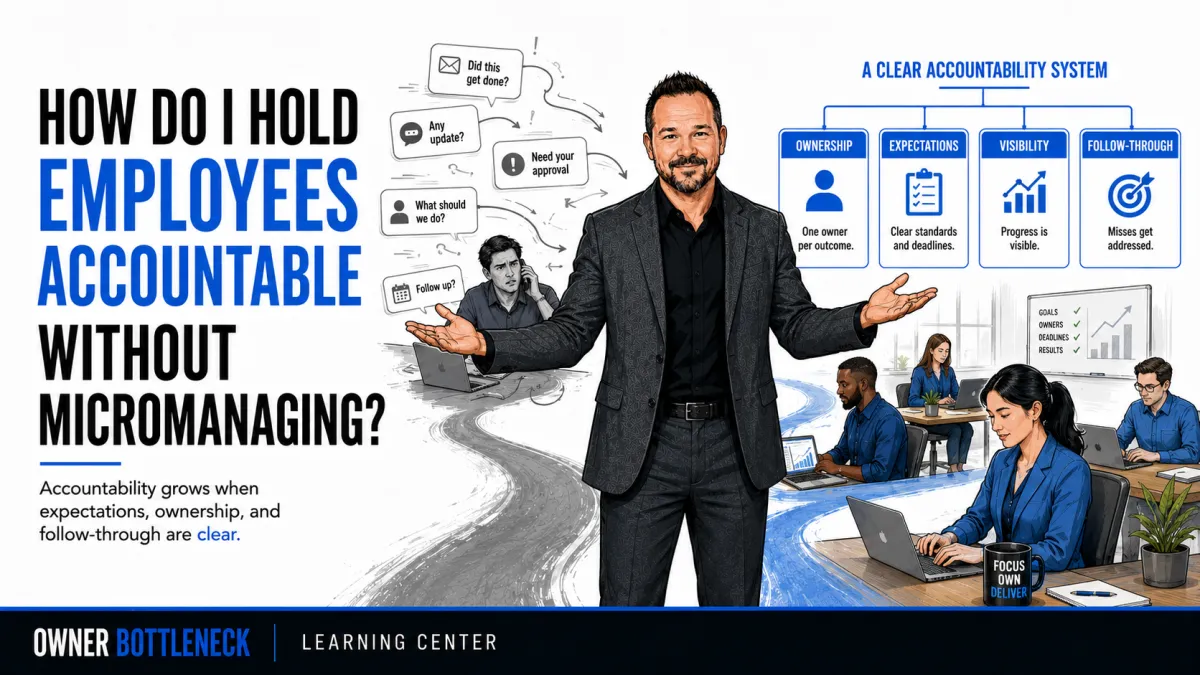
How Do I Hold Employees Accountable Without Micromanaging?
You hold employees accountable without micromanaging by making the outcome, standard, authority, deadline, visibility, and follow-through clear before the work begins. When those pieces are missing, the owner usually becomes the reminder system, approval process, and backup plan.
An owner walks into the office on Monday morning.
Before 9:30, they’ve already asked:
Did that proposal go out?
Did the customer get called back?
Where are we on the hiring decision?
Did anyone confirm the delivery?
Who’s handling the problem with the Johnson account?
By lunch, the owner has checked on twelve different things.
They don’t want to micromanage.
They know the team hates being watched.
They hate doing the watching.
But they’ve learned something through experience.
When they stop asking, things get missed.
So the owner keeps checking.
The team waits to be checked on.
And both sides blame the other.
The owner thinks:
Nobody takes accountability unless I stay on top of them.
The employees think:
Why take ownership when the owner is going to question, change, or take over everything anyway?
That’s the trap.
Micromanagement is often what accountability looks like when no real accountability system exists.
The owner’s memory becomes the project manager.
The owner’s questions become the reporting system.
The owner’s frustration becomes the consequence.
And the business stays dependent on the owner to make sure everyone else follows through.
Key Takeaways
Accountability doesn’t mean constantly checking on people.
Employees need a clear outcome, not just a task.
Responsibility without authority creates dependence, not ownership.
The owner needs visibility into progress without being involved in every step.
Missed commitments must lead to a direct conversation and a clear next action.
When the owner becomes the reminder system, accountability still depends on the owner.
Accountability Is Not Hovering
Accountability doesn’t mean asking someone for an update three times a day.
It doesn’t mean watching every step.
It doesn’t mean rewriting their work before they finish it.
And it doesn’t mean waiting until you’re angry, then telling the team they need to take more ownership.
Real accountability means everyone knows:
Who owns the result
What result is expected
What good looks like
When it must be completed
What authority they have
When they should ask for help
How progress will be visible
What happens when the commitment isn’t met
When those things are clear, the owner can step back without going blind.
That’s the part owners often miss.
They believe the choice is between involvement and ignorance.
Either they stay close to the work, or they risk finding out too late that something went wrong.
That’s a false choice.
A healthy accountability system gives the owner visibility without requiring constant intervention.
Why Does Micromanaging Feel Necessary?
Most owners don’t wake up wanting to control every detail.
They start checking because something has gone wrong before.
A deadline was missed.
A customer wasn’t called.
An employee assumed someone else was handling the problem.
A manager waited too long to escalate an issue.
The owner stepped in, fixed it, and promised themselves they wouldn’t let it happen again.
So they began checking earlier.
Then more often.
Eventually, the owner became part of every important workflow.
The checking feels necessary because one or more parts of accountability are missing.
The Outcome Is Unclear
The owner says:
Take care of this customer.
The employee hears:
Call the customer back.
The owner meant:
Solve the issue, protect the relationship, confirm the customer is satisfied, and tell me if the solution falls outside our normal limits.
The employee completed the task.
The owner expected an outcome.
That gap creates frustration.
Before assigning work, define what must be true when the work is complete.
“Follow up with the customer” is a task.
“The customer understands the solution, accepts the next step, and has a confirmed completion date” is an outcome.
People can own outcomes.
They can only complete tasks.
The Standard Is Unclear
Employees may know what needs to be done without knowing what “good” looks like.
The owner has a picture in their head.
They know the tone the customer should hear.
They know how accurate the proposal should be.
They know which details matter.
They know when a job is ready to move forward.
But nobody else can see that picture.
When the standard remains inside the owner’s head, the team has two choices.
Guess what the owner wants.
Or keep asking.
Then the owner becomes frustrated that nobody can operate independently.
You can’t hold someone accountable to a standard they were never given.
The Employee Lacks Authority
An employee may own the customer issue but need approval before offering a solution.
A manager may own labor performance but need permission before changing the schedule.
A salesperson may own the proposal but need the owner to approve every price.
That person owns the responsibility.
The owner still owns the decision.
The work can’t move independently because the authority didn’t move with it.
That’s why delegating decisions, not just tasks, matters so much.
Accountability without authority is usually just blame.
Progress Is Invisible
Owners often micromanage because they don’t know what’s happening.
They aren’t always trying to control the work.
They’re trying to reduce uncertainty.
When progress is invisible, the owner has to ask:
Is it done?
Are we on schedule?
Did the customer respond?
Are we waiting on anything?
The team experiences those questions as micromanagement.
The owner experiences them as the only way to know whether the business is under control.
The answer isn’t fewer questions.
The answer is a better way to see the work.
Nothing Happens When Commitments Are Missed
A deadline is missed.
The owner is frustrated.
The employee apologizes.
Everyone moves on.
Then it happens again.
That isn’t accountability.
That’s disappointment without follow-through.
The consequence doesn’t always need to be punishment.
It may be:
A direct conversation
A new commitment
Additional training
A change in process
Reduced authority
A performance plan
A different role
A decision that the person isn’t right for the job
But something has to change.
When missed commitments produce no response, the company teaches employees that deadlines are preferences.
The Six Parts of Accountability Without Micromanagement
You don’t need a complicated management system.
You need six things to be clear.
1. Name One Owner
Every meaningful outcome needs one person who owns it.
That doesn’t mean they perform every task.
It means they’re responsible for making sure the outcome happens.
When two people “share” ownership, the work often belongs to neither one.
The owner should be able to ask:
Who owns this result?
And receive one name.
Not a department.
Not a group.
Not “we.”
One person.
2. Define the Outcome
Explain what must be true when the work is finished.
Instead of:
Put together the proposal.
Say:
Deliver an accurate proposal to the customer by Thursday at 3:00. It should include the agreed scope, price, timeline, payment terms, and next step.
That removes guesswork.
It also gives the employee a result they can evaluate without waiting for the owner to inspect every detail.
3. Make the Standard Visible
The employee needs to know how quality will be judged.
That may come from:
A checklist
An example
A customer promise
A financial target
A service standard
A definition of complete
A short decision rule
Don’t tell people to use common sense when what you really mean is:
Use the same judgment I developed through fifteen years of experience.
Make the standard teachable.
If the business still depends on what only you know, read How Do I Get the Knowledge in My Head Into the Business?.
4. Define the Authority and Limits
Tell the person what they can decide without you.
For example:
You can issue a customer credit up to $500 when we failed to meet the written promise. Anything above that comes to me.
Or:
You can move labor between jobs as long as it doesn’t delay a committed customer date.
That gives the employee room to act without giving them unlimited authority.
Clear limits reduce unnecessary approvals.
They also protect the business.
5. Create Visibility
The owner shouldn’t need to interrupt the employee to learn whether the work is moving.
Progress should be visible through something simple:
A project board
A dashboard
A customer system
A weekly scorecard
A shared deadline tracker
A short manager update
A red, yellow, or green status
The tool matters less than the habit.
The owner needs to know:
What’s on track
What’s off track
What’s blocked
What needs a decision
What changed
Visibility should reduce interruptions.
It shouldn’t create hours of reporting work.
6. Close the Loop
Every commitment should end in one of three ways:
It was completed.
It was renegotiated before the deadline.
It was missed and addressed.
What shouldn’t happen is silence.
The employee shouldn’t wait until the owner notices.
If a commitment is at risk, the employee should raise it early and bring a recommendation.
Accountability means saying:
This is off track. Here’s why. Here’s what I’m doing. Here’s what I need.
That’s ownership.
Use a Review Rhythm Instead of Constant Checking
The owner shouldn’t ask for updates whenever anxiety appears.
The business should have a predictable rhythm for reviewing commitments.
That may be:
A daily five-minute operations check
A weekly leadership meeting
A Friday deadline review
A monthly performance conversation
The frequency depends on the work.
The important part is that everyone knows when progress will be reviewed.
A simple weekly accountability conversation can focus on four questions:
What did you commit to?
What was completed?
What’s off track?
What decision or support is needed?
That conversation shouldn’t become a two-hour tour of everything everyone did.
It should focus on results, exceptions, decisions, and commitments.
Nobody should leave with:
I’ll keep working on it.
The next commitment should be specific.
Who will do what by when?
That one sentence removes a lot of future confusion.
What Should You Say When Someone Misses a Commitment?
Don’t begin with a lecture.
Begin with the agreement.
Say:
We agreed this would be completed by Friday. It wasn’t. Walk me through what happened.
Then listen.
You’re trying to understand why the commitment was missed.
Was the expectation unclear?
Did the person lack the skill?
Were they missing information?
Did another priority replace it?
Did they wait too long to ask for help?
Did they simply fail to follow through?
The answer determines what happens next.
But don’t let the conversation end with an explanation.
Ask:
What should have happened differently?
Then:
What are you committing to now?
And finally:
What will you do next time before the commitment is missed?
That moves the conversation from excuse to ownership.
The employee needs to learn that raising a problem early is responsible.
Hiding it until the deadline passes isn’t.
Is It a Skill Problem, a System Problem, or a Will Problem?
Owners often treat every missed commitment as an attitude problem.
That’s a mistake.
You need to diagnose the real issue.
A Skill Problem
The employee wants to do the work but doesn’t know how.
They may need:
Training
Examples
Practice
Feedback
More experience
A smaller first step
You don’t solve a skill problem by telling someone to care more.
Teach the capability.
A System Problem
The employee may understand the work, but the system makes success difficult.
They may be receiving conflicting priorities.
The information may be unavailable.
The process may be broken.
Another department may be creating delays.
The employee may not have the authority required to move forward.
Don’t hold someone accountable for a system designed to make them fail.
Fix the system.
A Will Problem
The person understands the expectation.
They have the capability.
They have the resources and authority.
They still don’t follow through.
That’s a performance issue.
It requires a direct conversation and a real consequence.
Owners sometimes avoid this part.
They keep reminding, rescuing, and tolerating the pattern because replacing the employee feels difficult.
But allowing one person to repeatedly ignore commitments teaches the rest of the team that accountability isn’t real.
How Owners Accidentally Destroy Accountability
Owners often say they want accountability while behaving in ways that make it impossible.
They Change Priorities Without Acknowledging the Tradeoff
The owner gives someone a Friday deadline.
On Wednesday, they assign three urgent tasks.
On Friday, they’re upset that the original commitment wasn’t completed.
You can change priorities.
But when you do, acknowledge what moves.
Ask:
If this becomes the new priority, what are we agreeing to delay?
Accountability requires stable commitments or clearly renegotiated ones.
They Take the Work Back
The employee struggles.
The owner becomes impatient.
The owner says:
It’ll be faster if I do it.
It probably will be faster today.
The business will remain dependent tomorrow.
Sometimes the work must be rescued.
But if you take it back, return later and complete the learning.
What was missing?
What needs to change before the next attempt?
Otherwise, the employee learns that difficulty is the signal for the owner to take over.
They Override Managers Publicly
An employee doesn’t like a manager’s decision.
They go to the owner.
The owner gives them a different answer.
The owner just taught the team that the manager’s authority is optional.
If the manager made a bad decision, address it privately.
Don’t build accountability by destroying the authority of the person responsible for it.
This is especially important when you’ve hired a general manager to run the business.
They Accept Vague Commitments
An employee says:
I’ll try to get to it next week.
The owner hears a commitment.
The employee hears an intention.
Ask for clarity:
What day will it be complete?
What result will be delivered?
Is there anything that could prevent that?
Vague commitments create predictable disappointment.
They Confuse a Different Method With a Bad Result
The employee produces the right outcome but takes a different path than the owner would have taken.
The owner corrects them anyway.
That teaches the employee that the owner doesn’t want ownership.
They want imitation.
Hold people accountable to the agreed result and standard.
Don’t require them to copy your personality.
How Do You Stay Informed Without Being Involved in Everything?
This is the fear beneath micromanagement.
The owner worries:
If I stop checking, how will I know what’s happening?
You need an exception-based reporting system.
The team shouldn’t report every normal action.
They should make important changes, risks, and missed commitments visible.
For example:
Green means the commitment is on track.
Yellow means the commitment is at risk, but there’s a recovery plan.
Red means the commitment will be missed or requires help.
Now the owner doesn’t need to ask everyone for an update.
They can look at the system.
The conversation moves from:
What’s happening?
to:
I see this is yellow. What’s the recovery plan?
That’s a better management conversation.
Visibility is what allows the owner to stop hovering without becoming disconnected.
What Does Accountability Look Like in Practice?
Imagine a service company that keeps missing customer onboarding dates.
The owner checks every new customer personally.
They ask whether the agreement was signed.
Whether the first appointment was scheduled.
Whether the welcome message went out.
Whether the customer provided the required information.
The owner believes they’re protecting the customer experience.
But the onboarding process depends on the owner remembering to check it.
A better accountability structure might look like this:
Outcome: Every new customer receives a confirmed onboarding date within two business days of signing.
Owner: The customer success manager.
Standard: The date, assigned team member, required documents, and next step are confirmed with the customer.
Authority: The manager can adjust the onboarding schedule within available capacity without owner approval.
Visibility: Every new customer appears on a shared onboarding board with a due date and status.
Escalation: Any customer without a confirmed date after one business day becomes yellow. After two days, it becomes red and requires an action plan.
Review: Onboarding exceptions are reviewed every Tuesday.
Now the owner doesn’t need to inspect every customer.
They can see whether the outcome is being produced.
They only become involved when the issue reaches an agreed threshold.
That’s accountability without micromanagement.
A 30-Day Accountability Reset
Don’t try to rebuild the entire company at once.
Choose three recurring outcomes that currently require too much owner follow-up.
Week 1: Identify the Owner Dependence
Track every reminder, follow-up, status request, approval, and rescue related to those outcomes.
Ask:
Why did I need to get involved?
Look for missing clarity, authority, visibility, skill, or follow-through.
Week 2: Define the Agreements
For each outcome, write down:
The owner
The result
The standard
The deadline
The authority
The escalation point
The review rhythm
Keep it simple enough that the team will actually use it.
Week 3: Stop Being the Reminder System
Let the agreed process create the visibility.
Don’t send side messages before the review time unless there’s a genuine emergency.
When someone asks you to make a decision that belongs to them, send it back.
Ask:
What do you recommend?
Week 4: Address What Missed
Review every missed commitment.
Diagnose whether it was a skill, system, or will problem.
Correct the real issue.
Don’t simply add more reminders.
At the end of 30 days, ask:
Does the outcome still depend on me noticing, remembering, and following up?
If the answer is yes, the accountability system isn’t complete yet.
When Is Close Oversight Not Micromanagement?
Not every close review is micromanagement.
A new employee may need more direction.
A high-risk financial decision may need approval.
Safety, legal, compliance, or quality issues may require strong controls.
A person learning a new skill may need frequent feedback.
The difference is purpose and duration.
Healthy oversight says:
I’m staying close while you build capability. Here’s what you need to demonstrate before the oversight reduces.
Micromanagement says:
I need to remain involved because I don’t trust anyone to do this without me.
One builds independence.
The other preserves dependence.
Accountability Should Make the Owner Less Necessary
The goal isn’t to become better at checking on everyone.
It’s to build a company that doesn’t need the owner to remember every commitment, ask every question, and rescue every missed result.
When accountability lives inside the company:
Employees know what they own
Managers have authority
Standards are visible
Problems surface early
Commitments are reviewed
Misses are addressed
The owner sees what matters without touching everything
That’s when employees begin taking more ownership.
Not because the owner demanded it.
Because the business finally gave them something real to own.
Read How Do I Get Employees to Take More Ownership? for a deeper look at responsibility, authority, standards, and accountability.
If your team still brings every normal decision back to you, the issue may also be a Decision Bottleneck.
The owner shouldn’t be the accountability system.
The owner should build the accountability system.
Frequently Asked Questions
How Do I Hold Someone Accountable Without Being Harsh?
Be direct about the commitment, the result, and what happened.
Accountability doesn’t require anger.
It requires clarity and follow-through.
How Often Should I Check on Employees?
The frequency depends on the work, risk, and experience of the employee.
Use agreed review times and visible progress instead of checking whenever you feel uncertain.
What if an Employee Says I’m Micromanaging?
Ask what part of your involvement feels unnecessary.
Then examine whether the outcome, standard, authority, and reporting rhythm are clear.
Sometimes the employee needs more ownership.
Sometimes the owner needs better visibility.
Sometimes both are true.
Should Employees Set Their Own Deadlines?
Employees should participate in setting realistic commitments.
But the deadline must still meet the needs of the business and customer.
A commitment isn’t useful if it ignores the required result.
What if Someone Keeps Missing Deadlines?
Determine whether the issue is skill, system, capacity, priority, or will.
If the person has clarity, capability, resources, and authority but repeatedly fails to follow through, treat it as a performance problem.
Can Accountability Work Without Consequences?
Not for long.
Consequences don’t always mean punishment.
They may include coaching, training, changed authority, a performance plan, or a role decision.
But repeated misses can’t be ignored.
How Do I Know Whether I’m Micromanaging?
Ask whether your involvement creates necessary visibility and development or whether the work can’t move without your approval, reminders, and preferred method.
If everything still depends on you, you’re probably managing through an Owner Bottleneck.
Find Out Why Accountability Still Depends on You
You may believe the team needs more accountability.
The deeper problem may be that decisions, standards, follow-up, knowledge, and authority still live with you.
The free Owner Bottleneck Scorecard helps identify where the business still depends too heavily on the owner.
It evaluates dependence across:
Decisions
Sales
Operations
Team
Value