
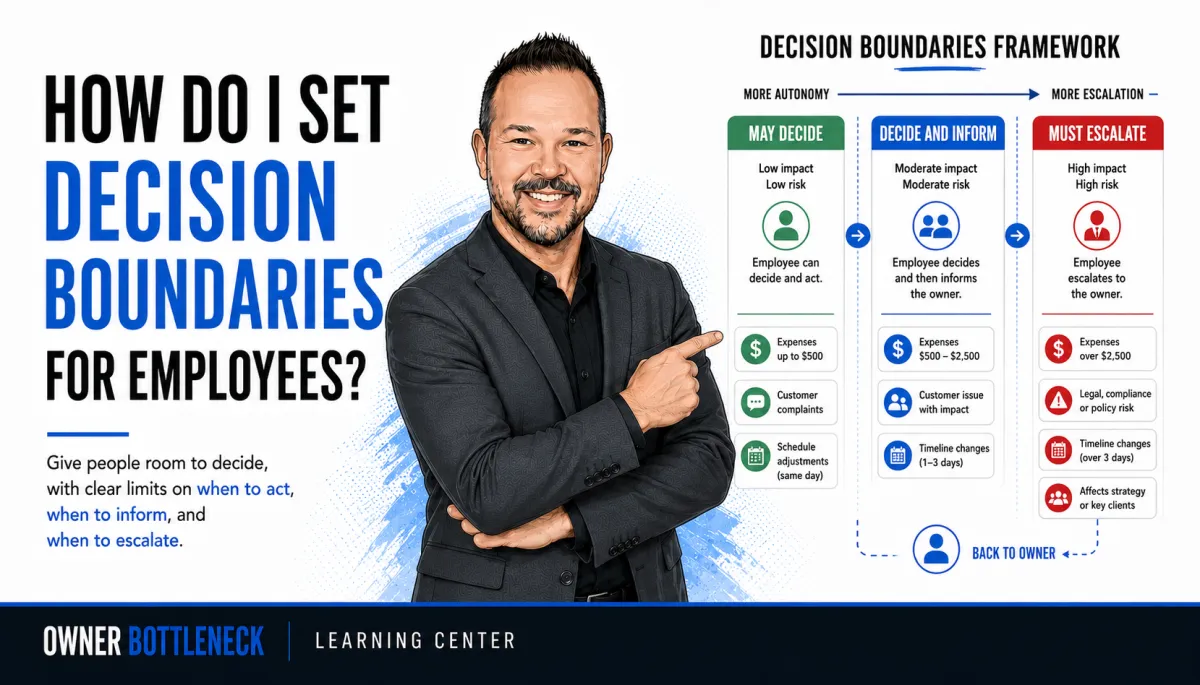
How Do I Set Decision Boundaries for Employees?
You set decision boundaries for employees by defining what they may decide without asking, what they should decide and report afterward, and which specific risks must be escalated before they act. Good boundaries don’t eliminate judgment. They make judgment safe enough to use.
The owner called his customer service manager into the office.
For the third time that month, an angry customer had asked to speak directly with him.
The owner was frustrated.
You’re the customer service manager. I need you to handle these things without bringing every complaint to me.
The manager nodded.
Okay. What am I allowed to offer them?
The owner paused.
Whatever you think is fair.
Two days later, a customer complained that a project had been completed late.
The manager apologized and offered a $750 credit.
The owner saw the credit and immediately called her.
Why would you give them that much?
The manager explained that the company had clearly missed the deadline and the customer had threatened to leave.
The owner reduced the credit to $300.
The customer accepted it.
The next complaint arrived a week later.
The manager walked into the owner’s office.
What do you want me to do?
The owner was annoyed.
I told you that you could handle these.
The manager looked confused.
I thought I could too.
The owner believed he had transferred authority.
The manager had learned that the authority disappeared the moment her decision was different from his.
That’s what vague decision boundaries create.
The owner says:
You decide.
The employee hears:
You decide, unless I don’t like what you decide.
Responsibility Without Boundaries Isn’t Real Authority
Owners often believe they’ve delegated a decision because they assigned someone responsibility for the result.
The sales manager owns revenue.
The operations manager owns scheduling.
The customer service manager owns customer satisfaction.
The department leader owns employee performance.
But then the employee reaches the moment when a real tradeoff must be made.
Can sales reduce the price?
Can operations authorize overtime?
Can customer service issue a refund?
Can the manager move an employee off a project?
Can the department head address repeated underperformance?
The decision comes back to the owner.
The employee owns the result on paper.
The owner still owns every decision required to produce it.
That’s a Decision Bottleneck.
Responsibility without authority makes the employee a messenger.
They gather the facts.
Present the options.
Wait for the owner.
Then carry the owner’s answer back into the business.
The work moved.
The decision didn’t.
“Use Your Judgment” Isn’t a Boundary
An owner says:
Use your judgment.
That sounds empowering.
It may feel terrifying to the employee.
They don’t know:
How much money they can commit
Which customer promises they can change
What level of risk is acceptable
Which decisions the owner wants to hear about
Whether a different answer will be supported
What happens if the result is poor
Which issues still belong to ownership
The employee has two choices.
Ask the owner about everything.
Or act and hope they guessed correctly.
Most capable people won’t choose unlimited risk.
They’ll choose safety.
They’ll ask.
Then the owner concludes:
They don’t have enough confidence.
The employee may have confidence.
They may lack a usable definition of their authority.
Good boundaries answer a simpler question:
Which decisions are mine, and where does my authority stop?
Decision Boundaries Protect Both Sides
Owners sometimes resist decision boundaries because they fear becoming too rigid.
They don’t want every situation reduced to a rule.
That isn’t what the boundary does.
The boundary doesn’t determine the exact answer.
It defines the space in which the employee can make the decision.
Imagine a fenced yard.
The fence doesn’t tell the person where to stand.
It tells them where they’re free to move.
Inside the boundary, they use judgment.
Outside the boundary, they escalate.
That protects the employee from unknowingly accepting a risk they weren’t authorized to carry.
It protects the owner from discovering that someone made a commitment the company can’t afford, deliver, or defend.
The boundary isn’t there to eliminate thinking.
It’s there to make thinking safer.
That’s one part of the broader Judgment Transfer System.
The Three Decision Statuses
Every recurring decision area should have three clear statuses.
May Decide
The employee may make the decision without asking beforehand.
They don’t need permission.
They don’t need to wait.
They’re expected to act.
Examples might include:
The customer service manager may approve a customer credit up to $500 when the company clearly failed to meet the agreed standard.
The operations manager may move work between crews when customer commitments remain protected and no unapproved overtime is created.
The sales manager may approve a discount up to 3 percent when the contract remains above the minimum margin and standard payment terms are preserved.
A department leader may purchase normal operating supplies inside the approved monthly budget.
The words matter.
Don’t say:
You can probably handle this.
Say:
You may decide this without asking me first.
Authority should be stated clearly enough that the employee doesn’t need to interpret whether the owner really meant it.
Decide and Inform
The employee makes the call, then communicates what happened afterward.
This is useful when the decision needs visibility but not prior approval.
Examples might include:
You may move a project within the same week when the customer deadline remains protected. Include the change and your reasoning in the Friday operations review.
You may offer a replacement instead of a refund when the internal cost remains below $1,000. Record the remedy in the customer issue log.
You may extend a deadline by up to three business days when the delay doesn’t create a contractual penalty. Notify the account owner after the customer has agreed.
You may reassign an employee temporarily when coverage is needed. Inform the department manager before the end of the day.
This status prevents approval from becoming the owner’s only visibility system.
The owner still knows what happened.
The employee doesn’t have to wait for the owner before normal work can move.
That’s how you stay informed without being involved in everything.
Must Escalate
The decision falls outside the employee’s authority.
The employee must involve the owner or another designated leader before acting.
Examples might include:
Legal threats
Safety concerns
Serious misconduct
Commitments above an approved financial limit
Decisions likely to create major reputation risk
A likely loss of a key account
Pricing below the approved floor
Hiring or termination decisions outside the role’s authority
Promises beyond available capacity
A situation that could create an important company precedent
Escalation isn’t failure.
The problem is when everything becomes an escalation because the boundary was never defined.
The other problem is when the owner says:
Use your judgment,
then punishes the employee for failing to predict that this particular issue was supposed to be escalated.
Employees can’t follow invisible thresholds.
Name the triggers.
The Worst Boundary Is “Ask When You’re Unsure”
The owner says:
Handle normal decisions. Ask me if you’re unsure.
That sounds reasonable.
It creates a Decision Bottleneck.
The unusual decision is exactly when the employee is most likely to be unsure.
The boundary has made uncertainty itself the escalation trigger.
That means the employee is allowed to decide only when the answer is already obvious.
The owner still owns everything that requires judgment.
A better boundary asks:
Which uncertainty is the employee expected to work through?
And:
Which risks are too serious for them to carry alone?
For example:
You’re expected to work through normal questions involving customer preference, scheduling, and remedies inside the approved limits. Escalate when the decision involves legal threats, safety, a key-account risk, or financial exposure above $500.
Now the employee knows that feeling uncertain doesn’t automatically mean they should stop.
They’re expected to think.
They’re also protected from carrying risks that genuinely belong elsewhere.
Start With What the Business Is Trying to Protect
A financial limit alone isn’t enough.
Imagine telling the customer service manager:
You can approve up to $500.
They may now believe every complaint can be resolved by spending up to $500.
The employee needs to understand the intent behind the authority.
What is the business trying to protect?
For customer remedies, the priority might be:
Protect customer trust by delivering a fair remedy when we fail.
Then add the limits:
Stay inside the approved cost, don’t promise work we can’t deliver, and don’t reward abusive behavior.
For scheduling:
Protect committed customer dates first, stay inside approved labor capacity, and don’t solve one delay by creating a larger delay somewhere else.
For pricing:
Protect the value and delivery margin of the work, stay inside the approved pricing range, and don’t make a concession without understanding what changes in return.
For employee performance:
Protect the required result and fair treatment of the employee. Address repeated misses early, remain inside company policy, and escalate serious misconduct.
The boundary tells the person where they can act.
The decision intent tells them how to think while they’re there.
Use More Than Money
Owners often begin decision boundaries with financial limits.
That’s useful.
It’s also incomplete.
A decision may stay under the dollar limit and still create serious risk.
A salesperson offers a 2 percent discount.
That’s inside the approved amount.
They also promise a delivery date operations can’t meet.
A manager authorizes a $300 customer credit.
That’s inside the limit.
They create a precedent that the customer expects every time.
An operations leader moves a job without creating overtime.
They delay a key account that was already at risk.
The financial number didn’t protect the full business result.
Decision boundaries may need to address:
Money
Maximum credit
Maximum discount
Purchase limit
Overtime limit
Minimum margin
Budget authority
Time
Maximum schedule change
Approved deadline extension
Required response time
How long an issue may remain unresolved
Customer Promises
What may be changed
What may be offered
What can’t be promised
Which accounts require special review
Quality
Which standards can’t be compromised
What requires rework
What can be accepted temporarily
What evidence is required before completion
Capacity
Whether overtime can be used
Whether work may be moved
Whether a new commitment fits current resources
Whether one priority may displace another
Safety and Legal Risk
What must stop immediately
What requires specialist review
Which concerns must never be handled informally
Reputation
Public complaints
Social media issues
Community impact
Important referral relationships
Decisions that could become visible outside the company
Reversibility
Can the decision be changed later?
How expensive would reversal be?
Does the decision create a commitment that can’t easily be undone?
The harder a decision is to reverse, the narrower the first boundary may need to be.
The Decision Boundary Card
A Decision Boundary Card should be short enough to use.
Not a thirty-page policy.
Not a document nobody remembers exists.
It should answer seven questions.
What Is the Decision?
Name it in plain English.
Not:
Customer service discretion.
Use:
Resolving customer complaints when the company failed to meet the agreed standard.
Or:
Adjusting project schedules when two commitments conflict.
The employee should immediately recognize the decision area.
What May You Decide?
State the authority clearly.
For example:
You may choose a refund, credit, replacement, or rework when the remedy remains inside the limits below.
Avoid weak wording such as:
You may make recommendations about possible remedies.
A recommendation isn’t authority.
What Must You Protect First?
Name the primary outcome or standard.
For example:
Protect customer trust by making the customer whole when we clearly failed.
Or:
Protect committed deadlines and safe workload before speed.
Or:
Protect margin and delivery capacity before closing the deal.
This gives the employee a reference point when two reasonable options compete.
What Limits Must You Stay Within?
Include the specific financial, time, quality, capacity, or customer limits.
For example:
Cash credit up to $500.
Rework up to $1,200 in internal cost.
No commitment beyond currently available capacity.
No change to signed contract terms.
No safety or legal risk.
The limits should be specific enough to guide a real decision.
What Must You Avoid?
Name the outcome or precedent the business doesn’t want created.
For example:
Don’t reward abusive behavior.
Don’t hide a delay to protect the schedule metric.
Don’t solve one customer problem by making a promise operations can’t keep.
Don’t reduce price without changing another part of the exchange.
This section captures the lessons owners often remember only after something goes wrong.
What Must You Inform Us About Afterward?
Define the reporting expectation.
For example:
Record the issue, remedy, cost, customer response, and any process weakness in the weekly exception log.
Or:
Report schedule changes affecting more than one customer during the Friday operations review.
Visibility shouldn’t be vague.
The employee should know what gets reported, to whom, and when.
When Must You Escalate?
Name exact triggers.
For example:
Escalate legal threats, safety concerns, key-account risk, remedies above the approved amount, suspected fraud, or any issue likely to become public.
Don’t write:
Escalate major issues.
“Major” means whatever the owner thinks it means after the fact.
Worked Example 1: Customer Remedies
The company misses a promised completion date.
The customer is angry and asks for a full refund.
Decision
Resolving customer complaints caused by a confirmed company failure.
You May Decide
The customer service manager may choose a refund, credit, replacement, or rework inside the approved limits.
Protect First
Protect customer trust by delivering a remedy that reasonably matches the company’s failure and the customer’s actual impact.
Stay Within
Cash credit up to $500
Rework up to $1,200 in internal cost
No promise outside current delivery capacity
No change to signed contract terms
Document the reason and outcome
Avoid
Rewarding abusive behavior
Offering the maximum amount simply because the customer asks
Promising faster work than operations can deliver
Giving a remedy without confirming what happened
Inform After
Record the issue, remedy, cost, customer response, and any process weakness within one business day.
Escalate When
Legal action is threatened
Safety is involved
The requested remedy exceeds the limit
The customer is a defined key account
The issue could create significant public or reputation risk
The facts are disputed and can’t be verified
Now the manager has more than permission.
They know what decision they own, what matters, which options exist, and where the authority stops.
Worked Example 2: Scheduling Changes
Two important jobs need the same crew.
Both customers expect work this week.
The operations manager could ask the owner.
Or they could use a boundary.
Decision
Moving jobs within the active schedule when capacity or availability changes.
You May Decide
The operations manager may move work within the same calendar week without prior approval.
Protect First
Protect committed customer dates and safe team capacity. Choose the change that creates the smallest total customer and operating impact.
Stay Within
No unapproved overtime
No movement beyond the current week
No safety compromise
No delay to a contractually protected date
No change affecting a key account without notifying the account owner
Avoid
Moving the easiest customer simply because they complain less
Solving one delay by creating several smaller delays
Hiding schedule changes from customers
Overloading the strongest crew every time
Inform After
Include the change, reason, customer communication, and impact during the daily schedule review.
Escalate When
The change requires overtime beyond the approved limit
A protected deadline will be missed
A key account is at serious risk
Multiple departments disagree on the priority
The issue is caused by a capacity problem that will continue beyond the week
The owner no longer has to settle every conflict.
The operations manager also isn’t being told to “figure it out” without protection.
Worked Example 3: Pricing and Discounts
The buyer asks for a better price.
The salesperson knows the customer is serious.
They don’t know whether they can make the concession.
Decision
Adjusting price or commercial terms on a standard offer.
You May Decide
The salesperson may approve a discount up to 3 percent when the deal remains above the approved margin and standard scope and payment terms remain unchanged.
Protect First
Protect the value, margin, cash, and delivery requirements of the offer.
Stay Within
Maximum 3 percent discount
Minimum approved margin
Standard payment terms
No additional custom scope
No delivery commitment outside available capacity
Avoid
Discounting before understanding the buyer’s concern
Giving a concession without receiving something in return
Changing price and terms at the same time without approval
Using the maximum discount on every deal
Inform After
Record the discount, reason, trade received, margin impact, and outcome in the CRM.
Escalate When
Pricing falls below the approved floor
The buyer requests unusual payment terms
Custom scope creates uncertain delivery cost
The opportunity is strategically important
The agreement creates legal or reputation risk
The salesperson believes the normal offer doesn’t fit
This turns pricing authority into something the team can use instead of another request that automatically returns to the owner.
The deeper commercial system is covered in How Do I Stop Approving Every Discount and Proposal?.
Test the Boundary Against Real Decisions
A boundary can sound clear in a meeting and fall apart the first time it reaches reality.
Don’t ask:
Does everyone understand?
They’ll probably say yes.
Give the team three real scenarios.
Ask:
Would you decide this?
Would you decide and inform?
Or would you escalate?
Then ask why.
For a customer remedy:
Scenario one:
The company arrives two hours late. The customer asks for a $100 credit.
Scenario two:
The company damages property worth approximately $800.
Scenario three:
The customer threatens to post publicly and contact an attorney.
The first may fall inside the employee’s authority.
The second may require a defined repair or insurance process.
The third may require escalation.
The conversation exposes whether the intent and boundaries are actually usable.
If capable people interpret the same boundary differently, the boundary may need clarification.
Don’t wait for a live customer problem to discover that.
Boundaries Should Widen Through Evidence
An employee begins with a $250 customer remedy limit.
After three months, they’ve made sound decisions.
They document issues well.
They protect the customer without giving away unnecessary money.
They recognize legal and reputation risks.
They escalate appropriately.
The limit may grow to $500.
Later, perhaps $1,000.
Authority should expand with evidence.
Not merely tenure.
Not confidence.
Not because the owner is tired of being asked.
Look for:
Decisions stay inside the boundary
Reasoning reflects the agreed priorities
Important risks are noticed
Escalations are appropriate
The person learns from outcomes
Similar mistakes aren’t repeated
Reporting remains reliable
Results stay healthy
The person can explain the decision to someone else
The goal isn’t to give everyone maximum authority as quickly as possible.
It’s building decision capability until the boundary can safely expand.
What if the Employee Crosses the Boundary?
Suppose the customer service manager approves a $900 credit when their limit is $500.
Don’t begin with:
This is why I can’t trust you.
Find out what happened.
Did the manager know the limit?
Did they believe waiting would make the problem worse?
Did the customer threaten something that should have triggered escalation?
Was the boundary unrealistic?
Did the manager knowingly ignore it?
Those situations are different.
The Boundary Was Unclear
Clarify it.
The Situation Exposed a Missing Exception
Improve the boundary.
Information Was Missing
Fix access to the information.
The Employee Misjudged the Risk
Coach the reasoning.
The Employee Knowingly Ignored Clear Authority
Address the accountability problem.
Decision boundaries protect real authority.
They’re not suggestions.
The employee should have room to make different decisions inside the boundary.
They shouldn’t have room to pretend the boundary doesn’t exist.
What if the Decision Stays Inside the Boundary but You Disagree?
This is where the system becomes real.
The manager approves a $400 credit.
You would have offered $250 and a future discount.
The manager’s decision:
Stayed inside the $500 limit
Protected customer trust
Didn’t create a delivery problem
Was based on confirmed company failure
Was documented
Didn’t create major precedent
Do you reverse it?
Probably not.
You may review the reasoning.
You may ask whether another remedy could have worked.
You may improve the examples.
But if every different decision is replaced with the owner’s preferred answer, the boundary is fake.
Authority is proven the first time someone makes a different but sound decision and the owner allows it to stand.
That principle is central to teaching employees to make good decisions without you.
Don’t Turn Reporting Into Delayed Approval
A manager makes a decision and reports it afterward.
The owner reviews every decision and changes half of them.
The employee learns:
Decide and inform really means decide, then wait to see whether it gets approved later.
That isn’t authority.
It’s delayed approval.
Use the review to ask:
What happened?
What mattered?
What were you trying to protect?
What options did you consider?
What risk did you accept?
Did you stay inside the boundary?
What happened because of the decision?
What should we repeat or change?
Correct the decision when the employee crossed the boundary, ignored an important fact, violated a nonnegotiable standard, or used reckless reasoning.
Don’t correct it merely because you would have chosen another path.
A good review builds the next decision.
A bad review sends the next decision back to the owner.
Reviewing the decision requires its own discipline. This guide explains how to examine the employee’s reasoning, result, risk, and boundary without turning Decide and Inform into delayed owner approval.
The Owner Has Boundaries Too
Most decision-boundary systems focus only on the employee.
The owner also needs rules.
For the decision to transfer, the owner may need to stop:
Answering before the employee forms a recommendation
Joining every difficult customer conversation
Reviewing every normal decision
Reversing sound choices because they feel unfamiliar
Accepting employee bypasses around a manager
Correcting style differences that don’t affect the outcome
Monitoring the work more closely after announcing authority
Taking the responsibility back after one coachable mistake
The employee’s boundary defines what they own.
The owner’s boundary defines what they must stop reclaiming.
This is why many owners keep taking back work they delegated.
They transfer the task, then cross back over the boundary whenever they become uncomfortable.
Don’t Create Boundaries for Every Decision at Once
An owner reads this and decides to map every decision in the company.
Hiring.
Pricing.
Purchasing.
Scheduling.
Customer service.
Quality.
Marketing.
Employee issues.
Project management.
Vendor relationships.
The project becomes enormous.
The owner is now responsible for building a decision system for everything.
Start with one recurring category.
Choose a decision that:
Reaches the owner frequently
Creates delay
Is meaningful but usually reversible
Happens close to a capable employee
Falls inside manageable risk
Has enough examples to understand
Is narrow enough to define
Customer remedies may be a better first pilot than “all customer decisions.”
Scheduling changes may be better than “all operations authority.”
Discounts on standard proposals may be better than “all sales terms.”
A useful boundary changes one real queue.
Then you build the next one.
A 30-Day Decision Boundary Test
Days 1 Through 7: Track the Decisions
Record every decision in the selected category that reaches the owner.
Capture:
What happened
Who asked
What they needed
How long the work waited
What the owner decided
Which risk mattered
Whether the decision was reversible
Whether a similar issue happened before
Look for the normal range and the genuine exceptions.
Days 8 Through 14: Build the Boundary Card
Define:
The decision
What the person may decide
What must be protected first
The limits
What must be avoided
What should be reported afterward
What requires escalation
Test the card against at least three past decisions.
Ask the employee to explain the boundary back to you.
Days 15 Through 21: Transfer Real Decisions
Move the employee from asking to recommending.
Then move appropriate decisions into May decide or Decide and inform.
Don’t answer too early.
Ask:
What do you think should happen, and why?
Review the first decisions shortly afterward.
Days 22 Through 30: Improve the Boundary
Ask:
Which decisions moved without the owner?
Which still returned?
Why?
Were the limits too narrow?
Were important risks missed?
Did the employee understand what to protect?
Did the owner reverse sound decisions?
Did reporting create useful visibility?
Can the authority widen?
Does the boundary need another example?
The goal isn’t to write the perfect boundary card.
It’s to prove that one decision category can move safely without the owner.
A boundary is only one part of the transfer. This complete 30-day Judgment Transfer pilot shows how to choose the right decision and person, define success, transfer real authority, review the reasoning, and measure whether owner dependence actually falls.
How Do You Know the Boundary Is Working?
You’ll see:
Fewer unfinished questions
More recommendations
Faster decisions
Fewer preventable delays
Appropriate escalations
Fewer owner reversals
Better visibility after decisions
Less owner approval
Stable customer, financial, and operating results
Greater confidence without greater recklessness
Track the number of decisions that still require the owner, how long they wait, and how often the owner reverses a team decision.
Those measures are part of the Owner Dependence KPIs.
A boundary is working when owner involvement falls while the business result remains healthy.
Fewer questions alone aren’t enough.
Employees may have stopped asking because they’re afraid.
The work still has to move.
The risks still have to remain visible.
Frequently Asked Questions
How Much Decision Authority Should Employees Have?
Give employees enough authority to make normal decisions required by their roles.
Begin with frequent, meaningful, usually reversible decisions and widen the boundary as evidence builds.
Should Every Decision Have a Financial Limit?
No.
Some decisions are better limited by time, quality, capacity, customer impact, safety, legal exposure, or reversibility.
Use the boundary that reflects the actual risk.
What’s the Difference Between May Decide and Decide and Inform?
May Decide requires no prior approval and no special reporting beyond the normal system.
Decide and Inform also requires no prior approval, but the decision must be communicated afterward because leadership needs visibility.
When Should Employees Escalate?
Escalation should occur when the decision crosses a defined financial, safety, legal, customer, reputation, capacity, or authority threshold.
Avoid using uncertainty alone as the trigger.
What if an Employee Makes a Bad Decision Inside the Boundary?
Review the reasoning, information, standards, and result.
A poor outcome may reveal weak judgment, missing information, or a boundary that needs improvement.
Don’t automatically reclaim the decision category.
What if I Would Have Chosen Differently?
Judge the decision against the outcome, standards, authority, and risk.
Different isn’t automatically wrong.
Allow a different but sound decision to stand.
How Do I Prevent Employees From Hiding Problems?
Define mandatory escalation conditions clearly and keep important results visible through reporting and review.
The goal is fewer unnecessary escalations, not hidden risk.
Can Decision Boundaries Replace SOPs?
No.
SOPs guide repeatable work.
Decision boundaries define authority when context, exceptions, or tradeoffs require judgment.
Who Should Create the Boundary?
Build it with the person making the decision and the leader accountable for the result.
The owner may provide standards, history, and risk limits, but the boundary should reflect how the work actually happens.
How Often Should Boundaries Be Reviewed?
Review them when similar exceptions repeat, the role changes, risk changes, the employee’s judgment improves, or the current boundary creates unnecessary delay.
Stop Making Authority a Guess
Your employees shouldn’t have to predict whether a decision belongs to them.
They shouldn’t need to guess how much risk you’ll tolerate.
They shouldn’t learn the real boundary only after they cross it.
Tell them what they may decide.
Tell them what must remain visible.
Tell them what the business is trying to protect.
Tell them where the limits are.
Tell them exactly when the decision must come back.
Then let the authority survive the first sound decision you wouldn’t have made yourself.
The free Owner Bottleneck Scorecard evaluates dependence across:
Decisions
Sales
Operations
Team
Value
It’ll help you identify where normal decisions still wait for your approval, judgment, or confidence.
Take the Owner Bottleneck Scorecard
Don’t tell people to use their judgment.
Give them a place where they’re allowed to use it.