
What Should I Turn Into an SOP First?
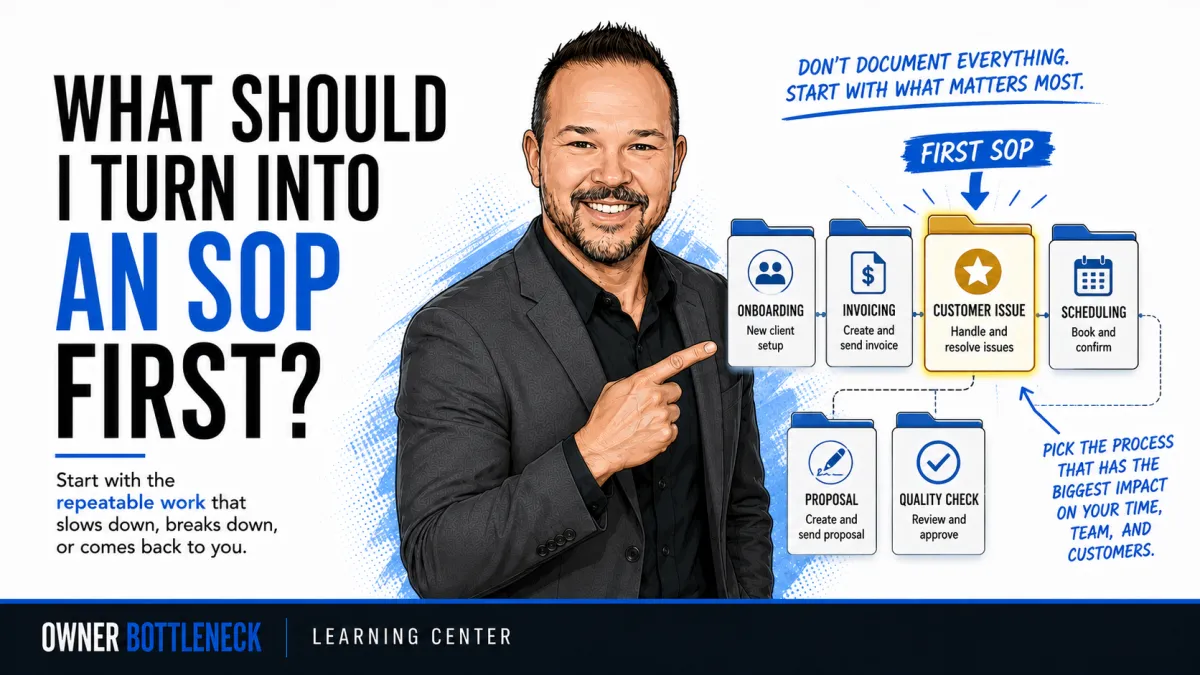
The first thing you should turn into an SOP is a recurring, stable process that creates delays, mistakes, questions, or owner involvement when it isn’t performed consistently. Start with work that happens often, has a clear outcome, can reasonably be owned by someone else, and follows a predictable path most of the time.
The owner spent most of Sunday documenting the business.
He created folders.
Named files.
Recorded videos.
Took screenshots.
Wrote instructions.
By Monday morning, the company had twelve new SOPs.
At 9:14, an employee asked:
Which customer should we schedule first?
At 9:37, another asked:
Can I waive this fee?
At 10:05, a salesperson asked:
Does this proposal need your approval?
At 10:42, the operations manager said:
The process doesn’t cover what happened here. What do you want us to do?
The owner looked at the new documentation library.
Everything was written down.
Everything still came back to him.
He had documented how to complete the normal steps.
He hadn’t transferred the decisions, standards, exceptions, and tradeoffs that made the work difficult.
That’s why choosing what to document first matters.
The wrong SOP creates another file.
The right SOP removes a queue.
Don’t Start by Documenting Everything
“Document everything” sounds responsible.
It’s also one of the fastest ways to create a project nobody finishes.
The owner makes a list of every process in the company.
Sales.
Hiring.
Onboarding.
Purchasing.
Scheduling.
Customer service.
Payroll.
Production.
Quality.
Marketing.
Inventory.
Billing.
The list keeps growing.
Soon, the company has created an entire documentation initiative.
Guess who owns it?
The owner.
They spend evenings recording videos and writing instructions for work they’re trying to stop carrying.
Employees are asked to document their roles while still performing them.
Managers debate templates.
Folders multiply.
The company produces more pages than changed behavior.
Then the owner says:
We have SOPs. Nobody follows them.
The problem may not be employee resistance.
The company may have documented too much work, in too much detail, before deciding which documentation would actually improve an important result.
You don’t need an SOP for everything.
You need the right operating tools for the work that repeatedly becomes inconsistent, slow, risky, confusing, or owner-dependent.
An Operations Bottleneck appears when work repeatedly slows, breaks, or returns to the owner because the business lacks enough process, clarity, standards, judgment, ownership, or capacity to keep it moving.
An SOP can solve part of that.
It can’t solve all of it.
The First SOP Should Remove a Recurring Dependence
Look at the last two weeks.
Where did normal work stop?
What question was asked more than once?
Which task was performed differently by three people?
Which result required you to inspect it before it could continue?
Which mistake had to be corrected again?
Which employee said:
Nobody showed me how.
Which manager said:
I thought someone else handled that.
Which process worked until one person was absent?
Which customer experience depended on who happened to answer?
Those are better places to start than the most complicated process in the company.
Your first SOP should usually sit where four things meet:
The work happens repeatedly
Variation creates a meaningful consequence
The correct path is reasonably predictable
The owner or another key person is still supplying unnecessary guidance
The first SOP doesn’t need to be impressive.
It needs to reduce a dependency the business currently feels.
Start With the Queue, Not the Process List
Imagine five invoices are waiting because only the owner knows how to review them.
The company could begin documenting the entire accounting function.
Or it could start with the invoice approval process that repeatedly creates the delay.
Imagine new employees perform their first week differently depending on who trains them.
The company could document every position.
Or it could standardize the first-week onboarding experience.
Imagine sales proposals repeatedly return to the owner because each one is structured differently.
The company could build a complete sales manual.
Or it could document the proposal workflow, required information, quality standard, authority limits, and final review rules.
Begin with what is waiting, weakening, or returning.
Ask:
What recurring work would continue more reliably if the business no longer needed one person to remember, explain, inspect, or rescue it?
That question connects documentation to owner dependence instead of documentation for its own sake.
If you aren’t sure where dependence exists, start by measuring what waits, slows, weakens, or stops without the owner.
The Five-Part SOP Priority Test
Before documenting a process, test it against five conditions.
You don’t need a complicated scoring model.
You need a reason to believe the SOP will be used and will change something important.
1. Does the Work Repeat?
A process that happens every day or every week usually deserves attention before something that happens once a year.
Repetition creates leverage.
A ten-minute improvement repeated five times a day matters.
A common mistake prevented every week matters.
A question the owner answers twice a month may matter less than the scheduling issue that reaches them every morning.
Frequency alone isn’t enough.
But frequent work gives the SOP more opportunities to earn its place.
2. Does Variation Create a Real Consequence?
Two employees perform the same task differently.
Does it matter?
Sometimes it doesn’t.
Different methods can still produce an acceptable result.
You don’t need to standardize every personal preference.
Document the process when variation creates consequences such as:
Customer confusion
Quality problems
Missed deadlines
Compliance risk
Rework
Margin loss
Safety concerns
Lost information
Poor handoffs
Owner intervention
The purpose of an SOP isn’t to make everyone move identically.
It’s to protect a result that matters.
3. Is the Process Stable Enough to Document?
Some work changes every week.
The offer is still being redesigned.
The software is temporary.
The role is unclear.
The team hasn’t agreed on the process.
The owner records an SOP anyway.
Two weeks later, it’s outdated.
Don’t document chaos too early.
First determine how the work should operate.
Test the process.
Fix the obvious problems.
Then document the version you want repeated.
An SOP should capture a working process.
It shouldn’t preserve confusion.
4. Can the Outcome Be Clearly Defined?
“Handle customer service” isn’t a clear outcome.
“Respond to every customer message within two business hours, resolve normal issues inside approved limits, and keep unresolved risks visible until they are closed” is closer.
Before writing steps, define what must be true when the process is complete.
Ask:
What result is this process designed to produce?
What promise does it protect?
What would make us say it was done well?
What would make the result unacceptable?
Without a clear outcome, the SOP becomes a sequence of activity disconnected from the result.
Employees can follow every step and still miss the point.
5. Can Someone Actually Own It?
An SOP without an outcome owner is a reference document.
Someone must be responsible for using it, maintaining it, and improving it when reality exposes a weakness.
That doesn’t mean one person performs every step.
It means one role owns whether the process produces its intended result.
If five people are involved and nobody owns the outcome, the work may still disappear between handoffs.
The SOP should name:
Who owns the result
Who performs each part
Where handoffs occur
What must remain visible
Who updates the process
Who decides when the process no longer fits
Documentation doesn’t create ownership by itself.
It supports ownership that has already been made clear.
Don’t Write an SOP When You Need a Different Tool
Owners often call every form of documentation an SOP.
That creates documents that are too long, too vague, or built for the wrong kind of work.
Sometimes you need an SOP.
Sometimes you need something else.
Use an SOP for a Repeatable Process
An SOP is useful when the work follows a reasonably stable sequence.
Examples include:
Opening the facility
Processing a new order
Onboarding a customer
Entering a vendor bill
Preparing a standard proposal
Closing out a completed project
Conducting a routine quality check
Handling a common warranty request
The SOP should explain the outcome, owner, sequence, required information, handoffs, quality checks, and escalation points.
It answers:
How does this process normally move from beginning to end?
Use a Checklist When the Sequence Is Short
A checklist is better when people already understand the work but need to avoid missing critical steps.
A pilot doesn’t need a textbook every time the aircraft prepares to leave.
They need a checklist that protects the few things that can’t be forgotten.
Your team may need a checklist for:
Closing the building
Preparing for a customer kickoff
Sending a proposal
Offboarding an employee
Completing payroll
Final project inspection
Publishing an article
Preparing for an event
Don’t turn a seven-item checklist into a fourteen-page SOP.
The tool should make the work easier to perform.
Not harder to access.
Use a Standard When the Problem Is Quality
The owner reviews work and says:
This isn’t good enough.
The employee followed the process.
The problem isn’t the sequence.
It’s the standard.
A quality standard explains what acceptable work looks like.
For a proposal, the standard might require:
The customer’s problem is stated accurately
The recommendation is clear
Scope is specific
Exclusions are visible
Price and terms are correct
Proof supports the recommendation
The next decision is obvious
For a finished job, the standard might include photos, measurements, customer confirmation, cleanup requirements, and final documentation.
When the issue is “good enough,” more steps may not help.
The employee needs a clearer picture of the result.
Use a Decision Guide When Judgment Is Required
A customer wants an exception.
Two priorities conflict.
A project is behind.
A refund may be justified.
A valuable employee breaks a rule.
A buyer requests unusual terms.
There may not be one correct sequence.
Someone has to weigh context, risk, and tradeoffs.
That requires a decision guide.
A decision guide can explain:
The outcome to protect
The factors to consider
The financial or risk limits
Common examples
Acceptable tradeoffs
Previous decisions
What can be decided independently
What should be reported afterward
What must be escalated
This is how you move judgment without pretending every decision can be reduced to steps.
If the employee knows how to complete the task but still can’t decide what to do when reality changes, the missing tool may be a decision guide, not another SOP.
That distinction is central to delegating decisions instead of only assigning tasks.
Use an Escalation Rule When the Problem Is Boundaries
The employee asks the owner because they don’t know when they’re allowed to decide.
Define the boundary.
For example:
Customer service may approve credits up to $300 when we clearly failed to meet the agreed standard. Anything involving safety, legal threats, a key account, or exposure above $300 must be escalated before a commitment is made.
Now the employee knows:
What they own
What they may decide
What limit applies
What requires the owner
An escalation rule prevents two failures.
Everything being escalated.
And important risk being hidden.
Use a Template When the Problem Is Recreating Work
The employee writes the same type of email every week.
The salesperson builds each proposal from a blank page.
The manager recreates the same meeting agenda.
The operations team starts every customer update from nothing.
A template may solve the problem faster than a full SOP.
Templates are useful for:
Proposals
Customer updates
Meeting agendas
Project plans
Follow-up emails
Reports
Job postings
Employee reviews
Recovery plans
The SOP may explain when and how the template is used.
The template reduces the repeated creation.
The Process Often Breaks at the Handoff
An owner documents the work each employee performs.
The problem remains between them.
Sales gathers the customer information.
Operations receives the project.
Something important is missing.
Operations contacts sales.
Sales contacts the customer.
The customer gives a different answer.
The project waits.
Each person may be performing their individual job correctly.
The handoff is failing.
Document:
What information must move
Who supplies it
Who confirms it is complete
When the handoff occurs
What conditions must be met
What happens when information is missing
Who owns the work while it is between stages
Many operating problems don’t live inside one person’s task.
They live in the space between roles.
Your first SOP may need to standardize the handoff rather than either department’s entire job.
Document the Normal Path and the Common Exceptions
A weak SOP explains what happens when everything goes right.
The customer submits complete information.
The product is available.
The employee arrives.
The schedule holds.
The payment processes.
The project finishes on time.
Reality doesn’t always cooperate.
A useful SOP should also address the few exceptions that happen repeatedly.
For example:
Normal path:
The customer submits the required information and the project is scheduled.
Common exception:
Information is incomplete.
Response:
The project remains unscheduled. The customer receives the missing-information template. The account owner follows up within one business day.
Escalation:
If the customer deadline is within five business days or the account exceeds the defined value threshold, notify the operations manager.
You don’t need to predict every strange event.
Start with the exceptions that repeatedly bring the work back to the owner.
That’s where the documentation can reduce dependence.
Capture the Thinking, Not Just the Clicking
The owner records a screen-share video.
Click here.
Open this menu.
Enter the number.
Select this field.
Send the message.
That may be useful.
But the employee still needs to know:
Which number should I enter?
Which option applies?
What makes this customer different?
When should I stop the process?
What risk am I checking for?
What happens when the information conflicts?
Button-clicking instructions transfer navigation.
They don’t always transfer understanding.
The strongest documentation explains:
What the process is trying to accomplish
Why each important step matters
What information is being evaluated
Which standards must be protected
What commonly goes wrong
How exceptions should be handled
When the employee must stop and escalate
That’s part of getting the knowledge in your head into the business.
The owner’s knowledge isn’t only the sequence.
It’s knowing which details matter.
Build the First Version With the Person Who Does the Work
The owner sits alone and documents how the work should happen.
Then the employee reads it and says:
That isn’t how we actually do it.
Or:
This step can’t happen until we receive information from another department.
Or:
The software changed six months ago.
Or:
This happens only for one type of customer.
The owner may understand the outcome and the history.
The employee may understand the current reality.
Build the first version together.
Have the person perform the work while explaining:
What starts the process
What information they need
What decisions they make
Where they usually get stuck
Which mistakes repeat
Who they depend on
What exceptions occur
What the owner still supplies
Then test the process with someone who didn’t help write it.
Can they find it?
Can they understand it?
Can they complete the normal work?
Do they know when to stop?
Do they know what good looks like?
Do they know who owns the result?
An SOP is proven through use.
Not through approval.
Don’t Write It for the Person Who Already Knows
Experts skip steps.
Not because they’re careless.
Because experience has made the steps automatic.
The owner says:
Review the customer history.
They know what they’re looking for.
Previous complaints.
Payment problems.
Special promises.
Contract terms.
Decision-makers.
Unresolved issues.
The employee may open the customer record and see a wall of information.
“Review the history” means something to the owner because years of judgment are compressed inside the instruction.
Write for the capable person who doesn’t yet have that history.
Explain enough that they can see the important parts without turning the SOP into a textbook.
Use examples.
Show a good result.
Show a weak result.
Name the common mistake.
Explain why it matters.
The purpose isn’t to remove all thinking.
It’s to give the person a better starting point for thinking.
An SOP Should Answer Nine Questions
A useful SOP doesn’t need a complicated template.
It should answer nine practical questions.
1. What Outcome Does This Process Produce?
Name the result.
Not merely the activity.
2. Who Owns the Outcome?
Identify the role accountable for whether the result is achieved.
3. What Starts the Process?
A new order?
A signed contract?
A customer request?
A missed payment?
A completed project?
A specific date?
4. What Information Is Required?
Name the documents, data, approvals, and context needed before work begins.
5. What Are the Normal Steps?
Explain the sequence clearly enough for a capable person to follow.
6. What Standard Must Be Met?
Describe what good looks like and what is unacceptable.
7. What Common Exceptions Occur?
Include the recurring variations that normally create confusion.
8. When Should the Work Be Escalated?
Define the safety, legal, financial, customer, authority, or complexity threshold.
9. How Do We Know the Process Is Working?
Name the visible evidence.
That may include timeliness, accuracy, completion rate, customer result, error rate, margin, or another meaningful measure.
If the document can’t answer those questions, it may not yet be ready to reduce dependence.
Keep the SOP Close to the Work
An SOP nobody can find doesn’t exist.
The company may have a beautiful folder structure.
Employees still ask the owner because finding the answer takes longer than sending a message.
Put the documentation where the work happens.
That may mean:
Linked inside the project management system
Attached to the CRM stage
Embedded in the onboarding workflow
Printed at the workstation
Included in the recurring task
Connected to the relevant form or template
Available through a simple searchable library
The employee shouldn’t need to remember that the SOP exists.
The system should place it in front of them when the process begins.
Your First SOP Will Be Wrong
Not completely wrong.
Incomplete.
You’ll miss an exception.
A step will be unclear.
The responsibility will shift.
The software will change.
Someone will interpret the standard differently.
That’s normal.
The first version is a working hypothesis.
Use it.
Watch where the process still breaks.
Ask:
Which question still came back?
Which instruction was misunderstood?
Which handoff failed?
Which exception wasn’t covered?
?
Which instruction was misunderstood?
Which handoff failed?
Which exception wasn’t covered?
Which step created unnecessary work?
Did the outcome remain healthy?
Then improve the document.
An SOP should evolve from real use.
It shouldn’t become permanent simply because the owner once approved it.
Don’t Let the Owner Become the SOP Department
The owner may create the first few SOPs because much of the knowledge still lives with them.
That shouldn’t become the permanent system.
Eventually, the outcome owner should maintain the process.
When the workflow changes, they update it.
When a recurring exception appears, they document the response.
When a step creates unnecessary work, they recommend an improvement.
When the SOP no longer produces the intended result, they lead the revision.
The owner shouldn’t remain responsible for documenting everyone else’s work.
That would turn the documentation system into another Owner Bottleneck.
The company should own its operating knowledge.
The SOP Should Reduce Questions Without Silencing Problems
An owner publishes an SOP and says:
Stop asking me. It’s in the process.
Employees may stop asking.
That doesn’t prove the process works.
They may guess.
Hide the issue.
Work around the problem.
Follow the instruction even when the situation no longer fits.
A healthy SOP reduces predictable questions.
It doesn’t discourage judgment or appropriate escalation.
Employees should know:
When to follow the process
When to use judgment
When to report an exception
When to stop
When the issue crosses their authority
The goal isn’t robotic compliance.
It’s reliable work with visible risk.
A 30-Day First SOP Test
Choose one recurring dependency.
Don’t begin with the entire company.
Days 1 Through 7: Find the Right Process
Track repeated questions, owner approvals, errors, rework, delays, and handoff failures.
Choose a process that:
Repeats often
Creates a real consequence
Is reasonably stable
Has a clear outcome
Can be owned by someone else
Define the problem the SOP is expected to solve.
Days 8 Through 14: Document the Working Process
Build the first version with the person closest to the work.
Include:
Outcome
Outcome owner
Trigger
Required information
Normal steps
Standard
Common exceptions
Escalation rules
Evidence of success
Add any checklist, template, example, or decision guide needed to support it.
Days 15 Through 21: Test It
Have another capable person use the SOP.
Don’t explain the missing pieces while they test it.
Watch where they hesitate.
Record:
Questions
Confusing language
Missing information
Incorrect assumptions
Uncovered exceptions
Weak handoffs
Steps that no longer match reality
Update the document.
Days 22 Through 30: Measure Whether Dependence Changed
Ask:
Did the process continue without the owner?
Did the same questions return?
Were mistakes reduced?
Did work move faster?
Did the outcome remain healthy?
Were appropriate exceptions still escalated?
Does the outcome owner maintain the process?
Can another person perform it?
The goal isn’t to finish a document.
It’s to change how the business operates.
If the owner still answers the same questions, the SOP hasn’t completed its job.
What Should You Document After the First SOP?
Use the same priority.
Move to the next recurring process that creates meaningful dependence or inconsistency.
A practical sequence may be:
High-frequency customer-facing work
Processes creating financial or quality risk
Work repeatedly delayed by owner input
Important handoffs between departments
Responsibilities with no trained backup
Work that repeatedly creates rework
Processes needed to onboard new employees
Common exceptions that still return to the owner
Don’t document in departmental order just because the organizational chart is arranged that way.
Document in the order that removes the most damaging dependence.
How Do You Know the SOP Is Working?
The evidence isn’t that the document exists.
It’s that the work has changed.
You should begin seeing:
Fewer repeated questions
Less owner approval
More consistent outcomes
Faster onboarding
Fewer preventable mistakes
Better handoffs
Appropriate exceptions handled inside clear boundaries
Less rework
More trained backup
Fewer delays caused by missing information
Employees improving the process without waiting for the owner
You can also track the number of projects, decisions, customer issues, and exceptions that continue without owner intervention.
Those are part of the Owner Dependence KPIs that show whether the company’s capability is actually growing.
SOPs Don’t Replace Leadership
An employee repeatedly ignores the process.
That may be an accountability issue.
The process produces the wrong result.
That may be a design issue.
The work requires judgment the employee doesn’t have.
That may be a capability issue.
The manager won’t correct the problem.
That may be a leadership issue.
The owner keeps overriding the documented authority.
That may be an owner-behavior issue.
Don’t ask an SOP to solve every business problem.
A document can clarify the work.
It can’t make someone care.
It can’t coach judgment.
It can’t enforce accountability.
It can’t support delegated authority.
It can’t fix a poor role fit.
It can’t lead the team.
SOP worship begins when the company treats documentation as a substitute for management.
The process matters.
So do the person, authority, standard, information, judgment, visibility, and accountability surrounding it.
Frequently Asked Questions
What Is the Best Business Process to Document First?
Start with a process that repeats frequently, creates meaningful mistakes or delays, follows a reasonably predictable path, and still requires unnecessary owner involvement.
Should I Document the Most Important Process First?
Not always.
The most important process may be too complicated, unstable, or dependent on judgment to become the best starting point.
Begin with a high-value process the team can realistically adopt and improve.
How Detailed Should an SOP Be?
Detailed enough for a capable person to complete the normal work, understand the outcome, meet the standard, and recognize when escalation is necessary.
Don’t document obvious details that make the SOP harder to use.
Should Every Task Have an SOP?
No.
Some work needs a checklist, template, quality standard, decision guide, or escalation rule instead.
Some low-risk, infrequent work may not need formal documentation.
What if the Process Has Too Many Exceptions?
Document the stable core and the most common exceptions.
If judgment drives most of the work, create a decision guide and authority boundaries instead of trying to predict every situation through steps.
Who Should Write the SOP?
Build it with the person closest to the work and the person accountable for the outcome.
The owner may provide context and standards, but shouldn’t remain the permanent documentation department.
How Often Should SOPs Be Updated?
Update them when the process, system, role, standard, risk, or common exceptions change.
The outcome owner should periodically confirm that the documentation still matches reality.
What if Employees Don’t Follow the SOP?
First determine whether the SOP is clear, accessible, practical, current, and connected to the work.
Then address training, accountability, or role-fit issues when the process is sound but still ignored.
Can SOPs Eliminate the Owner Bottleneck?
They can reduce dependence in repeatable work.
They won’t automatically transfer authority, judgment, relationships, standards, leadership, or accountability.
How Do I Know Whether I Need an SOP or Decision Guide?
Use an SOP when the normal sequence is reasonably predictable.
Use a decision guide when the person must weigh context, risk, options, and tradeoffs.
Don’t Build a Library Before You Remove a Queue
You don’t need 100 SOPs to make the business less dependent on you.
You need the first useful one.
Find the work that repeatedly waits, breaks, varies, or returns.
Define the outcome.
Choose the outcome owner.
Document the normal path.
Protect the standard.
Capture the common exceptions.
Clarify the authority.
Test it through use.
Then measure whether the work still comes back to you.
That’s how documentation becomes operating capability instead of shelf decoration.
The free Owner Bottleneck Scorecard evaluates dependence across:
Decisions
Sales
Operations
Team
Value
It’ll help you identify where work still depends on you and which recurring process deserves attention first.
Take the Owner Bottleneck Scorecard
Don’t document everything.
Document what removes the next queue.