
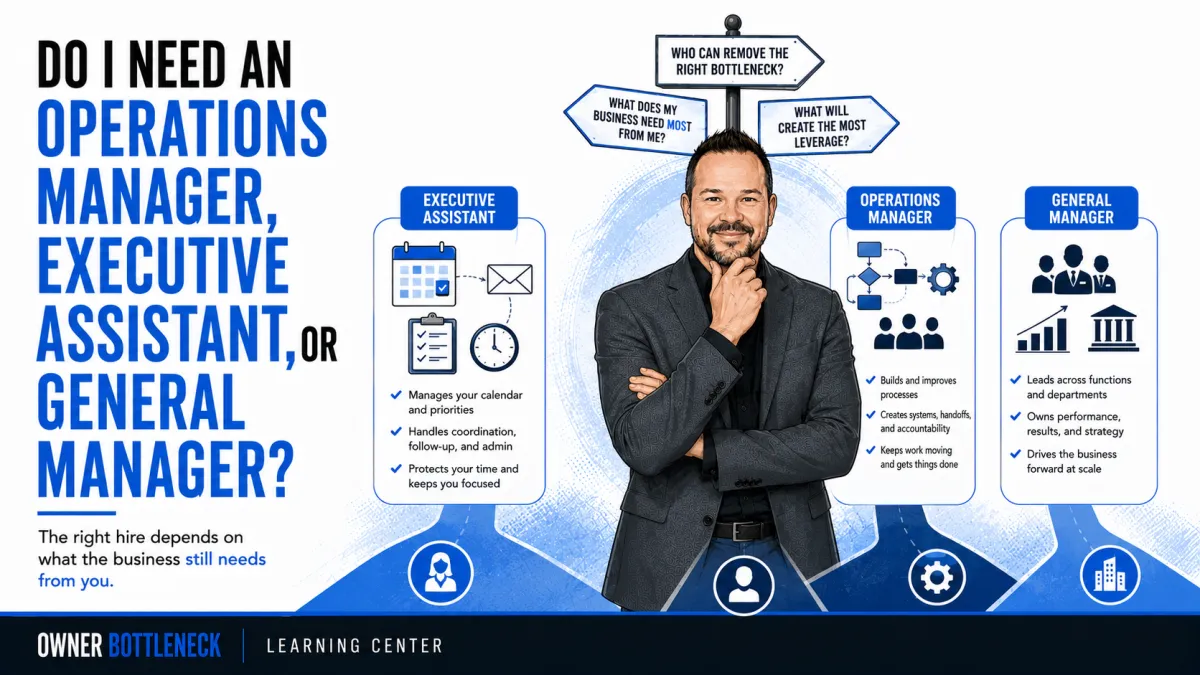
Do I Need an Operations Manager, Executive Assistant, or General Manager?
You need an executive assistant when your attention is being consumed by coordination, communication, scheduling, and follow-through. You need an operations manager when daily execution, handoffs, priorities, and accountability keep returning to you. You need a general manager when the business needs someone to lead across departments and carry responsibility for company-wide performance. The right hire depends on what the business still needs from the owner, not which title sounds most impressive.
The owner had finally admitted he needed help.
His calendar was full.
Employees interrupted him all day.
Projects slipped unless he followed up.
Sales made promises operations didn’t know about.
Customer issues crossed departments and landed in his office.
He spent Sunday evenings preparing for a week he knew would fall apart by Tuesday.
Three people had suggested three different hires.
His business coach said:
You need an executive assistant.
His operations leader said:
We need an operations manager.
A friend who had recently stepped away from his company said:
Hire a general manager and let them run it.
All three sounded reasonable.
So the owner began interviewing.
The executive assistant candidate talked about protecting his calendar, organizing priorities, preparing meetings, following up on commitments, and keeping communication from scattering.
He thought:
That would help.
The operations manager candidate talked about workflow, scheduling, handoffs, capacity, accountability, and making sure the work moved without constant owner intervention.
He thought:
That would help too.
The general manager candidate talked about leading the management team, connecting sales and operations, owning the numbers, making cross-functional decisions, and holding the company accountable for results.
The owner thought:
That sounds like what I really need.
Then the candidate asked:
Which decisions would I actually own?
The owner paused.
I’d still want to stay involved in the important ones.
The candidate asked:
Which departments would report to me?
Another pause.
I’d probably keep sales and finance reporting to me at first.
Could I make changes to the leadership team?
We’d need to talk about that.
Would I own the operating plan?
I’d want to approve it.
The candidate smiled.
It sounds like you want someone to run the business without having the authority to run the business.
The owner didn’t have a hiring problem yet.
He had a role-design problem.
He was choosing between titles before deciding what he was actually willing to transfer.
The Wrong Question Is, “Which Title Do I Need?”
Owners often begin with the title.
Do I need an executive assistant?
Is it time for an operations manager?
Am I big enough for a general manager?
Those questions sound practical.
They start in the wrong place.
The title is the container.
The real question is:
What work, decisions, communication, and leadership still depend on me?
Two companies with the same revenue and employee count may need completely different hires.
One owner may spend most of the day:
Scheduling meetings
Answering emails
Tracking commitments
Preparing information
Coordinating follow-up
Protecting priorities
That owner may need an executive assistant.
Another owner may spend the day:
Rearranging schedules
Solving production problems
Checking whether work was completed
Managing handoffs
Settling department conflicts
Following up on missed commitments
That owner may need an operations manager.
A third owner may still:
Lead every department head
Make cross-functional decisions
Own the company-wide plan
Resolve conflict between sales, operations, and finance
Hold leaders accountable
Carry responsibility for the overall operating result
That owner may need a general manager.
The titles overlap in some businesses.
The purpose shouldn’t.
Start with the dependence.
Then design the role.
What Does an Executive Assistant Actually Solve?
An executive assistant helps the owner use their time, attention, communication, and access more deliberately.
This role can become far more valuable than calendar management.
A strong executive assistant may:
Protect the owner’s calendar
Prepare meetings
Organize priorities
Track commitments
Coordinate communication
Collect information
Follow up with leaders
Manage recurring rhythms
Filter requests
Prepare decisions
Maintain important relationships
Keep projects moving between meetings
Make sure the owner’s promises don’t disappear
The role works close to the owner.
That’s its strength.
It can also become its weakness.
You Probably Need an Executive Assistant When
Your day is being consumed by coordination rather than leadership.
You repeatedly think:
I know what I need to do. I can’t get enough uninterrupted time to do it.
Your inbox, calendar, meeting preparation, follow-up, and shifting priorities are controlling the week.
People need information from you, but the work required to collect, organize, communicate, and track it doesn’t require your personal judgment.
You’re dropping commitments because too much is living in your head.
You’re making appropriate owner-level decisions, but you’re surrounded by administrative work that prevents you from preparing for or executing them well.
An executive assistant can help create leverage around the owner.
An Executive Assistant Won’t Solve the Problem When
The owner is still making every operating decision.
An executive assistant may organize the questions.
Schedule the meetings.
Collect the reports.
Remind the owner to answer.
Follow up after the owner decides.
But the decision still depends on the owner.
The owner may feel more organized while the company remains equally dependent.
That’s not failure by the executive assistant.
The role was given coordination responsibility around a decision structure that never changed.
An executive assistant can protect your attention.
They can’t independently lead operations, hold department managers accountable, or run the company unless the role is deliberately expanded far beyond executive assistance.
Don’t hire an executive assistant and quietly expect a general manager.
What Does an Operations Manager Actually Solve?
An operations manager owns how the work moves.
The exact scope depends on the business.
In one company, operations may include scheduling, production, delivery, customer handoffs, inventory, quality, and capacity.
In another, the operations manager may lead project management, implementation, service delivery, and internal systems.
A strong operations manager may:
Turn company priorities into operating plans
Coordinate people and capacity
Manage schedules
Protect deadlines
Improve handoffs
Track operating performance
Hold people accountable for commitments
Resolve normal workflow problems
Maintain quality
Manage recurring meetings
Improve processes
Address operating exceptions
Keep departments informed
Escalate the risks that genuinely require leadership
The role should own more than activity.
It should own an operating result.
You Probably Need an Operations Manager When
The company sells the work successfully, then execution becomes the owner’s problem.
The team can perform individual tasks, but somebody has to keep connecting them.
Sales hands work to operations.
Operations needs information from the customer.
The schedule changes.
A vendor misses.
An employee calls off.
A deadline moves.
The customer asks for an exception.
Everything eventually reaches the owner because no one else owns the whole operating flow.
The owner keeps asking:
Who’s making sure this actually happens?
An operations manager should be able to answer:
I am.
This role is often the right hire when the daily operations still depend on the owner.
An Operations Manager Won’t Solve the Problem When
The owner refuses to let them manage.
The owner continues assigning work directly to employees.
Changes priorities without informing the manager.
Approves every exception.
Steps into customer problems first.
Overrides the schedule.
Allows employees to bypass the manager.
Corrects every operating decision that differs from their own.
The operations manager becomes responsible for the result while the owner keeps rearranging the conditions.
That’s not authority.
It’s accountability without control.
The owner may then say:
I hired an operations manager, but I still have to stay involved.
Of course you do.
You kept doing the job after hiring someone to own it.
What Does a General Manager Actually Solve?
A general manager leads the business across functions.
They’re not merely the most senior operations person.
They should be able to connect the entire operating company.
Depending on the structure, a general manager may own:
Company-wide execution
The operating plan
Department alignment
Leadership-team performance
Cross-functional priorities
Sales and operational coordination
Financial results
Customer outcomes
Resource allocation
Management accountability
Major operating decisions
Escalation below the ownership level
Development of other leaders
The general manager doesn’t have to replace the owner’s vision or ownership authority.
They do need enough authority to lead the company’s operating system.
You Probably Need a General Manager When
You have managers or department leaders, but you’re still the only person connecting them.
Sales is managed.
Operations is managed.
Finance may be managed.
Customer service may be managed.
But the owner still has to:
Settle conflicts between departments
Decide which company priority wins
Hold managers accountable
Connect department plans
Own the full operating result
Translate strategy into execution
Make the decisions that fall between functions
The individual departments may be led.
The business still isn’t.
A general manager may be appropriate when the owner needs someone to carry company-wide operating leadership.
The deeper question is explored in Do I Need a General Manager to Run My Business?.
A General Manager Won’t Solve the Problem When
The owner wants the title without transferring the role.
The general manager is told to run the company but can’t:
Change priorities
Hold leaders accountable
Make normal cross-functional decisions
Allocate resources
Address management problems
See the financial information
Influence hiring
Change broken systems
Communicate directly with important customers
Let a different but sound decision stand
The owner keeps the authority.
The general manager receives the expectations.
Then everyone wonders why the hire isn’t working.
A general manager without real authority becomes an expensive coordinator.
These Roles Don’t Sit on a Simple Ladder
It’s tempting to think:
Executive assistant, then operations manager, then general manager.
That may happen.
It isn’t a universal progression.
The roles solve different forms of owner dependence.
An executive assistant works primarily around the owner’s attention, communication, and coordination.
An operations manager works primarily around the delivery and execution of the company’s work.
A general manager works primarily across the management system and company-wide operating result.
None of these roles is simply a more senior version of another.
A brilliant executive assistant may create enormous leverage but have no interest in leading operations.
A strong operations manager may run delivery exceptionally well but lack the commercial or financial range required to lead the whole company.
A general manager may understand the complete business but shouldn’t spend most of the week organizing the owner’s inbox and calendar.
Don’t hire one role and assume the person can naturally become all three.
Some people can grow.
The work still needs to be designed honestly.
Start With What Keeps Coming Back to You
For two weeks, record every interruption, approval, problem, and follow-up that reaches you.
Don’t begin by sorting it under job titles.
Record the actual work.
Examples might include:
Schedule a meeting with the lender.
Follow up with the sales manager.
Decide which customer gets priority.
Review the weekly numbers.
Confirm whether the project is still on time.
Approve a schedule change.
Resolve conflict between sales and operations.
Prepare for the management meeting.
Check whether a manager completed what they promised.
Decide who owns a customer problem.
Rearrange the calendar.
Review a department plan.
Make sure the customer received an answer.
Then ask why each item reached you.
Was it because:
Your time wasn’t protected?
Nobody coordinated the follow-up?
No one owned the operating flow?
A manager wasn’t being held accountable?
Departments couldn’t resolve a conflict?
The business needed a company-wide decision?
You hadn’t transferred the authority?
You stepped in before anyone else could act?
The situation genuinely required ownership?
The pattern usually points toward the role.
You Need an Executive Assistant When the Queue Is Around You
The work waits because it needs:
Access to your calendar
Your communication
Your preparation
Your follow-through
Better organization of your priorities
Someone to connect the people and information around you
Protection from unnecessary interruptions
The owner remains the appropriate person for much of the work.
They need leverage around their attention.
That’s an executive assistant problem.
You Need an Operations Manager When the Queue Is Inside the Work
The work waits because it needs:
A schedule decision
Clear ownership
Better handoffs
Capacity management
Follow-up
Process improvement
Accountability
A person coordinating daily execution
Resolution of normal operating exceptions
The owner shouldn’t be the appropriate person for most of the work.
The operating system needs a leader.
That’s an operations manager problem.
You Need a General Manager When the Queue Is Between Leaders
The work waits because it needs:
A company-wide priority
A decision between departments
Management accountability
Resource allocation
A connection between sales, operations, finance, and customers
Translation of strategy into execution
Leadership across the management team
Ownership of the broader operating result
The business has leaders.
The owner remains the leader of all the leaders.
That may be a general manager problem.
A general manager is only one way to create leadership depth. This guide explains how to build a management team that can run the business without you by giving leaders clear outcomes, authority, information, shared priorities, and accountability.
The Same Symptom Can Point to Different Roles
The owner says:
I’m in too many meetings.
That could mean they need an executive assistant to protect the calendar and prepare better meetings.
It could mean they need an operations manager because the owner is attending every workflow meeting.
It could mean they need a general manager because every department leader still reports to the owner.
The symptom alone isn’t enough.
Ask what the meeting is doing.
The Owner Is Coordinating Information
An executive assistant may help.
The Owner Is Managing Execution
An operations manager may help.
The Owner Is Leading Across Departments
A general manager may help.
Another owner says:
Everyone comes to me with problems.
Again, different causes.
People may lack a clear way to get the owner’s attention and follow through. That may require executive-assistant support.
Operating problems may have no clear owner. That may require an operations manager.
Managers may be unable to settle cross-functional issues. That may require a general manager.
Or the owner may have trained everyone to bypass the structure.
No hire fixes that until the owner changes the behavior.
Don’t Hire an Executive Assistant to Absorb Chaos You Refuse to Fix
The owner hires an executive assistant.
Now every request goes to the assistant.
The assistant sorts the inbox.
Schedules meetings.
Tracks follow-up.
Reminds the owner.
Rearranges priorities.
Apologizes when the owner delays.
The owner feels less exposed to the chaos.
The chaos remains.
A good executive assistant can reveal patterns.
They can improve communication and rhythm.
They can challenge the owner.
But the role shouldn’t become a shield between the owner and consequences of chronic indecision.
The assistant shouldn’t spend the week chasing answers the owner refuses to give.
Protecting the owner’s time isn’t the same as protecting the owner from accountability.
Don’t Hire an Operations Manager to Become Your Enforcer
The owner avoids difficult conversations.
Missed commitments continue.
Standards remain vague.
Managers lack authority.
The owner hires an operations manager and says:
I need someone to hold people accountable.
Accountable to what?
A clear outcome?
A visible standard?
A real deadline?
An authority structure the owner will support?
Or the owner’s changing preferences?
The operations manager can’t create accountability inside a system where the owner changes the rules and rescues everyone afterward.
They may become the bad cop.
The owner remains the friendly exception.
Employees learn to wait for the owner to overrule the manager.
That destroys the role.
The guide on holding employees accountable without micromanaging explains what must exist before accountability becomes usable.
Don’t Hire a General Manager to Be the Owner’s Messenger
The general manager meets with the leadership team.
They assign priorities.
A manager disagrees.
The manager calls the owner.
The owner changes the decision.
The general manager returns to the team with a new answer.
The role may have a senior title.
It has messenger authority.
The leadership team learns that the general manager’s decision is temporary.
The owner remains the real manager.
A general manager can’t lead if employees are allowed to appeal every uncomfortable decision directly to ownership.
The owner can retain owner-reserved decisions without becoming an appeals court for normal management.
The article on which decisions should stay with the owner separates true ownership-level decisions from important operating decisions that should move.
The Title Won’t Transfer the Authority
A new person begins Monday.
The owner introduces them:
This is Sarah, our new operations manager. She’ll be taking a lot off my plate.
Employees smile.
Then Monday afternoon, someone asks Sarah to approve overtime.
She checks with the owner.
Tuesday, a customer asks for a remedy.
Sarah checks again.
Wednesday, an employee misses a deadline.
The owner handles the conversation.
Thursday, the owner changes the schedule without telling Sarah.
By Friday, everyone knows what the title means.
Nothing.
Titles don’t transfer authority.
Actions do.
The new leader needs to know:
Which outcomes they own
Which decisions they may make
What they should report afterward
Which risks must be escalated
Who reports to them
Which information they can access
What resources they control
Which standards they may enforce
How the owner will respond to disagreement
Clear decision boundaries for employees matter even more as the role becomes more senior.
Define the Role by Outcomes, Not Tasks
A weak executive-assistant description says:
Manage calendar
Handle email
Schedule meetings
Take notes
Book travel
Those tasks may matter.
What outcomes should they create?
Perhaps:
The owner’s calendar reflects the company’s real priorities.
Leadership meetings begin prepared and end with clear commitments.
Important communication receives a timely response.
Owner commitments don’t disappear after meetings.
A weak operations-manager description says:
Manage schedules
Oversee employees
Improve processes
Handle customers
Run meetings
What outcomes should they create?
Perhaps:
Work moves from sale through delivery without routine owner intervention.
Commitments are visible and followed through.
Operating problems are resolved at the appropriate level.
Quality, capacity, and deadlines remain healthy.
A weak general-manager description says:
Manage departments
Lead the team
Oversee operations
Help grow the business
What outcomes should they create?
Perhaps:
Department leaders operate from one company-wide plan.
Cross-functional conflicts are resolved without routine owner involvement.
The operating result is achieved.
Managers are held accountable and developed.
Strategy becomes coordinated execution.
Tasks explain activity.
Outcomes explain why the role exists.
Decide What the Owner Will Stop Doing
A new hire’s job description isn’t enough.
The owner needs a stop-doing list.
After hiring an executive assistant, the owner may stop:
Personally coordinating routine meetings
Managing all calendar access
Tracking every follow-up
Searching for information others can prepare
Responding to every request immediately
Carrying every commitment in memory
After hiring an operations manager, the owner may stop:
Directly rearranging the schedule
Assigning work around the manager
Handling normal workflow exceptions
Following up with every employee
Leading every operating meeting
Becoming the first call for delivery problems
After hiring a general manager, the owner may stop:
Managing every department head
Settling normal cross-functional conflict
Running the weekly leadership meeting
Approving routine company-wide operating decisions
Translating every strategic priority into tasks
Becoming the leadership team’s final answer for normal execution
The role becomes real only when the owner’s involvement changes.
The owner can’t add a new leader while continuing to occupy the same space.
Give the Role Information, Not Just Responsibility
The owner says:
You own operations.
The manager can’t see current margins.
Doesn’t know what sales has promised.
Has no access to customer history.
Can’t see hiring plans.
Doesn’t understand cash constraints.
Receives the weekly numbers ten days late.
They’re expected to make operating decisions without the information the decisions require.
Responsibility without information creates another path back to the owner.
An executive assistant may need access to:
The owner’s priorities
Calendar
Key relationships
Communication history
Leadership commitments
Relevant financial or project context
An operations manager may need access to:
Capacity
Scheduling
Customer commitments
Quality measures
Labor information
Delivery costs
Project status
Sales handoffs
A general manager may need access to:
Financial performance
Sales pipeline
Operating results
Customer risks
Leadership performance
Cash constraints
Strategic priorities
Company-wide commitments
Don’t ask someone to own what the company won’t let them see.
Give the Role a Management Rhythm
A role won’t become real through random conversations.
Build a rhythm.
For an executive assistant, that may include:
Daily priority review
Weekly calendar planning
Meeting preparation
Commitment tracking
Communication review
Monthly priority reset
For an operations manager:
Daily operating huddle
Weekly schedule and capacity review
Customer exception review
Accountability follow-up
KPI review
Monthly process improvement
For a general manager:
Weekly leadership meeting
Company scorecard review
Cross-functional priority review
Manager one-on-ones
Monthly financial and operational review
Quarterly planning
The owner should receive visibility through the rhythm.
Not by reentering every workflow.
That’s how the owner can stay informed without being involved in everything.
What if You Need More Than One Role?
You might.
An executive assistant doesn’t eliminate the need for operating leadership.
An operations manager doesn’t automatically protect the owner’s calendar.
A general manager shouldn’t become the owner’s full-time personal coordinator.
The right structure may include:
An executive assistant supporting the owner
An operations manager leading daily execution
A general manager leading the management team
Most small businesses won’t hire all three at once.
Sequence matters.
Ask which constraint is most expensive now.
The Owner Can’t Focus
An executive assistant may create the first leverage.
The Work Can’t Move Reliably
An operations manager may be the priority.
The Leaders Can’t Operate as One Company
A general manager may be the priority.
Solve the largest bottleneck first.
Don’t build the future organizational chart while the current business is still unable to support it.
Can One Person Fill Two Roles?
Sometimes.
An executive assistant may also manage projects and operating rhythms.
An operations manager may coordinate leadership meetings.
A general manager may initially oversee operations directly.
That can work when:
The combined outcomes are clear
The person has the capability
The workload is realistic
Decision authority is defined
The company understands which role is being performed in each situation
It fails when the company uses one vague title to hide three full-time jobs.
A person can’t protect the owner’s calendar, run daily operations, lead every manager, build systems, manage customers, own the financial result, and execute every special project without eventually becoming the next bottleneck.
Don’t remove one overloaded owner by creating one overloaded employee.
Could the Role Be Fractional or Part-Time?
Possibly.
A full-time senior hire may be premature.
An executive assistant can begin part-time.
An experienced operations leader may help design systems, install rhythms, or coach an internal manager.
A fractional general manager or operator may help the owner clarify the role, develop leaders, and build the operating structure.
But fractional support can’t permanently own daily work that requires full-time presence.
Be honest about the need.
Do you need:
Advice?
System design?
Project support?
Temporary leadership?
Ongoing daily ownership?
A full-time decision-maker?
Don’t hire a few advisory hours and expect someone to run the company between calls.
How Do You Know Which Role to Hire First?
Use these questions.
Return to the queue you tracked.
If the dependence sits around your attention, begin with an executive assistant.
If it sits inside daily execution, begin with an operations manager.
If it sits between leaders and departments, consider a general manager.
Am I Actually Willing to Transfer the Necessary Authority?
If not, delay the hire and fix the role design.
Otherwise, you’ll hire someone into a job you won’t let them perform.
Can the Business Financially Support the Role?
Don’t look only at salary.
Consider:
Payroll taxes
Benefits
Recruiting cost
Ramp time
Tools
Management time
Potential severance
Cost of a bad hire
Also consider the cost of not hiring.
Owner delay.
Missed sales.
Poor delivery.
Turnover.
Slow decisions.
Customer risk.
A hire is expensive.
So is permanent owner dependence.
A 30-Day Role-Clarity Test Before You Hire
You don’t need to wait thirty days when the need is obvious.
But this test can prevent an expensive role mistake.
Days 1 Through 7: Track the Owner Queue
Record everything that returns to the owner.
Tag each item:
Attention and coordination
Daily operations
Cross-functional leadership
True owner-reserved decision
Work the owner unnecessarily reclaimed
Look for the largest category.
Days 8 Through 14: Define the Outcomes
Write the three to five results the new role must own.
Not a list of errands.
Not a list of vague leadership traits.
Real outcomes.
For example:
The active schedule moves without daily owner intervention.
Or:
Leadership meetings produce clear commitments that remain visible and completed.
Days 15 Through 21: Define the Authority
For each outcome, identify:
What the role may decide
What it should decide and report afterward
What must be escalated
What information it needs
Which people it leads
Which resources it controls
What the owner will stop doing
If the authority sounds impossible to transfer, the role won’t work as written.
Days 22 Through 30: Test the Design
Ask a capable internal leader, advisor, or potential candidate to walk through recent situations.
What would they own?
What would they need?
Where would they become blocked?
Which questions still return to the owner?
Improve the role before filling it.
The goal isn’t to create a perfect job description.
It’s to stop hiring someone into a contradiction.
How Do You Know the Hire Is Working?
Don’t measure success only by whether the owner likes the person.
Track the dependence the role was hired to remove.
For an executive assistant:
Owner focus time
Meeting preparation
Follow-through rate
Unnecessary interruptions
Commitments completed
Calendar alignment with priorities
For an operations manager:
Work moving without owner intervention
Schedule reliability
Handoff failures
Customer escalations
Missed commitments
Operating decisions made without the owner
Quality and margin
For a general manager:
Decisions waiting for the owner
Cross-functional issues resolved
Leadership commitments completed
Company-wide operating results
Manager performance
Owner involvement in daily leadership
Owner-independent operating days
These measures fit inside the broader Owner Dependence KPIs.
The hire is working when the business becomes more capable.
Not merely when the owner becomes less busy.
What if the New Hire Keeps Asking You Everything?
Don’t immediately assume they’re the wrong person.
Ask what’s missing.
Do they understand the outcome?
Do they have the authority?
Can they access the information?
Are the boundaries clear?
Have they seen examples?
Does the team respect the role?
Do you support their decisions?
Have you allowed employees to bypass them?
Do you reverse choices after the fact?
The person may lack capability.
But the role may also be structurally fake.
The Judgment Transfer System explains how to teach employees to make good decisions without you rather than merely demanding more confidence.
What if You Already Hired the Wrong Role?
Don’t force the title to solve a problem it wasn’t designed to solve.
You may have hired an executive assistant when the company needed operating leadership.
You may have hired an operations manager while expecting company-wide general management.
You may have hired a general manager when the owner really needed basic administrative leverage and clearer systems.
Reassess:
What outcomes is the person capable of owning?
What work are they actually doing?
What authority do they have?
What role does the company still need?
Can the current person grow into it?
Does the job need to be redesigned?
Are two roles being combined unrealistically?
Is a different hire required?
Changing the role isn’t automatically a failure.
Pretending the current structure is working when it isn’t will cost more.
Frequently Asked Questions
What’s the Difference Between an Executive Assistant and an Operations Manager?
An executive assistant primarily protects and extends the owner’s attention, communication, preparation, and follow-through.
An operations manager primarily owns the daily execution of the company’s work, including schedules, handoffs, capacity, quality, and operating accountability.
What’s the Difference Between an Operations Manager and a General Manager?
An operations manager usually leads the delivery or operating function.
A general manager leads across functions and carries responsibility for broader company-wide execution and performance.
Can an Executive Assistant Become an Operations Manager?
Possibly.
The person would need the capability and desire to lead operating outcomes, people, processes, priorities, and decisions.
Strong executive-assistant performance alone doesn’t guarantee that fit.
Can an Operations Manager Become a General Manager?
Yes, when they develop the commercial, financial, leadership, and cross-functional capability required to lead the wider business.
Not every excellent operations manager wants or needs that role.
How Many Employees Should I Have Before Hiring a General Manager?
Employee count alone doesn’t determine the need.
Consider management complexity, revenue, leadership structure, cross-functional dependence, financial capacity, and how much company-wide execution still depends on the owner.
Should a General Manager Own Sales?
It depends on the business structure and the person’s capability.
The general manager may directly lead sales, lead the sales manager, or coordinate sales with the rest of the company.
The authority must be explicit.
Does an Executive Assistant Need Decision Authority?
Yes, inside the role.
They may need authority over calendar access, meeting preparation, communication flow, follow-up, priority coordination, and recurring commitments.
They shouldn’t need owner approval for every normal choice.
Should an Operations Manager Report to the Owner?
In many small businesses, yes.
As the company develops, the operations manager may report to a general manager, president, or another senior leader.
What if I Can’t Afford the Ideal Hire?
Narrow the role to the highest-value outcome.
Consider part-time, fractional, internal development, or staged responsibility.
Don’t create a vague low-cost role and expect the full result of an experienced leader.
Which Role Gives the Owner the Most Time Back?
The role that removes the largest real dependence.
An executive assistant may create immediate calendar leverage.
An operations manager may remove daily workflow involvement.
A general manager may remove company-wide operating leadership.
The wrong hire can create more work.
Do I Need All Three Roles?
Not necessarily.
The appropriate structure depends on the size, complexity, leadership needs, and financial capacity of the business.
Some companies combine parts of the roles temporarily.
The outcomes and authority still need to remain clear.
Don’t Hire a Title to Solve an Undefined Problem
You may need an executive assistant.
You may need an operations manager.
You may need a general manager.
You may eventually need all three.
But don’t begin with the title.
Begin with the queue.
What keeps returning to you?
What kind of work is it?
What result does the business need someone else to own?
What decisions must move?
What information will the person need?
What will you stop doing?
An executive assistant can protect your attention.
An operations manager can lead daily execution.
A general manager can lead across the business.
None of them can remove the Owner Bottleneck while the owner keeps the authority required to do the job.
The free Owner Bottleneck Scorecard evaluates dependence across:
Decisions
Sales
Operations
Team
Value
It’ll help you identify which work, leadership, and decisions still depend on you before you decide which role to hire.
Take the Owner Bottleneck Scorecard
Don’t hire the most impressive title.
Hire the role that removes the right dependence.