
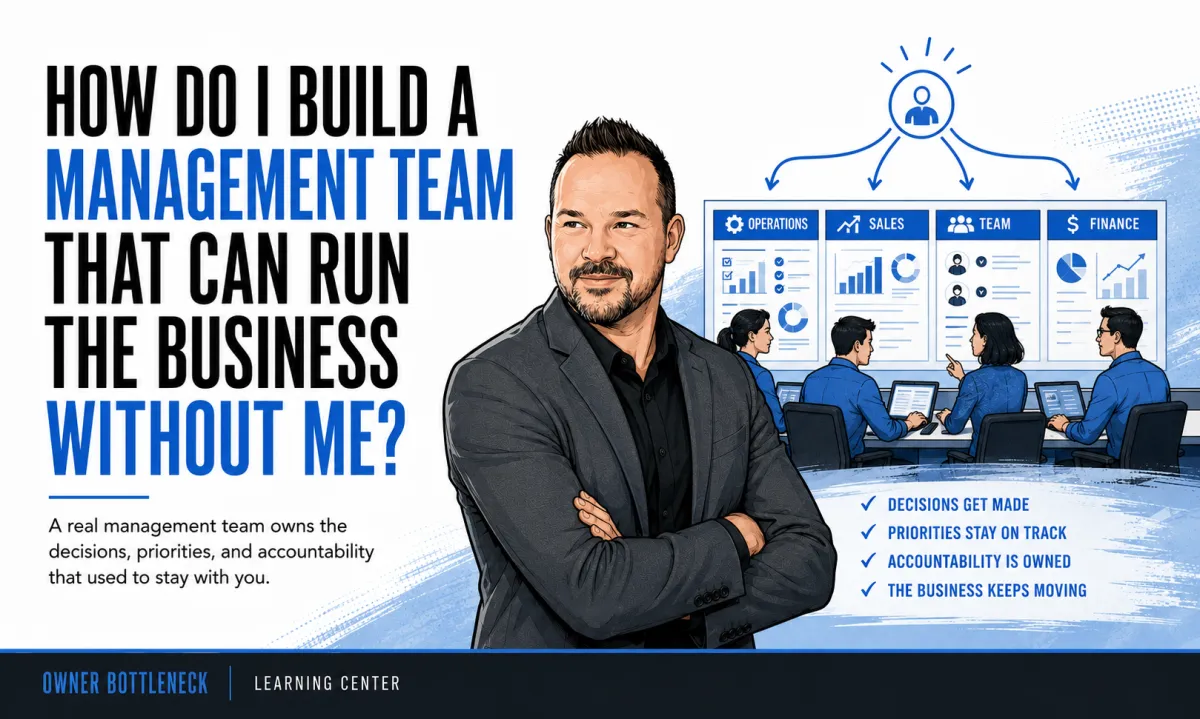
How Do I Build a Management Team That Can Run the Business Without Me?
How Do I Build a Management Team That Can Run the Business Without Me?
A management team can run the business without you when each major part of the company has one clear leader who owns results, has authority to make decisions, works from shared priorities, and is held accountable through a consistent operating rhythm.
Giving people management titles isn’t enough.
Hiring more supervisors isn’t enough.
Holding more meetings isn’t enough.
A management team becomes real when the leaders beneath you can:
Set priorities
Make normal decisions
Coordinate across departments
Hold employees accountable
Solve problems
Protect company standards
Track results
Communicate clearly
Escalate only what truly requires the owner
Until then, you may have managers.
You don’t yet have a management team.
You have people who supervise work while the owner still runs the business.
That’s why an owner can look around and say:
I have managers. Why does everything still come back to me?
The problem usually isn’t the number of managers.
The problem is that management responsibility, authority, information, and accountability haven’t actually moved.
The titles changed.
The operating system didn’t.
Key Takeaways
A management team isn’t a collection of people with titles. It’s a group of leaders who own different parts of the business and run them together.
Each major business function needs one clearly accountable leader.
Managers can’t own results when the owner keeps every important decision.
A strong management team needs shared priorities, decision rights, operating rhythms, standards, metrics, and cross-functional accountability.
The owner must stop acting as the hidden manager behind every manager.
Not every growing business needs a full executive team or general manager.
The real test is whether the business can maintain performance, solve normal problems, and make sound decisions when the owner is unavailable.
What Does a Management Team That Can Run the Business Actually Do?
A capable management team does more than pass information to the owner.
It runs the company’s normal operating system.
That means the team can:
Turn company goals into departmental priorities
Assign resources
Make tradeoffs
Resolve normal customer and employee problems
Manage performance
Coordinate handoffs
Track important numbers
Surface risk early
Improve processes
Make decisions within agreed boundaries
Keep the company moving when the owner isn’t present
The owner may still provide direction.
The owner may still set strategy.
The owner may still make major financial, legal, ownership, and leadership decisions.
But the owner isn’t required to coordinate every day.
A functioning management team turns the owner’s direction into action without needing the owner inside every step.
Managers and Lead Employees Aren’t the Same
Many small businesses promote their strongest employee into management.
The best technician becomes the operations manager.
The top salesperson becomes the sales manager.
The most reliable administrator becomes the office manager.
The employee receives a title.
Their work barely changes.
They’re still judged mainly on their own tasks.
They still solve only the problems placed directly in front of them.
They still depend on the owner to set priorities, make difficult decisions, handle weak employees, and coordinate with other departments.
That person may be valuable.
They may be experienced.
They may be respected.
But they’re functioning as a lead employee, not a manager.
A lead employee helps the work get done.
A manager owns the conditions that allow other people to produce the result.
Managers must be able to:
Set expectations
Plan work
Assign responsibility
Make decisions
Coach employees
Address missed commitments
Resolve conflicts
Monitor results
Improve the system
Coordinate with other leaders
Being the best at the work doesn’t automatically mean someone can lead the work.
Management is a different responsibility.
Why Doesn’t Hiring Managers Make the Business Less Dependent on the Owner?
Because owners often transfer tasks without transferring management authority.
The manager may be responsible for a department but unable to:
Change the schedule
Address poor performance
Approve reasonable expenses
Adjust a process
Resolve a customer issue
Set priorities
Reassign work
Enforce standards
Make hiring recommendations
Say no to another department
Hold peers accountable
When anything becomes uncertain, the manager goes to the owner.
The owner gives the answer.
The manager carries it back to the team.
That creates a management relay system.
Information travels up.
Decisions travel down.
The owner remains the center of the company.
This is closely connected to a Decision Bottleneck.
The manager may own the title.
The owner still owns the judgment.
Your Management Team May Be Organized Around You
Look at how information moves through the business.
Does each manager report problems separately to you?
Do you decide which department gets priority?
Do you resolve conflicts between sales and operations?
Do you decide when quality matters more than speed?
Do you determine which customer gets special treatment?
Do you tell managers what to communicate to one another?
Do you follow up to make sure commitments were completed?
If so, your management structure may look like a wheel.
You’re the hub.
Every manager is a spoke.
Each leader connects to you.
They don’t truly connect to one another.
That structure may work while the company is small.
It becomes heavier as the business grows.
More employees create more questions.
More customers create more exceptions.
More departments create more handoffs.
More managers create more reports for the owner to process.
The owner becomes the person who integrates the entire company.
That’s a Team Bottleneck.
A real management team can integrate the business together.
The Seven Capabilities Your Management Team Needs
A management team that can run the business without you needs more than talented people.
It needs a clear management system.
1. Clear Functional Ownership
Each major part of the business needs one accountable leader.
Depending on the company, those areas may include:
Sales
Marketing
Operations
Finance
Customer service
People
Production
Project delivery
Administration
The exact titles don’t matter as much as the ownership.
Someone must be able to say:
I own the result produced by this part of the business.
That doesn’t mean the person performs every task.
It means they’re responsible for:
Setting priorities
Assigning work
Monitoring performance
Solving normal problems
Coordinating with other functions
Improving results
Reporting risks
Closing unfinished loops
Avoid creating overlapping ownership.
When two leaders both believe they own the same result, conflict grows.
When neither leader believes they fully own it, problems fall between departments.
For every major outcome, ask:
Who is the one person responsible for making sure this result happens?
2. Real Decision Authority
A manager can’t run a function while asking the owner to approve every meaningful move.
Clarify what each leader can decide without you.
That may include:
Scheduling
Staffing assignments
Customer remedies
Routine discounts
Departmental spending
Vendor selection
Process changes
Performance conversations
Hiring recommendations
Overtime
Priority changes
Deadline adjustments
Authority should include limits.
For example:
The operations manager may authorize customer remedies up to $500, adjust project schedules inside available capacity, approve overtime within the monthly labor target, and change normal workflows as long as safety and quality standards are protected.
That manager has room to lead.
Anything outside those limits may still require escalation.
The goal isn’t unlimited authority.
The goal is enough authority to own the result.
For a deeper breakdown, read How Do You Delegate Decisions, Not Just Tasks?.
3. Shared Company Priorities
Managers can make good departmental decisions that hurt the business as a whole.
Sales wants faster growth.
Operations wants stability.
Finance wants stronger margins.
Customer service wants flexibility.
Each goal may be reasonable.
Conflict appears when leaders don’t know which priorities matter most right now.
The management team needs a shared answer to questions such as:
What are the company’s top priorities this quarter?
Which customer commitments must be protected?
Where are we willing to invest?
What risks are unacceptable?
Are we currently optimizing for growth, margin, quality, speed, or capacity?
What tradeoffs are acceptable?
What problem matters most?
Without shared priorities, managers escalate decisions because they don’t know how to weigh competing needs.
The owner becomes the only person who understands the whole picture.
Shared priorities allow managers to make decisions from the same map.
4. Clear Standards and Guardrails
Managers need to understand how the company defines a good decision.
Standards may cover:
Quality
Customer experience
Safety
Profitability
Communication
Hiring
Performance
Scheduling
Documentation
Legal risk
Spending
Escalation
Standards turn the owner’s judgment into something the management team can use.
For example:
We don’t promise work before capacity has been confirmed. We notify customers early when commitments are at risk. We protect safety and quality before speed. We don’t allow a customer exception to quietly become the new standard.
Those principles help managers decide without asking the owner every time.
If the standard exists only inside your head, your managers will remain dependent on you.
5. Reliable Visibility
Owners often stay involved because they don’t trust what they can’t see.
That’s reasonable.
The answer isn’t to remain copied on every email.
The answer is better visibility.
Each manager should know:
Which results matter
How those results are measured
What healthy performance looks like
What requires attention
When the owner needs to be informed
A management dashboard doesn’t need hundreds of numbers.
It needs the few numbers that show whether the business is working.
Examples might include:
Revenue
Gross margin
Pipeline
Close rate
Labor utilization
On-time delivery
Customer complaints
Rework
Cash balance
Accounts receivable
Employee turnover
Capacity
Open positions
Managers should bring explanations and actions, not merely numbers.
A strong update sounds like:
On-time delivery dropped from 94 percent to 87 percent. Two vendor delays caused most of the decline. We changed the ordering schedule, added a backup supplier, and expect to return above 92 percent within three weeks.
The number creates visibility.
The manager still owns the response.
6. A Consistent Operating Rhythm
A management team can’t run the business through random conversations.
It needs a rhythm.
That usually includes:
Short daily or departmental huddles
A weekly management meeting
Monthly financial and operating reviews
Quarterly planning
Regular one-on-one meetings
Clear follow-up on commitments
The weekly management meeting should not become a two-hour report to the owner.
Managers should already know the numbers.
The meeting should focus on:
What changed
What’s off track
Which commitments are due
Which cross-functional problems need resolution
What decisions must be made
What risks are emerging
Who owns each next step
The owner may participate.
The owner shouldn’t be required to carry the entire agenda, solve every issue, and assign every action.
A strong rhythm makes management predictable.
7. Cross-Functional Accountability
The business doesn’t operate in departments.
Customers experience one company.
Problems often happen between functions:
Sales promises something operations can’t deliver
Operations completes work finance can’t bill
Marketing generates leads sales doesn’t follow up
Customer service makes commitments without checking capacity
Finance changes a rule without explaining it to the team
Managers protect their own department at the expense of the company
A capable management team can resolve these issues together.
Leaders must be able to:
Challenge one another respectfully
Clarify ownership
Make tradeoffs
Protect the company’s priorities
Hold peers accountable
Leave the meeting with one decision
If every disagreement requires the owner to choose a winner, the management team isn’t truly functioning as a team.
What Seats Does Your Management Team Need?
Don’t copy another company’s org chart.
Build the team around the work your business actually requires.
A small company may need:
One operations leader
One sales leader
One finance or administrative leader
A larger company may need separate leaders for:
Sales
Marketing
Operations
Finance
Customer experience
People
Production
Technology
Some people may own more than one function.
That’s fine when the responsibilities are clear and the workload is realistic.
The mistake is creating titles before defining outcomes.
Start with the work.
Ask:
What major results must the company produce?
Which results currently depend on me?
Which results need full-time management?
Where do problems repeatedly cross departments?
Which leadership gaps are limiting growth?
Which seats are missing?
Which seats exist only on paper?
Then define the role around the outcome.
Do You Need a Full Executive Team?
Probably not.
A $2 million company doesn’t need to imitate a $200 million company.
You may not need:
A chief operating officer
A chief revenue officer
A chief people officer
A chief marketing officer
Multiple vice presidents
You need enough management capacity to run the business you actually have.
Titles should match the level of responsibility.
A strong operations manager with clear authority may be more valuable than a premature chief operating officer title.
A practical management structure beats an impressive org chart.
Build the next level the business requires.
Don’t build for appearance.
How Do You Know Whether Your Current Managers Are Ready?
Evaluate the pattern, not one good or bad day.
Ask whether each manager can:
Define the results they own
Set priorities
Make decisions
Explain their reasoning
Hold employees accountable
Communicate difficult information
Solve recurring problems
Coordinate across departments
Use numbers
Coach employees
Surface risk early
Follow through
Improve the system
Operate without constant reminders
Then ask:
What happens when I’m unavailable?
Does the manager continue leading?
Do they freeze?
Do they wait?
Do they tell employees nothing can happen until you return?
Readiness isn’t only confidence.
It’s demonstrated judgment and follow-through.
A Simple Management Readiness Test
For each manager, rate these five areas from one to five:
Ownership
Can they clearly explain the outcome they own?
Authority
Can they make the decisions required to produce that outcome?
Capability
Do they have the judgment, skills, and experience needed?
Accountability
Do they follow through and address missed commitments?
Leadership
Can they create results through other people?
A manager with a low score doesn’t automatically need to be replaced.
The score tells you what must be developed.
Someone may have strong technical capability but weak people leadership.
Someone may be an effective leader but lack financial understanding.
Someone may have the skill but no real authority.
Diagnose before deciding.
How Do You Build the Management Team?
You don’t build it by announcing a new org chart.
Build it in stages.
Stage 1: Map What Still Depends on You
List the management work you still perform.
Include:
Decisions
Approvals
Priorities
Customer exceptions
Employee issues
Scheduling
Financial reviews
Cross-functional coordination
Hiring
Performance management
Problem-solving
Follow-up
Don’t list only tasks.
List the judgment and coordination work.
That’s usually where the real owner dependence lives.
Stage 2: Define the Management Seats
Group the work into clear areas of ownership.
For each seat, define:
The outcomes
The responsibilities
The decisions
The measures
The standards
The escalation limits
The relationships with other functions
Avoid vague statements such as:
Responsible for helping operations run smoothly.
Use clear outcomes such as:
Owns scheduling, labor capacity, on-time delivery, operational quality, and coordination between sales and production.
Stage 3: Assess the People
Determine whether the current person can grow into the seat.
Ask:
Do they want the responsibility?
Do they have the capacity?
Can they lead people?
Can they make decisions?
Will they accept accountability?
Can the missing skills be developed?
How long will development reasonably take?
Don’t force a loyal employee into a role they don’t want or can’t perform.
That’s unfair to them and dangerous for the business.
Stage 4: Transfer Authority
Move decisions in clearly defined groups.
Start with lower-risk, recurring decisions.
Use a staged transfer:
Observe
Recommend
Decide with review
Decide and report
Own and improve
This is the same progression used to help employees take more ownership.
Stage 5: Install the Management Rhythm
Create the meetings, metrics, and review structure that allow the team to run together.
Agree on:
Weekly priorities
Scorecard measures
Meeting cadence
Commitment tracking
Escalation rules
Quarterly goals
Cross-functional issues
The rhythm should replace random owner involvement.
Stage 6: Stop Acting as the Hidden Manager
This may be the hardest part.
You must stop:
Giving instructions around the manager
Reversing normal decisions without explanation
Taking employee problems back directly
Solving issues before the manager has tried
Holding private meetings that bypass the team
Becoming the backup owner of every commitment
When an employee comes directly to you, ask:
Have you discussed this with your manager?
When a manager brings you a normal problem, ask:
What do you recommend?
When another department complains, ask:
Have the two leaders worked through this together?
You’re not refusing to lead.
You’re strengthening the leadership structure.
How Do You Avoid Becoming the Manager Behind the Managers?
Owners often transfer responsibility publicly and keep control privately.
The manager is told:
You own this department.
Then the owner:
Approves the schedule
Talks directly to employees
Reassigns work
Changes priorities
Handles customer complaints
Decides spending
Reviews every detail
Gives conflicting instructions
Employees quickly learn who still has the real authority.
The manager becomes a messenger.
To prevent this, clarify your own role.
Decide:
Which decisions remain with you
Which decisions belong to management
How managers report results
What qualifies as an escalation
When you’ll review performance
How disagreements will be handled
Then behave consistently.
You can’t build management authority while repeatedly proving that it isn’t real.
What Should the Owner Still Own?
A business that can run without your daily involvement still needs ownership.
You may continue owning:
Vision
Long-term strategy
Major capital allocation
Ownership structure
Financing
Major acquisitions
Executive hiring
Material legal risk
Company-threatening decisions
Culture at the highest level
Relationships you intentionally choose to retain
The goal isn’t to remove the owner from leadership.
It’s to remove the owner from work the management team should carry.
Ask:
Does this decision require the owner, or has the company simply never learned to make it without the owner?
How Should a Management Team Handle Escalations?
Escalation isn’t failure.
Good managers escalate the right issues early.
The problem is when everything becomes an escalation.
Create clear levels.
Level 1: Manager Decides
Normal decisions inside the manager’s authority.
Level 2: Management Team Decides
Issues involving more than one department or a company-wide tradeoff.
Level 3: Owner Input
Decisions involving major risk, strategy, capital, ownership, or a threshold outside management authority.
This prevents two extremes:
Managers escalating every decision
Managers hiding serious risk
The management team should understand both the freedom to act and the responsibility to surface what matters.
How Do You Build Accountability Without Creating More Meetings?
Meetings aren’t the point.
Accountability is.
Every management commitment should include:
One owner
One outcome
One deadline
One measure
One next review date
For example:
Operations will reduce overdue projects from 14 to 6 by August 31. Maria owns the result. Progress will be reviewed each Monday.
That’s clearer than:
Operations needs to improve project flow.
Use a shared commitment tracker if necessary.
Keep it simple.
The team should be able to see:
What was promised
Who owns it
When it’s due
Whether it’s on track
What’s blocking it
A meeting without clear commitments creates discussion.
A management system creates follow-through.
What If One Manager Is Holding the Team Back?
One weak management seat can keep the owner involved across the entire company.
If the operations manager can’t lead, the owner may return to operations.
If the sales manager can’t forecast or coach, the owner may return to sales.
If the finance leader can’t explain the numbers, the owner may return to financial control.
Determine the source of the weakness.
It may be:
Unclear expectations
Missing authority
Lack of training
Too much workload
Poor role design
Weak judgment
Avoidance of conflict
Lack of follow-through
Low willingness
Wrong person for the seat
Create a development plan with:
Specific expectations
Required outcomes
Coaching
Resources
Decision authority
Review dates
A reasonable deadline for improvement
Then evaluate the results honestly.
Loyalty matters.
So does role fit.
Keeping the wrong person in a key management seat can force the owner to remain the real manager indefinitely.
How Long Does It Take to Build a Management Team?
It depends on the business and the people already in place.
You may improve clarity, meetings, and decision rights within 30 to 90 days.
Developing strong managers may take much longer.
The process often includes:
Clarifying seats
Redefining roles
Coaching
Replacing weak habits
Transferring knowledge
Building decision confidence
Learning to handle conflict
Measuring results
Testing the system
Don’t judge progress only by whether you still receive questions.
Look for changes such as:
Questions come with recommendations
Managers solve more problems together
Fewer decisions wait for you
Commitments are closed without reminders
Employee issues are handled at the right level
Departmental performance is visible
Risks are raised earlier
The company remains steady when you’re unavailable
How Do You Test Whether the Team Can Run the Business Without You?
Don’t begin with a month away.
Start smaller.
Test 1: One Day
Make yourself unavailable for routine operating decisions.
Review what waited for you.
Test 2: Three Days
Ask managers to run the normal rhythm without your involvement.
Track the questions, delays, and escalations.
Test 3: One Week
Stay available for true emergencies, but don’t participate in normal operations.
Review:
Decisions delayed
Problems escalated
Customer issues
Missed commitments
Manager conflicts
Information gaps
Results
Test 4: Two Weeks or Longer
Once the shorter tests are stable, increase the owner’s absence.
The purpose isn’t to prove the team failed.
It’s to reveal where the management system still depends on you.
Every problem becomes useful evidence.
For a broader operating transition, read How Do I Remove Myself From Daily Business Operations?.
What Does a Strong Management Team Look Like?
You’ll know the management team is becoming stronger when:
Each leader knows what they own
Employees understand who makes which decisions
Managers make normal decisions without waiting
Problems come with recommendations
Leaders challenge one another respectfully
Cross-functional issues are resolved together
Departmental results are visible
Weak performance is addressed
Commitments are tracked
Risks surface early
The owner is no longer the automatic tie-breaker
The business remains steady when the owner is unavailable
The owner may still be involved.
But the company isn’t frozen without them.
A Management Team Is Built When Ownership Moves
A management team doesn’t become real because you announce it.
It becomes real when ownership moves.
The managers own:
Results
Decisions
Standards
People
Problems
Commitments
Improvement
The team owns how the departments work together.
The owner owns the direction and the decisions that truly belong at the ownership level.
That’s the shift.
You stop being the person who runs every part of the company.
You become the person who leads the people responsible for running it.
Frequently Asked Questions
Do I Need a General Manager to Run My Business?
Not necessarily.
Some businesses need one person to integrate daily operations across departments.
Others can operate with a strong management team whose functional leaders coordinate directly.
The right structure depends on the company’s size, complexity, management capability, and the owner’s desired role.
What Is the Difference Between a Manager and a Leader?
A manager is accountable for producing results through a defined function or team.
Leadership is the ability to create direction, trust, judgment, accountability, and progress through other people.
Strong managers need leadership ability.
A title alone provides neither management capability nor leadership.
Can I Promote My Best Employee Into Management?
Possibly, but technical performance doesn’t guarantee management ability.
The person must be willing and able to set expectations, make decisions, coach employees, address performance, communicate clearly, and own results through other people.
Assess the management responsibility separately from their technical skill.
How Many Managers Does a Small Business Need?
There is no universal number.
The business needs enough management capacity to own its major functions and coordinate them effectively.
Start by identifying the outcomes that currently depend on the owner. Then determine which management seats are required to carry them.
What If My Managers Aren’t Confident Making Decisions?
Confidence often grows from clear authority, standards, information, coaching, and repeated practice.
Begin with lower-risk recurring decisions.
Ask managers to recommend an answer before you provide one.
Gradually expand their authority as judgment improves.
Should the Owner Attend Management Meetings?
Usually, at least during the transition.
The owner may provide direction, clarify priorities, and coach the team.
However, the owner shouldn’t be required to provide every update, solve every issue, assign every commitment, and control every discussion.
The meeting should increasingly belong to the management team.
How Do I Know Whether My Business Is Too Dependent on Me?
Look at what stops, waits, weakens, or becomes uncertain when you’re unavailable.
You can also use the Owner Bottleneck Scorecard to evaluate dependence across Decisions, Sales, Operations, Team, and Value.
Find the Management Gaps Keeping You in the Middle
A weak management team may be only one part of the problem.
The company may also depend on your customer relationships, decisions, operating knowledge, standards, or personal credibility.
The free Owner Bottleneck Scorecard helps identify where the business still depends too heavily on you.
It evaluates owner dependence across:
Decisions
Sales
Operations
Team
Value