
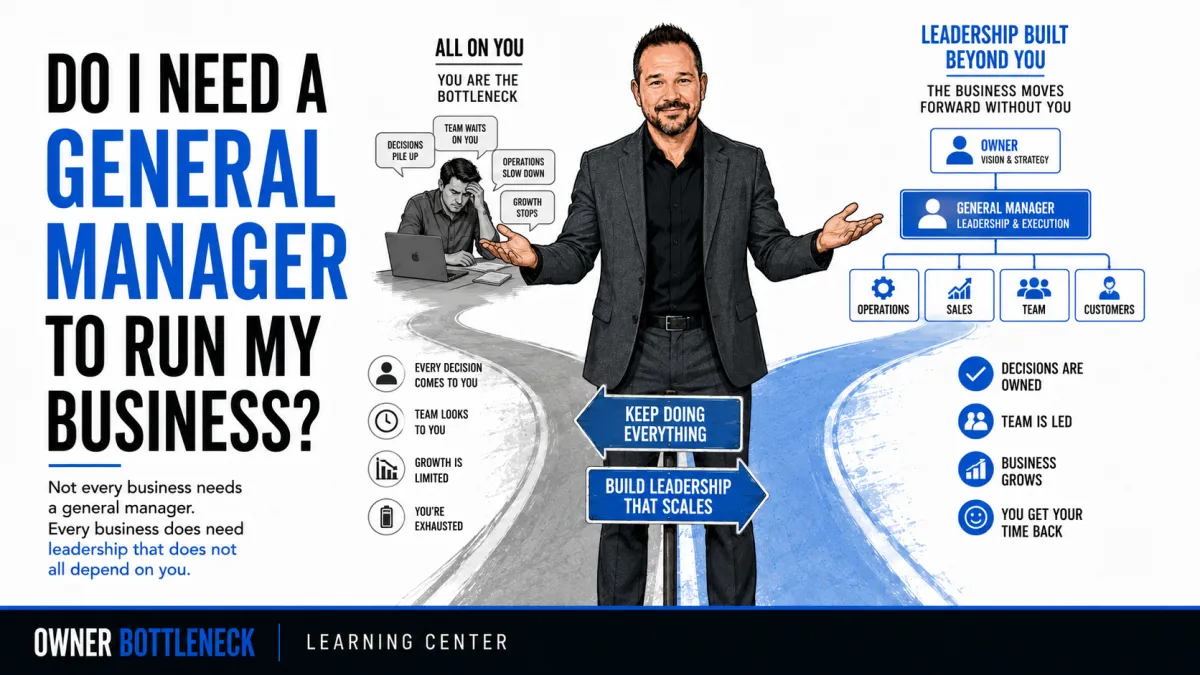
Do I Need a General Manager to Run My Business?
You may need a general manager if your business has enough complexity, managers, and cross-functional decisions to justify one, and you’re genuinely ready to transfer authority. If you only need help with tasks, scheduling, or one department, a general manager is probably the wrong hire.
An owner finally gets tired of carrying the business.
Every department needs something.
Sales wants pricing approved.
Operations needs priorities clarified.
Employees are arguing about who owns a problem.
A major customer is unhappy.
The owner has become the person who connects everything.
So they hire a general manager.
The title goes on the organizational chart.
The announcement goes out to the team.
Everyone is told:
Start going to the general manager instead of me.
For a few days, it feels like progress.
Then the questions start coming back.
The general manager asks whether they can approve the discount.
An employee goes around them and calls the owner.
A department manager disagrees with the general manager, so the owner steps in.
The general manager makes a decision the owner wouldn’t have made, so the owner reverses it.
Soon, the team learns the new structure.
Go to the general manager first.
Go to the owner when you want the real answer.
The owner didn’t hire someone to run the business.
They hired a very expensive messenger.
That doesn’t mean general managers don’t work.
It means the title alone solves nothing.
A general manager can’t run the business unless the owner is willing to let them.
Key Takeaways
A general manager should own companywide operating performance, not just complete tasks for the owner.
The need for a GM is driven more by complexity than by a specific revenue or employee count.
If one department is struggling, you may need a stronger department leader rather than a general manager.
A GM won’t fix unclear standards, weak managers, undocumented knowledge, or an owner who keeps taking authority back.
The business needs enough profit to support the role without creating a new financial problem.
The hire works only when authority, accountability, information, and boundaries move with the responsibility.
What Does a General Manager Actually Do?
A real general manager is responsible for the performance of the business across departments.
That’s different from helping the owner stay organized.
It’s different from managing one function.
It’s different from being the person who follows up after everyone else.
A general manager should be able to look across sales, operations, people, customers, and financial performance and answer:
What does the business need most right now?
They should turn the company’s goals into operating priorities.
They should hold department leaders accountable.
They should resolve conflicts that cross departmental lines.
They should make normal operating decisions without waiting for the owner.
They should see where one part of the company is creating problems for another.
Most importantly, they should be responsible for results.
Not activity.
Not updates.
Not carrying messages between the team and the owner.
Results.
The Difference Between a General Manager and an Assistant
Owners sometimes say they need a general manager when they really want someone to make their day easier.
They want a person who will:
Attend meetings
Chase follow-ups
Organize projects
Track deadlines
Answer employee questions
Keep the owner informed
Make sure things don’t get dropped
That role may be valuable.
But it may be an executive assistant, project manager, operations coordinator, or chief of staff.
A general manager is different.
The assistant helps the owner manage the work.
The general manager owns the operating result.
An assistant may say:
Here are the three decisions the team needs from you.
A general manager should say:
I made two of the decisions. The third falls outside my authority, so here’s my recommendation.
That difference matters.
One role makes the owner more efficient.
The other reduces how much the business depends on the owner.
Do You Need a General Manager or a Stronger Department Leader?
Before hiring a GM, identify where the problem actually lives.
Suppose operations is disorganized, jobs are late, and quality is inconsistent.
That doesn’t automatically mean the company needs a general manager.
It may need a capable operations manager.
Suppose the sales team lacks coaching, the pipeline is weak, and deals depend on the owner.
That may call for sales leadership.
Suppose employees are unclear about responsibilities and nobody is managing performance.
That may mean the current managers need clearer expectations, authority, and accountability.
A general manager becomes more useful when the problem crosses the entire business.
Sales is promising work operations can’t deliver.
Operations is making choices that hurt customers.
Department managers are fighting over resources.
Priorities change depending on who spoke to the owner last.
Nobody owns the performance of the company as a whole.
That’s where a general manager may fit.
They don’t replace every manager.
They make sure the managers operate as one company.
The Real Test Is Complexity, Not Company Size
There isn’t one employee count or revenue number that tells you when to hire a general manager.
A company with 40 employees may not need one.
A company with 15 employees might.
The better question is:
How much cross-functional coordination does the business require?
A straightforward company with one location, one service, a strong supervisor, and predictable work may operate well without a GM.
A smaller company with multiple locations, several departments, complicated projects, major customer relationships, and constant tradeoffs may need broader leadership much sooner.
Look at the amount of management work being created.
How often do departments need alignment?
How often does a decision affect multiple teams?
How often do managers need someone to settle priorities?
How much of your week is spent coordinating people who already have managers?
When your job has become translating, aligning, correcting, and connecting every department, the business may be outgrowing owner-led coordination.
That’s often where an Owner Bottleneck begins to become a management structure problem.
Signs You May Be Ready for a General Manager
You may be ready when the company has capable functional leaders, but nobody owns the whole operating picture.
Your sales manager may own sales.
Your operations manager may own delivery.
Your controller may own the numbers.
Your service manager may own customers.
But when those responsibilities collide, everything comes back to you.
You may also be ready when you’re no longer doing most of the frontline work, yet you’re still required to keep all the leaders moving in the same direction.
That’s a different problem from being overloaded with tasks.
The business doesn’t merely need another pair of hands.
It needs another operating brain.
A GM may also make sense when your time is being pulled away from work only the owner can do, such as strategy, capital decisions, acquisitions, major partnerships, or long-term direction.
The general manager handles the operating company.
The owner handles ownership.
That separation can be powerful.
But only when the business is ready for it.
Signs Hiring a General Manager May Be Premature
Hiring a GM too early can create an expensive layer between the owner and a team that still needs direct leadership.
The hire may be premature when the company doesn’t have clear department responsibilities.
A GM can coordinate leaders.
They can’t coordinate a structure that doesn’t exist.
It may also be too early when you expect the GM to absorb several jobs at once.
You want them to lead sales, run operations, manage every employee, fix customer service, build systems, oversee finance, and somehow free you from the business.
That isn’t one role.
That’s a list of unsolved problems wearing a job title.
The hire is especially risky when the owner can’t explain what the GM will own.
Saying:
I need someone to take things off my plate.
isn’t enough.
Which things?
What result will they be responsible for?
What authority will they have?
Which decisions remain with the owner?
How will performance be measured?
Without clear answers, the GM becomes a high-paid helper who spends months trying to guess what the owner wants.
A General Manager Won’t Fix a Weak Management Team
A GM can lead managers.
They can’t magically turn every employee into one.
If your department leaders can’t make decisions, manage performance, or take responsibility for results, the GM may become the new person carrying them.
The questions that once came to you will go to the GM.
The company may become less dependent on the owner.
It will become completely dependent on the general manager instead.
That’s not a durable solution.
It’s a relocated bottleneck.
A healthy management structure has leaders who own real parts of the business.
The general manager integrates their work.
They don’t perform all of it.
Before making the hire, ask whether your current managers can:
Explain their results
Make normal decisions
Lead their teams
Solve routine problems
Work across departments
Accept accountability
Operate without constant rescue
If the answer is no, you may need to build the management team before placing a GM above it.
Read How Do I Build a Management Team That Can Run the Business Without Me? for a deeper look at that work.
A General Manager Won’t Fix Missing Standards
Imagine telling a new GM:
Make sure the business runs the way I would run it.
The GM asks:
What does that mean?
The owner responds:
You’ll know once you’ve been here awhile.
That’s not a standard.
That’s mind reading.
The owner may know what a good decision looks like.
They may know when quality is acceptable.
They may know which customer exceptions are reasonable.
They may know when to protect margin and when to make an exception.
If those expectations live only inside the owner’s head, the GM will either make different decisions or keep asking for approval.
Neither outcome should be surprising.
Before transferring the business, the owner needs to make the important standards visible.
The GM doesn’t need a script for every situation.
They do need to understand:
What the company protects
How decisions are evaluated
What results matter most
Which risks are unacceptable
When an exception is justified
When the owner must still be involved
That’s how judgment begins moving into the company.
Read How Do I Get the Knowledge in My Head Into the Business? for the full process.
The Authority Has to Move With the Responsibility
This is where many GM hires fail.
The owner gives the GM responsibility for results.
Then keeps control of the decisions required to produce those results.
The GM is responsible for labor costs but can’t change staffing.
They’re responsible for customer satisfaction but can’t approve a remedy.
They’re responsible for manager performance but can’t replace or discipline a manager.
They’re responsible for profit but can’t influence pricing, spending, or priorities.
That isn’t accountability.
It’s blame with a title.
A general manager needs defined authority over normal operating decisions.
That may include:
Staffing within an approved plan
Spending within an agreed budget
Customer remedies within set limits
Scheduling and resource allocation
Manager accountability
Operating priorities
Vendor decisions
Process improvements
Cross-functional conflict
The owner should still retain certain decisions.
Ownership structure, major debt, acquisitions, large capital commitments, the company’s strategic direction, and decisions outside the GM’s agreed limits may remain with the owner.
The line needs to be clear.
The general manager shouldn’t wonder whether a decision belongs to them.
The team shouldn’t wonder either.
Read How Do You Delegate Decisions, Not Just Tasks? for a practical way to move authority without losing control.
Can Your Business Afford a General Manager?
The company needs to afford more than the salary.
A strong GM may require competitive compensation, benefits, incentives, recruiting costs, onboarding time, and room to make mistakes while learning the company.
The business should be able to carry that investment without needing the new hire to perform a miracle immediately.
Don’t justify the role by saying:
They’ll pay for themselves somehow.
Explain how.
Will they improve gross margin?
Reduce costly mistakes?
Increase management capacity?
Allow the company to grow without adding owner hours?
Improve customer retention?
Strengthen accountability?
Free the owner to generate higher-value opportunities?
The benefit doesn’t need to appear as one simple number.
But there should be a credible economic reason for the role.
If hiring a GM would place the company under severe financial pressure, the business may need a smaller leadership step first.
You may need an operations manager, stronger department leaders, or clearer systems before adding companywide management.
What Should You Look for in a General Manager?
The best salesperson isn’t automatically the best GM.
Neither is the longest-tenured employee.
Neither is the person the owner trusts most.
Trust matters.
It isn’t enough.
A good general manager needs judgment across the business.
They should be able to look past one department and understand how decisions affect the whole company.
They need to challenge managers without taking over their jobs.
They need to use financial information, not avoid it.
They need to communicate clearly when priorities conflict.
They need to make decisions without complete information.
They need to protect the company’s standards without copying the owner’s personality.
Most importantly, they need the confidence to disagree with the owner respectfully.
A GM who only tells the owner what they want to hear won’t reduce dependence.
They’ll become another person waiting for direction.
Should You Promote From Within or Hire From Outside?
Both can work.
An internal candidate already understands the company.
They know the customers, employees, history, and unwritten rules.
That gives them a head start.
But internal knowledge can hide a lack of broader leadership experience.
Someone may be excellent at running operations and still struggle to lead sales, finance, customer strategy, and other managers.
An outside hire may bring stronger management experience, new ideas, and a more objective view.
They may also underestimate the amount of knowledge and trust tied to the owner.
The right question isn’t:
Who already knows the business best?
It’s:
Who can lead the entire operating company, and what will they need to learn before they can do it?
Internal candidates need room to grow beyond their old identity.
Outside candidates need a deliberate transfer of context, relationships, and standards.
Neither should be handed the keys on Friday and expected to run the company on Monday.
How Do You Transfer the Business to a General Manager?
The transition shouldn’t begin with the owner disappearing.
It should begin with the owner changing how decisions are made.
First 30 Days: Understand Before Changing
The GM should learn how the business actually operates.
They should meet with managers, review financials, understand customers, observe meetings, study recurring problems, and map where decisions currently flow.
The owner should explain the history behind the company’s standards.
This isn’t the time for the GM to redesign everything.
It’s the time to understand what they’ve inherited.
Days 31 Through 60: Begin Moving Decisions
The GM starts owning normal operating decisions within defined limits.
Managers begin reporting to the GM.
Cross-functional issues go to the GM first.
The owner stops answering questions that now belong to the new role.
That last part will feel uncomfortable.
It’s also necessary.
Days 61 Through 90: Make Accountability Real
The GM should be running the operating rhythm.
That may include:
Leadership meetings
Company priorities
Manager accountability
Operating reviews
Problem-solving
Performance reporting
The owner should begin stepping out of normal operating conversations.
Not because the GM knows everything.
Because they’ll never become capable if the owner remains the automatic answer.
After 90 Days: Reduce Owner Intervention
The owner and GM should review what still comes back to the owner.
Some issues may legitimately remain with ownership.
Others are evidence that authority, knowledge, or trust hasn’t transferred yet.
The goal isn’t zero communication.
The goal is a company that no longer needs the owner inside every operating loop.
The Owner’s Behavior Will Decide Whether the Hire Works
You can hire an exceptional GM and still make the role fail.
The owner fails the transition when they keep giving employees side instructions.
They fail it when they reverse the GM’s decisions without discussing them first.
They fail it when they let employees bypass the new structure.
They fail it when they complain that the GM doesn’t take ownership while requiring approval for every meaningful choice.
They fail it when they compare every decision to:
That’s not how I would’ve done it.
The GM isn’t supposed to become a copy of the owner.
They’re supposed to produce strong results inside agreed standards.
That means some decisions will look different.
Different isn’t automatically wrong.
The owner has to decide what truly matters.
Is the standard being protected?
Is the result acceptable?
Was the decision within the GM’s authority?
Did they use sound judgment?
If the answer is yes, the owner needs to let the decision stand.
Otherwise, the team will keep learning that the owner remains the real general manager.
How Do You Stop Employees From Going Around the GM?
Don’t reward the behavior.
When an employee brings you an operating issue that belongs to the GM, don’t answer it.
Say:
Have you discussed this with the general manager?
If they say yes and they didn’t like the answer, send them back.
If the GM made a poor decision, address it privately with the GM.
Don’t publicly take the authority away.
Employees will test the new structure.
That’s normal.
They may be used to the owner making the final call.
They may believe the owner will give them a better answer.
They may not trust the GM yet.
The owner’s consistency teaches the team whether the new authority is real.
Every time you let someone bypass the GM, you weaken the role.
Every time you support the structure, you strengthen it.
How Do You Know the General Manager Is Working?
The goal isn’t simply fewer questions for the owner.
Silence can mean the business is improving.
It can also mean the owner no longer knows what’s happening.
Look for evidence.
Managers should know what they own.
Normal decisions should happen without delay.
Leadership meetings should produce commitments.
Problems should be solved at the right level.
Departments should work from shared priorities.
Financial and operating results should be visible.
The owner’s involvement should become more focused.
The owner should spend less time coordinating daily work and more time on the responsibilities that truly belong to ownership.
Most importantly, the company should become more capable.
Not merely quieter.
What if the General Manager Becomes the New Bottleneck?
That can happen.
Every manager begins bringing decisions to the GM.
The GM becomes involved in every customer issue.
Nothing moves without their approval.
The owner is free, but the company is still dependent on one person.
That’s not the final goal.
The GM should build decision-making capacity beneath them.
They should clarify authority.
Develop managers.
Create standards.
Improve information.
Push decisions to the lowest capable level.
A strong GM doesn’t prove their value by becoming indispensable.
They prove it by building a company that can operate through a management system.
The same principle that applies to the owner also applies to the GM.
Leadership should create capability.
Not dependence.
Do You Need a General Manager Right Now?
Ask yourself five questions.
Does the business have real managers or only employees with manager titles?
Is the problem companywide or mostly contained inside one department?
Can the company financially support an experienced leader?
Can you clearly define what the GM will own?
Are you prepared to let them make decisions differently from you?
If those answers are mostly no, hiring a general manager may be premature.
Start by strengthening the structure underneath the role.
Clarify responsibilities.
Build department leadership.
Move normal decisions.
Capture important knowledge.
Create an operating rhythm.
If the answers are mostly yes, and you’ve become the person holding the entire management system together, a general manager may be the right next hire.
A General Manager Should Replace a Role, Not Rescue an Owner
The goal isn’t to find someone who can tolerate your overload.
It isn’t to hire a person who follows you around collecting loose ends.
And it isn’t to hand the business to someone and hope they figure it out.
A general manager should fill a clear role inside a business that’s ready to be led.
They need authority.
They need standards.
They need capable managers.
They need access to information.
They need accountability.
They need an owner who will stop stepping back into the role every time something feels uncomfortable.
Done well, the GM becomes the leader of the operating business.
The owner can finally stop being the person who connects every department, resolves every conflict, and keeps the whole company moving through personal involvement.
Done poorly, the owner adds another salary and remains the real general manager.
The difference isn’t the title.
It’s whether the business, the team, and the owner are ready for the authority to move.
Frequently Asked Questions
What Size Business Needs a General Manager?
There isn’t one universal size.
The need depends on management complexity, number of departments, locations, operating decisions, leadership depth, and the owner’s role.
Complexity matters more than a single revenue or employee number.
Is a General Manager the Same as an Operations Manager?
Not usually.
An operations manager typically owns the delivery or production side of the business.
A general manager is responsible for performance across multiple functions, which may include sales, operations, people, customers, and financial results.
Can a General Manager Replace the Owner?
A GM can replace the owner’s operating role.
They don’t replace ownership itself.
Major strategic, capital, governance, and ownership decisions may still belong to the owner.
Should a General Manager Be Responsible for Profit?
In many businesses, the GM should understand and influence profit because their decisions affect revenue, labor, spending, productivity, and customer performance.
Their exact financial responsibility should be clearly defined.
How Long Does It Take a General Manager to Learn the Business?
It depends on the complexity of the company, the person’s experience, the quality of the transition, and how much knowledge currently lives with the owner.
Expect a real transfer process, not an immediate handoff.
What if My Team Keeps Coming to Me After I Hire a GM?
Send operating questions back to the GM.
Don’t provide a second answer behind their back.
Address mistakes privately and support the agreed structure publicly.
Can I Promote My Best Manager to General Manager?
Possibly.
But success in one department doesn’t automatically prove someone can lead the entire business.
Evaluate their judgment, financial understanding, ability to lead managers, and capacity to work across functions.
Do I Need a General Manager to Make the Business Less Dependent on Me?
No.
Many businesses reduce owner dependence through stronger department leaders, clearer authority, better systems, and improved management.
A GM is one possible solution, not the first solution for every company.
Find Out What the Business Still Needs From You
A general manager may be the answer.
Or the business may need clearer decisions, stronger managers, better systems, or knowledge that no longer lives only with you.
The free Owner Bottleneck Scorecard helps identify where the company still depends too heavily on the owner.
It evaluates dependence across:
Decisions
Sales
Operations
Team
Value