
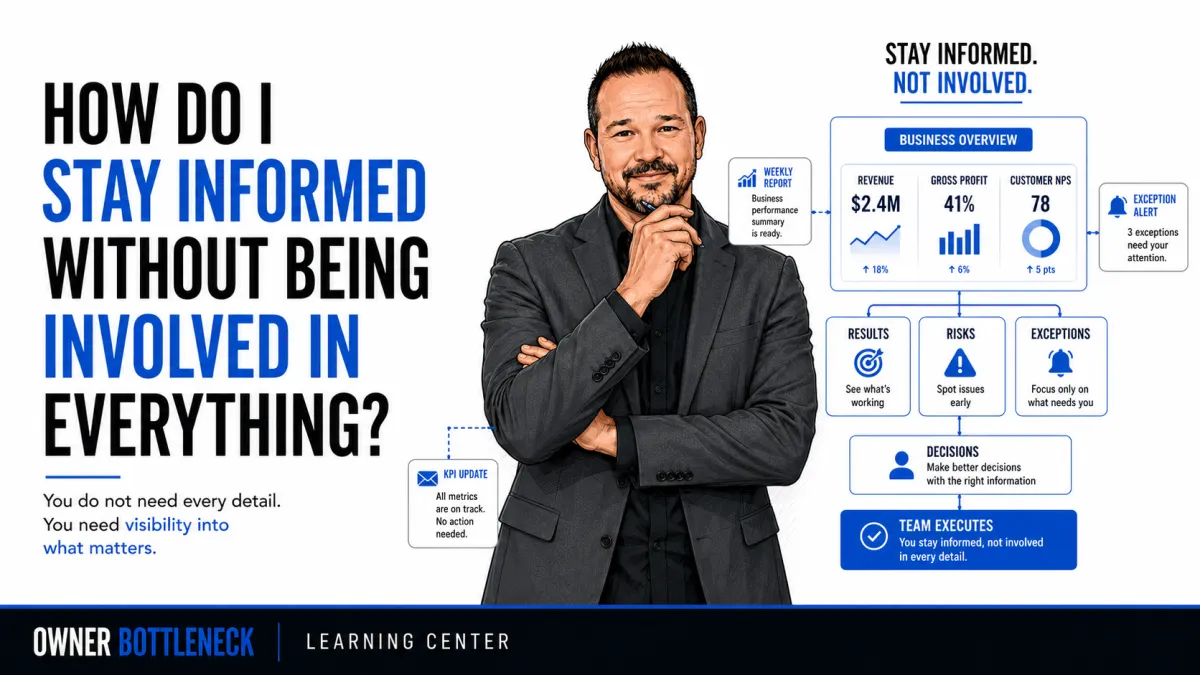
How Do I Stay Informed Without Being Involved in Everything?
You stay informed without being involved in everything by deciding what information you need, when you need it, and which exceptions require your attention. The goal isn’t to know every detail. It’s to see the few changes, risks, missed commitments, and decisions that could materially affect the business.
An owner finally decides to step back.
They stop attending the operations meeting.
They tell the team to make more decisions.
They stop asking for approval on every purchase.
For three days, it feels good.
Then the questions start inside the owner’s head.
Did that major customer get called back?
Are we still on schedule?
Did the salesperson give away too much margin?
Is cash getting tight?
What did the team decide about the hiring problem?
The owner checks email.
Then the project board.
Then the bank balance.
Then they message a manager.
Just checking in. How are things going?
The manager says:
Everything’s fine.
That answer makes the owner even more nervous.
Fine compared to what?
What’s on track?
What’s slipping?
What changed?
What isn’t anyone telling me?
By the end of the week, the owner is back inside the business.
Not because the team couldn’t operate.
Because the owner couldn’t see enough to trust what was happening.
That’s an important distinction.
Sometimes owners stay involved because the business needs their decisions.
Other times they stay involved because involvement is the only visibility system the company has.
The owner attends every meeting because that’s where the information lives.
They approve every decision because that’s how they learn what’s happening.
They ask constant questions because nobody agreed on what should be reported.
The business doesn’t merely depend on the owner’s work.
It depends on the owner personally gathering the information required to understand the company.
That’s still an Owner Bottleneck.
Key Takeaways
Stepping back shouldn’t mean becoming uninformed.
Owners need visibility into outcomes, risks, trends, and exceptions, not every normal activity.
Reporting should happen on a predictable rhythm instead of whenever the owner becomes anxious.
Managers should bring recommendations, not just problems.
Decision thresholds clarify what the team handles and what reaches the owner.
A good dashboard reduces questions. A bad dashboard creates more data without producing clarity.
The owner should be able to see the business without touching every part of it.
Why Owners Confuse Involvement With Visibility
Many owners know what’s happening because they’re standing in the middle of it.
They hear the customer complaints.
They notice the schedule falling behind.
They see which employee looks overwhelmed.
They know when a salesperson is getting desperate.
They feel when cash is tightening.
That awareness becomes part of how the business operates.
Then the owner tries to step back.
The work moves.
The information doesn’t.
Now the owner has fewer conversations, fewer approvals, and fewer meetings.
But they also lose the small signals they used to collect all day.
That can feel dangerous.
The owner may conclude:
I tried stepping back, but I lost control of the business.
Usually, they didn’t lose control.
They lost visibility.
Those aren’t the same problem.
Control comes from clear authority, standards, accountability, and decision rights.
Visibility comes from information arriving in a useful form at the right time.
When those systems are weak, the owner uses involvement to replace both.
You Don’t Need to Know Everything
Owners often say:
I just want to know what’s going on.
That sounds reasonable.
It’s also too vague.
What does “knowing what’s going on” actually require?
Do you need to know every customer call?
Every schedule change?
Every employee conversation?
Every quote?
Every purchase?
Every project update?
Probably not.
You need to know enough to answer four questions:
Are we producing the results we committed to?
Where are we at risk?
What changed that could materially affect the business?
Which decisions still require ownership?
Everything else should remain at the level where the work is being done.
The owner doesn’t need a live feed of normal activity.
They need early visibility into meaningful exceptions.
That’s the difference between being informed and being buried.
What Is Exception-Based Visibility?
Exception-based visibility means normal work stays with the team, while unusual, risky, delayed, or high-impact issues become visible before they cause serious damage.
Suppose the business has a customer service standard of responding within four business hours.
The owner doesn’t need to see every response.
They need to know when:
A major customer hasn’t received a response
The response time is trending upward
The same complaint keeps appearing
A customer threatens to leave
The solution requires authority beyond the manager’s limit
The normal work stays normal.
The exceptions become visible.
That allows the owner to step back without becoming blind.
It also teaches the team what matters.
When everything gets reported, nothing feels important.
When the reporting system highlights specific exceptions, attention can go where it creates value.
The Five Parts of an Owner Visibility System
A useful visibility system doesn’t need to be complicated.
It needs five things.
1. Clear Outcomes
You can’t build useful reporting until you know what the company is trying to produce.
“Operations is busy” tells you very little.
“Twenty-four jobs were scheduled, twenty-two were completed on time, and two are at risk” tells you something.
Every department should have a small number of meaningful outcomes.
Sales may own qualified opportunities, proposals, closing rate, margin, and pipeline.
Operations may own schedule performance, quality, capacity, and rework.
Customer service may own response time, unresolved issues, retention risk, and customer commitments.
Management may own employee performance, staffing, priorities, and cross-functional problems.
The owner shouldn’t receive a diary of everything the department did.
They should see whether the department is producing the result.
2. A Reporting Rhythm
Information should arrive on a predictable schedule.
Not whenever the owner asks.
Not whenever a manager happens to remember.
Not only when something goes wrong.
The right rhythm depends on the information.
Cash may need weekly attention.
A safety issue may require immediate escalation.
Department results may be reviewed weekly.
Strategic progress may be reviewed monthly or quarterly.
The business should decide:
What gets reviewed daily
What gets reviewed weekly
What gets reviewed monthly
What gets escalated immediately
Predictability reduces anxiety.
The owner knows when the next update is coming.
The manager knows what they’re expected to bring.
The team doesn’t spend all week answering random status requests.
3. Decision Thresholds
The team needs to know which decisions belong to them and which ones still belong to ownership.
Without thresholds, every uncertain issue can travel upward.
A customer credit might come to the owner.
Then a discount.
Then a purchase.
Then a schedule change.
Soon the owner is informed about everything because they’re still approving everything.
Decision thresholds might sound like:
The service manager can approve customer remedies up to $750 when we failed to meet a written commitment.
The sales manager can approve discounts up to 5 percent as long as the deal remains above the minimum margin.
The operations manager can authorize overtime within the monthly labor plan.
Any legal threat, safety issue, major customer loss, or cash shortfall is escalated immediately.
That creates a clear line.
Normal decisions move.
Ownership decisions remain visible.
If your team still sends normal decisions back to you, read How Do You Delegate Decisions, Not Just Tasks?.
4. Exception Rules
Managers need to know what the owner wants to hear about before the normal reporting meeting.
A useful exception rule answers:
What change is important enough that waiting would create unacceptable risk?
That may include:
A top customer threatening to leave
A material cash shortage
A serious safety issue
A legal complaint
Fraud or theft
A major project falling behind
A key employee resigning
A large deal moving outside approved terms
A quality problem affecting multiple customers
A significant change in forecasted revenue
The list should be short.
If everything qualifies as an exception, the owner remains inside everything.
5. A Clear Response
Visibility isn’t useful if nobody knows what happens after an issue becomes visible.
Managers shouldn’t simply send the owner a problem and wait.
They should bring:
What happened
Why it matters
What they’ve already done
What they recommend
What decision or support they need
The conversation should sound like:
The Johnson project is four days behind because the supplier missed the delivery. We’ve moved another crew to protect the customer date. That will cost approximately $2,400 in overtime. I recommend we approve the overtime and charge the supplier under the delay clause. I need your approval because the expense exceeds my $2,000 limit.
That’s very different from:
The Johnson project is behind. What do you want us to do?
One keeps the manager responsible.
The other transfers the whole problem back to the owner.
Use Red, Yellow, and Green Carefully
A red, yellow, and green system can make status easy to understand.
But only if the colors have agreed meanings.
For example:
Green: The commitment is on track. No owner involvement is needed.
Yellow: The commitment is at risk, but the person responsible has a recovery plan.
Red: The commitment will be missed, the risk exceeds the manager’s authority, or the recovery plan needs an ownership decision.
The mistake is making managers afraid to report yellow or red.
If a manager believes bad news will lead to blame, they’ll keep everything green until the failure becomes impossible to hide.
That destroys visibility.
The owner has to reward early warning.
You don’t have to like the problem.
But you should make it safe to surface the problem while there’s still time to act.
The standard should be:
Red isn’t failure. Hidden red is failure.
A company becomes easier to lead when bad news travels quickly and accurately.
What Should Be on the Owner’s Dashboard?
A dashboard should help the owner make decisions.
It shouldn’t simply display everything the software can measure.
Most owners need a short view across five areas.
Financial Health
The owner may need to see:
Cash available
Expected cash in and out
Accounts receivable concerns
Gross margin
Profitability
Material spending changes
The goal isn’t to turn every owner into a daily bookkeeper.
It’s to make sure financial problems don’t remain invisible until they become emergencies.
Sales
Useful sales visibility may include:
Qualified pipeline
New opportunities
Proposals
Closing rate
Average deal size
Margin
Deals requiring owner involvement
Revenue concentration
The last two matter because a healthy pipeline can still depend heavily on the owner.
Operations
Operations visibility may include:
Work completed on time
Capacity
Jobs at risk
Rework
Quality problems
Delayed handoffs
Exceptions requiring escalation
You don’t need every project detail.
You need to know where delivery is becoming uncertain.
Customers
Customer visibility may include:
Major unresolved issues
Accounts at risk
Retention
Response time
Recurring complaints
Customer commitments that may be missed
An owner shouldn’t learn that a major customer is unhappy only after the customer leaves.
Team
Team visibility may include:
Key vacancies
Employee turnover
Missed performance commitments
Manager capacity
Important employee issues
Roles that still depend on one person
The dashboard doesn’t replace management.
It gives management a clear picture of what needs attention.
Add Owner Dependence Measures
Most business dashboards measure sales, cash, customers, and operations.
They don’t measure how much the company still depends on the owner.
Your dashboard should.
Useful Owner Bottleneck measures may include:
Decisions waiting for the owner
Deals requiring owner involvement
Customer issues escalated to the owner
Projects delayed because of owner approval
Meetings the owner must attend
Commitments the owner personally follows up on
Hours the owner spends inside daily operations
Responsibilities with no trained backup
Recurring questions that still return to the owner
These measures reveal something traditional KPIs miss.
The business may be performing well while becoming more dependent on the owner.
Or the company may produce the same results with less owner involvement.
That’s real progress.
Don’t Turn the Dashboard Into Another Owner Job
The owner shouldn’t spend hours collecting, correcting, and interpreting every number.
Each manager should own the accuracy of the information connected to their area.
The dashboard should come from the operating system.
Not from the owner chasing updates before the meeting.
If the owner still has to:
Ask everyone for their numbers
Correct the reports
Find missing information
Explain what each number means
Build the presentation
Remind managers to update it
then the dashboard is still owner-dependent.
The system should create visibility for the owner.
The owner shouldn’t create visibility for the system.
What Should the Weekly Owner Review Look Like?
A weekly review should help the owner understand the business and make the few decisions that genuinely belong to ownership.
It shouldn’t become a three-hour recital of department activity.
A useful review can focus on five questions:
What results are on track?
What’s off track?
What changed?
What decision or support is needed?
What commitment will be completed before the next review?
Managers should lead their part of the conversation.
They should know their numbers.
They should explain the exceptions.
They should bring recommendations.
The owner should resist the urge to solve every problem in the meeting.
Ask:
What do you recommend?
What’s within your authority?
What would happen if we did nothing?
What support do you need from me?
That keeps the manager inside the problem-solving process.
If every problem ends with the owner assigning themselves work, the weekly review has become another path back to dependence.
How Much Detail Should Managers Provide?
Enough to understand the result, risk, and recommendation.
Not enough to recreate every step.
An owner who receives too little information feels exposed.
An owner who receives too much information gets pulled back into the weeds.
The right level depends on the size of the decision and the risk involved.
For a normal operating update, the manager may only need to explain:
The current result
The variance
The cause
The recovery plan
For a major decision, the owner may need:
The financial impact
Customer impact
Alternatives considered
Risks
Recommendation
The owner shouldn’t have to perform the manager’s analysis.
The manager shouldn’t hide meaningful uncertainty behind a one-line update.
How Owners Accidentally Destroy Visibility
Owners often complain that nobody tells them anything.
Then they punish the people who bring them bad news.
A manager raises an early concern.
The owner becomes angry.
They criticize the manager for not preventing it.
They take over the issue.
They question every related decision.
Next time, the manager waits longer.
The owner then says:
Why didn’t anyone tell me sooner?
The business learned not to.
Owners also destroy visibility when they react to every yellow status as if it were red.
Yellow means attention is needed.
It doesn’t necessarily mean ownership should take over.
The manager should still own the recovery plan.
Another mistake is asking for reports that never lead to decisions.
If managers spend hours building presentations the owner barely reads, reporting becomes a ritual instead of a management tool.
Measure less.
Use more.
What if the Numbers Look Good but You Still Don’t Trust the Business?
Trust doesn’t come from a dashboard alone.
It comes from evidence over time.
The owner needs to see that managers:
Report accurately
Surface problems early
Keep commitments
Make sound decisions
Correct misses
Protect agreed standards
Ask for help at the right time
That history builds confidence.
If a manager repeatedly marks work green until it fails, the problem isn’t the color system.
It’s judgment or honesty.
If the numbers are consistently wrong, the reporting process needs attention.
If every result looks good only because the owner is still doing the hidden work, the business hasn’t become independent.
Visibility helps you understand the business.
It doesn’t replace capable people, clear authority, or accountability.
For that, read How Do I Hold Employees Accountable Without Micromanaging?.
What if You’re Afraid the Team Will Make the Wrong Decision?
They will sometimes.
So will you.
The goal isn’t to create a business where nobody makes mistakes.
It’s to create a business where normal mistakes are contained, visible, corrected, and turned into better judgment.
Use limits.
A manager may control a $2,500 decision before needing approval.
A new employee may have a smaller limit.
A proven manager may have a larger one.
Review decisions after they’re made.
Ask what happened, what they considered, and what they learned.
Don’t automatically take the authority back because the decision differed from yours.
The business will never develop judgment if the owner remains the only person allowed to use it.
How Do You Know Whether You’re Informed Enough?
Ask yourself:
Can I explain how the company is performing?
Can I identify the largest current risks?
Do I know which major commitments are off track?
Do I know where an ownership decision is required?
Can managers explain what they own?
Do problems surface before they become emergencies?
Can I see whether owner dependence is decreasing?
Can I step away without constantly asking for updates?
You don’t need to know everything.
You need enough information to fulfill the responsibilities that still belong to ownership.
The rest should remain with the people responsible for running the business.
A 30-Day Visibility Reset
Choose one area where you currently ask too many questions.
It might be operations, sales, customers, cash, or employee performance.
Days 1 Through 7: Track Your Questions
Write down every time you ask:
Is it done?
Are we on track?
What happened?
Did anyone handle this?
Why didn’t I know about that?
Then ask why you needed to ask.
Was the outcome unclear?
Was the information unavailable?
Was the reporting rhythm missing?
Was there no escalation rule?
Did you not trust the data?
Your questions reveal the holes in the visibility system.
Days 8 Through 14: Define What You Need to See
Choose a small number of measures.
Define:
The result
The person responsible
The reporting rhythm
The yellow threshold
The red threshold
What requires immediate escalation
Don’t build the perfect dashboard.
Build the smallest useful view.
Days 15 Through 21: Move the Reporting Responsibility
The manager should own the update.
They should explain the results, exceptions, and recommendations.
The owner shouldn’t assemble the report for them.
When information is missing, address the system instead of creating another reminder for yourself.
Days 22 Through 30: Stop Random Checking
Use the agreed reporting rhythm.
Don’t ask for updates between reviews unless an agreed exception occurs.
Notice what anxiety makes you want to check.
Then determine whether the concern reveals a real information gap or simply discomfort with stepping back.
At the end of 30 days, ask:
Can I understand this part of the business without personally moving through it?
That’s the test.
Staying Informed Should Make You Less Necessary
The purpose of reporting isn’t to keep the owner connected to every action.
It’s to let the owner see the business while the business continues operating through other people.
When visibility lives inside the company:
Results are measured
Risks surface early
Managers bring recommendations
Decisions happen at the right level
Missed commitments are visible
The owner sees what matters
Normal work continues without interruption
That’s when stepping back becomes safer.
Not because nothing can go wrong.
Because the company can see, communicate, and respond when something does.
You don’t need to choose between control and freedom.
You need a management system that creates visibility without requiring your presence.
The owner shouldn’t have to walk through every room to know whether the business is working.
The business should be able to show them.
Frequently Asked Questions
How Often Should a Business Owner Review KPIs?
It depends on the measure and the speed of the business.
Cash, sales activity, and operating risks may need weekly review. Strategic measures may be reviewed monthly or quarterly. Serious exceptions should be escalated immediately.
How Many KPIs Should an Owner Track?
Track the smallest number needed to understand performance, risk, and required decisions.
A short dashboard that drives action is more useful than dozens of measures nobody uses.
Should I Attend Every Management Meeting?
No.
Attend meetings where ownership input is genuinely required.
Managers should be able to run normal operating meetings without the owner.
What Should Managers Report to the Owner?
Managers should report results, meaningful variances, risks, exceptions, recovery plans, and decisions that exceed their authority.
They shouldn’t report every normal activity.
How Do I Stop Asking for Constant Updates?
Create a predictable reporting rhythm and make progress visible.
When you feel the urge to check, ask whether the information should already exist inside the agreed system.
What if Managers Don’t Tell Me About Problems?
Clarify the escalation rules, reward early warning, and address repeated failures to report accurately.
Hidden problems are an accountability issue.
Can a Dashboard Replace a General Manager?
No.
A dashboard provides information.
A capable manager interprets the information, makes decisions, leads people, and owns results.
If your company needs broader operating leadership, read Do I Need a General Manager to Run My Business?.
How Do I Test Whether the Business Can Operate Without Me?
Take structured absences and track which decisions, customer issues, approvals, and problems still return to you.
Read Can Your Business Run Without You for 30 Days? for a practical test.
Find Out What You Still Have to Personally Watch
You may believe you need to stay involved because nobody else sees what you see.
The deeper problem may be that reporting, decisions, accountability, and escalation still depend on your presence.
The free Owner Bottleneck Scorecard helps identify where the business still depends too heavily on you.
It evaluates dependence across:
Decisions
Sales
Operations
Team
Value