How Do I Stop Approving Every Discount and Proposal?
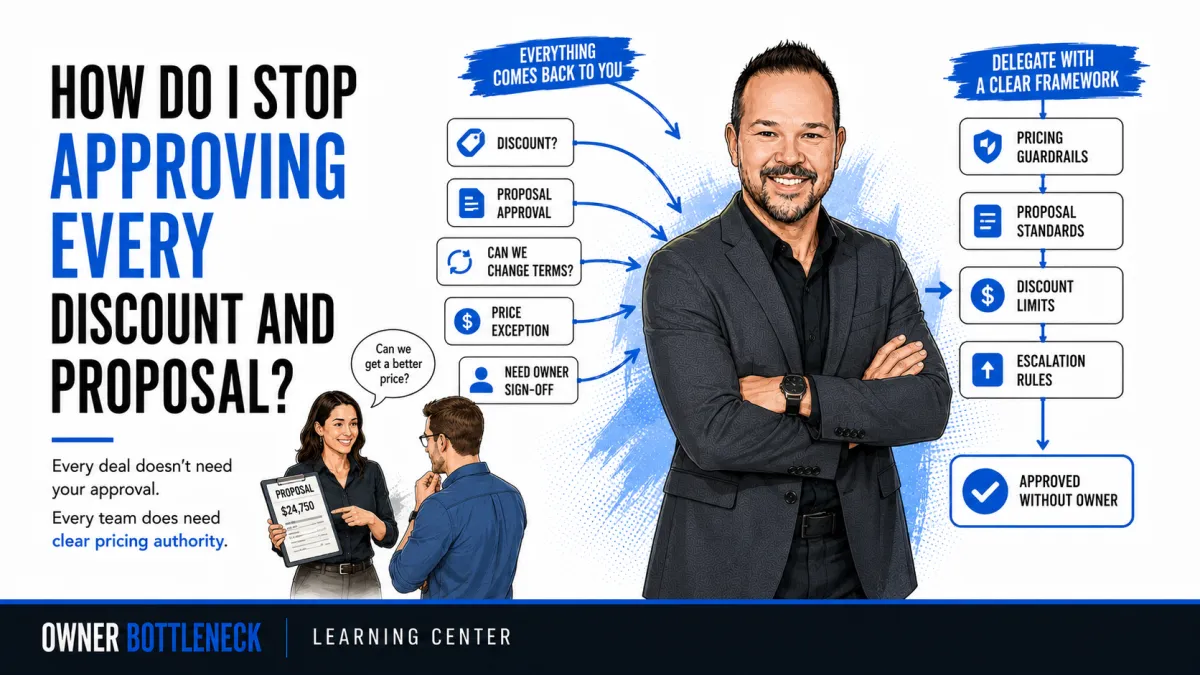
You stop approving every discount and proposal by defining what the sales team can decide, what commercial standards must be protected, what they must receive in exchange for a concession, and which unusual risks genuinely require the owner. The goal isn’t unlimited pricing freedom. It’s clear authority inside boundaries the company can afford.
The salesperson had been working the opportunity for nearly a month.
The customer was interested.
The problem was real.
The proposal fit.
Then the customer asked:
Is there any flexibility on price?
The salesperson said:
Let me check with the owner.
They called.
The owner asked how serious the buyer seemed.
What the margin was.
Whether the competitor’s quote included the same scope.
How quickly the customer could start.
Whether payment terms were changing.
The salesperson didn’t know all the answers.
The owner joined the next call.
He asked a few questions, reduced the scope, approved a smaller discount, and kept the payment terms intact.
The customer signed.
The owner had protected the deal.
He had also taught everyone involved where the real commercial authority lived.
The salesperson learned that pricing becomes the owner’s responsibility when the buyer pushes.
The customer learned that the salesperson can present the offer but can’t really negotiate it.
The owner learned that margin feels safer when he stays involved.
The next proposal came back too.
Then the next discount.
Then the next payment-term request.
Soon, the salesperson was responsible for revenue but couldn’t make the normal decisions required to produce it.
The owner wasn’t approving every deal because he loved reviewing proposals.
He was approving every deal because the business had never turned his commercial judgment into a system anyone else could use.
Every Approval Looks Small Until You Count the Queue
A salesperson sends a message:
Can I give them 5 percent off?
The owner replies in two minutes.
Another salesperson asks:
Can we split the payments over three months?
The owner answers before lunch.
A proposal arrives for review.
The owner changes two paragraphs, corrects the scope, and sends it back.
None of those decisions feels large.
That’s why the dependence is easy to miss.
The owner may spend only twenty minutes approving discounts that day.
But the proposals waited.
The salespeople paused.
The customers waited for answers.
The owner’s judgment remained the bridge between buyer interest and a signed agreement.
A Sales Bottleneck doesn’t always mean the owner generates every lead or leads every sales conversation.
It can mean the sales team carries the process until money, scope, terms, risk, or commitment enters the conversation.
Then the sale returns to the owner.
The salesperson owns the opportunity.
The owner owns whether the opportunity can move.
The Buyer Quickly Learns Who Can Make a Real Decision
A buyer asks:
Can you change the payment terms?
The salesperson says:
I need to check.
The buyer asks whether one part of the scope can be removed.
The salesperson checks again.
The buyer proposes a lower price.
Another check.
By the third request, the buyer understands the structure.
The salesperson isn’t the final decision-maker.
That changes the negotiation.
The buyer may stop working through the salesperson and begin negotiating toward the owner.
They may hold back their real concerns until the person with authority appears.
They may ask:
Can I speak directly with whoever approves this?
That doesn’t mean every salesperson needs unlimited authority.
It means responsibility without usable authority weakens the person carrying the sale.
The buyer should know that the salesperson can make normal commercial decisions and explain where the boundaries are.
Otherwise, the salesperson becomes a messenger carrying requests between the buyer and the owner.
Why Owners Keep Every Discount and Proposal
Owners usually have a legitimate reason for staying involved.
They’ve watched salespeople give away margin too quickly.
They’ve seen promises made that operations couldn’t fulfill.
They’ve found missing exclusions buried inside proposals.
They’ve discovered payment terms that created cash problems.
They’ve watched one customer exception become an expectation for the next customer.
The owner may be protecting the company from decisions the sales team doesn’t fully understand.
That matters.
But protecting the company one proposal at a time doesn’t build a stronger sales system.
It builds permanent dependence on the protector.
The better question isn’t:
Should I trust my salespeople with pricing?
It’s:
What would they need to understand, protect, and control before normal commercial decisions could move without me?
Discounts Aren’t the Real Problem
Owners often believe the problem is discounting.
It usually isn’t.
The deeper problem is that nobody has defined the commercial decision behind the discount.
A customer asks for 10 percent off.
Why?
Is the buyer comparing a genuinely similar offer?
Are they trying to fit a fixed budget?
Did the salesperson fail to establish enough value?
Is part of the scope unnecessary?
Would different payment timing solve the issue?
Is the customer testing whether the first price was real?
Does the company gain anything by making the concession?
A salesperson who treats every objection as a request for a lower price will destroy margin.
A salesperson who understands the commercial decision can examine the full exchange.
Price is one part.
So are:
Scope
Timing
Payment terms
Contract length
Volume
Capacity
Risk
Implementation requirements
Customer responsibilities
Guarantees
Service levels
The owner often protects margin because they can see those tradeoffs.
The goal is to help the sales team see them too.
A Discount Should Buy Something
A salesperson says:
They’ll sign if we reduce the price by $2,000.
The owner asks:
What do we receive in return?
Silence.
The salesperson saw a discount.
The owner saw a trade.
A concession shouldn’t be an automatic reward for asking.
It should create a better exchange for both sides.
The company might receive:
Faster payment
A longer commitment
Reduced scope
A later start date
Greater volume
Fewer custom requirements
A simpler delivery model
A customer responsibility that lowers implementation work
A commitment by a specific date
That doesn’t mean forcing artificial trades into every conversation.
Sometimes the right commercial decision is simply holding the price.
Sometimes the right decision is changing the solution.
Sometimes the customer genuinely needs a smaller version.
Sometimes a concession preserves a valuable relationship without creating meaningful risk.
The important point is that the salesperson shouldn’t ask:
How much can I give away?
They should ask:
What problem are we trying to solve, and what changes on both sides if we adjust the offer?
Discounting becomes dangerous when it’s treated as a one-way gift.
Proposal Review May Be Hiding Three Different Problems
An owner says:
Every proposal needs my approval.
That sounds like one process.
It may be three different problems.
The Recommendation Isn’t Reliable
The salesperson may not fully diagnose the buyer’s situation.
They build a proposal based on what the customer requested rather than what the customer actually needs.
The owner reviews it and realizes the recommended solution doesn’t solve the real problem.
That isn’t mainly a proposal-format issue.
It’s a sales diagnosis issue.
The salesperson needs to understand the current situation, the business impact, the desired outcome, previous attempts, constraints, and decision process before recommending anything.
The owner often rewrites the proposal because they’re still the person converting customer information into a confident recommendation.
Until that judgment transfers, proposals will keep returning.
The Commercial Boundaries Aren’t Clear
The recommendation may be right.
The salesperson still doesn’t know:
The minimum acceptable margin
Which payment terms are standard
Which scope changes create delivery risk
Which promises can be made
Which guarantees are approved
How much customization is acceptable
Which concessions require something in return
What crosses the owner’s threshold
The salesperson sends the proposal to the owner because the company has never clearly defined the commercial box.
The Quality Standard Lives in the Owner’s Head
The proposal may contain the right solution and acceptable pricing.
The owner still doesn’t like it.
The problem isn’t necessarily the deal.
It may be how the recommendation is communicated.
The proposal is vague.
The customer’s problem isn’t stated clearly.
The scope can be interpreted several ways.
The exclusions are hidden.
The next step is weak.
The owner knows it isn’t good enough but hasn’t turned that instinct into a visible standard.
That’s a quality-standard problem.
Not every proposal problem needs a longer SOP. Sometimes the team needs a clear definition of what a proposal must accomplish. That distinction is explained in What Should I Turn Into an SOP First?.
Stop Approving Deals One at a Time
Five discount requests reach the owner.
He answers all five.
The business is still missing the same thing on Friday that it was missing Monday.
A usable commercial decision system.
Start grouping the requests.
Perhaps the five questions were:
A small discount for annual prepayment
A request for longer payment terms
A lower price tied to reduced scope
A pricing exception for a large volume
A customer recovery credit after the company missed a deadline
Those aren’t all the same decision.
One is a payment trade.
One affects cash.
One changes the solution.
One may improve delivery efficiency.
One is customer recovery.
When every situation is called “a discount,” the owner must interpret it from the beginning.
A better system identifies the category, the outcome to protect, the tradeoffs, and the authority available.
The owner stops answering isolated requests and starts transferring repeatable commercial decisions.
Build Three Commercial Decision Lanes
You don’t need a 40-page pricing manual.
Start with three lanes.
Standard Deal
The salesperson can proceed without approval when the agreement fits the normal offer.
That may mean:
Approved product or service
Standard scope
Standard pricing
Standard payment terms
Standard timeline
Standard contract language
Approved customer type
Normal delivery risk
The salesperson prepares the proposal and moves the buyer forward.
No owner review is required.
If every standard proposal still needs approval, the company hasn’t actually standardized the offer.
Bounded Exception
The salesperson can make or recommend specific adjustments inside defined limits.
Examples might include:
You may reduce the price by up to 3 percent when the customer signs an annual agreement and maintains standard payment terms.
Or:
You may remove optional scope to meet a budget as long as the remaining work still produces a responsible result.
Or:
You may extend payment from 30 to 45 days for approved customer types when the total contract value remains above the defined threshold.
Or:
You may approve a customer recovery credit up to $500 when the company clearly failed to meet the agreed standard.
These decisions don’t need the owner beforehand.
They may need to be reported afterward.
That preserves visibility without turning visibility into another approval queue.
Strategic Exception
The issue reaches ownership or senior leadership because it creates material risk beyond normal authority.
That may include:
Pricing below the approved floor
Significant margin erosion
Major customization
Unusual legal language
A large guarantee
Serious delivery risk
A strategic account
A precedent the company may have to repeat
A commitment outside available capacity
A customer whose risk profile falls outside normal policy
An opportunity that could materially affect the company
Escalation is appropriate here.
The goal isn’t zero owner involvement.
It’s preventing normal variation from being treated like a strategic exception.
This is the same basic principle used when delegating decisions instead of only assigning tasks.
Define What Sales Must Protect
Authority without standards is dangerous.
The salesperson needs to understand what the company is trying to protect when making a commercial decision.
That may include:
Margin
What minimum gross margin must remain?
Does the salesperson understand the real cost of delivery?
Can they see when a discount removes profit rather than merely reducing revenue?
Scope
What exactly is included?
What is excluded?
Which small request creates a large delivery burden?
Which customization can operations realistically support?
Cash
Which payment terms create strain?
What deposits are required?
How much exposure can the company carry?
Capacity
Can the promised date be delivered?
Will winning this deal displace more valuable work?
Does the concession create overtime or operational disruption?
Customer Fit
Is the buyer likely to succeed with the solution?
Are they asking for terms that signal future problems?
Does the relationship fit how the company operates?
Precedent
Could this exception become something the customer expects again?
Would other customers reasonably receive the same treatment?
Is the company comfortable repeating the decision?
A salesperson who understands these protections can make better decisions than someone who only memorizes an approved discount percentage.
Create a Proposal Standard Before Creating Another Approval Step
The owner reviews a proposal and says:
It doesn’t explain the value.
The salesperson revises it.
The next proposal comes in.
The owner says:
The scope isn’t clear.
Another revision.
The next proposal buries the payment terms.
The owner fixes that too.
The owner is quality control because the quality standard changes depending on what’s missing this time.
Create one proposal standard.
A strong proposal should make these things clear:
What problem did the customer describe?
Why does that problem matter?
What outcome is the customer trying to create?
What does the company recommend?
Why does the recommendation fit?
What is included?
What is excluded?
What must the customer provide?
What is the investment?
What are the terms?
What happens next?
The proposal shouldn’t require the owner to interpret the salesperson’s thinking.
It should make the thinking visible.
The owner can review examples while the standard is being built.
The long-term goal is for the salesperson or sales manager to judge the proposal against the standard before it reaches the customer.
Don’t Turn Every Proposal Into a Custom Invention
The salesperson begins with a blank document.
They rewrite the explanation.
Rebuild the scope.
Choose new language.
Create a different payment structure.
Ask operations whether the delivery model will work.
Then send the proposal to the owner because nobody is certain what has been created.
Too much customization creates approval dependence.
The company may need a clearer set of:
Standard offers
Approved options
Common scope combinations
Pricing rules
Payment structures
Customer responsibilities
Delivery assumptions
Proposal templates
A standard offer doesn’t mean every customer receives an identical solution.
It means the sales team starts inside a commercial structure the company already understands.
Customization should happen where the customer’s situation genuinely requires it.
Not because every salesperson rebuilds the business model during every proposal.
Give Salespeople Access to the Information Behind the Decision
The owner knows the discount is too deep because he knows the delivery cost.
The salesperson sees only the selling price.
The owner knows the requested deadline is dangerous because three large projects are starting that week.
The salesperson can’t see capacity.
The owner knows the customer’s proposed payment terms are risky because the company is already carrying too much receivables exposure.
The salesperson doesn’t see the cash picture.
The owner concludes:
They don’t understand the business.
They may not have access to enough of the business to understand it.
Commercial authority requires commercial information.
That doesn’t mean every salesperson needs complete access to every financial detail.
They do need the relevant information required to stay inside their authority.
That might include:
Approved price ranges
Margin bands
Delivery costs
Capacity availability
Payment-term rules
Customer credit requirements
Scope assumptions
Current promotions
Deal-risk indicators
Offer eligibility
Don’t hold someone accountable for commercial judgment while hiding the information the judgment requires.
Review Decisions Afterward Instead of Approving Everything Beforehand
The owner believes approval prevents mistakes.
It does.
It also prevents the salesperson from making enough decisions to develop judgment.
Start with lower-risk commercial decisions.
Let the salesperson decide inside the approved lane.
Then review a selection afterward.
Ask:
What did the buyer request?
Why did they request it?
What options did you consider?
What did we give?
What did we receive?
Which standard did you protect?
What happened?
Would you make the same decision again?
The purpose isn’t catching the salesperson doing something wrong.
It’s helping them connect the decision to the business result.
Approval protects one deal.
Review develops the person handling the next hundred.
Track the Exception, Not Just the Discount
Suppose a salesperson uses the full approved discount range on nearly every deal.
Technically, they’re inside their authority.
The pattern still matters.
Track:
Type of exception
Reason requested
Concession made
Value received in return
Margin impact
Payment impact
Scope impact
Decision-maker
Final outcome
Whether the exception repeated
This helps the company distinguish between several problems.
Perhaps the price is consistently too high for the market.
Perhaps salespeople haven’t learned to establish value.
Perhaps the offer includes something customers don’t want.
Perhaps one competitor is changing the buying environment.
Perhaps salespeople are giving away the maximum because it feels easier.
The exception log isn’t designed to rebuild the owner approval process after the fact.
It’s designed to improve the commercial system.
A recurring exception is information.
Use it.
What if the Salesperson Makes a Bad Commercial Decision?
They will eventually.
The salesperson may approve a discount that wasn’t necessary.
Promise a timeline operations struggles to meet.
Leave an exclusion unclear.
Accept a payment structure that creates more risk than expected.
The owner may think:
This proves I need to approve everything.
It proves the system found a weakness.
Now diagnose it.
Did the salesperson understand the limit?
Did they have the correct information?
Was the standard clear?
Did they exceed their authority?
Did they make a reasonable decision that produced an unexpected result?
Did they repeat a mistake already coached?
Those situations require different responses.
The Boundary Was Unclear
Clarify it.
The Information Was Missing
Fix access to the information.
The Person Lacked Judgment
Coach the decision and use similar examples.
The Person Exceeded Clear Authority
Address the accountability issue.
The Rule Produced a Bad Result
Improve the rule.
Don’t turn every mistake into proof that authority belongs permanently with the owner.
Otherwise, the company can never learn from a commercial decision without taking the entire category back.
What if the Owner Is Still the Best Negotiator?
That may be true.
You may understand the customer better.
See the tradeoff faster.
Hold the price more confidently.
Know when to walk away.
The goal isn’t pretending everyone is equally skilled.
It’s deciding where your skill should be used.
Should the owner negotiate every $15,000 proposal?
Or should the owner focus on the few large, unusual, strategic opportunities where their experience materially changes the outcome?
Normal sales capability won’t develop if the company keeps substituting the best negotiator for every salesperson.
The broader transfer process is covered in How Do I Get My Sales Team to Close Deals Without Me?.
When Should the Owner Still Review a Proposal?
Owner review may still be appropriate when:
The opportunity is strategically important
The commitment creates unusual delivery risk
The pricing falls outside approved limits
The contract contains material legal changes
The offer is being sold for the first time
The company is testing a new market
The scope is highly customized
The customer has significant financial or reputation risk
The proposal could create a precedent
The salesperson is still developing and the review is part of a defined training period
The reason should be clear.
“Because the owner always reviews proposals” isn’t a risk category.
It’s a habit.
Stop Letting Internal Uncertainty Leak Into the Buyer Conversation
The salesperson says:
I think we can do that, but I’ll need to check.
Or:
This should be okay, but the owner has the final say.
Or:
I’m not sure how flexible we are.
The buyer hears internal uncertainty.
That weakens confidence.
A salesperson doesn’t need to know the answer to every unusual request immediately.
They do need to speak clearly about the process.
For example:
That request sits outside our standard terms. Let me understand why it matters and what you’re trying to solve. Then I can determine whether there’s an option that works for both sides.
That keeps the salesperson in the commercial conversation.
If escalation is required, they can say:
This falls outside the authority I have for a standard agreement. I’ll bring you a clear answer after I review the specific risk with our leadership team.
The salesperson hasn’t pretended to have authority they don’t possess.
They also haven’t reduced themselves to a courier.
Don’t Use Authority to Avoid Sales Coaching
An owner may create clear discount limits and believe the problem is solved.
The salesperson still discounts too early.
They lower the price before understanding the concern.
They offer concessions before the buyer asks.
They use price to escape tension.
That isn’t primarily an authority problem.
It’s a sales capability problem.
The salesperson needs to understand:
Why the buyer is hesitating
Whether price is the real concern
What outcome matters
What the buyer is comparing
Whether the recommendation is still right
Which part of the offer creates uncertainty
Whether the deal should move at all
Commercial authority should support good selling.
It shouldn’t become a substitute for it.
A 30-Day Approval Transfer
Choose one category first.
Don’t attempt to transfer every pricing, proposal, scope, payment, and contract decision at once.
Days 1 Through 7: Track What Comes Back
Record every proposal review, discount request, scope exception, payment-term change, and commercial approval that reaches the owner.
For each one, capture:
What was requested
Why it reached the owner
What decision was made
Which risk was being protected
How long the deal waited
Whether a similar request has happened before
Look for the largest repeated category.
Days 8 Through 14: Define the Commercial Box
For the selected category, define:
The standard deal
The approved exception range
What must be protected
What the salesperson should receive in return
The information required
What can be decided independently
What should be reported afterward
What must be escalated
Who owns the decision
Walk through recent examples.
Ask the sales team how they would decide under the new rules.
Clarity is tested by application, not by whether everyone nodded in the meeting.
Days 15 Through 21: Let the Team Decide
Move the selected decisions.
Don’t stand behind the salesperson waiting to reverse them.
Require them to document the reasoning.
Review a sample after the decision.
Coach the tradeoff.
Let reasonable decisions stand.
If something crosses the defined threshold, escalate it.
Days 22 Through 30: Review the Evidence
Ask:
How many approvals moved without the owner?
How long did proposals wait?
Did margin remain healthy?
Did payment risk change?
Did salespeople use the authority responsibly?
Which requests still came back?
Why?
Were the boundaries too narrow or too broad?
Did customers receive faster answers?
What rule needs to improve?
Then choose the next category.
Pricing.
Scope.
Payment terms.
Proposal quality.
Customer recovery.
Move them one at a time.
Measure Whether the Approval Bottleneck Is Actually Shrinking
Don’t rely on the owner’s feeling that fewer things are reaching them.
Track:
Proposals awaiting owner review
Average proposal approval time
Deals requiring owner pricing approval
Revenue closed without owner involvement
Discounts used by salesperson and category
Commercial exceptions resolved without the owner
Margin by salesperson
Payment-term exceptions
Deals delayed by owner input
Proposal rework rate
These are part of the KPIs that show whether the business is becoming less dependent on the owner.
Read them alongside sales performance.
Fewer owner approvals aren’t progress if margins collapse, proposals become unreliable, or customers receive promises the company can’t keep.
The goal is stronger sales capability with less routine owner dependence.
Stay Informed Without Returning to Approval
Owners often keep proposal approval because it’s how they see what sales is promising.
If they stop reviewing, they fear:
Margin will erode
Scope will become inconsistent
Bad-fit customers will be accepted
Payment risk will increase
Operations will inherit impossible commitments
Those concerns are valid.
The answer is visibility.
A weekly commercial review might show:
Deals closed
Margin
Discounts
Scope exceptions
Payment-term exceptions
Delivery risks
Strategic escalations
Patterns requiring a policy change
The owner sees the commercial health of sales.
They don’t need to sit inside every transaction to obtain it.
That’s how you stay informed without being involved in everything.
The company should report commercial exceptions to the owner.
The owner shouldn’t need to become the commercial exception.
Your Approval May Be Protecting a Weak Manager
If several salespeople report to a sales manager but every proposal still reaches the owner, ask why.
Does the manager have authority?
Do they understand margin and delivery?
Can they coach proposal quality?
Will the owner support their decision when a salesperson disagrees?
Or is the manager responsible for the sales team while the owner retains every meaningful commercial decision?
The title may have moved.
The authority didn’t.
A sales manager can’t develop commercial judgment while the owner remains the automatic final answer.
Some approvals may appropriately move to the manager before they move fully into the sales team.
That’s still progress, as long as the owner isn’t simply adding another person to the approval chain.
The Goal Isn’t Fewer Approvals
The goal is better decisions closer to the work.
A company can reduce owner approvals by telling salespeople:
Do whatever you need to close the deal.
That isn’t transfer.
It’s exposure.
A company can also preserve every approval because the owner fears losing control.
That isn’t control.
It’s dependence.
The healthier middle is clear commercial authority.
The salesperson knows what they can decide.
They understand what must be protected.
They can explain the trade.
They know what information matters.
They recognize when the situation crosses the line.
The owner sees the pattern without becoming part of every normal transaction.
That’s how the business becomes less dependent on the owner without becoming careless with its money, promises, or customers.
Frequently Asked Questions
Should Salespeople Be Allowed to Discount?
They may be given limited discount authority when the company has defined the approved range, margin requirements, trade rules, and reporting expectations.
Unlimited discounting isn’t required to remove owner dependence.
How Much Discount Authority Should a Salesperson Have?
The answer depends on your margins, offer, customer type, deal size, delivery risk, and sales experience.
Begin with a narrow range the company can afford and expand authority as evidence builds.
Should Every Proposal Use the Same Template?
A standard template can improve clarity and reduce avoidable variation.
The recommendation and scope should still reflect the buyer’s situation.
Standardization should support judgment, not replace it.
Should the Owner Review Large Deals?
Strategic, unusual, or high-risk opportunities may appropriately require owner or executive involvement.
Define the threshold instead of reviewing every proposal simply because it matters.
What if Salespeople Give Away Too Much?
Review whether the authority, margin requirements, trade rules, information, and coaching were clear.
Repeated misuse after clear expectations may become an accountability issue.
How Do I Protect Margins Without Approving Every Deal?
Give salespeople visibility into approved pricing, delivery costs, margin floors, scope assumptions, and exception rules.
Review patterns afterward rather than approving every normal decision beforehand.
What if the Buyer Insists on Speaking With the Owner?
Find out what the buyer needs.
They may be seeking authority, confidence, or a specific exception.
Bring the owner in only when the issue genuinely requires ownership, and keep the salesperson leading the relationship.
Is a Discount Always Bad?
No.
A concession may be reasonable when it creates a responsible exchange, supports a strategic relationship, solves a genuine constraint, or corrects a company failure.
The decision should protect the business result, not merely close the deal.
Should Payment Terms Be Treated Separately From Price?
Yes.
A deal can maintain its stated price while creating significant cash or credit risk through weak payment terms.
Define authority and thresholds for both.
How Do I Know Whether Proposal Approval Is an Owner Bottleneck?
It’s likely an Owner Bottleneck when normal proposals repeatedly wait for the owner because the sales team lacks authority, standards, information, judgment, or confidence to move them.
Stop Being the Company’s Pricing Policy
Your salespeople don’t need permission to give away the business.
They need enough commercial authority to make normal decisions without borrowing you.
Define the standard deal.
Protect the margin.
Protect the scope.
Protect the cash.
Protect the delivery promise.
Define the trade.
Name the boundary.
Review the evidence.
Escalate the real exceptions.
The owner should remain involved where ownership-level judgment matters.
But a routine question about price shouldn’t require the person who owns the company.
The free Owner Bottleneck Scorecard evaluates dependence across:
Decisions
Sales
Operations
Team
Value
It’ll help you identify where sales still depends on your approval, authority, relationships, or judgment.
Take the Owner Bottleneck Scorecard
Don’t approve every deal.
Build a company that knows how to make one.