
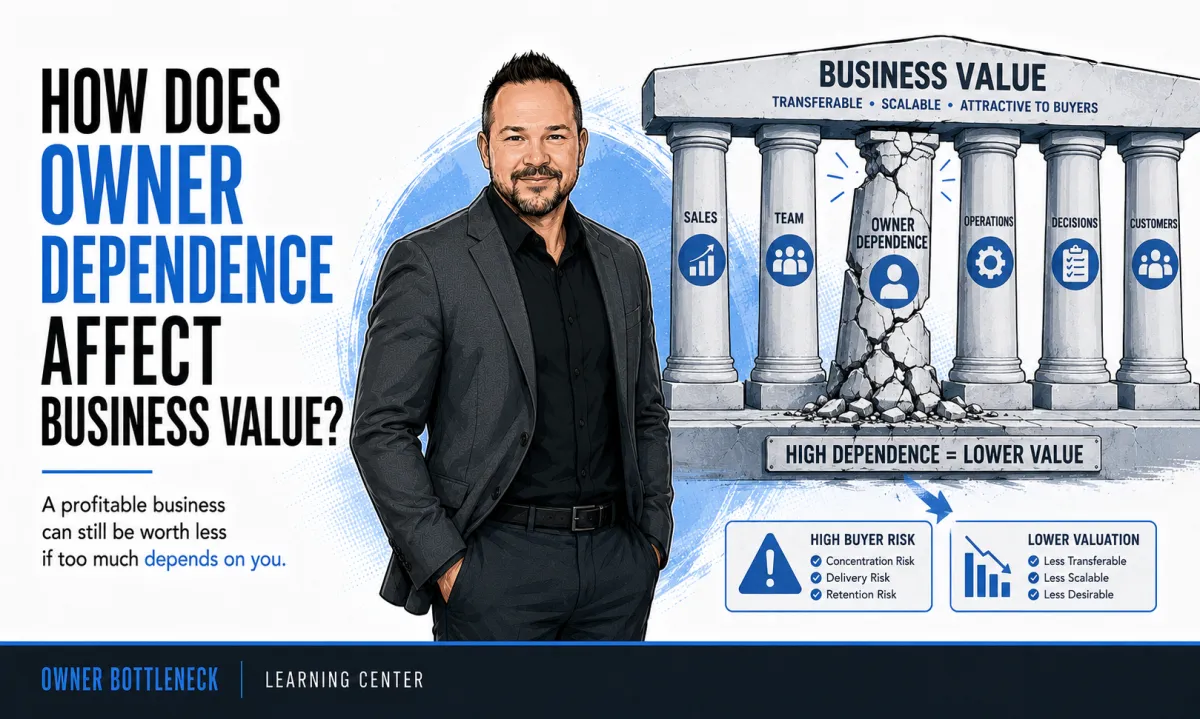
How Does Owner Dependence Affect Business Value?
Owner dependence can reduce business value because a buyer isn’t only evaluating what the company earns today. They’re evaluating whether those earnings, customer relationships, decisions, standards, and operations will survive after the owner leaves.
A profitable business can still carry significant risk.
Revenue may depend on the owner’s relationships.
Important decisions may depend on the owner’s judgment.
Employees may wait for the owner before acting.
Customers may expect the owner to personally handle anything important.
Critical knowledge may exist only inside the owner’s head.
The financial statements may show a successful company.
The operating reality may show a company that still depends on one person.
That difference matters.
A buyer isn’t simply purchasing last year’s profit.
They’re purchasing the future ability of the business to keep producing results.
When too much of that ability is attached to the owner, the buyer may see less transferable value.
The business may still sell.
It may still be attractive.
But owner dependence can affect:
The price
The valuation multiple
The number of interested buyers
The amount of due diligence
The transition period
The deal structure
The amount paid at closing
The conditions attached to the sale
The buyer’s confidence that results will continue
A business can be profitable and still have a Value Bottleneck.
Key Takeaways
Business value depends on the company’s ability to produce future results, not only its recent profit.
Owner dependence creates risk when revenue, customers, decisions, operations, relationships, or standards may leave with the owner.
A buyer may respond to that risk through a lower valuation, longer transition, more protective deal terms, or reduced interest.
Owner involvement isn’t automatically a problem. The problem is whether the company can perform without that involvement.
Customer dependence, sales dependence, operational dependence, management weakness, and owner-held knowledge can affect value differently.
Transferable value grows when the company can prove that results come from the business, not only from the owner.
The best time to reduce owner dependence is before a sale becomes urgent.
What Does Business Value Actually Mean?
Owners often think about value as a financial calculation.
Revenue.
Profit.
Assets.
Cash flow.
Growth.
Those numbers matter.
But they don’t tell the entire story.
Business value also reflects the likelihood that the company will continue producing those results in the future.
A buyer wants to understand:
Where revenue comes from
Why customers stay
How sales are generated
Who makes decisions
How work gets delivered
Whether employees can run the company
What happens when the owner is unavailable
Whether the business can survive the ownership transition
Which risks could weaken future earnings
Imagine two companies with similar revenue and profit.
Company A has documented systems, a capable management team, diversified customers, measurable sales processes, clear decision authority, and stable operations.
Company B depends on the owner to generate opportunities, close major deals, approve pricing, resolve customer problems, manage employees, remember important details, and keep each day moving.
The financial results may look similar.
The risk doesn’t.
Company A offers a buyer a functioning business.
Company B may offer a buyer a functioning business plus a serious question:
What happens when the owner leaves?
That question can affect value.
What Is Owner Dependence?
Owner dependence exists when the business relies too heavily on the owner’s:
Judgment
Decisions
Relationships
Approvals
Knowledge
Standards
Reputation
Problem-solving
Personal credibility
Daily presence
Some owner involvement is normal.
Owners set direction.
They make major capital decisions.
They protect the culture.
They may maintain important relationships.
They may choose to remain involved in areas where they provide unusual value.
Dependence is different.
Dependence means important results weaken, stop, wait, or become uncertain without the owner.
The owner isn’t only contributing to the business.
The owner is holding part of the business together.
That’s an Owner Bottleneck.
Why Does Owner Dependence Create Risk for a Buyer?
A buyer pays for the future.
They may use historical results to estimate that future, but the real question is whether those results are likely to continue.
Owner dependence creates uncertainty around that continuation.
The buyer may wonder:
Will customers stay after the owner leaves?
Will referrals keep coming?
Can the sales team close without the owner?
Does the team know how to handle exceptions?
Can managers make sound decisions?
Are the company’s standards documented?
Can operations continue without the owner’s daily coordination?
Will important employees leave during the transition?
Is the owner’s knowledge transferable?
How long must the owner remain involved?
What happens if the owner exits sooner than expected?
The greater the uncertainty, the greater the perceived risk.
Buyers usually protect themselves from risk.
They may do that by:
Offering less
Requiring the owner to stay longer
Paying part of the price later
Tying payments to future performance
Requesting seller financing
Adding stronger conditions to the agreement
Increasing due diligence
Walking away from the opportunity
The issue isn’t that buyers dislike owners.
The issue is that they don’t want the value they purchased to leave with the owner.
A Buyer May Be Purchasing the Owner Instead of the Business
This is the simplest way to understand the problem.
Ask:
Is the buyer purchasing a company, or are they purchasing temporary access to the owner?
Consider a company where the owner:
Knows every major customer personally
Produces most sales opportunities
Closes the largest deals
Approves every important price
Handles key vendor relationships
Resolves serious customer problems
Makes every hiring decision
Coordinates the management team
Holds the company’s operating knowledge
Protects quality through personal inspection
The buyer may see a profitable company.
They may also see that much of the company’s performance is still attached to the owner.
If the owner leaves, the buyer could lose:
Revenue
Customers
Employee confidence
Decision quality
Operational stability
Vendor trust
Company knowledge
Quality control
Leadership
The buyer may still want the company.
But they’re unlikely to ignore that risk.
The Five Types of Owner Dependence That Can Affect Value
Owner dependence isn’t one problem.
It may appear in different parts of the company.
Each type creates a different kind of risk.
1. Sales Dependence
Sales dependence exists when revenue depends heavily on the owner’s personal ability to:
Generate leads
Build trust
Create referrals
Conduct discovery
Price work
Write proposals
Negotiate
Close deals
Reassure customers
Maintain major accounts
The business may have salespeople.
It may have a CRM.
It may have a sales process.
But customers still want the owner.
The largest opportunities still need the owner.
Revenue becomes less predictable when the owner steps away.
That’s a Sales Bottleneck.
From a value perspective, the concern is straightforward:
Can the company continue producing revenue after the owner leaves?
A buyer may be less confident when:
Most referrals come directly to the owner
Customers don’t know the sales team
Important relationships haven’t been transferred
The sales process depends on the owner’s instinct
Salespeople can’t close without owner involvement
Forecasting is weak
Lead generation isn’t repeatable
Revenue that depends on the owner may be profitable today but less transferable tomorrow.
2. Customer Relationship Dependence
Customer dependence becomes especially risky when customers believe their relationship is with the owner rather than the company.
You may hear:
“I only work with the owner.”
“Have Darrell call me.”
“I want the owner involved.”
“The owner has always handled this for us.”
“We came here because we trust the owner.”
Strong owner relationships can help build a company.
They can also create risk when those relationships never move into the business.
A buyer may worry that customers will:
Leave after the sale
Demand special treatment
Resist working with new leadership
Renegotiate terms
Follow the former owner elsewhere
Reduce their purchases
Lose confidence during the transition
This risk becomes larger when a few customers represent a significant portion of revenue.
The concern isn’t only customer concentration.
It’s customer concentration combined with owner dependence.
3. Decision Dependence
A company may have employees and managers while the owner still makes nearly every meaningful decision.
The owner may approve:
Pricing
Discounts
Schedules
Spending
Customer remedies
Hiring
Overtime
Vendor changes
Process changes
Priorities
Exceptions
Quality decisions
The team can perform tasks.
The owner still supplies the judgment.
That’s a Decision Bottleneck.
A buyer may wonder whether the organization can make sound decisions without the owner.
If every meaningful decision has historically moved through one person, the new owner may inherit a team that has never been expected to think, decide, or lead independently.
That creates transition risk.
4. Operational Dependence
Operational dependence exists when the owner is the person who:
Keeps the schedule moving
Coordinates departments
Resolves handoff failures
Handles exceptions
Protects quality
Remembers customer commitments
Adjusts priorities
Fixes recurring problems
Knows how the work actually gets done
The company may have written procedures.
But reality doesn’t always follow the normal procedure.
Customers change their minds.
Vendors miss deadlines.
Employees call off.
Materials arrive late.
Projects overlap.
Quality slips.
The process works until something unusual happens.
Then everything goes back to the owner.
That’s an Operations Bottleneck.
A buyer may be concerned when the company’s operating system lives inside the owner’s head.
The procedures may explain normal work.
The owner may still be the only person who knows how to handle reality.
5. Team and Management Dependence
A company may employ capable people while still lacking management capacity.
Managers may supervise employees but depend on the owner to:
Set priorities
Resolve conflict
Address poor performance
Coordinate departments
Make difficult decisions
Interpret the numbers
Hold leaders accountable
Keep commitments moving
The owner becomes the manager behind every manager.
That’s a Team Bottleneck.
A buyer may ask:
Who can actually run this company after the owner leaves?
A strong management team can increase confidence because leadership already exists inside the business.
A weak management team tells the buyer that leadership may need to be recruited, developed, or supplied by the buyer.
That takes time, money, and risk.
How Can Owner Dependence Reduce the Valuation Multiple?
A valuation multiple reflects more than profitability.
It also reflects confidence.
A company with stable, transferable earnings may support a stronger valuation than a company whose earnings depend heavily on the departing owner.
Owner dependence can create questions about:
Future revenue
Customer retention
Operational stability
Management depth
Growth potential
Transition difficulty
The reliability of reported earnings
The buyer may decide that the company’s recent profit isn’t as secure as it appears.
That can reduce what they’re willing to pay for each dollar of earnings.
This doesn’t mean every owner-dependent company receives a low valuation.
Industry, growth, margins, customer concentration, recurring revenue, assets, competition, buyer strategy, and market conditions also matter.
Owner dependence is one factor.
But it can be a significant one because it affects the buyer’s confidence that the earnings will continue.
Owner Dependence Can Affect More Than the Price
Many owners focus only on the final number.
But value also shows up in the structure of the deal.
Two offers may have the same headline price and very different risk for the seller.
For example, a buyer may offer:
Less cash at closing
A longer earnout
Seller financing
Payments tied to customer retention
Payments tied to future revenue
A longer owner transition
Consulting requirements
Noncompete protections
Employment agreements
Stronger closing conditions
The buyer may be saying:
We see the value, but we aren’t certain it will transfer.
A longer transition or performance-based payment doesn’t automatically make a deal bad.
But owners should understand why those terms may appear.
The buyer is attempting to reduce uncertainty.
Owner Dependence Can Shrink the Buyer Pool
Different buyers have different abilities to absorb risk.
A strategic buyer may already have:
Management
Sales capacity
Operational systems
Customer support
Finance
Technology
Leadership
That buyer may be able to replace some of what the owner does.
An individual buyer may need the company to operate more independently from the start.
A financial buyer may require strong management and predictable performance.
A competitor may understand the business but still worry about losing customers tied to the owner.
The more owner-dependent the company is, the fewer buyers may feel comfortable taking it on.
Fewer suitable buyers can reduce competition for the business.
Lower competition can affect value and deal terms.
Owner Involvement and Owner Dependence Aren’t the Same
This distinction matters.
An involved owner can still have a valuable business.
The owner may be involved in:
Strategy
Major partnerships
Product development
Executive leadership
Capital allocation
Culture
Important industry relationships
The question is whether the business requires that involvement to maintain normal performance.
Consider two owners.
Owner A remains active because they enjoy strategic relationships and product development. The management team runs normal operations, sales are repeatable, customer relationships are distributed, and results remain stable when the owner is away.
Owner B remains active because pricing, scheduling, customer complaints, hiring, sales, quality, and daily decisions all require them.
Both owners are involved.
Only one company may be dependent.
Value is affected less by how many hours the owner works and more by what stops working when they don’t.
Can a Business Be Valuable Even If the Owner Is Still Important?
Yes.
Most small businesses involve some owner dependence.
A buyer may expect the owner to support a reasonable transition.
The issue is the amount, type, and duration of the dependence.
A business may still be valuable when the owner:
Maintains a few strategic relationships
Sets high-level direction
Participates in major sales
Supports leadership
Provides specialized knowledge
Remains during a planned transition
The risk grows when the business can’t maintain normal results without the owner.
The goal isn’t necessarily to make the owner irrelevant.
It’s to make the company’s value transferable.
What Evidence Shows That Value Exists Beyond the Owner?
Promises aren’t enough.
A buyer will be more confident when the business can demonstrate independence.
Useful evidence may include:
Stable results during owner absences
A capable management team
Documented decision authority
Customers connected to multiple employees
A repeatable sales process
Sales produced without owner involvement
Clear operating procedures
Documented standards
Reliable financial reporting
Consistent performance metrics
Diversified customer relationships
Strong employee retention
Predictable lead generation
Recurring or repeat revenue
Cross-trained employees
Clear vendor relationships
Management meetings that function without the owner
A history of delegated decisions
The strongest evidence is operating history.
A document may say the company can run without the owner.
Actual performance proves it.
A Simple Owner Dependence Example
Imagine a service company producing $3 million in annual revenue.
The owner generates most referrals, closes major accounts, approves pricing, manages the operations leader, and resolves every serious customer concern.
The company is profitable.
The team is busy.
But when the owner leaves for one week:
Quotes wait
Discounts aren’t approved
Managers delay decisions
Customers ask for the owner
Problems pile up
The owner returns to a full inbox
The company’s profit is real.
So is the dependence.
Now imagine the same company two years later.
The business has:
A documented sales process
Account leaders assigned to major customers
Pricing boundaries
A capable operations manager
Clear escalation levels
Weekly management reviews
Visible performance measures
Stable results during owner absences
The company may produce similar profit.
But the second version may be more transferable because the buyer can see how the results are produced without relying on the former owner.
The value didn’t improve only because profit increased.
The quality of the business improved.
How Do You Reduce Owner Dependence Before a Sale?
Don’t begin by trying to remove yourself from everything.
Start with the dependencies that create the most risk.
Step 1: Identify What Would Leave With You
Ask:
Which customers rely on me?
Which sales depend on me?
Which decisions require me?
Which problems only I can solve?
Which information exists only in my head?
Which employees report directly to me because no manager owns them?
Which standards do I personally enforce?
Which relationships would weaken if I left?
Which financial results require my daily involvement?
Be honest.
The business can’t address dependence it refuses to see.
Step 2: Prioritize the Highest-Value Risks
Not every dependency matters equally.
Focus on areas tied to:
Revenue
Major customers
Leadership
Financial control
Quality
Operational continuity
Legal or safety risk
Strategic vendors
Critical knowledge
Removing yourself from ordering office supplies won’t meaningfully improve value if the top five customers still call you directly.
Step 3: Move Relationships Into the Company
Introduce other leaders into important customer and vendor relationships.
Don’t disappear suddenly.
Use a gradual transfer.
For example:
Include the account leader in meetings
Allow them to lead part of the conversation
Position them as an authority
Route normal communication through them
Reduce the owner’s role over time
Confirm that the relationship remains stable
The customer should learn that the company can support them, not only the owner.
Step 4: Transfer Decisions With Boundaries
Managers need enough authority to own results.
Clarify:
What they can decide
What they can spend
What they can promise
What they can change
What requires review
What must be escalated
Don’t transfer accountability while keeping every meaningful decision.
Step 5: Build Management Capacity
A buyer is more confident when capable leaders are already running the business.
That requires more than titles.
Managers need:
Clear outcomes
Authority
Shared priorities
Standards
Metrics
Operating rhythms
Accountability
Cross-functional coordination
Read How Do I Build a Management Team That Can Run the Business Without Me? for the complete process.
Step 6: Move Knowledge Into the Business
Document more than tasks.
Capture:
Decision rules
Customer history
Quality standards
Common exceptions
Tradeoffs
Pricing logic
Vendor knowledge
Operational risks
The reasons behind important processes
The buyer shouldn’t have to depend on the owner’s memory.
Step 7: Test the Business
Take structured absences.
Start with:
One day
Three days
One week
Two weeks
Track:
Decisions that waited
Customers who requested you
Problems that escalated
Work that slowed
Information people couldn’t find
Results that weakened
Commitments that were missed
Don’t treat each problem as proof that the team failed.
Treat it as evidence of where owner dependence remains.
Step 8: Build a Track Record
Improvement becomes more credible when it can be demonstrated over time.
A buyer may trust:
Twelve months of manager-led performance
Stable customer retention
Sales closed without the owner
Consistent financial reporting
Successful owner absences
Strong operating metrics
Reduced owner involvement
More than they trust a new procedure created one month before the sale.
Value grows through evidence.
How Far in Advance Should You Reduce Owner Dependence?
Earlier is better.
A business may improve parts of owner dependence within 30 to 90 days.
Building transferable value usually takes longer.
Customer relationships need time to move.
Managers need time to develop.
Sales processes need time to produce results.
Operating systems need time to be tested.
The company needs a history of performing without constant owner intervention.
Owners who begin one to three years before a possible sale usually have more options than owners who begin after receiving an offer.
But reducing dependence is valuable even when you aren’t planning to sell.
It can improve:
Growth capacity
Owner freedom
Management strength
Customer experience
Decision speed
Operational stability
Employee development
Risk
Succession options
A more transferable business is usually a better business to own.
Does Recurring Revenue Eliminate Owner Dependence?
No.
Recurring revenue may make future revenue more predictable.
That can be valuable.
But recurring customers may still depend heavily on the owner.
Operations may still depend on the owner.
Decisions may still wait for the owner.
Management may still be weak.
The company may still lose customers if the owner leaves.
Recurring revenue helps.
It doesn’t automatically make the business transferable.
Does a Management Team Automatically Increase Value?
Not automatically.
A management team can reduce owner dependence when the managers genuinely:
Own outcomes
Make decisions
Lead employees
Coordinate departments
Track results
Solve problems
Improve the business
Operate without constant owner direction
A management team that only reports information to the owner may not reduce much risk.
Titles don’t create transferable value.
Capability and evidence do.
Does Documentation Automatically Increase Value?
Documentation helps.
But documents that no one uses have limited value.
A procedure matters when:
Employees can find it
Employees understand it
The process reflects reality
Exceptions are addressed
Managers reinforce it
Results remain consistent
The document is updated
The buyer wants to know whether the operating system works.
A folder full of procedures may support that conclusion.
It can’t replace it.
What Should the Owner Continue Doing?
Reducing dependence doesn’t require abandoning the company.
The owner may continue to own:
Vision
Long-term strategy
Major capital decisions
Ownership matters
Major acquisitions
Executive leadership
Material legal risks
High-level culture
Strategic relationships
Responsibilities the owner intentionally chooses to retain
The important question is:
Does this responsibility require ownership-level judgment, or does it remain with me because we never built the ability anywhere else?
A valuable business doesn’t need an absent owner.
It needs a business that can perform without depending on the owner for normal results.
How Do You Measure Whether Owner Dependence Is Improving?
Track evidence across five areas.
Decisions
How many decisions wait for the owner?
Which decisions have moved?
Are managers making sound decisions?
Are escalation limits clear?
Sales
How many opportunities require the owner?
Can salespeople close without the owner?
Are leads produced through repeatable channels?
Do customers trust people beyond the owner?
Operations
Can work continue without daily owner coordination?
Are exceptions handled at the right level?
Are standards documented?
Do handoffs work?
Team
Do managers own results?
Are employees accountable to leaders other than the owner?
Can the management team resolve cross-functional problems?
Does the company remain stable during owner absences?
Value
Are customer relationships transferable?
Is revenue diversified?
Is critical knowledge documented?
Can the company demonstrate performance without the owner?
Has transition risk decreased?
Improvement should be visible.
The owner shouldn’t have to rely only on feeling less busy.
Owner Dependence Is a Value Problem Before It Becomes a Sale Problem
Many owners wait until they’re preparing to sell before thinking about owner dependence.
That’s late.
Owner dependence affects the company long before a buyer appears.
It can limit:
Growth
Leadership development
Decision speed
Customer transferability
Owner freedom
Succession
Stability
Strategic options
A company that depends heavily on the owner may produce strong income.
But income and transferable value aren’t identical.
Income rewards the owner for what the business produces today.
Transferable value reflects what the company can continue producing after the owner changes.
That’s the real test.
The goal isn’t to build a company that no longer values the owner.
The goal is to build a company whose value doesn’t disappear with the owner.
Frequently Asked Questions
Can an Owner-Dependent Business Still Be Sold?
Yes.
Many owner-dependent businesses sell.
However, owner dependence may affect price, deal structure, transition requirements, buyer interest, and the amount of risk the seller must continue carrying after closing.
Does Owner Dependence Always Lower Business Value?
Not automatically.
Value depends on many factors, including earnings, growth, industry, assets, customer concentration, recurring revenue, management, market demand, and buyer strategy.
Owner dependence becomes more important when it creates uncertainty about whether future results will continue.
What Type of Owner Dependence Matters Most?
The most damaging dependence is usually attached to revenue, major customers, leadership, decision-making, operating knowledge, or the company’s ability to deliver its product or service.
The greatest risk depends on the business.
How Long Does It Take to Make a Business Less Owner-Dependent?
Some responsibilities can move within weeks.
Customer relationships, management development, sales capability, operating knowledge, and a proven track record may take months or years.
Start with the dependencies that create the greatest risk.
Will Staying After the Sale Solve the Problem?
A transition period can help transfer knowledge, relationships, and leadership.
However, a transition doesn’t automatically create a business that can operate independently.
The company still needs systems, management, authority, customer relationships, and operating knowledge that remain after the former owner leaves.
Is Owner Dependence the Same as Customer Concentration?
No.
Customer concentration means a large percentage of revenue comes from a small number of customers.
Owner dependence means the business depends heavily on the owner.
The risks can exist separately, but they become more serious when major customers are also personally tied to the owner.
Should I Reduce Owner Dependence Even If I Never Plan to Sell?
Yes.
Reducing dependence can improve owner freedom, management capability, growth capacity, decision speed, customer stability, succession options, and the company’s ability to handle unexpected events.
Find the Dependence Limiting Your Business Value
Owner dependence may exist in one part of the company or across the entire business.
It may appear in:
Decisions
Sales
Operations
Team
Value
The free Owner Bottleneck Scorecard helps identify where the company still depends too heavily on your judgment, approval, relationships, knowledge, standards, problem-solving, or presence.