How Do I Get My Sales Team to Close Deals Without Me?
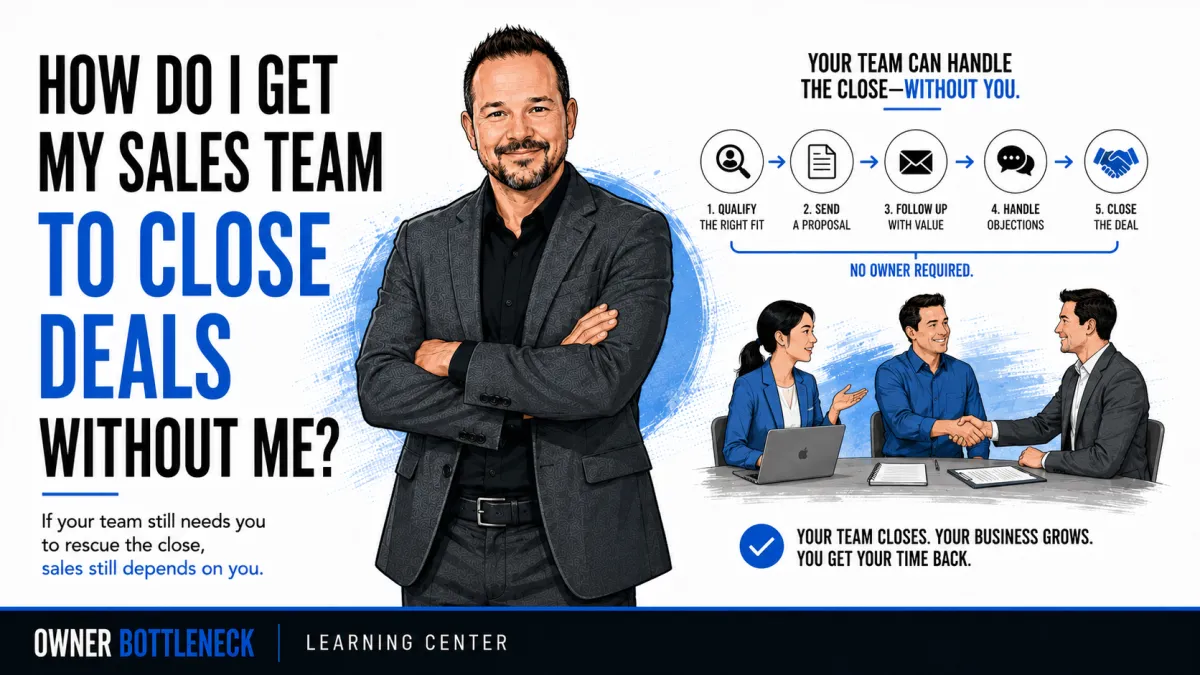
Your sales team will close deals without you when they can create trust, diagnose the problem, recommend the right solution, handle normal commercial decisions, and lead the buyer to a clear next step without borrowing your credibility or authority.
A salesperson has been working an opportunity for six weeks.
They found the lead.
They held the first call.
They followed up.
They prepared the proposal.
The prospect seems interested, but the deal hasn’t moved.
Then the salesperson says:
I think it would help if you joined the next call.
The owner joins.
Within twenty minutes, the conversation changes.
The owner asks a sharper question.
The prospect opens up about the real problem.
The owner tells a story from another customer.
They explain why the recommended approach will work.
The prospect asks for different payment terms.
The owner approves them.
The deal closes.
Everyone celebrates.
The salesperson says:
That’s why we needed you.
The owner feels useful.
But the business just learned the wrong lesson.
The salesperson learned that serious buyers need the owner.
The prospect learned that the owner is the person with the real answers.
And the owner learned that deals become safer when they step in.
One successful rescue makes the next rescue more likely.
Soon, the salesperson manages the process, but the owner closes the business.
That isn’t a sales team.
It’s sales support surrounding one indispensable closer.
Key Takeaways
The problem may not be closing technique. The salesperson may be missing credibility, diagnosis, pricing authority, proof, or judgment.
Every time the owner rescues a deal without transferring the lesson, the company reinforces the Sales Bottleneck.
Salespeople need the authority to make normal commercial decisions within clear limits.
The owner should coach before and after sales calls, not become the automatic answer during them.
Some major deals may still deserve owner involvement, but the reason and role should be defined.
The goal isn’t to remove the owner from every customer conversation. It’s to stop making the owner necessary for normal revenue.
The Problem Isn’t Always Closing Skill
Owners often say:
My salespeople can’t close.
Sometimes that’s true.
The salesperson may avoid asking direct questions.
They may present too early.
They may fail to uncover urgency.
They may not ask for a decision.
But many owner-dependent sales teams have a different problem.
The salesperson can’t carry the entire buying decision without the owner.
They may be able to explain the service.
They may be able to build rapport.
They may be able to prepare the proposal.
But when the buyer asks a difficult question, challenges the price, wants an exception, or needs greater confidence, the salesperson reaches for the owner.
The sale still depends on something the company hasn’t transferred.
That may be:
The owner’s reputation
The owner’s technical knowledge
The owner’s ability to diagnose the real problem
The owner’s customer stories
The owner’s pricing judgment
The owner’s authority to change the deal
The owner’s confidence when the buyer hesitates
You can give a salesperson a script.
You can give them a CRM.
You can give them leads.
If the important judgment still lives with you, the sale still comes back to you.
That’s a Sales Bottleneck.
What Does Closing Without the Owner Actually Mean?
Closing without the owner doesn’t mean the salesperson pressures every prospect into signing.
It means the salesperson can lead a qualified buyer from interest to a clear decision.
That decision may be yes.
It may be no.
It may be a specific next step with an agreed timeline.
The salesperson should be able to:
Understand the buyer’s situation
Identify the real problem
Connect the problem to business impact
Recommend the right solution
Explain why the recommendation fits
Address reasonable concerns
Navigate normal pricing and terms
Ask for a decision
Keep the next step from becoming vague
The owner shouldn’t need to appear simply because the conversation became important.
If the buyer only becomes confident after meeting the owner, the business hasn’t transferred enough trust.
If the real problem only appears after the owner asks questions, the business hasn’t transferred enough diagnosis.
If every commercial decision needs approval, the business hasn’t transferred enough authority.
The close is where those missing pieces become visible.
Why Do Important Deals Keep Coming Back to You?
Most owner-assisted closes come back for one of five reasons.
The Buyer Trusts You More Than the Salesperson
You may have built the company.
Your name may be connected to its reputation.
You may know the industry.
You may have handled similar problems for years.
When you enter the conversation, the buyer feels closer to the source.
That creates confidence.
It also creates dependence.
Your salesperson doesn’t need to become you.
They do need enough credibility to represent the company without feeling like a messenger.
That credibility can come from preparation, expertise, proof, clear answers, and the authority to make commitments.
If every salesperson says:
Let me ask the owner,
the buyer quickly learns where the real authority lives.
The Salesperson Isn’t Diagnosing the Real Problem
A salesperson may ask what the prospect wants.
The owner asks why it matters.
That difference can change the entire sale.
The prospect says:
We need a better scheduling system.
The salesperson starts explaining software.
The owner asks:
What happens now when the schedule breaks?
The prospect explains that jobs get delayed, customers call angry, overtime increases, and the operations manager spends every afternoon rebuilding the schedule.
Now the conversation isn’t about software.
It’s about margin, customer trust, and management capacity.
The owner often closes because they understand the business problem beneath the request.
If that diagnosis never transfers, the owner remains the person who makes the solution valuable.
The Salesperson Can’t Make Normal Commercial Decisions
The salesperson may understand the buyer and still lack the authority to move the deal forward.
They need approval for:
Pricing
Discounts
Payment terms
Scope changes
Guarantees
Start dates
Customer remedies
Contract exceptions
The buyer asks a reasonable question.
The salesperson pauses.
I’ll have to check with the owner.
The sale loses momentum.
Worse, the buyer may begin negotiating past the salesperson.
They know the person in front of them can’t make the final decision.
Responsibility without authority creates the same problem in sales that it creates everywhere else in the business.
The work moved.
The decision didn’t.
The Proof Still Lives in Your Memory
You know the stories.
You remember the customer who had the same concern.
You know what went wrong, what changed, and what result followed.
The salesperson may have a testimonial or a case study.
You have context.
That context makes the proof believable.
When prospects hesitate, you can say:
We worked with another company in a similar situation. Here’s what they tried first, why it failed, and what changed once we addressed the real problem.
The salesperson needs access to more than a page of logos.
They need a usable library of customer problems, decisions, objections, solutions, and outcomes.
Otherwise, the company’s best proof remains trapped inside the person who experienced it.
You Keep Entering Before the Salesperson Has to Lead
Sometimes the owner is invited into the deal.
Sometimes the owner volunteers.
The salesperson mentions an important prospect.
The owner joins the next call.
The owner rewrites the proposal.
The owner sends the follow-up.
The owner negotiates the final terms.
The owner may believe they’re helping.
But the salesperson never reaches the moment where they must use judgment.
They don’t learn to carry the tension because the owner removes it.
The owner then concludes:
They’re not ready to close without me.
They may not be ready.
But constantly stepping in guarantees they won’t become ready.
The Owner-Assisted Close Trap
An owner-assisted close feels efficient.
The deal matters.
The owner is good at selling.
The owner can probably improve the odds.
So why not join?
Because every owner rescue has a hidden cost.
The salesperson loses part of the learning.
The buyer builds a relationship with the owner.
Future questions go to the owner.
Renewals may go to the owner.
Problems may go to the owner.
The owner doesn’t just help close the deal.
They may accidentally become part of delivering and retaining it.
That’s how a sales bottleneck spreads into a customer relationship bottleneck.
The first sale required the owner.
Now the account does too.
If that’s happening, read How Do I Transfer Customer Relationships Away From Me?.
The answer isn’t banning the owner from every sales conversation.
It’s deciding whether the owner is participating strategically or rescuing a process that can’t work without them.
The Five Things Your Salesperson Must Be Able to Carry
A salesperson who can close without you needs more than a polished presentation.
They need to lead five parts of the buying decision without borrowing the owner.
Credibility
The buyer must believe the salesperson understands the problem and can represent the company accurately.
Credibility grows when the salesperson:
Understands the buyer’s industry and situation
Asks informed questions
Explains the company’s approach clearly
Admits what they don’t know
Follows through
Has access to useful proof
The salesperson doesn’t need to pretend they founded the company.
They need to sound like someone the company trusts.
Diagnosis
The salesperson must be able to identify the problem beneath the request.
They should understand:
What’s happening now
Why it matters
What it costs
What has already been tried
Why the problem hasn’t been fixed
Who is affected
What changes if the problem continues
What a successful outcome would look like
Without diagnosis, the proposal becomes a guess.
The owner often gets pulled in because they’re the only person who can turn a request into a business problem worth solving.
Recommendation
The salesperson must be able to say:
Based on what you’ve told me, this is what I recommend and why.
That requires judgment.
They need to understand which solution fits, which one doesn’t, and where the company should walk away.
A salesperson who can only present options may force the buyer to make a decision they don’t feel qualified to make.
The owner then enters to provide certainty.
Commercial Judgment
Salespeople need clear authority over normal pricing, scope, and terms.
That doesn’t mean unlimited freedom.
It means agreed boundaries.
For example:
You can approve a discount up to 4 percent when the contract remains above our minimum margin and the customer commits to the standard payment terms.
Or:
You can adjust the start date within the current capacity plan. Anything that requires overtime or displaces another committed customer must be escalated.
Good limits help the salesperson make decisions without exposing the company to uncontrolled risk.
This is the same principle covered in How Do You Delegate Decisions, Not Just Tasks?.
Control of the Next Step
The salesperson must be willing to lead the buying process.
Weak next steps sound like:
Let me know what you think.
I’ll follow up sometime next week.
Feel free to reach out with questions.
Strong next steps are specific:
You’re reviewing this with your partner Thursday morning. Let’s reconnect Thursday at 3:00 so we can answer any final questions and decide whether to move forward.
The salesperson isn’t controlling the buyer.
They’re preventing a serious business conversation from dissolving into vague follow-up.
Build a Sales System That Carries Your Judgment
The answer isn’t writing a giant script that tries to predict every conversation.
It’s moving the judgment your salespeople need into the business.
1. Define What a Qualified Opportunity Looks Like
Not every interested prospect should receive a proposal.
Define the conditions that make an opportunity worth pursuing.
That may include:
A problem you can solve
A meaningful business impact
A buyer who wants the problem fixed
A realistic budget
Access to the decision-maker
A workable timeline
A fit with your delivery model
If the salesperson proposes too early, the owner may be asked to rescue deals that never should have reached the proposal stage.
Better qualification reduces the number of deals that need saving.
2. Standardize the Discovery, Not the Conversation
Don’t force salespeople to read a script word for word.
Make sure they understand what must be learned before recommending a solution.
A useful discovery framework should uncover:
The current situation
The visible problem
The deeper cause
The business impact
Previous attempts
Decision process
Desired result
Urgency
Fit
The salesperson can use their own words.
The required understanding shouldn’t change.
3. Turn Your Best Sales Stories Into Company Proof
Start with the stories you tell most often.
For each story, capture:
Who the customer was
What was happening
Why the problem mattered
What they had already tried
What you recommended
What changed
What result followed
What type of buyer should hear the story
That last question matters.
A story is useful when the salesperson knows when to use it.
A pile of testimonials isn’t a proof system.
The company needs organized evidence connected to the problems buyers actually bring.
Moving those stories is part of getting the knowledge in your head into the business.
4. Create Pricing and Exception Rules
List the commercial decisions that repeatedly return to you.
Then define:
What the salesperson can approve
What conditions must be protected
What requires manager approval
What genuinely requires the owner
What the company won’t agree to
The goal isn’t to say yes to every request faster.
It’s to let the team make good decisions without turning every negotiation into an ownership issue.
Track the exceptions.
If the same exception keeps appearing, the policy may need to change.
5. Coach Around the Call, Not Through It
Before the call, ask the salesperson:
What do you understand about the buyer?
What still needs to be learned?
What decision are they trying to make?
Where do you expect the conversation to become difficult?
What do you recommend?
After the call, ask:
What did you hear?
What changed?
Where did you lose control of the conversation?
What would you do differently?
What’s the next commitment?
Don’t turn coaching into the owner taking the next call.
The salesperson needs a chance to apply the lesson.
6. Review Lost and Owner-Rescued Deals
Most companies review wins.
You’ll learn more by reviewing the deals that required you.
Ask:
Why was I needed?
Was it credibility?
Diagnosis?
Proof?
Pricing?
Authority?
A technical question?
A customer relationship?
Then ask:
What would need to exist inside the sales system for the salesperson to handle that next time?
Every owner-assisted close should create something transferable.
A new decision rule.
A better story.
A qualification standard.
A pricing boundary.
A coaching lesson.
A technical resource.
If the owner rescues the deal and nothing moves into the company, the same rescue will be needed again.
When Should the Owner Still Join a Sales Call?
Some owner involvement is strategic.
A major account may deserve an executive relationship.
A complicated partnership may require ownership authority.
A large risk may sit outside the salesperson’s limits.
The prospect may be evaluating the leadership team as part of the purchase.
That’s different from joining because the salesperson can’t move a normal deal forward.
Before joining, clarify your role.
Are you there to:
Provide executive sponsorship
Answer one specialized question
Approve an unusual term
Build a peer-level relationship
Support a strategic opportunity
Or are you there because the deal has stalled and everyone hopes you can save it?
If you join, the salesperson should still lead the call whenever possible.
The owner shouldn’t automatically take over the agenda, diagnosis, recommendation, and next step.
Support the salesperson’s authority.
Don’t replace it in front of the buyer.
Stop Letting Prospects Sell Past the Salesperson
Some buyers learn to bypass the salesperson.
They ask:
Can I speak directly with the owner?
Sometimes that request is reasonable.
Sometimes the buyer believes the salesperson can’t make a real decision.
Don’t reward that belief automatically.
The salesperson can say:
I can handle the normal decisions around this project. Tell me what concern you’d like the owner involved in, and I’ll make sure we bring them in for the right reason.
That response keeps the salesperson in the conversation.
It also reveals what the buyer actually needs.
If the owner joins, reinforce the salesperson.
Say:
Sarah has been leading this process and knows the situation best. I’m here to address the specific concern around the implementation commitment.
Now the buyer sees a team.
Not a salesperson who must be replaced when the conversation gets serious.
What if Your Salesperson Loses a Deal You Could Have Closed?
They will.
That’s painful.
It’s especially painful when you believe a short owner conversation would have saved it.
But you need to separate two questions:
Did we lose because the salesperson lacked a capability we need to build?
And:
Did we lose because the buyer wasn’t a strong fit or wasn’t ready to decide?
Don’t treat every lost deal as proof that the owner should return.
Review the sale.
Identify the miss.
Coach it.
Improve the system.
Then let the salesperson try again.
You can’t build owner-independent sales while requiring the owner to protect every opportunity from failure.
The cost of building capability includes some uncomfortable losses.
The alternative is keeping the entire revenue system attached to you.
A 30-Day Owner-Free Closing Test
Choose a small group of qualified opportunities that would normally pull you into the sale.
Don’t start with the largest account in company history.
Start with real deals that fit the normal sales process.
Week 1: Find Where the Owner Enters
Review recent opportunities.
Identify when the salesperson requested your involvement and why.
Look for patterns in diagnosis, pricing, objections, proof, authority, and next steps.
Week 2: Transfer the Missing Tools
Create the smallest useful improvement.
That might be:
A better discovery guide
A case story
A pricing limit
A technical answer
A proposal standard
A call-planning worksheet
A clear escalation rule
Don’t build an entire sales university.
Solve the recurring reason deals come back to you.
Week 3: Coach Without Taking Over
Prepare the salesperson before the call.
Review the conversation afterward.
Don’t join unless the issue crosses an agreed threshold.
When the salesperson asks:
What should I do?
respond with:
What do you recommend?
Make them use the judgment you’re trying to develop.
Week 4: Review the Evidence
At the end of the month, ask:
Which deals moved without the owner?
Which deals still required the owner?
Why was the owner needed?
What capability improved?
What still needs to transfer?
Did the salesperson control the next step?
Did any buyer relationship become owner-dependent?
The goal isn’t a perfect closing rate.
It’s evidence that normal revenue can move without automatically returning to you.
How Do You Know Sales Has Actually Transferred?
Sales is becoming less owner-dependent when:
Qualified opportunities are created without you
Discovery reaches the real business problem
Salespeople make clear recommendations
Normal pricing decisions stay within the team
Proof can be used without your storytelling
Proposals don’t need your rewrite
Prospects see the salesperson as credible
The salesperson controls the next step
Closed customers build relationships beyond the owner
Revenue doesn’t fall when you step away
You should also track owner involvement directly.
How many deals required you this month?
At what stage?
For what reason?
How much revenue closed without you?
Those measures help you stay informed without being involved in everything.
The sales number alone doesn’t tell the whole story.
Revenue may be growing while the Sales Bottleneck is getting worse.
The Sales Team Shouldn’t Need to Borrow You
Your reputation matters.
Your knowledge matters.
Your customer stories matter.
Your judgment may be one of the reasons the company grew.
The goal isn’t to remove those assets from the sale.
It’s to stop trapping them inside one person.
Move the stories.
Move the diagnosis.
Move the authority.
Move the commercial judgment.
Move the customer trust.
Then coach the team until they can carry the buying decision without borrowing you every time it matters.
You may still join strategic conversations.
You may still maintain important relationships.
You may still make the few decisions that genuinely belong to ownership.
But normal revenue shouldn’t require the owner to appear before the buyer feels safe enough to say yes.
The owner shouldn’t be the company’s closing strategy.
The company should have one.
Frequently Asked Questions
Should the Owner Ever Help Close a Deal?
Yes.
Owner involvement may be appropriate for strategic accounts, unusual risk, major partnerships, or decisions outside the salesperson’s authority.
The role should be clear, and the salesperson should remain involved.
Why Do Prospects Ask to Speak With the Owner?
They may want greater authority, confidence, technical expertise, or reassurance.
Look for the reason behind the request instead of automatically handing the sale to the owner.
Should Salespeople Be Allowed to Discount?
They may be given limited discount authority as long as margin, scope, and other commercial standards are protected.
The limits should be clear and measurable.
How Long Does It Take to Make Sales Less Owner-Dependent?
It depends on the complexity of the sale, the salesperson’s experience, the strength of the process, and how much credibility and judgment currently live with the owner.
Expect a transfer process, not a single training session.
What if the Owner Is the Best Salesperson?
That may be true.
The goal isn’t to prove the owner isn’t talented.
The goal is to turn what the owner does well into a sales capability the company can use through other people.
Should the Owner Stop Talking to Customers?
No.
The owner may still maintain strategic relationships.
The problem is when every meaningful customer relationship, sale, and decision depends on the owner personally.
What if Sales Drop After I Step Back?
Review where the process weakened.
Look at lead quality, discovery, recommendations, proof, pricing authority, follow-up, and customer trust.
Don’t immediately assume the only solution is putting the owner back into every deal.
How Do I Know Whether I Have a Sales Bottleneck?
You likely have one when leads, proposals, pricing, closing, referrals, customer trust, or important accounts still depend heavily on the owner.
The Owner Bottleneck Scorecard can help identify where that dependence is strongest.
Find Out Why Revenue Still Comes Back to You
You may believe your salespeople need a better closing technique.
The deeper problem may be that the company’s credibility, diagnosis, proof, pricing judgment, and customer trust still live with you.
The free Owner Bottleneck Scorecard evaluates dependence across:
Decisions
Sales
Operations
Team
Value