
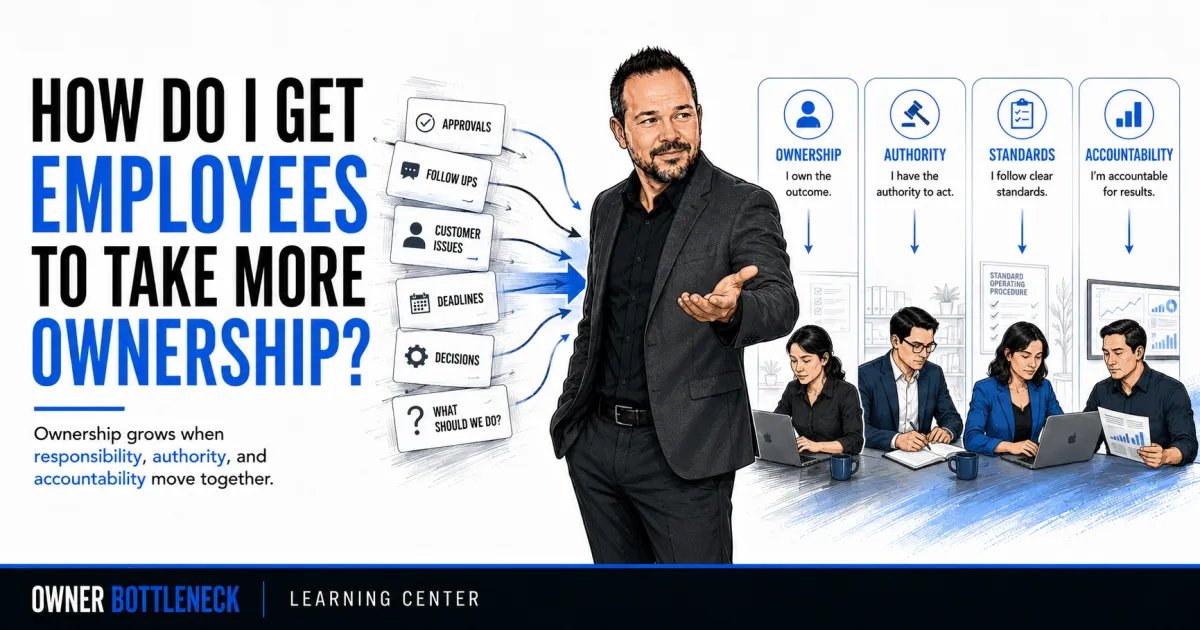
How Do I Get Employees to Take More Ownership?
How Do I Get Employees to Take More Ownership?
Employees take more ownership when the business transfers the complete result, not just the work.
One person must understand the outcome, have enough authority to act, know the standards, have access to the right information, receive room to make decisions, and be held accountable for closing the loop.
Telling people to “take ownership” won’t work when the owner still controls every meaningful decision, rewrites the work, rescues every difficult situation, and remains responsible for the final result.
The task may move.
Ownership stays with the owner.
That’s why the owner keeps asking:
Why won’t anyone take ownership around here?
The employee completed the assignment.
They sent the email.
Made the call.
Updated the schedule.
Prepared the proposal.
Passed the information to the next person.
Then something changed.
The customer didn’t respond.
The deadline slipped.
A problem appeared.
Another department dropped the handoff.
The original employee considered their part complete.
The owner stepped in to make sure the actual result happened.
The employee did the task.
The owner still owned the outcome.
That’s the difference this article will help you fix.
Key Takeaways
Ownership means carrying a result to completion, not merely finishing an assigned activity.
Good employees may still avoid ownership when outcomes, authority, standards, information, and accountability are unclear.
Assigning responsibility without transferring authority creates dependence, not ownership.
Owners often take ownership back by answering too quickly, reversing decisions, bypassing managers, and rescuing uncomfortable situations.
Accountability should focus on agreed results, deadlines, standards, and follow-through, not constant owner supervision.
Some ownership problems are system problems. Others are genuine capability, effort, or fit problems.
The goal isn’t for employees to act without limits. It’s for them to act confidently inside clear limits without needing the owner at every step.
What Does It Mean for an Employee to Take Ownership?
Employee ownership means accepting responsibility for producing an outcome and carrying it through until it’s complete.
That includes more than performing the assigned task.
It may include:
Noticing when something is off track
Communicating before a deadline is missed
Following up without being reminded
Solving normal problems
Coordinating with other people
Making decisions within established limits
Asking for help before the situation becomes a crisis
Confirming the result was actually achieved
Learning from what went wrong
Improving how the work gets done next time
An employee who owns the outcome doesn’t disappear when their individual task is finished.
They remain connected to the result.
This doesn’t mean they must personally do everything.
It means they’re responsible for making sure everything necessary happens.
They may delegate parts of the work.
They may involve another department.
They may ask for help.
They may escalate an issue that falls outside their authority.
But they don’t simply drop the responsibility and assume someone else will catch it.
Ownership means:
I’m responsible for making sure this reaches the right result.
Task Completion and Ownership Aren’t the Same
Task completion asks:
Did you do what I told you to do?
Ownership asks:
Did the result we needed actually happen?
Imagine a customer is waiting for an updated delivery date.
The owner tells an employee:
Call the customer and give them an update.
The employee calls.
The customer doesn’t answer.
The employee leaves a voicemail and marks the task complete.
Technically, the employee did what they were told.
The customer still doesn’t know what’s happening.
An employee who owns the result may:
Leave a voicemail
Send an email or text
Try again later
Confirm the customer received the update
Answer any follow-up questions
Record the final communication
Alert the right person if the customer becomes concerned
The task was making the call.
The outcome was keeping the customer informed and confident.
Those aren’t the same thing.
This is why delegation alone doesn’t solve the Owner Bottleneck.
Delegation can move an activity.
Ownership moves responsibility for what that activity is supposed to accomplish.
Why Don’t Employees Take More Ownership?
Owners often assume the problem is motivation.
They believe employees don’t care enough.
Sometimes that’s true.
But it’s a weak place to begin.
Many employees avoid ownership because the company hasn’t made ownership clear, safe, or possible.
They may not know what they own.
They may not have the authority to act.
They may not know what a good result looks like.
They may not have the information required to make a sound decision.
They may have learned that the owner will change the answer anyway.
They may be held responsible for outcomes they don’t control.
They may have watched someone make one mistake and lose their decision-making freedom.
They may have been trained to complete tasks instead of carry results.
Before deciding your employees need a better attitude, examine the environment in which you’re asking them to take ownership.
Your Team May Have Been Trained to Wait
Most owners don’t intentionally teach dependence.
It happens one interaction at a time.
Someone asks a question.
You answer it.
Someone has a problem.
You solve it.
A manager makes a decision you wouldn’t have made.
You reverse it.
A customer becomes upset.
You take over.
An employee struggles.
You finish the work yourself.
Each response makes sense in the moment.
The customer gets helped.
The mistake gets corrected.
The deadline gets saved.
But the team also learns something:
When the situation becomes uncertain, important, or uncomfortable, the owner will step in.
That becomes the safest path.
The employee avoids risk.
The owner gets the result they want.
The business keeps moving.
The cost appears later.
Employees stop sitting with problems long enough to think.
Managers stop developing judgment.
Responsibility lasts only until something becomes difficult.
The owner becomes the person who closes every unfinished loop.
The company may have capable people.
It has trained them to rely on one person.
That’s a Team Bottleneck.
The Six Conditions Employees Need to Take Ownership
You can’t demand ownership into existence.
You have to build the conditions that make it possible.
1. A Clear Outcome
Start by defining the result.
Not merely the activity.
Not the first step.
Not the owner’s preferred method.
The result.
A weak assignment sounds like this:
Keep an eye on our overdue accounts.
A clear outcome sounds like this:
Keep accounts more than 30 days overdue below $50,000, contact every overdue customer weekly, and alert me before any balance reaches 60 days.
The second version gives the person something to own.
They understand:
What result matters
How success will be measured
What action is expected
When the owner should become involved
You can’t hold someone accountable for an outcome that was never made clear.
Before assigning responsibility, ask:
What result should this person be able to point to and say, “That’s mine”?
2. One Clear Owner
Shared involvement is normal.
Shared ownership is dangerous.
When two or three people all “kind of” own something, no one is fully responsible for making sure it gets done.
People assume:
Someone else followed up
Someone else told the customer
Someone else updated the system
Someone else noticed the deadline
Someone else made the decision
Someone else will raise the problem
Every meaningful result needs one clear owner.
Other people may support the work.
Only one person should be responsible for ensuring the loop closes.
For example:
Rebecca owns the customer onboarding outcome. Sales provides the signed agreement. Finance confirms payment. Operations schedules the work. Rebecca is responsible for making sure the customer successfully moves through the entire handoff.
Rebecca may not perform every step.
She owns whether the outcome happens.
3. Real Authority and Room to Decide
You can’t give someone responsibility while keeping every meaningful decision.
That creates accountability without control.
The employee becomes responsible for the result but must ask the owner before doing anything that could affect the result.
They can’t:
Adjust the schedule
Reassign work
Contact the customer
Approve a small expense
Change a normal process
Resolve a routine complaint
Enforce a standard
Hold another employee accountable
Then the owner becomes frustrated because the employee isn’t taking ownership.
The employee may be trying.
They don’t have the authority required to own the outcome.
Clarify:
What they can decide
What they can change
What they can spend
What they can promise
Who they can involve
What requires approval
What must be escalated
Employees don’t need unlimited freedom.
They need a clear field in which they can act without waiting for you.
For a deeper explanation, read How Do You Delegate Decisions, Not Just Tasks?.
4. Clear Standards and Boundaries
Employees hesitate when they don’t know how the owner judges the situation.
They may understand the outcome but still wonder:
How much quality is enough?
How quickly should this be handled?
How much can we spend?
How much customer flexibility is appropriate?
When does a normal problem become a serious risk?
What tradeoffs are acceptable?
What should never be compromised?
Standards help employees make decisions that are consistent with the business.
For example:
Resolve legitimate customer concerns quickly. You may authorize remedies up to $300. Don’t make promises that change the project scope without operations confirming the impact. Escalate anything involving safety, legal risk, or a threat to cancel.
That isn’t micromanagement.
It’s a decision structure.
The employee knows what outcome to protect and where the limits are.
Standards turn the owner’s invisible judgment into something other people can use.
5. The Right Information and Resources
Sometimes employees don’t take ownership because they don’t have access to what the owner knows.
The owner may know:
The customer’s history
The true project priority
The available budget
The expected margin
The company’s capacity
The history behind a policy
What was promised during the sale
The owner’s tolerance for risk
Which tradeoffs matter most
The employee receives a task but not the context required to carry the result.
Then they either guess or ask the owner.
Neither option builds strong ownership.
Ask:
What information does this person need?
Where will they find it?
Is it current?
Can they access it without asking me?
Do they understand what it means?
What tools, people, or budget do they need?
Information locked inside the owner’s head creates dependence even when authority has supposedly been delegated.
6. Accountability and Review
Ownership without accountability becomes neglect.
Accountability without authority becomes frustration.
You need both.
Agree in advance on:
The result
The deadline
The standard
The measures
The review rhythm
The situations that must be escalated
What happens when commitments aren’t met
Then review the outcome.
Don’t wait until something fails and announce that the person should’ve known better.
Accountability should be predictable.
It might sound like:
You own weekly scheduling. We’ll review next week’s schedule every Thursday. Your targets are full coverage, no unapproved overtime, and customer commitments met. Bring me conflicts you can’t resolve within those limits.
The person knows what they own.
They know when it will be reviewed.
They know how success will be judged.
They know what still requires the owner.
That creates accountability without placing the owner inside every daily step.
A Simple Way to Transfer Ownership
Before handing off an important responsibility, answer these six questions together:
What outcome are you responsible for?
Who is the one person who owns it?
What decisions can you make without asking me?
What standards and boundaries must you protect?
What information and resources will you need?
When and how will we review the result?
Write the answers down.
They don’t need to become a 40-page procedure.
A one-page ownership agreement may be enough.
For example:
Outcome: Customers receive a confirmed installation date within two business days of signing.
Owner: Operations coordinator.
Authority: May schedule within available capacity, move nonurgent work by up to two days, and coordinate directly with sales.
Standards: Don’t promise unavailable capacity. Confirm materials before scheduling. Notify the customer immediately if the original expectation can’t be met.
Information: Signed agreement, customer commitments, capacity calendar, material status, and scheduling rules.
Review: Weekly review of time to schedule, reschedules, and customer complaints.
That’s a responsibility someone can understand and carry.
How Owners Accidentally Take Ownership Back
Transferring ownership is only half the job.
The owner must stop reclaiming it.
Here are some of the most common ways owners take responsibility back.
Answering Every Question Immediately
A fast answer solves the immediate issue.
It may also teach the employee that thinking is optional.
Before answering, ask:
What do you recommend?
The goal isn’t to play games or refuse help.
It’s to make sure the employee participates in solving the problem.
Reversing Decisions Without Teaching
Employees won’t trust their authority when the owner regularly changes their decisions without explaining why.
Sometimes the owner must reverse a decision.
When you do, explain:
What information changed the answer
Which principle mattered
What risk was missed
How the employee should handle a similar situation next time
Otherwise, the employee learns only one lesson:
My decisions aren’t real.
Bypassing the Person Who Owns the Outcome
An owner may walk past the manager and give instructions directly to the employee.
It feels faster.
It also weakens the manager’s ownership.
The team learns that the real authority still sits with the owner.
When possible, route the issue through the person who owns it.
Fixing the Work Instead of Coaching the Person
You may be able to correct the proposal in ten minutes.
Coaching the employee may take thirty.
The faster option protects today’s deadline.
The slower option builds tomorrow’s capability.
Owners who always choose speed may remain trapped doing the work because nobody else gets enough practice to improve.
Rescuing Every Uncomfortable Situation
Ownership becomes real when the work becomes difficult.
A missed deadline.
An upset customer.
A performance conversation.
A disagreement between departments.
A mistake that needs to be admitted.
If the owner takes over every time discomfort appears, employees learn that they own only the easy part.
Support the person.
Don’t automatically replace them.
Remaining Copied on Everything
Being copied can feel like visibility.
It can also tell everyone:
The owner is still watching and may need to step in.
Decide which information you truly need.
Create a review rhythm or dashboard instead of remaining inside every conversation.
Visibility and involvement aren’t the same thing.
What Should You Say When an Employee Brings the Problem Back?
Don’t immediately take the problem.
Help the employee continue owning it.
Ask:
What result are we trying to protect?
Then:
What do you believe should happen?
You can follow with:
What options did you consider?
What information are you missing?
What standard applies?
What’s inside your authority?
What risk concerns you?
What do you recommend?
When will you update me?
The employee may still need coaching.
They may need context.
They may need you to approve something outside their limits.
That’s fine.
The goal isn’t to make employees struggle alone.
The goal is to keep the responsibility from silently transferring back to you.
You can help without becoming the owner of the issue again.
A useful response is:
I’ll help you think through it, but you still own making sure it gets resolved.
That sentence separates support from rescue.
How Do You Create Accountability Without Micromanaging?
Micromanagement usually focuses on activity.
Accountability focuses on commitments and results.
Micromanagement asks:
Did you send the email?
Did you make the call?
Did you update the spreadsheet?
Did you talk to operations?
Did you follow up again?
Accountability asks:
Did we achieve the agreed outcome?
Is the result on track?
What changed?
What risk needs attention?
What commitment will you make next?
When will the loop be closed?
You don’t need to disappear.
People need support, coaching, and review.
But the review should be designed in advance.
Use:
Clear outcomes
Visible measures
Agreed deadlines
Regular check-ins
Early warning thresholds
Consistent consequences
This creates visibility without forcing the owner to supervise every action.
The owner sees whether the system is working.
The employee retains responsibility for making it work.
How Do You Transfer Ownership Gradually?
Ownership doesn’t need to move all at once.
A staged transfer may be safer and more effective.
Stage 1: Observe and Learn
The employee watches how the owner handles the responsibility.
The owner explains their thinking, standards, priorities, and tradeoffs.
Don’t only show what you do.
Explain why.
Stage 2: Recommend
The employee evaluates the situation and recommends what should happen.
The owner still makes the final decision.
This builds judgment without creating immediate risk.
Stage 3: Decide With Review
The employee makes the decision and reviews it with the owner before acting.
The owner checks the reasoning, not merely the answer.
Stage 4: Own and Report
The employee acts without prior approval inside the agreed boundaries.
They report the result through the established review rhythm.
Stage 5: Own and Improve
The employee carries the outcome, handles normal exceptions, reviews performance, and improves the system.
The owner is involved only when the situation crosses the agreed threshold.
This gradual approach allows capability and confidence to grow together.
What If an Employee Still Won’t Take Ownership?
Here’s the hard truth.
Not every ownership problem is caused by the owner or the system.
Some employees avoid responsibility even when expectations are clear.
They may:
Lack the required skill
Avoid difficult conversations
Fail to follow through
Hide mistakes
Resist accountability
Refuse reasonable authority
Wait for reminders
Show little interest in developing
Want the title without the responsibility
Before reaching that conclusion, make sure the business has provided:
A clear outcome
One clear owner
Real authority
Defined standards
Necessary information
Coaching
Feedback
A reasonable development period
Consistent accountability
Then look at the pattern.
One mistake isn’t proof that someone can’t take ownership.
Repeated avoidance after clarity, authority, support, and feedback may be.
At that point, the problem may involve capability, effort, role fit, or personnel.
A broken ownership system shouldn’t be blamed entirely on the employee.
A persistent performance problem shouldn’t be excused forever as a system issue.
Strong leadership requires knowing the difference.
Should Employees Be Allowed to Make Mistakes?
Yes, within responsible limits.
You can’t ask people to make decisions and expect every decision to match what you would’ve done.
If employees believe one imperfect judgment will cause the owner to take back all authority, they’ll stop taking reasonable risks.
Define which mistakes are:
Reversible
Affordable
Teachable
Unacceptable
Dangerous
Required to be escalated
A $100 customer remedy may be a reasonable learning decision.
A major legal commitment isn’t.
People need enough room to build judgment without placing the company at unreasonable risk.
The standard shouldn’t be:
Never make a mistake.
It should be:
Make decisions inside the agreed boundaries, surface problems early, learn from the outcome, and don’t hide what happened.
What Should Remain With the Owner?
Not every result should be transferred.
The owner may properly retain responsibility for:
Company strategy
Major capital decisions
Ownership and financing
Material legal risks
Critical culture decisions
Executive hiring and removal
Major acquisitions
Company-threatening customer commitments
Decisions that could permanently change the business
Responsibilities the owner intentionally chooses to keep
The goal isn’t to make the owner absent.
It’s to stop making the owner responsible for outcomes the business should be capable of carrying.
Ask:
Does this require ownership-level judgment, or does it keep reaching me because we haven’t built ownership anywhere else?
That question exposes a lot.
What Does Strong Employee Ownership Look Like?
You’ll know ownership is growing when:
Problems come with recommendations
Employees follow through without reminders
People communicate before deadlines are missed
Managers handle normal performance issues
Customer problems are resolved without automatic owner involvement
Employees coordinate across departments
Decisions are made inside clear boundaries
Mistakes produce learning and system improvements
The owner is no longer copied by default
Commitments are tracked and closed
Results remain steady when the owner is unavailable
The owner learns about fewer problems because fewer problems require them
The team won’t stop asking questions.
Questions aren’t the enemy.
Dependence is.
A strong team asks for context, coaching, and help when appropriate.
It doesn’t automatically hand every uncertain result back to the owner.
Ownership Has to Move Before the Owner Bottleneck Can
You can hire more employees.
Add managers.
Create processes.
Buy software.
Hold accountability meetings.
None of those changes will make the business less dependent on you if you remain the person who carries every meaningful outcome.
Ownership moves when the business makes six things clear:
The outcome
The owner
The authority
The standards
The information
The accountability
Then the owner has to allow the structure to work.
Don’t assign the task while secretly keeping the result.
Don’t give authority and reverse every decision.
Don’t ask for initiative and punish every imperfect attempt.
Don’t demand accountability for things the employee can’t control.
Your team may need to step up.
You may also need to stop stepping in so quickly.
That’s how ownership begins to move.
And when ownership moves, the business becomes less dependent on you.
Frequently Asked Questions
Can Employee Ownership Be Taught?
Yes, to a point.
People can develop stronger judgment, follow-through, communication, and accountability through clear expectations, authority, coaching, practice, and feedback.
However, willingness matters. An employee who repeatedly avoids reasonable responsibility despite support may not be suited for a role that requires ownership.
How Long Does It Take Employees to Take Ownership?
It depends on the responsibility, the employee’s experience, the risk involved, and how much owner-held knowledge must be transferred.
A recurring, low-risk responsibility may move within weeks. A complex management outcome may require months of coaching and staged authority.
The better measure isn’t time alone. It’s whether fewer decisions, reminders, and unresolved problems return to the owner.
What If an Employee Makes a Decision I Disagree With?
First determine whether the decision violated an agreed boundary or was simply different from what you would’ve chosen.
When the reasoning was sound and the decision stayed inside the person’s authority, coach the lesson without automatically taking the authority back.
When a boundary was ignored, address it directly and clarify what should happen next time.
Is Employee Ownership the Same as Employee Empowerment?
They’re connected, but not identical.
Empowerment provides authority and room to act.
Ownership includes responsibility for producing the result, communicating progress, solving problems, and closing the loop.
Authority without accountability isn’t ownership.
Accountability without authority isn’t ownership either.
How Do I Hold Employees Accountable Without Constantly Following Up?
Agree on the result, measure, deadline, review rhythm, and escalation point before the work begins.
Use visible commitments and scheduled reviews instead of relying on random reminders.
When a commitment is missed, address the pattern directly rather than quietly taking the work back.
Why Do My Managers Still Bring Every Problem to Me?
They may lack authority, information, confidence, standards, or clarity about what they own.
They may also have learned that you’ll override their decisions or take over when situations become uncomfortable.
Read Why Does My Team Keep Coming to Me for Every Decision? for a deeper breakdown of that pattern.
Find Where Your Team Still Depends on You
A lack of employee ownership may be a Team Bottleneck.
It may also be connected to unclear decisions, weak operations, owner-held information, or responsibilities that were never fully transferred.
The free Owner Bottleneck Scorecard evaluates owner dependence across Decisions, Sales, Operations, Team, and Value.
It’ll help you identify where the business still depends too heavily on your judgment, approval, problem-solving, relationships, standards, or presence.