
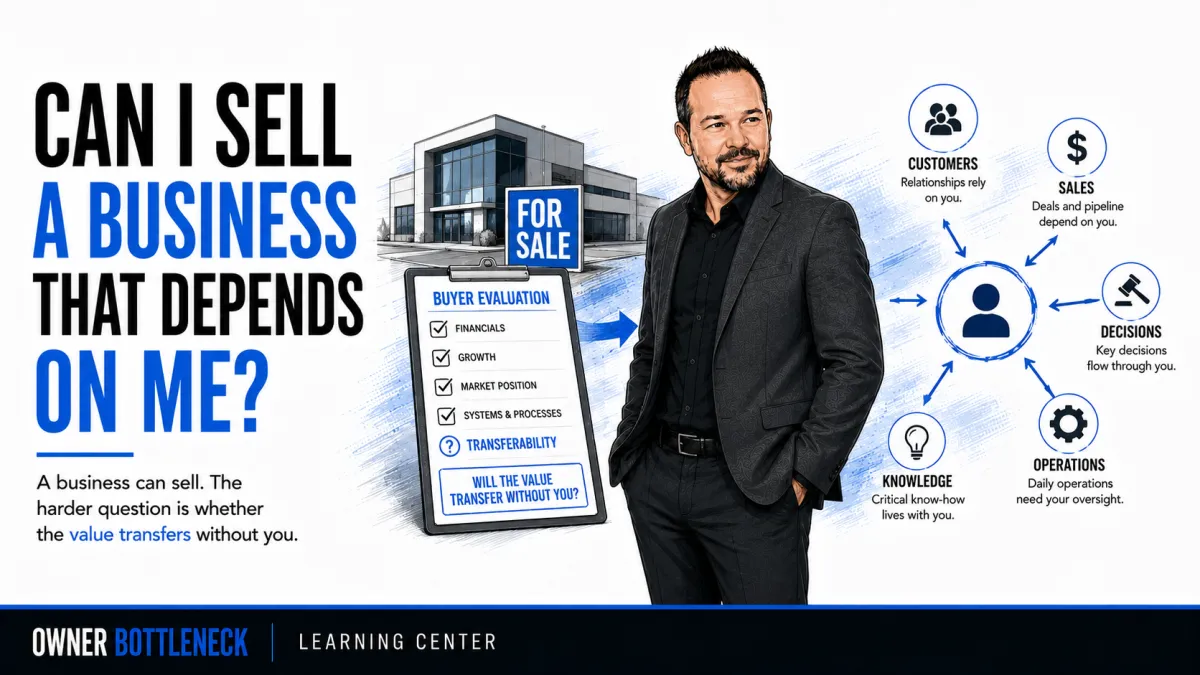
Can I Sell a Business That Depends on Me?
Yes, you can sell a business that depends on you. But the more revenue, customers, decisions, operations, relationships, and knowledge depend on your continued involvement, the more difficult it may be to transfer the business on the terms you want.
The business isn’t automatically unsellable.
It isn’t automatically worthless.
And you don’t need to become completely unnecessary before a buyer will consider it.
But a buyer will want to understand what they’re actually purchasing.
Are they buying a company that can continue producing results?
Or are they buying a company that works because you’re still there?
That question may affect:
Who’s willing to buy
How much they’re willing to pay
How much cash is paid at closing
How long you’re expected to remain
Whether part of the price depends on future performance
How much seller financing is requested
How difficult the transition becomes
Whether the buyer believes customers and employees will stay
Whether the buyer proceeds at all
A profitable owner-dependent business can still sell.
The harder question is:
How much of the company’s value can actually transfer without you?
Key Takeaways
Owner dependence doesn’t automatically prevent a sale, but it can increase buyer risk.
The business is more transferable when customers, sales, decisions, operations, knowledge, and management can continue after the owner leaves.
A buyer may respond to dependence through a lower price, longer transition, delayed payments, seller financing, or stronger protections.
A strategic buyer may be better equipped to absorb some owner dependence than an individual buyer who needs the company to operate immediately.
Promising to stay after closing may support the transition, but it doesn’t solve the underlying dependence.
The best preparation is to reduce the few dependencies most connected to revenue, major customers, operations, and leadership.
If you must sell soon, honesty, realistic expectations, the right buyer, and a structured transition matter more than pretending the business is independent.
What Does It Mean When a Business Depends on the Owner?
A business depends on the owner when important results weaken, stop, wait, or become uncertain without the owner’s involvement.
That dependence may exist in:
Sales
Customer relationships
Pricing
Decisions
Scheduling
Quality
Problem-solving
Employee leadership
Financial oversight
Vendor relationships
Company knowledge
Daily coordination
The company may have employees.
It may have managers.
It may have systems.
It may be profitable.
The owner may still be the person who makes everything work together.
For example, the owner may:
Generate most referrals
Close the largest deals
Approve important pricing
Personally reassure major customers
Resolve serious complaints
Make every difficult decision
Coordinate department priorities
Remember important promises
Protect quality through personal involvement
Hold the management team accountable
Know how to handle every unusual situation
That’s an Owner Bottleneck.
The company produces results.
The owner remains part of the system required to produce them.
Is an Owner-Dependent Business Unsellable?
No.
Many small businesses have some level of owner dependence.
Buyers often expect the seller to provide:
Training
Introductions
Knowledge transfer
Customer reassurance
Vendor handoffs
Employee communication
Transition support
The presence of owner dependence isn’t unusual.
The problem is the amount and type of dependence.
A buyer may be comfortable when:
The dependence is clearly understood
The owner’s responsibilities can be transferred
The transition has a realistic timeline
Capable employees are already in place
Customer relationships can be introduced gradually
The business produces enough profit to support additional management
The buyer has resources that can replace part of the owner’s role
A buyer may become more concerned when:
Most revenue depends on the owner
Major customers won’t work with anyone else
The owner personally manages daily operations
Employees can’t make normal decisions
Important knowledge isn’t documented
There’s no management team
Financial results weaken when the owner steps away
The owner wants to leave immediately
Nobody can clearly explain what the owner actually does
The business may still sell.
The dependence changes what the buyer must solve after closing.
Saleable and Transferable Aren’t the Same
A business can attract a buyer without being easy to transfer.
That distinction matters.
A saleable business has something a buyer wants.
That may include:
Profit
Customers
Contracts
Assets
Employees
Market position
Technology
Brand
Location
Intellectual property
Growth potential
A transferable business can continue producing value after ownership changes.
The buyer needs both.
They may love the customer base, profit, equipment, or opportunity.
They may still worry that those advantages are attached to you.
The question isn’t only:
Is this a good business?
It’s also:
Will it remain a good business after the seller leaves?
That’s why owner dependence creates a Value Bottleneck.
What Happens When a Buyer Finds Owner Dependence?
Buyers usually don’t ignore owner dependence.
They try to understand it, price it, replace it, transfer it, or protect themselves from it.
The Buyer May Offer Less
The buyer may believe future earnings are less certain than the financial statements suggest.
They may reduce the price to account for risks such as:
Customer loss
Revenue decline
Employee turnover
Weak management
Operational disruption
Knowledge loss
Transition costs
The need to hire additional leadership
This doesn’t mean owner dependence always produces a specific discount.
It means the buyer may place less value on earnings they’re less confident will continue.
For a deeper explanation, read How Does Owner Dependence Affect Business Value?.
The Buyer May Pay Less at Closing
A buyer may agree to a headline price but delay part of the payment.
For example, the deal may include:
An earnout
Seller financing
Payments tied to customer retention
Payments tied to future revenue
A holdback
A consulting agreement
Continued employment for the seller
An earnout means part of the purchase price is paid only if the business reaches agreed future results.
Seller financing means the buyer pays part of the price over time rather than paying everything at closing.
These structures don’t automatically make a deal bad.
They show that the buyer wants the seller to continue sharing some of the risk.
The Buyer May Require You to Stay Longer
The buyer may ask you to remain for:
Several weeks
Several months
A year
Multiple years in a reduced role
Your responsibilities may include:
Introducing customers
Transferring relationships
Training the buyer
Coaching managers
Explaining operations
Supporting sales
Protecting employee confidence
Helping with difficult decisions
A reasonable transition can help.
But staying longer may also delay the freedom you expected from selling.
The Buyer May Increase Due Diligence
The buyer may spend more time examining:
Customer relationships
Revenue concentration
Management depth
The owner’s daily activities
Sales processes
Decision authority
Operating procedures
Employee retention
Financial consistency
Transition risks
They’re trying to separate business performance from owner performance.
The Buyer May Walk Away
Some buyers won’t have the ability, time, experience, or appetite to replace the owner.
They may decide the business requires too much personal involvement.
That doesn’t prove the company can’t sell.
It means that buyer may not be the right buyer for the business in its current condition.
Which Types of Buyers May Consider an Owner-Dependent Business?
Different buyers see dependence differently.
An Individual Owner-Operator
An individual may be willing to replace you personally.
They may expect to:
Work inside the business
Manage employees
Handle customers
Sell
Make decisions
Learn the operations
Become the new face of the company
This buyer may be comfortable purchasing a job plus an investment.
The risk is whether the buyer can successfully replace your experience, credibility, relationships, and judgment.
A Strategic Buyer
A strategic buyer may already own a related company.
They may have:
Management
Salespeople
Customer service
Financial systems
Operating procedures
Vendors
Technology
Industry knowledge
That existing capacity may allow them to absorb responsibilities that currently depend on you.
They may be buying:
Customers
Territory
Employees
Market share
Capabilities
Equipment
Brand presence
Contracts
A strategic buyer may care less about replacing every owner responsibility exactly as it exists today.
They may integrate the company into a larger operating system.
A Financial Buyer
A financial buyer generally wants confidence that the company can produce results through management rather than through the departing owner.
Some may be willing to add leadership after closing.
Others may avoid a company without strong management already in place.
The more the buyer depends on the existing team to run the business, the more management depth matters.
An Employee or Management Buyer
A manager, employee, or internal group may already understand:
The customers
The team
The operations
The culture
The history
The owner’s role
That knowledge can reduce some transition risk.
But internal buyers may still need:
Financing
Leadership development
Decision authority
Customer credibility
Broader management experience
A gradual ownership transition
An internal buyer who has never been allowed to lead may understand the business but still be unprepared to run it.
A Family Successor
A family member may have more time to learn the owner’s responsibilities.
The transition can occur gradually.
But family involvement doesn’t solve dependence automatically.
The successor still needs:
Capability
Authority
Employee trust
Customer confidence
Financial understanding
Leadership experience
A clear role
Replacing one indispensable owner with another doesn’t create a transferable company.
What Types of Owner Dependence Create the Most Sale Risk?
Not all dependence matters equally.
The dependencies most likely to concern a buyer are tied to the company’s ability to keep producing revenue and serving customers.
Revenue Depends on You
The owner generates leads, closes deals, sets pricing, or maintains major accounts.
The buyer may wonder whether revenue will decline after the owner leaves.
Major Customers Depend on You
Customers see the relationship as personal.
They call you first.
They expect you to solve problems.
They may not know or trust another leader.
This can become especially risky when a small number of customers represent a large portion of revenue.
Daily Operations Depend on You
You coordinate schedules, solve exceptions, protect quality, and keep work moving.
The buyer may be purchasing a company without an operating leader.
Management Depends on You
Managers report information upward but don’t lead independently.
Employees wait for you.
Departments depend on you to resolve conflict.
The buyer may need to provide management immediately.
Critical Knowledge Depends on You
The company’s pricing logic, customer history, operating judgment, standards, and exceptions exist primarily in your memory.
The buyer may need an extended transition simply to understand how the company works.
Company Credibility Depends on You
The owner’s reputation, qualifications, licenses, public presence, or industry standing may be closely connected to the brand.
The buyer needs to know whether the company’s credibility can survive without the former owner.
What Owner Dependence May Be Easier to Transfer?
Dependence becomes more manageable when it is:
Clearly identified
Limited in scope
Connected to specific responsibilities
Transferable through training
Supported by documentation
Shared with capable employees
Covered by a realistic transition plan
Proven through gradual owner absence
For example, a buyer may be comfortable if the owner handles three strategic relationships but the rest of the company operates independently.
The buyer may be more concerned if the owner handles every important customer, approves every price, resolves every operating problem, and manages every leader.
The issue isn’t whether the owner matters.
It’s whether the owner’s role can be separated, taught, replaced, or reduced.
The Five Myths Owners Tell Themselves Before Selling
Myth 1: “The Buyer Can Just Do What I Do”
Maybe.
But the buyer may not have:
Your experience
Your customer trust
Your technical knowledge
Your relationships
Your judgment
Your willingness to work the same hours
The buyer isn’t only asking whether the work can be done.
They’re asking how difficult and risky it will be to replace you.
Myth 2: “I’ll Stay for Six Months and Teach Them Everything”
Six months may help.
It may not be enough to transfer years of undocumented experience, customer trust, and operating judgment.
A transition is easier when the knowledge and relationships have already started moving before the sale.
Myth 3: “The Customers Will Stay Because They Love the Company”
Maybe they will.
But don’t confuse customer satisfaction with transferable loyalty.
Ask:
Who does the customer call?
Who do they trust?
Who solves serious problems?
Who negotiates the agreement?
Who reassures them when something goes wrong?
If every answer is you, the buyer will notice.
Myth 4: “The Profit Proves the Business Works”
The profit proves the business has produced results.
It doesn’t automatically prove those results will continue without you.
The buyer wants to understand what created the profit.
Was it produced by:
The company’s systems
The team
Repeatable demand
Management
Customer loyalty
The owner’s personal labor
The owner’s relationships
The owner’s judgment
Profit matters.
The quality and transferability of the profit matter too.
Myth 5: “Nobody Needs to Know How Dependent the Business Is”
Trying to hide dependence is a bad strategy.
The buyer may discover it through:
Employee interviews
Customer concentration
Email patterns
Sales records
Management meetings
Approval processes
Customer conversations
The owner’s calendar
Due diligence questions
Be accurate about the owner’s role.
A buyer can plan for a risk they understand.
Hidden surprises destroy confidence.
Use qualified legal, financial, tax, valuation, and transaction advisors when preparing or negotiating a sale.
What Will a Buyer Want to Know About Your Role?
Be prepared to explain:
How many hours you work
What you do each week
Which customers depend on you
Which sales require you
Which decisions only you make
Which employees report to you
Which problems reach you
Which relationships you own
Which knowledge only you hold
What happens when you’re unavailable
How long your responsibilities would take to transfer
Who could assume each responsibility
Don’t describe your role as:
I mostly oversee things.
That tells the buyer almost nothing.
Map your responsibilities clearly.
For each responsibility, identify:
Frequency
Importance
Risk
Time required
Current backup
Transfer method
Expected transition period
The clearer the map, the easier it is for a buyer to understand the company they’re purchasing.
How Do You Prepare an Owner-Dependent Business for Sale?
Start with the dependencies that most directly affect revenue, customers, operations, and leadership.
Step 1: Audit What Still Depends on You
Track every:
Decision
Approval
Customer issue
Sales conversation
Employee problem
Operating exception
Follow-up
Meeting
Financial review
Relationship
Ask:
What would wait, weaken, or stop if I were gone?
Don’t rely on your job title.
Track what you actually do.
Step 2: Prioritize the Greatest Transfer Risks
Focus first on dependencies tied to:
Major customers
Revenue
Leadership
Delivery
Quality
Financial control
Important knowledge
Legal or safety risk
Removing yourself from low-value administrative work may create time.
It may not make the business more transferable.
Step 3: Transfer Customer Relationships
Introduce capable employees into important accounts.
Give them:
Context
Authority
Visibility
Responsibility
Time to earn trust
Don’t wait until after the sale to introduce the person who will become the customer’s primary contact.
Read How Do I Transfer Customer Relationships Away From Me? for the complete process.
Step 4: Move Normal Decisions
Clarify which decisions should remain with ownership and which should move into the company.
Managers and employees need:
Authority
Standards
Limits
Information
Escalation points
Accountability
This guide explains what you should delegate and what you should keep.
Step 5: Build Management Capacity
A buyer may be more comfortable when capable leaders already own:
Sales
Operations
Finance
Customer relationships
Employees
Performance
Cross-functional decisions
Titles aren’t enough.
The managers need a history of running the business.
Read How Do I Build a Management Team That Can Run the Business Without Me?.
Step 6: Move Knowledge Into the Company
Capture:
Decision rules
Customer history
Pricing logic
Standards
Exceptions
Risk knowledge
Vendor context
Operating lessons
The goal isn’t a giant manual.
It’s making critical knowledge available to the people who need it.
Read How Do I Get the Knowledge in My Head Into the Business?.
Step 7: Build Repeatable Sales
The buyer needs confidence that future revenue won’t disappear with you.
That may require:
Repeatable lead generation
A defined sales process
Salespeople who can close
Pricing rules
Customer relationships beyond the owner
Pipeline visibility
Account ownership
The company shouldn’t need your personal credibility for every meaningful sale.
Step 8: Test the Business Without You
Take structured absences.
Start with:
One day
Three days
One week
Two weeks
Thirty days when the business is ready
Track what waits, weakens, or returns to you.
A successful absence gives you evidence that the company can operate without constant owner involvement.
Read Can Your Business Run Without You for 30 Days?.
Step 9: Build Operating History
A buyer may trust demonstrated performance more than a recently created plan.
Useful evidence includes:
Sales closed without the owner
Customers retained after relationship transfer
Manager-led operations
Stable results during owner absences
Documented decision authority
Consistent financial reporting
Reduced owner hours
Successful problem-solving without owner intervention
Don’t wait until the month before listing the company to create the appearance of independence.
Build proof.
Step 10: Create a Realistic Transition Plan
Identify:
What you’ll transfer
Who will receive it
How the transfer will happen
How long it should take
Which customers need introductions
Which knowledge needs training
Which responsibilities should remain temporarily
What support you’re willing to provide
What you’re unwilling to do after closing
A clear transition plan makes the risk easier to understand.
It also prevents vague expectations from turning into years of continued owner involvement.
How Far in Advance Should You Prepare?
The earlier you begin, the more options you may create.
Some improvements can happen within 30 to 90 days.
Others need more time.
Customer Relationships
Customers need repeated experience with another trusted person.
Management
Managers need time to build judgment, credibility, and operating history.
Sales
The company needs evidence that opportunities and revenue can be produced without you.
Knowledge
Employees need time to learn, apply, and improve the company’s decision rules and standards.
Owner Absence
The business needs time to test whether results remain stable.
One to three years of preparation may create stronger evidence than a rushed transition.
But don’t use an imperfect timeline as a reason to do nothing.
Start with the dependencies that create the greatest risk.
What If You Need to Sell Soon?
Sometimes owners don’t have years.
You may be facing:
Health concerns
Family needs
Burnout
Financial pressure
A partnership change
An unexpected offer
A market opportunity
A personal deadline
You may still be able to sell.
Focus on what can realistically improve before going to market.
Map Your Role Clearly
Give buyers an accurate picture of what you do and what must be transferred.
Stabilize the Most Important Relationships
Introduce another leader into the highest-value customer, vendor, and employee relationships.
Protect Key Employees
Identify the people the buyer will need after closing.
Clarify roles, incentives, communication, and retention risk with qualified advisors.
Document Critical Knowledge
Capture the information that would be hardest for the buyer to replace quickly.
Create a Transition Offer
Decide how much support you’re willing to provide.
Be clear about:
Hours
Duration
Responsibilities
Availability
Compensation
Decision authority
Target the Right Buyers
A buyer with management, industry experience, or an existing operating platform may be better prepared to handle dependence than a buyer looking for a passive investment.
Set Realistic Expectations
The deal may require more transition, more seller risk, or less cash at closing than you originally hoped.
That’s better than pretending the dependence doesn’t exist and losing the deal later.
Does Staying After the Sale Fix Owner Dependence?
Not by itself.
Staying can help transfer:
Knowledge
Relationships
Credibility
Customer confidence
Vendor trust
Employee stability
Decision-making
But staying may also hide the fact that the company still depends on you.
The goal of the transition should be reducing dependence.
Not continuing the same operating structure under a new owner.
A useful transition has:
Defined responsibilities
A clear timeline
Transfer milestones
Reduced authority over time
A planned end
Without that structure, you may sell the company and keep the job.
Can an Earnout Solve the Problem?
An earnout doesn’t remove owner dependence.
It changes who carries part of the financial risk.
The buyer may agree to pay more if:
Revenue remains stable
Customers stay
Profit targets are reached
Specific contracts continue
Transition goals are achieved
The seller may accept an earnout to support a higher potential price.
But future payments may depend on results the seller no longer fully controls.
Understand:
How the target is calculated
Who controls the business
What decisions could affect performance
How long the earnout lasts
What reporting is required
What happens if the buyer changes strategy
What disputes could arise
Use qualified transaction and legal advisors before agreeing to an earnout.
The highest headline price isn’t always the safest or best offer.
Does Seller Financing Solve the Problem?
Seller financing may help a buyer complete the purchase.
It may also leave the seller exposed if the company struggles after closing.
The seller becomes partly dependent on the buyer successfully operating the company.
That risk may be greater when the business was heavily dependent on the former owner.
Seller financing can be useful.
It should be understood as an investment and credit risk, not simply delayed cash.
Should You Hire a General Manager Before Selling?
Maybe.
A capable general manager may reduce owner dependence when the business needs one person to integrate:
Operations
Employees
Decisions
Priorities
Performance
Cross-functional work
But hiring a general manager shortly before selling doesn’t create instant management depth.
The person needs:
Authority
Trust
Training
Knowledge
A clear role
Time to produce results
A history of running the company
Don’t hire an expensive title to create the appearance of independence.
Build actual leadership capacity.
How Do You Know When the Business Is Ready to Sell?
Perfect independence isn’t required.
Look for evidence that the company can continue producing results through the business.
The company may be more ready when:
Customers trust people beyond you
Sales continue without your direct involvement
Managers make normal decisions
Daily operations don’t require you
Important knowledge is documented and taught
Financial reporting is accurate and timely
Key employees are likely to remain
The company performs during your absence
Your role is clearly defined
Your responsibilities can be transferred within a realistic period
The buyer can understand how the business works
The final test is simple:
Can the buyer see how the value continues after I leave?
A 12-Month Owner Dependence Reduction Plan
Months 1 Through 3: Diagnose
Track owner responsibilities
Identify the biggest dependencies
Segment customer relationships
Map decision authority
Assess management
Identify critical knowledge
Months 4 Through 6: Transfer
Move normal decisions
Introduce relationship owners
Document standards and exceptions
Clarify management roles
Move recurring operating responsibilities
Begin structured owner absences
Months 7 Through 9: Test
Increase employee and manager authority
Reduce owner involvement
Test sales without the owner
Review customer retention
Measure operating performance
Correct transfer failures
Months 10 Through 12: Prove
Document results during owner absences
Confirm management accountability
Organize financial and operating information
Finalize the transition plan
Identify remaining buyer risks
Decide whether more preparation is needed
This doesn’t guarantee the business will sell.
It creates stronger evidence that the company’s value can transfer.
Selling the Business Shouldn’t Mean Selling Yourself With It
You built the relationships.
Made the decisions.
Solved the problems.
Protected the quality.
Carried the knowledge.
That work may be the reason the company exists.
It may also be the reason the company still depends on you.
A buyer can purchase an owner-dependent business.
But the more the company requires your continued involvement, the more the transaction may depend on your time, cooperation, future performance, and willingness to remain.
The goal isn’t to prove that the owner never mattered.
The goal is to make sure the value created by the owner now belongs to the business.
That creates more options.
More buyers.
A clearer transition.
Stronger negotiating power.
And a better chance that selling the business actually allows you to leave it.
Frequently Asked Questions
Can I Sell My Business If I’m the Main Salesperson?
Yes, but the buyer will want to understand whether sales can continue without you.
The transition may require transferring customer relationships, documenting the sales process, training another salesperson, and remaining involved temporarily.
Can I Sell If Customers Only Trust Me?
Possibly.
However, the buyer may worry that customers will leave after closing.
Begin introducing another credible relationship owner before the sale and allow that person to produce results for the customer.
How Long Will I Need to Stay After Selling?
It depends on the business, buyer, customer relationships, knowledge, management strength, and negotiated agreement.
A transition may last weeks, months, or longer.
Define the responsibilities and timeline clearly before closing.
Does Owner Dependence Mean My Business Is Worthless?
No.
The business may still have valuable customers, profit, employees, assets, contracts, brand recognition, and growth potential.
Owner dependence is a risk factor, not proof that the company has no value.
Should I Stop Working in the Business Before Selling?
Not necessarily.
The goal isn’t to disappear recklessly.
Gradually transfer normal responsibilities and prove that the company can maintain results without depending on your constant involvement.
Will Documentation Make My Business Ready to Sell?
Documentation helps, but it isn’t enough by itself.
The buyer also wants evidence that employees can use the knowledge, managers can lead, customers will stay, sales will continue, and operations can perform without you.
Can I Sell Quickly If the Business Depends on Me?
Possibly, but you may have fewer buyers, more transition requirements, greater seller risk, or different pricing expectations.
The right buyer and a realistic transition plan become especially important.
Should I Tell the Buyer Everything I Do?
You should accurately explain your role and work with qualified transaction, legal, financial, and tax advisors when preparing disclosures and negotiating the sale.
A buyer can plan around known dependence.
Unexpected dependence can damage trust and the transaction.
Find What a Buyer Would Still Be Purchasing From You
A buyer may be purchasing a company.
They may also be purchasing temporary access to your decisions, relationships, sales ability, knowledge, standards, and presence.
The free Owner Bottleneck Scorecard helps identify where the business still depends too heavily on you.
It evaluates owner dependence across:
Decisions
Sales
Operations
Team
Value