
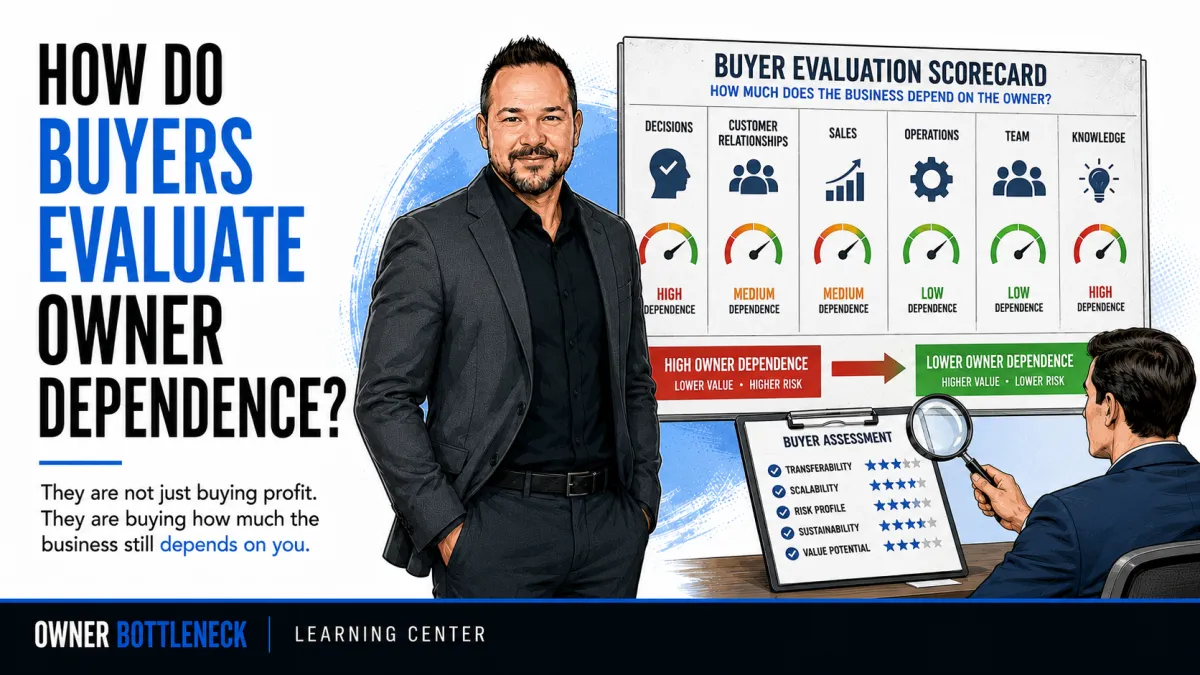
How Do Buyers Evaluate Owner Dependence?
Buyers evaluate owner dependence by tracing how the business produces revenue, serves customers, makes decisions, solves problems, and operates when the owner isn’t involved. They don’t rely only on what the seller says. They look for evidence that the company’s results can continue after the owner leaves.
The owner says:
My team runs most of the business now.
The buyer nods.
Then the buyer starts asking questions.
Who handles the largest customers?
The owner does.
Who approves discounts?
The owner does.
Who closes the bigger deals?
The owner does.
Who resolves problems between departments?
The owner does.
Who knows why certain jobs are priced differently?
The owner does.
Who steps in when a manager gets stuck?
The owner does.
The owner may genuinely believe the team runs the company.
From the owner’s point of view, employees perform most of the work.
From the buyer’s point of view, the owner still controls the judgment, relationships, and decisions that make the work successful.
That’s what buyers are trying to uncover.
They aren’t measuring how busy the owner looks.
They’re measuring how much of the company’s future still depends on the owner being there.
Key Takeaways
Buyers compare what the owner says with what the company’s records, employees, customers, and operating habits reveal.
Revenue, major customer relationships, decision authority, management strength, and owner-held knowledge usually receive the most attention.
A business may look independent on an organizational chart while still depending heavily on the owner in practice.
Buyers care more about demonstrated performance without the owner than promises that responsibilities can be transferred later.
Owner dependence may affect price, cash at closing, transition requirements, seller financing, earnouts, and whether the buyer proceeds.
The goal isn’t to hide the owner’s role. It’s to make that role clear, limited, and realistically transferable.
Buyers Don’t Take Your Word for It
A buyer will listen when you explain your role.
They just won’t stop there.
Owners often describe their involvement in broad terms:
I mostly oversee things.
The team handles the day-to-day.
I’m available when they need me.
I’m not really involved in operations anymore.
Those statements may be technically true.
They may also hide a lot.
“Overseeing things” might mean the owner:
Reviews every price
Talks to the top customers
Approves important purchases
Settles employee disputes
Fixes scheduling problems
Reviews every proposal
Makes every unusual decision
Keeps the management team accountable
The buyer’s job is to move past the description and understand what actually happens.
They want to know:
What would wait, weaken, change, or stop if this owner disappeared after closing?
That’s how they begin identifying an Owner Bottleneck.
The Buyer Is Trying to Answer Three Questions
Most of the buyer’s investigation comes back to three questions.
Will the earnings continue?
The buyer wants confidence that the revenue and profit shown in the financials aren’t tied primarily to the seller’s personal effort, reputation, or relationships.
Can the company keep operating?
The buyer wants to know whether employees, managers, systems, and processes can continue producing the work without the owner constantly coordinating everything.
How difficult will the owner be to replace?
Some owner responsibilities can be transferred through introductions, training, or documentation.
Others may require years of judgment, credibility, or relationship history.
The harder the owner is to replace, the more risk the buyer may see.
Buyers Start With the Financials
Financial statements don’t directly show owner dependence.
They leave clues.
A buyer may notice that revenue is strong but ask how that revenue is generated.
Are sales coming from a repeatable system?
Or do most opportunities come through the owner’s network?
Are margins consistent because the company has strong pricing controls?
Or because the owner personally reviews every unusual quote?
Does the business produce reliable profit when the owner takes time away?
Or do sales and productivity fall whenever the owner becomes less involved?
The numbers tell the buyer what happened.
They don’t always explain why it happened.
That’s why a buyer will begin connecting the financial results to the owner’s activities.
They may examine:
Revenue by customer
Revenue by salesperson
Gross margin by project
Sales concentration
Customer retention
Pricing history
Adjustments made to owner compensation
Related-party expenses
Unusual or one-time revenue
Changes during periods when the owner was absent
A profitable company can still have an owner dependence problem.
The concern is whether the profit belongs to the business or whether part of it depends on the owner continuing to perform unpaid, underpaid, or difficult-to-replace work.
That’s one reason owner dependence can create a Value Bottleneck.
Buyers Trace Where Revenue Comes From
Revenue is usually one of the first places dependence becomes visible.
The buyer may ask:
Who generates the leads?
Who follows up?
Who prepares proposals?
Who determines pricing?
Who closes the sale?
Who maintains the relationship?
Who handles renewals?
Who saves an account when something goes wrong?
The company may employ salespeople.
But if the owner is still required to close the meaningful opportunities, the buyer may not see a proven sales function.
They may see sales support surrounding one irreplaceable closer.
The same issue can appear in referrals.
An owner may say:
Most of our business comes from referrals.
The buyer may hear:
Most of our business comes from people who know and trust me personally.
Those aren’t always the same thing.
A healthy referral system can belong to the company.
An owner-controlled network may leave when the owner does.
The buyer will try to determine which one they’re purchasing.
Buyers Look Closely at Major Customers
A customer list can appear strong until the buyer asks who owns each relationship.
Suppose the company has a customer worth $500,000 a year.
That sounds valuable.
Then the buyer learns:
The customer calls the owner directly
The owner negotiates every renewal
The owner handles complaints
The customer has never met the management team
Important promises exist only in the owner’s memory
The relationship began through a personal friendship
The revenue is real.
The transferability of the revenue is less certain.
A buyer may want to know whether customers trust the company or whether they trust one person inside the company.
They may review customer concentration, contracts, renewal history, communication patterns, and account ownership.
They may also ask whether important customers can be introduced to another leader before closing.
This doesn’t mean every customer needs to become impersonal.
It means the relationship should have somewhere to go when the owner leaves.
The process for doing that is covered in How Do I Transfer Customer Relationships Away From Me?.
Buyers Follow the Decisions
An organizational chart tells the buyer who should make decisions.
Daily behavior shows who actually makes them.
The company may have:
A sales manager
An operations manager
A service manager
A controller
A general manager
Those titles look reassuring.
Then the buyer discovers that nearly every meaningful decision still moves upward.
Managers may need the owner to approve:
Discounts
Hiring
Pay increases
Customer remedies
Purchases
Schedule changes
Vendor decisions
Exceptions to policy
Employee discipline
Strategic priorities
The buyer may conclude that the business has managers in title but not in authority.
That matters because the buyer isn’t only purchasing employees.
They’re purchasing the company’s ability to make good decisions after the owner leaves.
A capable team that can’t decide isn’t a management system.
It’s a waiting line.
Buyers may learn this through approval records, emails, meetings, job descriptions, employee conversations, and the owner’s calendar.
They may also ask managers a simple question:
What can you decide without calling the owner?
The answer can reveal more than the org chart.
Buyers Test the Management Team
Owners often overestimate management depth because they confuse loyalty and experience with leadership.
A manager may have worked in the company for fifteen years.
That doesn’t automatically mean they can run it.
The buyer will want to understand whether the management team can:
Set priorities
Make decisions
Solve problems
Lead employees
Manage performance
Coordinate departments
Protect standards
Understand the financial impact of decisions
The buyer may meet with key managers during due diligence.
They’ll listen to what those managers say.
They’ll also notice what the managers don’t know.
Can they explain how the business makes money?
Can they describe their team’s performance?
Can they identify the largest risks?
Can they explain what they would do if the owner were unavailable?
Or do they keep looking toward the owner before answering?
That moment matters.
The buyer may not expect the management team to know everything.
They do want evidence that leadership exists beyond the seller.
A company with strong managers may still need the owner for strategy and a few important relationships.
That’s different from a company where every leader becomes uncertain without the owner’s approval.
Read How Do I Build a Management Team That Can Run the Business Without Me? for a deeper look at building real management capacity.
Buyers Watch How the Business Operates
A business may have documented processes and still depend heavily on the owner.
The steps may be written down.
The judgment may not be.
For example, an employee may know how to prepare a quote.
They may still need the owner to decide:
Whether the customer is worth pursuing
How much risk to accept
Whether to adjust the margin
Which exceptions are reasonable
What promise can safely be made
When to walk away
A buyer may examine:
Operating procedures
Workflows
Quality controls
Scheduling
Escalation rules
Project management
Customer service
Inventory
Financial reporting
Performance dashboards
They’re looking for more than documentation.
They want to see whether the company can use the documentation without the owner interpreting everything.
A process that constantly returns to the owner isn’t fully transferred.
It’s documented dependence.
Buyers Look for Knowledge That Can’t Be Found Anywhere Else
Every experienced owner carries knowledge.
That’s normal.
The problem appears when the company’s most important knowledge exists only inside the owner’s head.
The owner may know:
Why a customer receives special treatment
Which vendor can solve an emergency
Which employee needs a different management approach
Why a certain job always loses money
Which risks aren’t obvious
When a standard process shouldn’t be followed
How to recognize a problem before it becomes expensive
Buyers become concerned when that knowledge hasn’t been shared, documented, taught, or tested.
The owner may say:
I can teach the buyer all of that during the transition.
Some knowledge can transfer that way.
Some can’t.
Twenty years of pattern recognition doesn’t move through a three-week handoff.
The earlier the business begins capturing decision rules, customer context, standards, and lessons, the easier the company becomes to understand and operate.
That process is explained in How Do I Get the Knowledge in My Head Into the Business?.
Buyers Compare the Story With the Evidence
The owner says the business runs without them.
The buyer asks to see the last time that happened.
Did the owner take a two-week vacation?
What happened?
Were decisions delayed?
Did employees keep calling?
Did sales slow down?
Did customer complaints wait?
Did the owner attend meetings from the beach?
Did the owner spend every morning checking email?
A buyer may care less about whether the owner physically entered the building.
They care about whether the company continued using the owner’s judgment and attention.
That’s why a real absence is so valuable.
It creates evidence.
A company that has performed successfully without the owner can show:
Sales continued
Customers were served
Managers made decisions
Problems were solved
Financial reporting remained current
Operations stayed on schedule
Quality remained stable
The owner doesn’t need to vanish permanently before selling.
But proof beats a promise.
Read Can Your Business Run Without You for 30 Days? to test what still comes back to you.
What Will Buyers Ask During Due Diligence?
Buyers may ask direct questions about your role.
The useful questions often sound simple:
What do you do every week?
Which customers would notice first if you left?
Which sales require your involvement?
What decisions can’t be made without you?
Who runs the company when you’re gone?
Which employees are most important?
What knowledge hasn’t been documented?
What problems always come back to you?
How long would it take someone to replace your role?
The quality of the answer matters.
So does the consistency of the answer.
If the owner says managers make decisions but managers say they need permission, the buyer notices.
If the owner says customers are loyal to the company but every important email comes from the owner, the buyer notices.
If the owner says sales are repeatable but the pipeline depends on the owner’s personal relationships, the buyer notices.
Owner dependence usually isn’t discovered through one dramatic admission.
It appears through dozens of small contradictions.
Employees May Reveal More Than the Owner
Most owners aren’t trying to mislead a buyer.
They’re simply used to how the company works.
The owner may no longer notice how often employees depend on them.
Employees notice.
A buyer may ask employees:
What happens when you need a decision?
Who handles an unhappy customer?
Who approves pricing?
Who solves problems between departments?
What happens when the owner is out?
Which responsibilities would be hardest to replace?
The employee may say:
We usually wait until Darrell gets back.
That one sentence can change how the buyer understands the company.
It doesn’t mean the employees are weak.
They may have been trained to wait.
A company can accidentally teach good people that initiative is risky and owner approval is safer.
The buyer then has to decide how difficult that pattern will be to change.
Different Buyers May Judge the Same Dependence Differently
Owner dependence doesn’t affect every buyer the same way.
An individual buyer planning to work inside the company may be willing to replace part of the owner’s role personally.
A strategic buyer may already have sales, management, finance, technology, or operating systems that can absorb the dependence.
A financial buyer may want an established management team because they don’t intend to run daily operations.
An internal buyer may understand the company but still lack the authority or experience needed to lead it.
The dependence is the same.
The buyer’s ability to solve it is different.
That’s why a business may receive weak interest from one buyer and strong interest from another.
The right buyer doesn’t make owner dependence disappear.
They may simply be better equipped to replace it.
How Do Buyers Turn Owner Dependence Into Deal Terms?
Once a buyer identifies dependence, they decide how to address the risk.
Sometimes that affects the price.
Sometimes it affects how the price is paid.
Sometimes it affects how long the owner must remain.
A buyer may request:
A longer transition
Customer introductions
A consulting agreement
Seller financing
An earnout
A holdback
Payments tied to customer retention
Additional employee retention agreements
Stronger representations or protections
The buyer may still like the company.
They may simply be unwilling to carry all the risk alone.
That’s why the highest offer isn’t always the best offer.
A large headline price with years of uncertainty may be less attractive than a lower price with more cash at closing and a cleaner exit.
Business sale terms involve legal, tax, financial, and transaction risks. Use qualified advisors when evaluating offers or negotiating a deal.
For a broader explanation of how dependence can shape a transaction, read Can I Sell a Business That Depends on Me?.
What Doesn’t Convince a Buyer?
A new organizational chart doesn’t prove the company has management.
A thick operations manual doesn’t prove employees can operate without you.
A newly hired general manager doesn’t prove the company has been transferred.
A week-long vacation doesn’t prove independence if you answered calls every day.
A seller saying, “The buyer can easily take over,” doesn’t prove the role is easy to replace.
Buyers trust evidence.
They want to see:
Managers making decisions
Customers working with other people
Sales closing without the owner
Stable results during owner absences
Knowledge being used by employees
Clear financial reporting
Accountability beyond the owner
Don’t create the appearance of independence right before selling.
Build operating history.
How Should You Prepare Before a Buyer Starts Looking?
Start by seeing the company the way a buyer will.
Track your involvement for two weeks.
Don’t record only the time you spend.
Record the value of what you do.
Write down every decision, customer conversation, approval, exception, sales action, employee issue, and piece of knowledge that reaches you.
Then ask:
Could someone else handle this today?
If not, what would they need?
How long would it take to transfer?
What would happen if I stopped doing it?
Focus first on the dependencies connected to revenue, major customers, management, operations, and financial control.
Those are the areas most likely to affect the buyer’s confidence.
Move important customer relationships before the sale.
Give managers real authority before the sale.
Capture critical knowledge before the sale.
Test owner absences before the sale.
Let the business produce evidence before the sale.
The goal isn’t to fool the buyer into thinking you don’t matter.
The goal is to make sure the company can keep the value you created.
A 90-Day Buyer Readiness Test
During the first 30 days, map what still depends on you.
Track decisions, customers, sales, approvals, problems, and knowledge.
Identify the five dependencies that would concern a buyer most.
During the next 30 days, transfer one meaningful responsibility in each high-risk area.
That might mean:
Moving a customer relationship
Giving a manager pricing authority
Teaching someone to run an operating meeting
Capturing an important decision process
Removing yourself from a recurring approval
During the final 30 days, test the transfer.
Step back.
Let the new owner of the responsibility handle the work.
Review the result after the decision has been made.
Don’t take the responsibility back the first time something feels uncomfortable.
At the end of 90 days, ask:
Did the company become more capable, or did the work simply return to me?
That answer tells you whether the dependence moved or merely paused.
How Do You Know a Buyer Will See Less Risk?
The company is becoming more transferable when:
Customers trust people beyond the owner
Sales continue without the owner closing every opportunity
Managers can explain and defend their decisions
Normal operating issues don’t reach the owner
Important knowledge exists inside the company
Financial reporting is current and understandable
Employees know who has authority
The business performs during real owner absences
The owner’s remaining role is clear
The transition can be described realistically
You don’t need to make the owner invisible.
You need to make the business understandable without them.
Buyers Are Purchasing the Future, Not Rewarding the Past
The owner sees the years of work it took to build the company.
The buyer sees what happens next.
The owner sees the customers they won.
The buyer sees whether those customers will stay.
The owner sees every problem they solved.
The buyer sees whether someone else can solve the next one.
The owner sees loyalty.
The buyer sees concentration.
The owner sees experience.
The buyer sees knowledge that may leave after closing.
That doesn’t make the buyer cold.
It makes them a buyer.
They’re trying to determine whether the company’s value has moved from the owner into the business.
The strongest answer isn’t:
I’ll stay and help with everything.
The strongest answer is:
Here’s what still depends on me, here’s what has already been transferred, and here’s the evidence that the company can continue without me.
That’s what reduces uncertainty.
That’s what creates trust.
And that’s what gives the owner a better chance of selling the company without selling years of future involvement along with it.
Frequently Asked Questions
Do Buyers Talk to Employees During Due Diligence?
They may, especially when management strength and employee retention are important to the transaction.
The timing and scope of employee conversations depend on the deal and confidentiality requirements.
Will Buyers Contact Customers Before Closing?
Sometimes, but customer contact is often handled carefully because the seller may not want customers informed too early.
The parties may agree on when introductions or customer confirmations can occur.
Use qualified transaction and legal advisors when planning those conversations.
Can Strong Financials Overcome Owner Dependence?
Strong financials help, but they don’t automatically solve the problem.
The buyer still wants to know whether those financial results can continue after the owner leaves.
Does Having Managers Prove the Business Isn’t Owner-Dependent?
No.
Managers need real authority, accountability, and a history of producing results.
Titles alone don’t prove management depth.
How Far Back Will Buyers Look?
The period depends on the buyer, lender, business, and transaction.
Buyers commonly want enough history to understand revenue, profitability, customer concentration, operating trends, and unusual changes.
Should I Hide How Much the Business Depends on Me?
No.
Trying to hide owner dependence can damage trust and create legal or transaction problems.
Present the owner’s role accurately and show how the remaining responsibilities can be transferred.
Will a Buyer Pay More if the Business Runs Without Me?
A more transferable business may create greater buyer confidence, stronger negotiating leverage, and broader buyer interest.
That doesn’t guarantee a specific price.
Many other factors also affect value and deal terms.
See What a Buyer Would Find
A buyer won’t only look at your financial statements.
They’ll look for the decisions, relationships, knowledge, sales, and operating responsibilities that still depend on you.
The free Owner Bottleneck Scorecard helps you identify that dependence before a buyer does.
It evaluates the business across:
Decisions
Sales
Operations
Team
Value