
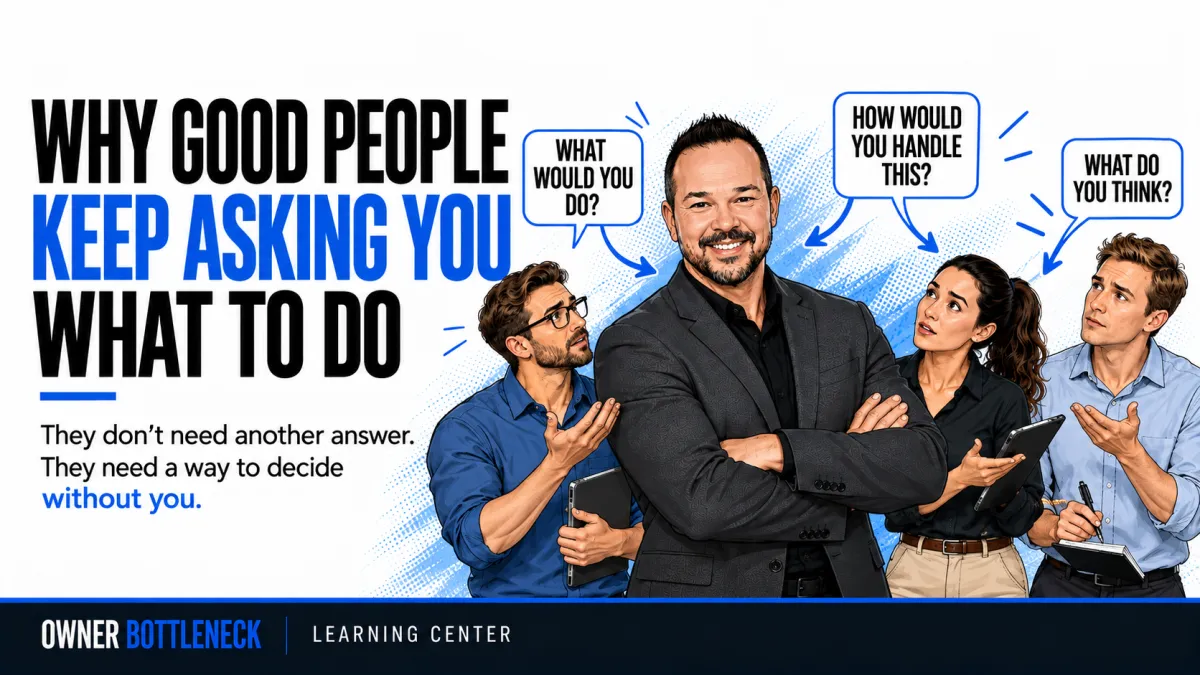
Why Good People Keep Asking You What to Do
The owner had a good employee.
Smart.
Hard working.
Wanted to do things right.
There was only one thing driving the owner crazy.
The employee kept asking questions.
“What do you want me to do here?”
“Would you be okay with this?”
“How would you handle it?”
At first, the owner answered.
It was faster.
Then the questions kept coming.
One day the owner finally said:
“I hired you so I would not have to make every decision.”
The employee looked confused.
From the employee’s point of view, they were doing exactly what the owner had taught them to do.
When you are not sure, ask me.
Good People Can Become Very Dependent
This is what makes a Team Bottleneck so frustrating.
The people may not be the problem.
They may care a lot.
They may want to protect the business.
They may know the work better than anyone.
But they also know that you have the final say.
So why take a risk?
Why guess what the owner wants when they can just ask?
It feels safe.
And every time you answer, the question goes away.
For now.
But another one comes tomorrow.
Then another.
Soon, your team is doing the work while you are still carrying all the thinking.
You May Have Taught Them to Ask
Imagine this.
An employee makes a call on their own.
You look at it and say:
“I would not have done it that way.”
So you change it.
A few days later, they make another call.
You change that one too.
Maybe you are right both times.
That is not the point.
Your employee is learning something.
My answer may get changed anyway.
So next time, they ask first.
That feels safer.
They do not want to mess up.
They do not want to get corrected.
They do not want to waste time doing something twice.
So they walk into your office.
“What do you want me to do?”
You answer.
The problem gets solved.
Then you wonder why everyone keeps asking you what to do.
But the team may only be following the rule they learned:
Do not decide until you know what the owner wants.
The Problem Is Not the Question
This is where owners can make things worse.
They get tired of being asked.
So they tell the team:
“Stop bringing everything to me.”
That sounds good.
But it does not teach anyone what to do instead.
Your people still want to make a good call.
They still want to know what matters.
They still want to know what they are allowed to decide.
If those things are not clear, asking you is still the safest choice.
The fix is not fewer questions.
The fix is better thinking.
Stop Giving Away the Answer So Fast
The next time someone asks what you would do, try something different.
Do not answer right away.
Ask:
“What do you think we should do?”
Then ask:
“Why?”
Now you can hear how they are thinking.
If their answer makes sense, let them make the call.
Even if it is not exactly how you would do it.
That part matters.
If the result will still be good, they may not need to do it your way.
If their answer misses something important, show them what they missed.
Do not just replace their answer with yours.
Maybe they forgot the cost.
Maybe they missed a promise made to the customer.
Maybe they did not see the risk.
Maybe they were protecting speed but hurting quality.
Now they are learning how to think through the problem.
Not just how to get an answer from you.
Let Good People Be Good
This can be hard for owners.
You built the business.
You have seen more problems.
You know what has gone wrong before.
So your answer may be better.
But if you always step in, your team never gets enough reps to get better.
They need room to think.
They need room to choose.
And sometimes they need room to make a small mistake.
That is how judgment grows.
If your people keep waiting for you, read How Do I Get Employees to Take More Ownership?
And if you want to help them build better judgment, read How Do I Teach Employees to Make Good Decisions Without Me?
The Goal Is Not Silence
You do not want a team that never asks for help.
Some things should come to you.
The goal is not to make people afraid to ask.
The goal is to stop making you the first stop for every hard choice.
You want people who can look at a problem, think it through, and bring you a point of view.
Instead of:
“What should I do?”
You start hearing:
“Here is what I think we should do, and here is why.”
That is a very different team.
And it creates a very different business.
Want to see where your business still depends on you? Take the Owner Bottleneck Scorecard.
If you want one short idea like this each week, join the Owner Bottleneck Brief.