
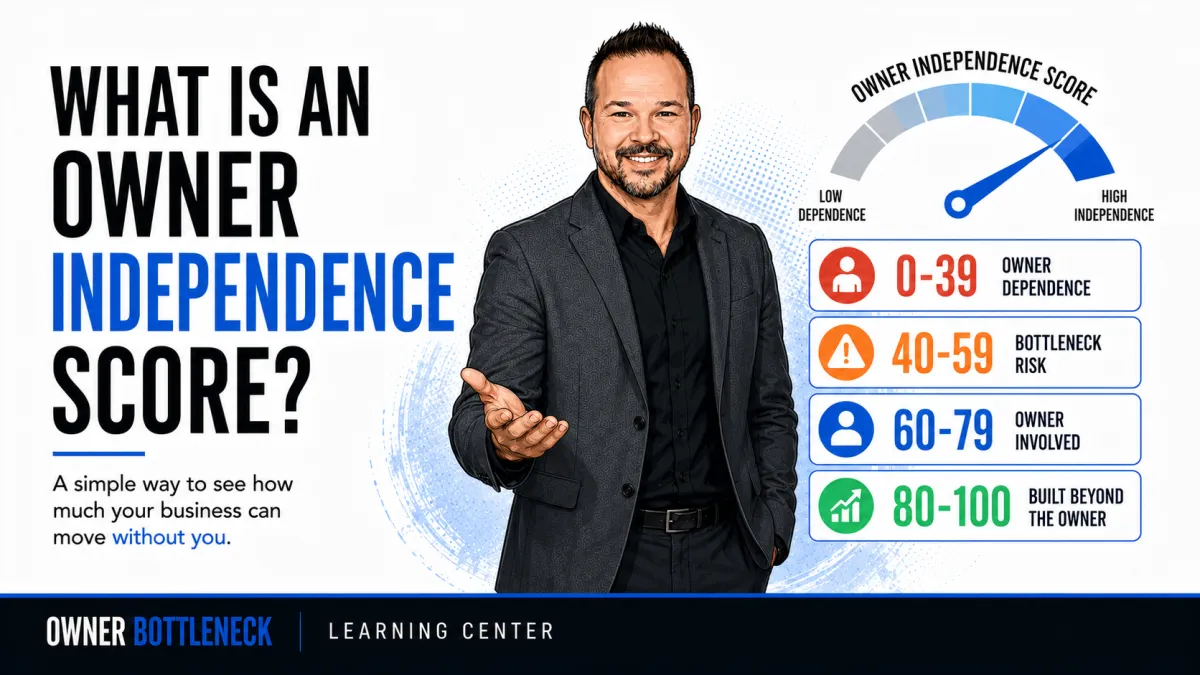
What Is an Owner Independence Score?
An owner looked at his score and asked me a simple question.
“72. Is that good?”
Fair question.
But it wasn’t the first question I wanted him asking.
Because an Owner Independence Score isn’t a grade on you as an owner.
It doesn’t tell you whether you have a good business.
It doesn’t tell you whether you work hard enough.
And it doesn’t tell you whether you should disappear from the company.
It tells you something much more useful:
How much can the business keep doing without everything needing to run through you?
That’s the point of an Owner Independence Score.
The number helps you see the dependence.
Then you figure out what’s creating it.
Key Takeaways
An Owner Independence Score is a 0 to 100 diagnostic score that shows how much the business can operate without depending on the owner for everything.
A higher score means more of the business can move through the team, systems, processes, and customer relationships without needing the owner.
A lower score means important parts of the business still depend heavily on the owner.
The score is not a business valuation, a grade on the owner, or an industry benchmark.
The number matters less than understanding where the dependence behind the number is coming from.
What Is an Owner Independence Score?
An Owner Independence Score is a 0 to 100 score I use to help measure how much a business can operate without everything running through the owner.
The score comes from the Owner Bottleneck Scorecard.
The Scorecard looks at 10 areas where owner dependence can hide:
Decision dependence
Sales dependence
Customer relationship dependence
Operations dependence
Team ownership
Financial visibility
Revenue predictability
Systems and handoffs
Owner freedom
Business value beyond the owner
The goal isn’t to prove that the owner is unnecessary.
That would be the wrong goal.
The goal is to see whether the owner is valuable by choice or required by design.
There’s a big difference.
What Does a Higher Owner Independence Score Mean?
A higher score means more of the business can operate without waiting for the owner.
People can make more of the right decisions.
Customers trust more than one person.
Work moves from one person or department to the next.
The team owns more outcomes.
Revenue doesn’t rely entirely on the owner’s personal effort.
Important knowledge exists somewhere besides the owner’s head.
The owner can step away without normal work immediately slowing down or coming apart.
That doesn’t mean the owner stops leading.
It means leadership and dependence are no longer the same thing.
What Does a Lower Owner Independence Score Mean?
A lower score means the business still needs more from the owner to keep normal work moving.
That dependence might not look dramatic.
The company may be profitable.
It may have employees.
It may have managers.
It may have systems.
But look closer.
The manager still wants your approval.
The salesperson still needs you for the hard deal.
The customer still asks for you when something goes wrong.
The team knows the process until something unusual happens.
The numbers exist, but you still have to dig to understand what’s really happening.
You leave for a few days, but the questions come with you.
The business works.
It just works by borrowing too much from the owner.
That’s what a lower score is trying to expose.
How Do You Interpret an Owner Independence Score?
I currently use four ranges in the Owner Bottleneck Scorecard.
80 to 100: Built Beyond the Owner
The business is in a stronger position.
It still needs leadership.
It just doesn’t need the owner for everything.
The team, systems, handoffs, customer relationships, and operating structure can carry much more of the business without everything returning to one person.
That doesn’t mean there are no Owner Bottlenecks left.
There usually are.
The question becomes:
Where is the remaining dependence still creating drag?
60 to 79: Owner Involved, But Improving
The business has real capacity beyond the owner.
Some things have transferred.
Some haven’t.
That can be a tricky place.
You may be able to leave early.
Take a few days off.
Hand work to managers.
Stay out of certain meetings.
From the outside, it can feel like the business is becoming independent.
Then one important customer calls.
Or one strange problem happens.
Or one decision falls outside the normal rules.
And everything comes back to you.
The business has made progress.
But there are still important places where you’re required.
40 to 59: Owner Bottleneck Risk
The company works, but too much still runs through the owner.
Decisions may wait.
Customer relationships may still belong to you.
Revenue may depend too much on your effort.
The team may complete work without fully owning the outcome.
Processes may work until something unusual happens.
You probably don’t need to fix everything.
But you do need to find where owner dependence is creating the most drag.
0 to 39: Owner Dependence
The business is highly dependent on the owner.
If you become unavailable, important parts of the company are likely to slow down, stall, weaken, or come back to you.
That doesn’t mean you built a bad business.
It means too much of the capability still lives in one place.
You.
That’s an Owner Bottleneck.
Is a Higher Owner Independence Score Always Better?
Generally, you want the business to become less dependent on you.
But that does not mean the goal is zero owner involvement.
Some things should stay with the owner.
You may choose to own strategy.
Capital allocation.
Certain major relationships.
Acquisitions.
Culture.
High-risk decisions.
Work you simply enjoy doing.
That’s fine.
The question isn’t:
Am I involved?
The better question is:
Does this need me?
I call that the difference between owner involvement and owner dependence.
Involvement can be intentional.
Dependence isn’t.
If you want to measure that distinction more closely, read How to Measure Owner Dependence in Your Business.
What an Owner Independence Score Does Not Tell You
This part matters.
An Owner Independence Score is a diagnostic tool.
It is not a perfect diagnosis.
It is not a business valuation.
It is not a guarantee that your business can run without you.
It is not a nationally recognized benchmark.
And a score of 82 doesn’t automatically mean your business is “better” than someone else’s business with a 61.
The score gives you a place to start.
That’s all I want it to do.
Because one number can hide very different businesses.
Can Two Businesses Have the Same Score and Different Owner Bottlenecks?
Absolutely.
Imagine two owners both score 58.
The first owner has a strong team and solid operations.
But nearly every important sale still depends on the owner.
Customers buy because of the owner’s reputation.
The owner joins difficult sales calls.
The owner handles the biggest accounts.
That business may have a Sales Bottleneck.
The second owner also scores 58.
Sales runs fine without them.
But operations are a mess whenever they leave.
People need the owner to connect departments.
Handoffs break.
Strange situations wait for the owner’s judgment.
That business may have an Operations Bottleneck.
Same overall score.
Very different problem.
That’s why I don’t want an owner obsessing over the number.
The score points toward the problem.
The problem is what we need to fix.
Should You Try to Improve Your Owner Independence Score?
Yes, but I wouldn’t manage the business around the score.
That can become another vanity metric.
The goal isn’t:
How do I get from 62 to 80?
The better question is:
What keeps needing me that shouldn’t?
Start there.
Maybe pricing exceptions keep coming back to you.
Maybe one important customer only trusts you.
Maybe your manager can run the department until somebody has to make a judgment call.
Maybe your salespeople can present the offer but still need you to close it.
Maybe a process exists, but the handoff between two departments still requires you to connect the dots.
Pick the biggest recurring dependency.
Fix it.
Then watch what changes inside the business.
Don’t rely on the score alone. Owner Dependence KPIs can show whether normal business is actually requiring fewer of your decisions, approvals, relationships, judgment, follow-up, or presence while performance stays strong.
The score should improve because the business became stronger.
The business shouldn’t change just because you wanted a better score.
What Should You Do After You Get Your Score?
Don’t try to attack ten things.
Find the biggest constraint.
Look at where the business repeatedly:
Waits.
Slows.
Weakens.
Changes.
Stops.
Those are the signals I use when looking for owner dependence.
Then ask:
What did the business need from me?
Was it your decision?
Your approval?
Your judgment?
Your relationship?
Your knowledge?
Your standard?
Your follow-up?
Your presence?
Once you know what the business is borrowing from you, you can start figuring out how to build that capability somewhere else.
Once you see the dependency, the next question is what it’s costing. The Owner Bottleneck Cost Model looks at five forms of drag: Queue Cost, Owner Time Cost, Rescue Cost, Capacity Cost, and Transferability Cost.
That’s much more useful than simply trying to “delegate more.”
What Does a Good Owner Independence Score Look Like?
There isn’t one perfect score for every company.
Different businesses need different levels of owner involvement.
Different stages of growth create different demands.
And some responsibilities should remain with ownership.
That’s why I wouldn’t use the Owner Independence Score as a universal benchmark.
I use it as a diagnostic.
The direction matters.
The pattern matters.
And the dependence behind the number matters most.
If your score shows that normal business repeatedly needs your decisions, relationships, knowledge, approval, judgment, standards, or presence, there’s something worth looking at.
Frequently Asked Questions
Is an Owner Independence Score the Same as an Owner Bottleneck Score?
The Owner Independence Score is the overall result produced by the Owner Bottleneck Scorecard.
It shows how independently the business can operate across the areas measured by the Scorecard.
The Owner Bottleneck is the underlying dependence the score is trying to uncover.
Is 80 a Good Owner Independence Score?
A score from 80 to 100 currently falls into the Built Beyond the Owner category in the Owner Bottleneck Scorecard.
That means the business has stronger independence from the owner overall.
It doesn’t mean there are no remaining bottlenecks.
Look at where dependence still shows up and whether it matters.
Can a Profitable Business Have a Low Owner Independence Score?
Yes.
Profit and owner independence measure different things.
A business can produce strong revenue and profit while still depending heavily on the owner’s decisions, relationships, knowledge, sales ability, or daily involvement.
The question is what happens when the owner isn’t available.
Is the Owner Independence Score a Business Valuation?
No.
The Owner Independence Score is not a valuation and should not be used as one.
Owner dependence can affect transferability and business risk, but your score does not tell you what the company is worth.
Can My Owner Independence Score Change?
Yes.
If decisions move to the right people, customer trust transfers, systems improve, handoffs become stronger, team ownership grows, and the business becomes less dependent on you, the underlying conditions measured by the Scorecard should change too.
But again, don’t chase the score.
Build a stronger business.
Let the score follow.
Your Score Is a Starting Point
A number by itself won’t fix an Owner Bottleneck.
It can show you where to look.
That’s the value of an Owner Independence Score.
It gives you a way to stop saying:
“The business still needs me too much.”
And start asking:
“Where does it need me, and why?”
That question is much easier to attack.
The free Owner Bottleneck Scorecard takes 10 questions and gives you your Owner Independence Score, category breakdown, and strongest owner-dependence signal.