
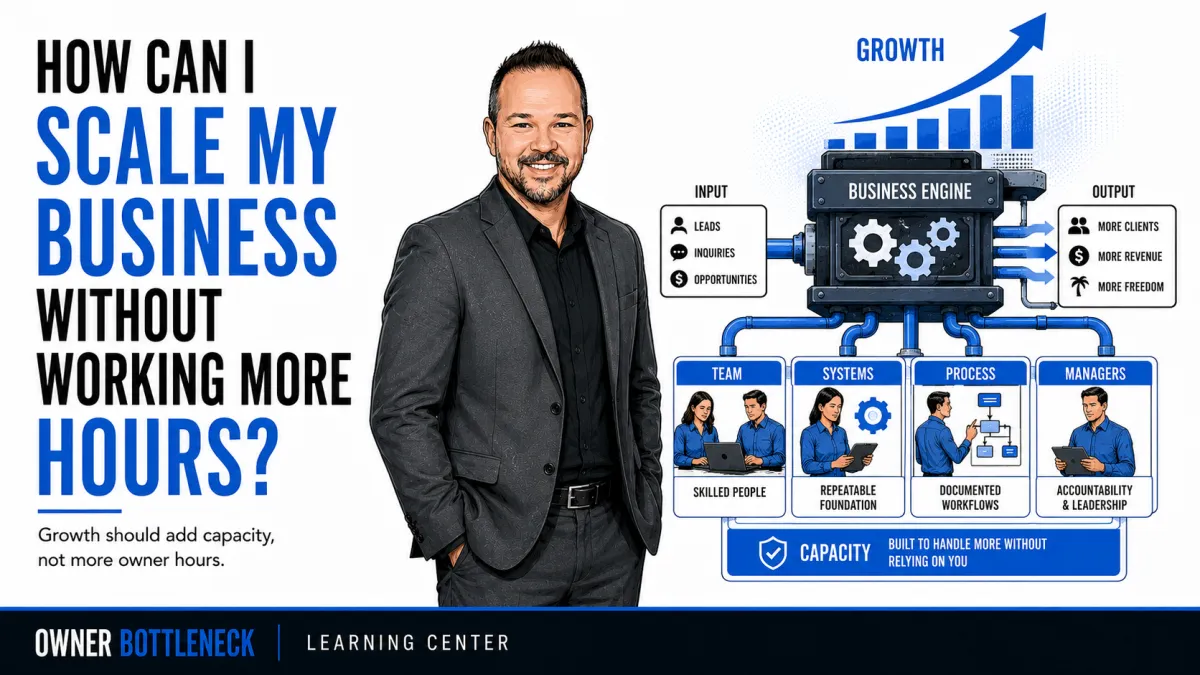
How Can I Scale My Business Without Working More Hours?
You can scale your business without working more hours when revenue, customers, employees, decisions, and complexity can increase without requiring a matching increase in your personal involvement.
That doesn’t happen by working faster.
It doesn’t happen by squeezing more tasks into the same day.
It doesn’t happen because you finally find the perfect productivity app.
It happens when the company builds the capacity to carry more without sending the additional weight back to the owner.
Many owners believe they’re scaling because revenue is growing.
But revenue growth and business scale aren’t the same thing.
If revenue increases 20 percent and your workload increases 20 percent, the company grew.
It didn’t necessarily scale.
If every new customer creates more owner questions, approvals, exceptions, follow-up, and problem-solving, growth may increase income while making the business harder to own.
The business gets bigger.
The owner becomes busier.
Eventually, growth reaches the limit of what one person can carry.
That limit is the Owner Bottleneck.
Key Takeaways
Growth means the business produces more. Scale means it can produce more without requiring a matching increase in owner effort.
If every new customer, employee, or dollar of revenue creates more owner work, the business is growing through the owner rather than through the company.
You don’t scale by delegating tasks while keeping every meaningful decision.
Repeatable demand, delivery capacity, management capacity, decision authority, financial visibility, and clear standards must grow together.
Hiring more people won’t fix the problem when the owner remains responsible for coordinating and managing everyone.
The goal isn’t to stop working. It’s to stop making owner time the company’s primary source of capacity.
A business is beginning to scale when results can grow while the owner’s daily involvement stays stable or decreases.
What Does It Actually Mean to Scale a Business?
Scaling means increasing the company’s output without increasing costs, complexity, and owner effort at the same rate.
That output may include:
Revenue
Customers
Locations
Employees
Projects
Transactions
Products
Service capacity
Profit
A company doesn’t need to become enormous to scale.
A local service business can scale.
A professional firm can scale.
A construction company can scale.
A manufacturer can scale.
A business with 15 employees can scale.
The question isn’t how large the company becomes.
The question is how the company carries growth.
A scalable business can add customers without the owner personally managing every relationship.
It can add employees without the owner becoming everyone’s direct manager.
It can make more decisions without routing them all through one person.
It can handle more work without the owner coordinating every handoff.
It can maintain standards without the owner personally inspecting everything.
The business develops capacity inside the company.
That’s the difference.
Growth and Scale Aren’t the Same
Growth usually adds more.
More customers.
More revenue.
More employees.
More projects.
More locations.
More responsibility.
Scale changes the relationship between more output and more owner involvement.
Imagine two companies.
Both grow from $2 million to $4 million in revenue.
In Company A, the owner works more hours, approves more decisions, handles more customer problems, attends more meetings, and manages more employees.
In Company B, managers own the major functions, normal decisions happen at the right level, standards are clear, performance is visible, and the owner focuses on direction and leadership.
Both companies grew.
Only one became less dependent on the owner while growing.
Company A added revenue.
Company B added capacity.
That distinction matters because growth without capacity eventually creates stress, delays, weaker quality, customer problems, and owner exhaustion.
Why Does Growth Usually Create More Owner Work?
Growth exposes whatever the business never learned to do without you.
When the company is small, you can personally cover the gaps.
You answer the question.
Call the customer.
Fix the schedule.
Approve the price.
Train the employee.
Check the work.
Remember the promise.
Follow up on the deadline.
You become the system.
That can work for a while.
Then growth multiplies the number of situations that need your attention.
Ten customers create ten sets of questions.
Twenty customers create twenty.
Five employees create five sources of communication and coordination.
Fifteen employees create more handoffs, management problems, exceptions, and decisions.
The company’s volume increases.
The operating system remains attached to the owner.
That’s when owners say:
We’re growing, but it feels like the business is getting harder to run.
Growth didn’t create every weakness.
It revealed them.
The Owner-Hour Scale Test
Ask a simple question:
When the business grows, what happens to the number of hours I must personally contribute?
There are three common patterns.
Pattern 1: Owner Hours Rise Faster Than Revenue
The business becomes less efficient as it grows.
More customers create disproportionately more problems, complexity, and owner involvement.
This is dangerous growth.
Pattern 2: Owner Hours Rise With Revenue
The business may be growing, but owner time remains a direct input.
More revenue requires more of you.
The company hasn’t created much leverage.
Pattern 3: Revenue Grows While Owner Hours Stay Stable or Decrease
The company is developing internal capacity.
Managers, systems, standards, information, and decision authority are carrying more of the load.
That’s the pattern you’re trying to build.
This doesn’t mean owner hours must constantly decline.
Growth may require temporary investment from the owner.
You may spend more time hiring, training, building systems, or entering a new market.
The issue is whether that additional effort builds lasting company capacity or merely creates another permanent job for you.
The Five Ways Growth Becomes Attached to the Owner
Growth usually creates more owner work in five areas.
1. Decisions
More activity creates more decisions.
More pricing questions.
More schedule conflicts.
More customer exceptions.
More spending requests.
More hiring choices.
More quality issues.
More priority conflicts.
When decision authority hasn’t moved, growth increases the owner’s decision queue.
Employees may be working.
Managers may have titles.
Everyone still waits for the owner.
That’s a Decision Bottleneck.
You can’t scale decision-making by simply answering faster.
The business needs more people who can make sound decisions inside clear boundaries.
2. Sales
More growth may require more opportunities, follow-up, proposals, closing, and account management.
If the owner remains the company’s primary rainmaker, relationship builder, or closer, revenue is limited by the owner’s personal selling capacity.
The business may hire salespeople.
But if the owner still joins every important call, prices every opportunity, and reassures every major customer, the sales function hasn’t truly scaled.
That’s a Sales Bottleneck.
A scalable sales system produces trust and revenue through the company, not only through the owner.
3. Operations
More customers create more work.
More work creates more scheduling, coordination, handoffs, communication, quality control, and exceptions.
When the owner remains the person who keeps every day moving, growth creates more daily operating work for the owner.
That’s an Operations Bottleneck.
You don’t scale operations by asking everyone to move faster.
You scale by building ownership, standards, capacity, information, and operating rhythms into the company.
4. Team and Management
More employees don’t automatically create more capacity.
They can create more management work.
Employees need:
Direction
Training
Decisions
Feedback
Accountability
Coordination
Conflict resolution
Priorities
When every employee ultimately depends on the owner, hiring more people can make the Owner Bottleneck worse.
That’s a Team Bottleneck.
A scalable company doesn’t only add employees.
It adds management capacity.
5. Knowledge and Standards
Owners often carry the company’s invisible operating knowledge.
You know:
Which customers require special handling
What quality should look like
Which promises can safely be made
How to price unusual work
Which risks matter
How to handle exceptions
What tradeoffs are acceptable
Why the process works the way it does
As the company grows, more people need access to that judgment.
If the knowledge remains inside your head, more activity creates more questions for you.
The company can’t scale knowledge it hasn’t captured, taught, or distributed.
The Six Capacities a Business Must Build to Scale
Scale isn’t created by one system.
Several kinds of capacity must grow together.
1. Demand Capacity
The business needs a repeatable way to create opportunities.
That may include:
Referrals
Outbound sales
Content
Advertising
Partnerships
Events
Repeat customers
Sales development
Account expansion
If all demand comes through the owner’s personal relationships, the company’s growth remains limited by the owner’s reach.
The business needs a way to generate interest without waiting for the owner to personally create every opportunity.
2. Delivery Capacity
The company must be able to fulfill more work without quality collapsing.
Delivery capacity may require:
Clear processes
Trained employees
Reliable handoffs
Equipment
Vendors
Technology
Scheduling systems
Quality standards
Capacity planning
Cross-training
Selling more than the business can reliably deliver isn’t scale.
It’s a future customer problem.
3. Decision Capacity
The company must be able to make more decisions without creating a longer line outside the owner’s door.
That requires:
Clear decision ownership
Standards
Financial limits
Escalation points
Access to information
Coaching
Review rhythms
Start by separating the decisions that truly require you from the decisions the business should make.
This guide explains what you should delegate and what you should keep.
4. Management Capacity
More people require more leadership.
Managers must be able to:
Set priorities
Assign work
Make decisions
Coach employees
Address weak performance
Coordinate departments
Monitor results
Improve systems
Close commitments
A manager who only passes questions to the owner doesn’t add much management capacity.
To scale, the company needs leaders who can produce results through other people.
Read How Do I Build a Management Team That Can Run the Business Without Me? for the full framework.
5. Information Capacity
People can’t make decisions without information.
As the company grows, the right people need access to:
Customer history
Financial performance
Sales pipeline
Capacity
Schedules
Project status
Quality measures
Inventory
Employee performance
Company priorities
Information shouldn’t need to be requested from the owner every time.
It should live in systems the right people can access and understand.
6. Financial Capacity
Growth consumes cash.
More revenue may require:
Payroll
Inventory
Equipment
Vehicles
Marketing
Technology
Facilities
Training
Working capital
A growing business can be profitable and still run out of cash.
Scale requires financial visibility.
Owners and managers need to understand:
Gross margin
Cash flow
Capacity costs
Customer acquisition cost
Labor efficiency
Accounts receivable
Break-even points
The financial impact of growth
Growth that weakens cash, margin, and stability isn’t healthy scale.
How Do You Scale Without Adding More Owner Hours?
You change what carries the growth.
Step 1: Identify Where Growth Creates More Work for You
Look at the last stage of growth.
What increased?
Did you receive more:
Questions
Approvals
Customer calls
Pricing requests
Employee issues
Meetings
Schedule conflicts
Quality problems
Follow-up
Financial surprises
Don’t begin by asking how to work faster.
Ask why the additional volume became your responsibility.
For each item, identify:
What triggered it
Why it reached you
Who should eventually own it
What authority was missing
What information was missing
What standard was unclear
What system failed
Growth leaves clues.
Step 2: Separate Owner Work From Company Work
Some work truly belongs with the owner.
That may include:
Long-term direction
Capital allocation
Major risk
Ownership decisions
Executive leadership
Strategic opportunities
Other work reaches the owner because the business never built another place for it to go.
That may include:
Routine approvals
Scheduling
Customer remedies
Standard pricing
Employee follow-up
Project coordination
Normal purchasing
Quality checks
Departmental priorities
Don’t confuse work you’ve always done with work only you can do.
Those aren’t the same thing.
Step 3: Standardize What Repeats
Repeated work is where scale begins.
If the same question, problem, or exception reaches you regularly, create a repeatable answer.
That might include:
A checklist
A pricing rule
A decision boundary
A standard response
A workflow
A template
A meeting rhythm
An escalation rule
A quality standard
A dashboard
Don’t document every tiny action.
Capture what people need to produce a consistent result without relying on your memory.
Pay special attention to exceptions.
The normal process may already be easy.
The owner is often needed when reality doesn’t fit the normal process.
Step 4: Move Decisions With the Work
Delegating tasks without decisions doesn’t create scale.
It creates more people waiting for approval.
When someone owns an outcome, clarify:
What they can decide
What they can spend
What they can promise
What they can change
What requires review
What must be escalated
For example:
You own customer scheduling. You may move routine projects within available capacity, authorize overtime inside the monthly labor target, and communicate schedule changes directly to customers. Escalate any delay longer than five business days or any issue involving a cancellation risk.
The person can now move the work.
The owner doesn’t need to make every normal decision.
Step 5: Assign One Owner to Each Major Result
Scale breaks down when everyone is involved but nobody owns the outcome.
Every major result needs one clear owner.
Examples include:
Lead generation
Sales conversion
Customer onboarding
Scheduling
On-time delivery
Quality
Customer retention
Hiring
Cash collection
Financial reporting
Other people may support the work.
One person is responsible for making sure the result happens.
That person needs enough authority, information, and accountability to carry it.
This is the foundation of helping employees take more ownership.
Step 6: Build a Management Rhythm
The owner often stays involved because the company lacks a predictable way to surface information and problems.
Create a rhythm that provides visibility without requiring you inside every action.
That may include:
Daily departmental huddles
Weekly management meetings
Monthly financial reviews
Quarterly planning
One-on-one meetings
Visible commitments
Performance dashboards
The rhythm should answer:
What are we trying to accomplish?
What’s on track?
What’s off track?
What changed?
What needs a decision?
What risk is emerging?
Who owns the next step?
When will it be reviewed?
Visibility reduces the owner’s need to chase information.
Step 7: Add Capacity Before Everything Breaks
Many owners add people only after the business is overwhelmed.
By then:
Quality is slipping
Customers are frustrated
Employees are exhausted
The owner is buried
Training becomes rushed
The new hire enters chaos
Capacity planning means looking ahead.
Ask:
How much more volume can the current team carry?
Which role will become the next constraint?
What equipment or technology will be needed?
When will management capacity become too thin?
How long does hiring and training take?
What financial resources will growth require?
Don’t hire blindly.
But don’t wait until failure makes the decision for you.
Step 8: Remove Low-Value Complexity
Not all growth is good growth.
Some customers, products, services, and exceptions create far more complexity than value.
You may need to simplify:
Unprofitable offerings
Custom work
Low-value customers
Unnecessary approvals
Duplicate reports
Poorly designed services
Excessive options
Special exceptions
Weak processes
Scale becomes easier when the business stops carrying complexity that doesn’t produce enough return.
Sometimes the best way to increase capacity isn’t adding more.
It’s removing what shouldn’t be there.
Step 9: Test Whether the Capacity Is Real
Don’t assume the company can carry growth because the org chart looks better.
Test it.
Make yourself unavailable for normal operating decisions.
Start with one day.
Then three days.
Then one week.
Track:
What waited
What slowed
Which customers asked for you
Which decisions were delayed
Which managers lacked authority
Which information couldn’t be found
Which standards were unclear
Which commitments were missed
Each problem reveals where the business still depends on your involvement.
For a deeper transition plan, read How Do I Remove Myself From Daily Business Operations?.
What Should You Stop Doing First?
Don’t start by removing the work you dislike most.
Start with work that creates the greatest repeated drag on your capacity.
Look for tasks and decisions that are:
Frequent
Predictable
Repeatable
Time-consuming
Low to moderate risk
Easy to measure
Connected to a capable person
Guided by clear standards
Good first targets may include:
Routine pricing approvals
Scheduling
Standard customer remedies
Normal purchasing
Employee follow-up
Project status updates
Vendor coordination
Basic quality reviews
Routine sales follow-up
The best first move is often something that reaches you several times each week.
Removing one repeated dependency may create more freedom than delegating ten occasional tasks.
What Should the Owner Work On Instead?
Owner time shouldn’t disappear.
It should move toward work that increases the company’s future capacity.
That may include:
Developing managers
Clarifying strategy
Improving the offer
Building demand
Strengthening financial performance
Removing constraints
Recruiting key people
Building partnerships
Improving systems
Making capital decisions
Developing future leaders
Creating new opportunities
The owner shifts from producing today’s output to building tomorrow’s capacity.
That’s a different job.
Hiring More People Isn’t Always Scaling
Hiring can add capacity.
It can also add cost, communication, and management work.
Hiring won’t create scale when:
Roles are unclear
Authority remains with the owner
Processes are inconsistent
Standards live inside the owner’s head
Managers are weak
Information is scattered
Nobody owns outcomes
The owner still coordinates everything
In that environment, every employee becomes another person connected directly to the owner.
The company gets larger.
The Owner Bottleneck gets heavier.
Before hiring, define:
The outcome the role owns
The work the person will perform
The decisions they can make
The measures that matter
Who will manage them
How they’ll be trained
What capacity the role should create
Hire into a system.
Don’t hire people and hope the system appears later.
Software Isn’t Scale Either
Technology can help.
But software doesn’t fix unclear ownership, weak management, poor standards, or missing accountability.
A new system may make the same confusion move faster.
Before buying software, ask:
What problem are we solving?
Who owns the process?
What should the process produce?
Where does it fail today?
What information is needed?
What behavior must change?
How will we measure success?
Technology should support a working operating model.
It shouldn’t be expected to invent one.
How Do You Know Whether You’re Actually Scaling?
Look for evidence.
The company may be scaling when:
Revenue grows without matching growth in owner hours
Decisions happen faster without owner approval
Managers own measurable results
Sales are produced by repeatable channels
Customers trust people beyond the owner
Quality remains stable as volume grows
Employees solve normal problems
The owner is copied on fewer conversations
The company can absorb additional work
Financial performance remains visible
Owner absences don’t create major backlogs
Growth doesn’t automatically create chaos
The owner may still work hard.
Scaling isn’t about avoiding effort.
It’s about making sure the company’s growth doesn’t depend on endlessly increasing owner effort.
What If Growth Slows While You Build Capacity?
That may happen.
Building capacity takes time.
Managers need development.
Processes need improvement.
Standards need clarification.
New employees need training.
Technology needs implementation.
The owner may temporarily invest more time while building the next level.
The important question is:
Will this work reduce future dependence, or will it create another permanent responsibility for me?
Temporary effort can create scale.
Permanent owner rescue doesn’t.
Should You Grow Before Fixing the Owner Bottleneck?
It depends on the severity of the dependence.
You don’t need a perfect company before growing.
But growth can amplify serious weaknesses.
Be cautious when:
Customers already wait for the owner
Quality is unstable
Managers can’t make decisions
Cash is tight
Handoffs regularly fail
Employees lack accountability
The owner is already at capacity
Financial performance isn’t visible
Adding more demand to an unstable system can make the business less valuable and harder to fix.
Sometimes the fastest path to healthy growth is attacking the bottleneck first.
A 30-Day Scale Audit
Use the next 30 days to examine how growth creates owner work.
Week 1: Track Owner Involvement
Write down every:
Question
Approval
Decision
Customer issue
Employee problem
Follow-up
Exception
Meeting
Task
Note why it reached you.
Week 2: Identify Repeated Patterns
Group the items into:
Decisions
Sales
Operations
Team
Knowledge
Financial visibility
Find the repeated dependencies.
Week 3: Transfer One Outcome
Choose one recurring result.
Define:
The owner
The outcome
The authority
The standards
The information
The review rhythm
Move it to the right person.
Week 4: Test and Review
Step back from that outcome.
Review what happened.
Ask:
What worked?
What returned to me?
What authority was missing?
What information was missing?
What standard needs clarification?
What should change next?
Then repeat the process.
Scale is built one transferred capability at a time.
Scaling Changes the Source of Capacity
Early in a company’s life, the owner is often the primary source of capacity.
The owner sells.
Decides.
Solves.
Coordinates.
Remembers.
Leads.
Protects.
That may be necessary.
It shouldn’t remain the permanent design.
A scalable company moves capacity into:
People
Management
Standards
Processes
Information
Decision authority
Operating rhythms
Financial visibility
The owner remains important.
But the owner is no longer required for every additional unit of growth.
That’s the shift.
You stop asking:
How can I personally carry more?
You start asking:
What must the business become capable of carrying without me?
That’s how you grow without turning every additional dollar of revenue into another hour of owner work.
Frequently Asked Questions
Can a Small Business Really Scale?
Yes.
Scale doesn’t require becoming a national company.
A small business scales when it can serve more customers, produce more revenue, or handle more work without requiring the owner to increase their involvement at the same rate.
Can I Scale Without Hiring More Employees?
Sometimes.
You may create capacity by improving processes, reducing complexity, using technology, changing pricing, eliminating low-value work, improving scheduling, or moving decisions.
Eventually, more demand may require more people.
The goal is to hire only when the role creates clear capacity.
What Should I Delegate First to Create More Time?
Start with decisions and responsibilities that are frequent, repeatable, reasonably reversible, easy to measure, and already connected to a capable employee or manager.
Routine approvals, scheduling, customer remedies, purchasing, and project coordination are common starting points.
Do Systems Make a Business Less Flexible?
Poorly designed systems can.
Good systems create a reliable normal path while clearly explaining how exceptions should be handled.
The goal isn’t rigid compliance.
It’s consistent results without requiring the owner to reinvent the answer every time.
When Should I Hire a Manager?
Consider adding management capacity when the owner is directly coordinating too many employees, departments, decisions, or operating problems.
Define the outcomes and authority of the management role before hiring or promoting someone into it.
Should the Owner Stop Selling?
Not necessarily.
The owner may continue participating in strategic sales, major relationships, or high-value opportunities.
The risk is when all meaningful revenue depends on the owner’s personal involvement.
How Long Does It Take to Scale a Business?
There’s no universal timeline.
Some dependencies can move within weeks.
Developing managers, building repeatable sales, improving operations, and proving the company can perform without the owner may take months or years.
The speed matters less than whether each improvement creates lasting capacity.
Find What’s Limiting Your Capacity
Your business may be growing through the company.
Or it may still be growing through you.
The free Owner Bottleneck Scorecard helps identify where the business depends too heavily on your decisions, sales ability, operating knowledge, team leadership, relationships, standards, or presence.
It evaluates owner dependence across:
Decisions
Sales
Operations
Team
Value