
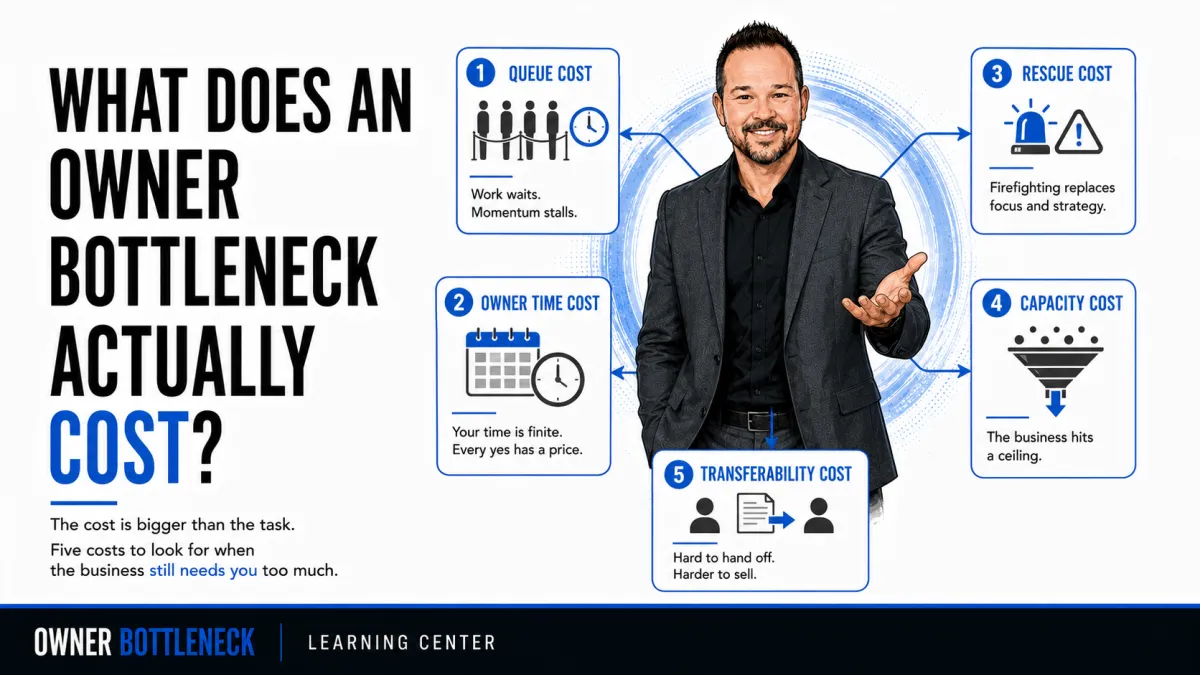
What Does an Owner Bottleneck Actually Cost?
It took Ben two minutes.
Maybe less.
His sales manager had sent him a quote that morning.
“Can I send this?”
Ben saw the message.
He'd get to it in a minute.
Then a customer called.
A meeting ran long.
Someone needed him in the shop.
A little after lunch, Ben finally opened the quote.
He changed one number.
Typed, “Looks good.”
Done.
Two minutes.
No big deal.
Except the quote had been ready since 9:15.
So had the salesperson.
So had the customer.
Ben thought the decision had cost him two minutes.
It hadn't.
The Short Answer
An Owner Bottleneck costs more than the time the owner spends answering questions or fixing problems.
The real cost is what happens around the owner while the business waits.
Work sits. People wait. Problems get bigger. The owner gets pulled back in. Growth gets harder. And when too much still depends on the owner, the business can become harder to transfer too.
I look at that through five costs: Queue Cost, Owner Time Cost, Rescue Cost, Capacity Cost, and Transferability Cost.
I call it the Owner Bottleneck Cost Model.
It's not an accounting rule.
It's not a business valuation.
It's just a simple way to see what owner dependence may really be costing you.
The Two-Minute Decision
Ben's sales manager was Chris.
Chris had the quote ready at 9:15.
The customer wanted it that morning.
The price was a little outside their normal range, so Chris needed Ben to approve it.
Ben had always approved those.
Nobody had really talked about why.
That's just how they did it.
So Chris sent the message.
Then he waited.
At 10:00, he checked again.
Nothing.
At 11:15, the customer emailed.
“Any update?”
Chris wrote back.
“Working on it.”
But he wasn't working on it.
It was done.
He was waiting on Ben.
That difference matters.
The Business Doesn't Experience the Two Minutes
Ben's part took two minutes.
The business waited almost four hours.
That's Queue Cost.
Queue Cost is what happens while work sits because somebody needs the owner before they can move.
Ben looked at the approval and thought:
“This only takes me a minute.”
And he was right.
For Ben.
But the business didn't experience the minute.
It experienced the wait.
That's why a two-minute decision can become a four-hour problem.
And Ben's quote wasn't unusual.
That was the next thing he started to notice.
The following day Chris needed another pricing answer.
Then somebody needed Ben to approve a customer credit.
Then operations wanted him to make a call about the schedule.
None of those things took very long.
Five minutes here.
Ten minutes there.
A quick answer while eating lunch.
Ben would've told you he barely spent any time on them.
So one week he paid attention.
By Friday, those little things had eaten almost five hours.
Five hours spent because normal work still needed something only Ben could provide.
That's Owner Time Cost.
The important word there is needed.
Ben could choose to spend five hours selling because he loved selling.
Fine.
He could choose to spend five hours with an important customer.
Also fine.
The problem was that Ben couldn't use those five hours somewhere else.
The business had already decided where they were going.
Then Ben Saved the Day
A few weeks later, Chris sent out a quote without checking with Ben.
The customer said yes.
Great.
Except Chris had missed something.
The job needed more labor than he'd figured.
The margin was going to be ugly.
Ben saw it the next morning.
He jumped in.
He called the customer.
Changed part of the job.
Moved the schedule.
Got operations involved.
They saved it.
Ben felt pretty good.
“Good thing I caught that.”
And he wasn't wrong.
Good thing he caught it.
But there was another question.
Why did Ben have to catch it?
The job didn't just cost Ben a few minutes.
People had to redo work.
The schedule moved.
Operations got pulled in.
The customer had another conversation they shouldn't have needed.
That's Rescue Cost.
It's what the business spends when the owner has to come back in and save the outcome.
And this one's tricky because owners get praised for it.
The customer says:
“Thanks for jumping in.”
The team says:
“Good thing Ben saw it.”
Ben feels useful.
And he is useful.
But being great at the rescue can hide why the rescue keeps being needed.
Ben fixed the job.
He still hadn't fixed the pattern.
Then Growth Made the Problem Bigger
A few months passed.
Sales were good.
Chris was getting better.
So they hired another salesperson.
That should've helped.
Instead, Ben got more questions.
More quotes.
More pricing calls.
More exceptions.
Now two salespeople ended up at the same place.
Ben.
He could keep up.
Barely.
Then Chris said something during a meeting.
“If we doubled the leads next month, I don't know what we'd do.”
Ben looked at him.
“Why?”
Chris laughed.
“You.”
Ben didn't love that answer.
But Chris was right.
They could add leads.
They could hire another salesperson.
They could buy another CRM.
None of that changed the fact that too much of the sales process still needed Ben.
The company could only grow as fast as Ben could keep up.
That's Capacity Cost.
And that's what makes this cost easy to miss.
The company wasn't failing.
It was growing.
Sales were good.
Ben was still getting deals done.
But if twice the growth needed twice as much Ben, the business hadn't really built twice the capacity.
It had just created more demand for Ben.
You can't hire another Ben.
Then a Buyer Asked One Question Too Many
A couple of years later, Ben met someone who was interested in buying the company.
Nothing serious yet.
Just a conversation.
The buyer asked about revenue.
Good.
Margins.
Pretty good.
Customers.
Strong.
Then the questions changed.
“Who approves pricing?”
Ben paused.
“I do most of it.”
“Who handles the biggest customer issues?”
Ben smiled a little.
“Usually me.”
“Could Chris run sales without you?”
“Yeah.”
The buyer waited.
Ben added:
“I mean, mostly.”
That word sat there.
Mostly.
Then came the question Ben hadn't really thought about.
“If you left six months after the sale, what would change?”
Ben didn't have a clean answer.
That's Transferability Cost.
It's the risk created when too much of what makes the company work still lives with Ben.
A buyer isn't only looking at what the company earns today.
They're trying to figure out how much of that can keep working when Ben isn't standing there.
That doesn't mean we can make up some number and say Ben's Owner Bottleneck knocked $700,000 off the value of his company.
We don't know that.
A real valuation has a lot more going on.
But dependence creates risk.
And buyers notice risk.
If selling your business is something you're thinking about, read Can I Sell a Business That Depends on Me?.
The Problem Was Never the Two Minutes
Ben had started with one tiny approval.
Two minutes.
But the longer he watched it, the more he saw.
The problem wasn't the two minutes.
The problem was everything those two minutes were connected to.
That's why the better question isn't:
“How much time does this take me?”
It's:
“What happens in the business because this still needs me?”
That's a very different question.
Don't Turn It Into Fake Math
Ben didn't need a giant spreadsheet.
He didn't need to put a dollar amount on every interruption.
And he definitely didn't need to create the scariest number he could come up with.
If a delayed quote led to a lost sale, he couldn't count the whole sale, all the waiting time, all his time, some made-up future growth, and then pile a fake valuation hit on top.
That might make a huge number.
It wouldn't make it true.
Some of these costs touch each other.
That's okay.
The point of the model isn't to make the number big.
It's to make the pattern visible.
So Ben picked one thing.
Pricing approvals.
For two weeks, he watched them.
Every time one came back to him, he paid attention.
How long had it been waiting?
How much of his time did it take?
Did anything else stop because of it?
Did he have to rescue something later?
By the end of two weeks, Ben didn't need a perfect dollar amount.
He had enough evidence.
Pricing depended too much on him.
That was the problem.
If you want to do the same thing in your business, read How to Measure Owner Dependence in Your Business.
Then Ben Changed the Right Thing
Ben and Chris sat down with the pricing decisions that kept coming back.
At first, Ben thought the answer was obvious.
Chris just needed to get better at pricing.
But the more they talked, the less true that seemed.
Chris knew how they priced jobs.
He understood margin.
He knew the customers.
The problem was that Ben had never made the line clear.
Chris knew how to price.
He didn't always know how far he could go without Ben.
So they fixed that.
Normal pricing decisions moved to Chris.
They agreed on the few things Ben still wanted to see.
And then Ben had to let Chris use the room he'd been given.
That last part mattered.
Because the first time Chris made a call Ben would've handled differently, Ben wanted to take the whole thing back.
He didn't.
They talked about it.
Chris got another rep.
The next one was better.
Over time, the line got shorter.
Quotes moved faster.
Ben got time back.
But that wasn't the biggest win.
The business had learned how to carry something it used to need Ben for.
That's the point.
What Did the Owner Bottleneck Really Cost?
Ben's quote took two minutes.
That wasn't the real cost.
The real cost was everything that had learned to wait for Ben.
Once he could see that, he knew where to start.
Not with the whole company.
Not with ten new projects.
With the dependence costing the business the most right now.
That's what makes an Owner Bottleneck worth finding.
It may look small.
It may even feel normal.
But normal doesn't mean cheap.
Find the dependence.
See what it's really costing.
Help the business learn to carry it.
Then look again.
Find it. Attack it. Level up. Repeat.
Where Is Owner Dependence Costing You?
If you're not sure where your business still depends on you most, start with the Owner Bottleneck Scorecard.
It'll help you see where owner dependence is showing up across Decision, Sales, Operations, Team, and Value.
You don't need to fix everything.
You need to see where to start.